



Education Journalist | Study Abroad Lead
Echinos (spiny mammal) and derma (skin) are two Greek words that mean hedgehog and skin respectively. As a result, these are organisms with spiny skin. These are only free-living marine creatures with a coelomic cavity and are triploblastic. They also have a strange water-powered tube system that they use to go around.
Echinoderms are enterocoelous coelomates with pentamerous radial symmetry, a calcareous endoskeleton made up of discrete plates or sections and a distinctive coelomic water circulatory system with podia or tube-feet protruding out of the body. In this article, we will look at the characteristics, classification and examples of animals belonging to Phylum Echinodermata.
| Table of Content |
Key Terms: Phylum, Echinoderms, Skin, Animalia, Species, Water Vascular System, Open Circulatory System, Life Cycle, Radial Symmetry, Bioluminescence
What are Echinoderms?
[Click Here for Sample Questions]
Echinoderms are members of the Phylum Echinodermata that belong to the kingdom Animalia. These are the invertebrate creatures with a skeleton made of strong calcium carbonate formations. The members of this phylum are colourful and possess unique shapes which is one of their distinct features. They are marine animals found in sea or ocean depth only. Sea stars and sea urchins are two examples.
Echinoderms possess a water vascular system which is their identifying characteristic. This water vascular system performs the function gaseous exchange, circulation of nutrients and waste elimination in these creatures.
Echinoderms
Characteristics of Phylum Echinodermata
[Click Here for Sample Questions]
Some of the unique characteristics possessed by Echinoderms are mentioned below:
- They are only found in the depths of sea and oceans and are one of the most common and extensively dispersed marine species.
- They have a body organisation system based on organ grade.
- Symmetry is almost invariably pentamerous and usually radial.
- The body is triploblastic, coelomate and lacks a recognisable head or segmentation.
- They range in size from moderate to large but none are microscopic.
- They have globular, star-like, spherical, discoidal or elongated body shapes.
- The body's surface is rarely smooth, having five symmetrically radiating grooves known as ambulacra and five alternating inter-radii or inter-ambulacra.
- The body wall is made up of three layers: an outer epidermis, a middle dermis and a peritoneal lining.
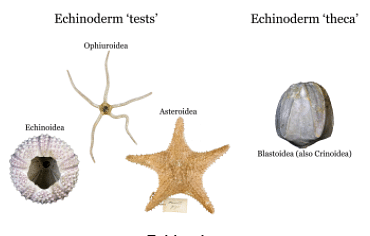
- The endoskeleton is made up of closely fitting plates that create a shell called theca or test or it can be made up of individual tiny ossicles.
- They have a coelomic water-vascular system with podia or tube feet for mobility and generally with a madreporite.
- The alimentary canal is a coiled tube that runs from the mouth to the anus which is positioned on the aboral or oral surface.
- They have coelomic peripheral channels encompassing the vascular and haemal or blood lacunar systems.
- Branchiae, tube-feet, respiratory tree and bursae are examples of respiratory organs.
- They also possess a neurological system with a circumoral ring and radial nerve but no brain.
- They have poorly developed sense organs including chemoreceptors, tactile organs and terminal tentacle.
- With a few exceptions, sexes are usually dioecious.
- The development of Echinoderms is transitional with distinctive larvae that metamorphose into radially symmetrical adults.
- A unique feature of Echinoderms is the regeneration of missing parts.

Water Vascular System of Echinoderms
Classification of Phylum Echinodermata
[Click Here for Sample Questions]
Phylum Echinodermata is classified into the following five classes:
- Asteroidea
- Ophiuroidea
- Echinoidea
- Holothuroidea
- Crinoidea
Asteroidea: Characteristics and Examples
Some of the characteristics exhibited by the members of class Asteroidea are:
- They have tube feet with suckers and a flattened, star-shaped body with five arms.
- Papulae are the organs that allow them to breathe.
- Calcareous plates and moveable spines make up the body.
- There is Pedicellaria present.
- Examples include Asterias, Zoroaster.

Asteroidea
Ophiuroidea: Characteristics and Examples
Some of the characteristics exhibited by the members of class Ophiuroidea are:
- The tube feet are devoid of suckers and the body is flat with pentamerous discs.
- Bursae are the organs that allow them to breathe.
- The middle disc is separated from the lengthy arms.
- Examples are Ophiderma and Amphuria.

Ophiuroidea
Echinoidea: Characteristics and Examples
Some of the characteristics exhibited by the members of class Echinoidea are:
- The body shape is hemispheric.
- There are suckers in the tube feet.
- There are no arms on the body.
- The skeleton is compact, and the spines are moveable.
- Examples are Echinus, Cidaris.

Echinoidea
Holothuroidea: Characteristics and Examples
Some of the characteristics exhibited by the members of class Holothuroidea are:
- The arms, spines, and pedicellariae are all missing from the body, which is long and cylindrical.
- They breathe via the cloacal respiratory system.
- They have suckers on their tube feet.
- Examples are Cucumaria, Holothuria.

Holothuroidea
Crinoidea: Characteristics and Examples
Some of the characteristics exhibited by the members of class Crinoidea are:
- The body is formed like a star.
- There are no suckers on the tube feet.
- The arms are divided into two parts.
- There are no spines or pedicellariae.
- Examples are Neometra, Antedon.

Crinoidea
Read More:
Things to Remember
[Click Here for Sample Questions]
- The members of Phylum Echinodermata are known as Echinoderms which are exclusively marine creatures.
- Sea Stars and Sea Urchins are the two most popular examples for Echinoderms.
- Echinoderms have a distinctive coelomic water circulatory system with podia or tube-feet protruding out of the body.
- Phylum Echinodermata is classified into five classes, namely, Asteroidea, Ophiuroidea, Echinoidea, Holothuroidea and Crinoidea.
- They are symmetrical with tube feet. Members of this phylum can form unique shapes and are colourful.
Sample Questions
Ques. Define some special features of Phylum Echinodermata. (4 marks)
Ans. Some of the special features of Echinoderms are:
- Water Vascular System which helps in locomotion, food and waste transportation, and respiration.
- The organs of locomotion are called tube feet. Aristotle’s Lantern is a characteristic feature of the echinoderm sea urchin.
- Echinoderms such as Brittlestar show bioluminescence.
- Star-like, spherical or elongated appearance is also one of the unique features.
- They are triploblastic and coelomate animals.
- The larvae are bilaterally symmetrical whereas the adults are radially symmetrical.
- They also have an organ system level of body organisation.
- They have a spiny body and the endoskeleton is made of calcareous ossicles.
Ques. With reference to phylum Echinodermata, identify the classes which of the following have Pedicellariae? (2 marks)
Ans. A pedicellaria is a tiny claw-shaped appendage with moveable jaws (valves) found on echinoderms (phylum Echinodermata), especially sea stars (class Asteroidea) and sea urchins (class Echinoidea). Straight and crossed pedicellariae are the two main forms of pedicellaria seen in sea stars. Straight pedicellariae are larger and more usually seen on the body surface, whereas crossed pedicellariae are smaller and more commonly found on stalks, raised above the body surface, or in bunches circling the spines. Sea urchins have four types of pedicellariae: tridactylus, ophicephalus, triphyllum, and globiferus.
Ques. Is StarFish an echinoderm? (2 marks)
Ans. Yes, star fish is an invertebrate marine creature that belongs to phylum echinodermata and class Asteroidea. A starfish wraps itself around the mollusc and then uses its small, suctioned feet to overwhelm the muscle that keeps the bivalve closed, allowing the creature to be exposed. To begin digesting, it moves its stomach out of its mouth, inside the shell, and around the organism. To finish digestion, it pulls its stomach back into its body.
Ques. Define reproduction process in echinoderms. (2 marks)
Ans. In echinoderms, there are two sexes, each of them release their eggs and sperm into the water; where the sperm further fertilises the eggs. In Starfish, males and females both release sperm and eggs into the ocean. The fertilised eggs hatch into a larval form that lives as plankton for months before becoming an adult and settling on the seafloor.
Ques. What is the scientific classification of Phylum Echinodermata. (2 marks)
Ans. The echinoderms belong to the phylum Echinodermata and subphylum Deuterostomia. Phylum Echinodermata belongs to the kingdom Animalia, they are triploblastic animals. Examples of echinoderms include sea urchins, sea star, etc. Echinoderms are marine animals, they are unisexual and their body have a tough spiny exoskeleton.
Ques. What makes Echinoderms different from other animals? (2 marks)
Ans. The main distinguishing feature of echinoderms is their water vascular system which is derived from coelom. This water vascular system not only helps them in excretion, i.e, transportation of food and water outside their bodies, but also helps them in gaseous and nutrient exchange. Moreover, echinoderms possess an open circulatory system but without a heart.
Ques. Are echinoderms bilateral? (2 marks)
Ans. No, echinoderms are not bilateral, rather they possess pentamerous body structure which is one of their unique features that distinguishes them from other marine creatures. Radial symmetry helps echinoderms in forming unique shapes, hence, they possess star-like, spherical or elongated body forms. Radial symmetry is found in adult echinoderms whereas bilateral symmetry is found in the larval stage of their life cycle.



Comments