



Exams Prep Master
Physical changes are the changes which are restricted to changes in the display, but no change occurs in the composition. These changes are also known as temporary changes because such changes take place for a particular period. On the other hand, whenever the composition of a substance changes it is a Chemical change. A chemical change always accompanies formation of at least one new substance. Lets learn more about physical and chemical change and discuss some important questions.
Read more: Crystal Lattices and Unit Cells
| Table of Contents |
Key takeaways: Physical change, Chemical change, Boiling of Water, Wax Melting, Rusting of Iron, Burning of Camphor.
What is Physical Change?
[Click Here for Sample Questions]
Properties such as state, shape, colour and size of a substance are called its physical properties. These properties get affected with occurence of physical changes. During a physical change, only the shape or appearance of the matter gets changed, but its type in the material remains exactly the same. In such changes, the change in arrangement of molecules leads to change in state of substance. Hence, no new products are formed, and the composition of molecules remains exactly the same.

Physical Change
Physical changes are reversible and temporary in nature. We can reverse these changes by generally reversing the conditions or the cause of producing the change. There are no energy changes in a physical change as the energy needed to bring a physical change is exactly equal to the energy required to reverse the change.
Examples of Physical Change
[Click Here for Sample Questions]
Some common examples of Physical change are as per the following:
- Melting/Freezing of ice
- Boiling of water
- Wax Melting
- Condensation of steam
- Glowing of an electric bulb
- Iron Magnetisation
- Powdering chalk stick
- Breaking of a glass tumbler
- Changing of water into steam by boiling
- Preparing a solution of salt and sugar
- Condensation of water vapour, such as the formation of clouds, mist, fog, etc.
Read more: Packing Efficiency
Characteristics of Physical Change
[Click Here for Sample Questions]
Some important characteristics of Physical change are given below:
- No new substances are formed during a Physical Change.
- Physical Changes are generally Reversible in nature.
- Very small amount of heat is Absorbed or Emitted (if any) during Physical Change.
- No change in weight occurs during a Physical Change.
What is Chemical Change?
[Click Here for Sample Questions]
Chemical changes are the change in which there is formation of one or more new substances having new properties. A chemical transition is the result of a chemical reaction and In such changes, the energy gets changed.
In other words, the changes in which the composition of molecules is completely changed and a new product gets formed, is called a Chemical change.
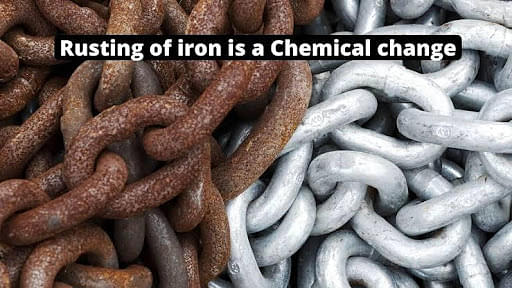
Chemical Change
During chemical changes, the changes are irreversible and permanent. Which means that chemical change cannot be reversed by changing the experimental procedure. In these changes, the mass of the substance is changed, it is either added or removed.
Examples of Chemical Change
[Click Here for Sample Questions]
- Rusting of Iron
- Digestion of food
- Burning of camphor
- Burning of a candle
- Burning of a paper or wood
- Milk Souring
Characteristics of Chemical Change
[Click Here for Sample Questions]
Some important characteristics of Chemical change are given below:
- There is formation of one or more new substances.
- The composition of the substance changes during chemical change.
- Chemical changes are generally irreversible in nature
- Chemical change may cause a change in colour of the substance.
- Light or heat may get produced by a chemical change.
Read more:
Things to Remember
- Only the structure of substance changes in a Physical change, while new substance formation also occurs in a Chemical change.
- During a physical change only the energy is added or removed and there is no involvement of mass.
- Reactions during which energy is released are Exothermic, while reactions in which energy is absorbed are called Endothermic.
- During some processes, both physical and chemical changes are observed.
Sample Questions
Ques. What is the basic difference between a Physical change and Chemical change? (2 marks)
Ans. A physical change, basically means a change in the appearance or shape of matter, while the type of matter remains the same. However, in a chemical change there is production of at least one new substance.
Ques. Why is Physical change also called temporary change? (2 marks)
Ans. Physical change is the change in the appearance or shape of a material, thus it can be turned back to its initial shape due to which it is a temporary change.
Ques. What are the different forms of energy produced with a chemical change? (1 marks)
Ans. During a chemical change energy can be produced in the form of Light, Heat, Sound etc.
Ques. What is Rusting of Iron? (2 marks)
Ans. Rusting is a chemical change which removes a layer of material from the surface of iron to make it weak. When substances made from iron are exposed to oxygen and water rusting occurs.
Ques. What is the chemical reaction occurring during rusting? (2 marks)
Ans. The chemical reaction that occurs during rusting is :

Ques. Why is no change in weight observed during a physical change? Give an example. (2 marks)
Ans. There is no change in the weight during a physical change because only the shape of material is changed. For example: If 10 grams of solid wax is melted, it gives us 10 grams of wax in molten state, this shows that the weight is unchanged during a physical change.
Ques. Is it possible to prevent iron from rusting? How. (2 marks)
Ans. Yes, it is possible to prevent rusting through Galvanization. To prevent iron from rusting, zinc is deposited on the iron & this process is known as Galvanization.
This method is commonly used in water pipes in houses to save them from rusting.
Ques. How is the glow of an electric bulb an example of physical change? (2 marks)
Ans. When an electric bulb is switched on, the current passes through its filament due to which it glows to give light. While, when the current is switched off, filament returns to the normal position and the bulb stops glowing. Hence, no new substance is produced in this process and it is a physical change.
Ques. What is Crystallization ? What type of change is it? (1 marks)
Ans. The process of obtaining large crystals of a pure substance from its own solution is known as "Crystallization. It is a Physical change.
Ques. Classify the following as Physical or Chemical changes. (1 marks)
Burning of paper, Melting of Butter, Almirah rusting
Ans.
- Burning of paper - Physical change
- Melting of Butter - Physical change
- Almirah rusting - Chemical change
Ques. Why is burning candle wax considered both physical and chemical changes ? (2 marks)
Ans. The burning of candle is considered both physical and chemical change due to the following reasons:
- When a candle is burned, the wax in the candle converts into liquid state from solid which is a physical change.
- However, when wax is kept near the flame it burns and converts into carbon dioxide. This is a chemical change which cannot be converted back into the initial state.
Check-Out:



Comments