



Content Curator
Group 2 alkaline earth metals include Beryllium, Magnesium, Calcium, Barium, Strontium, and Radium, which are silvery metals that are less metallic than Group 1 alkali metals.
- They are referred to as group 2 metals because they are located in the second column of the periodic table.
- Although several characteristics are common in the group, heavier metals like Ca, Sr, Ba, and Ra are almost as reactive as Group 1 Alkali Metals.
- All elements in Group 2 contain two electrons in their valence shells, resulting in an oxidation state of +2.
- All alkaline earth metals under the standard conditions are silvery-white colored solids.
- Their general electronic configuration is [Noble gas] ns2.
| Table of Content |
Key Terms: Alkali earth metals, Group 2 elements, Periodic table, Metals, Beryllium, Oxidation state, Noble gas, Valence shells, Electronic configuration, Atomic radius, Reactivity
What are Alkaline Earth Metals?
[Click Here for Sample Questions]
The alkaline earth metals belong to group 2 of the modern periodic table.
- This group of elements comprises beryllium, magnesium, calcium, strontium, barium, and radium.
- These elements are quite similar in their physical and chemical properties.
- Under normal conditions, all alkaline earth metals are silvery-white solids.
- They are also highly lustrous (shiny) and very reactive.
- These elements have a general electrical configuration of ns2.
- Because alkaline earth metals have full s-orbitals in their respective valence shells, they easily lose two electrons to form cations with a charge of +2.
- Thus, the most common oxidation state for alkaline earth metals is +2.
- Radium is a radioactive element, and the alkaline earth metals appear in succession from the first to the seventh periods.
- Alkaline earth metals can form amalgams with mercury.
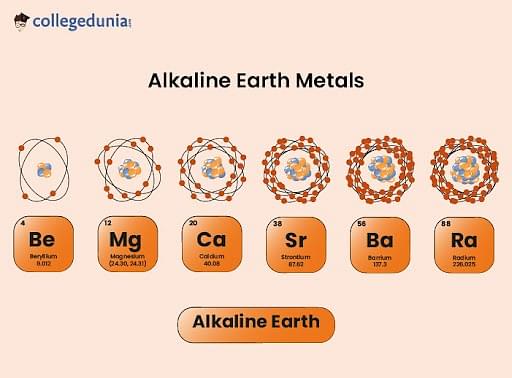
Alkaline earth metals
Examples of alkaline earth Metals: Beryllium (Be), Strontium (Sr), Magnesium(Mg), Calcium (Ca), Barium(Ba), and Radium (Ra).
| Metals | Beryllium | Magnesium | Calcium |
|---|---|---|---|
| Atomic number | 4 | 12 | 20 |
| Configuration | [He]2s2 | [Ne]3s2 | [Ar]4s2 |
| Atomic size | 112 | 160 | 197 |
| Density (g/cm3) | 1.85 | 1.74 | 1.55 |
| Ionization energy (kJ/mol) | 899 & 1757 | 737 & 1450 | 590 & 1146 |
| Hydration enthalpy (kJ/ mol) | -506 | -406 | -330 |
Also Read:
| Related Articles | ||
|---|---|---|
| S- Block Elements | d-block Elements | Solubility |
| Dichromate | Europium | Gadolinium |
Physical Properties of Alkaline Earth Metals
[Click Here for Sample Questions]
The nuclear charge increases as one moves down the column, and each alkaline earth atom gains a new orbital.
Atomic and Ionic Radii
Atomic and Ionic Radius increase with the down column of the periodic table in which the radii will be smaller than the alkaline metal and bigger than the atoms of the same period due to its charges and electron addition to the same energy level.
- The alkaline earth elements can lose s- electrons and then become double-positive cationic.
- The radius of the cationic is smaller than the neutral atom.
- Still, the radii increase of ionic.
- For example, RBe ˂ RMg ˂ RCa ˂ RSr ˂ RBa and RBe2+ ˂ RMg2+ ˂ RCa2+ ˂ RSr2+ ˂ RBa2+
Reactivity of Alkaline Earth Metals
Reducing ability and ionization energy are inversely related as according to the reducing ability, it is expected to increase from beryllium to barium but ionization energy decreases downwards.
- Reducing capabilities increase when reduction potential decreases from beryllium to barium.
- Due to higher ionization energy, alkaline earth metals are weaker reducing agents,
Melting and Boiling Points
Because of their smaller size and strong metallic bonding in close-packed structures, alkaline earth metals have higher melting and boiling points than alkali metals. Except for magnesium, the melting and boiling points of alkaline earth metals decrease as they move from beryllium to barium.
Flame Colouration
In alkaline earth metals, the energy required for an electronic transition between possible energy levels falls within the visible spectrum.
- So, with the exception of beryllium and magnesium, heating produces a characteristic color to the flame that is indicative of their emission or absorption spectra and can be used to identify them.
- Example: Sr – Crimson red color, Ca – Brick red color, and Ba – Apple green color.
Ionization Energy
Alkaline earth elements can donate both valence electrons to form an octet-based noble gas. So, they have two ionization energies:
First Ionization Energy
The first ionization energy of alkaline earth metals is the energy required to remove the first electron from a neutral atom. There are two reasons why it is bigger than the alkali metal atom.
- The electrons are closely trapped because of the smaller radii and the larger nuclear charge.
- Electrons are removed from a filled and so stable subshell.
Second Ionization Energy
The second ionization energy of alkaline earth metals required for the second electron from the cation will be more than the first ionization energy of the atom, but less than any second ionization of alkali metal. Despite the large ionization energy, removing both electrons is possible because,
- The atom adopts a noble gas configuration.
- The smaller size and greater charge help to overcome the higher ionization energy by generating more lattice energy as atoms or ions are packed close together in solids.
- Higher hydration energy in liquids due to greater solvation.
Density
The smaller the radius, the smaller the volume of the atoms.
- Furthermore, the presence of two valence electrons causes atoms to form stronger metallic bonds.
- As a result, alkaline earth metals have higher densities and are harder than alkali metals.
- Density usually increases from magnesium to radium, with calcium having the lowest density among the alkaline earth metals.
Solubility
The beryllium ion is the most soluble, and because solubility decreases with increasing size, the barium ion is the least water-soluble alkaline earth metal.
- Solubility in water is proportional to its ionic nature and size.
- Smaller ions have a higher charge density and can be dissolved by a greater number of water molecules.
- This produces a greater enthalpy of hydration and makes the hydrated ions more stable.
Chemical Properties of Alkaline Earth Metals
[Click Here for Sample Questions]
The important chemical properties of alkaline earth metal compounds are
Hydrides
Beryllium and hydrogen do not react directly. Beryllium hydride can be produced by reduction of beryllium chloride with lithium aluminum hydride.
2BeCl2 + LiAlH4 → 2BeH2 + LiCl + AlCl3
Beryllium and magnesium produce covalent hydrides, with each hydrogen bonded to two metal atoms. The "banana Bond" refers to molecules with three centers that share just two electrons.
Calcium, strontium, and barium react with hydrogen to produce metallic hydrides. Metallic hydrides produce hydride ions.
M + H2 → 2MH2 → M+ + 2H–
Hydrides react violently with water, releasing hydrogen. The calcium hydride known as "Hydrolith" is used to produce hydrogen.
CaH2 + 2H2O → Ca(OH)2 + H2
Reaction with Ammonia
Like alkali metals, alkaline earth metals produce ammonia-solvated cations and electrons.
- The solution is electrically conductive, reductive, and paramagnetic.
- Solvated electrons absorb in the visible range, causing the solution to turn blue.
- The concentrated solution is bronze in color.
- On long-term exposure, it decomposes into amide, ammonia, and hydrogen.
M + (x + y) NH3 → M(NH3)x]+ + [M(NH3)y]– → MNH2 + 1/2H2
Reaction with water
Beryllium is a metal that does not react even at higher temperatures.
- Magnesium is the one metal that reacts with hot water.
- It is due to form hydroxide and release hydrogen.
- To prevent attack by a water molecule, it gets a protective covering of oxide.
- Also, other metals react with cold water to liberate hydrogen.
Carbonates and Bicarbonates
Hydroxides react with carbon dioxide to form carbonates.
M(OH)2 + CO2 → MCO3 + H2O
Bicarbonates are soluble in water and can only exist in solution.
- Carbonates occur as solids that are insoluble in water.
- The solubility of carbonates decreases from Be to Ba.
- In the presence of carbon dioxide, carbonates dissolve to produce bicarbonates.
- The ionic nature and thermal stability of carbonates improve from Be to Ba.
Anomalous Behaviour of Beryllium
[Click Here for Sample Questions]
Beryllium has a stronger covalent nature due to its small size, high ionization energy, high electropositivity, and strongest polarizing tendency. Because of them, the properties of beryllium differ from those of other alkaline earth metals.
- The melting and boiling point is maximum.
- It does not react with hydrogen to form hydride directly.
- It is known for being its hardest metal.
- It does not react with water not even in red-hot conditions.
- It does not react with oxygen and nitrogen.
- It is volatile when it is beryllium nitride.
- It dissolves in acids to form salts and beryllate in bases.
Uses of Alkaline Earth Metals
[Click Here for Sample Questions]
The following are the uses of Alkaline Earth Metals
Calcium Carbonate
It occurs naturally in a variety of forms, including marble, limestone, chalk, coral calcite, and so on. The pure form is produced by the following steps:
- First, dissolve the mineral with hydrochloric acid.
- The use of ammonia removes hydroxide-forming contaminants like iron and aluminum.
- Finally, add ammonium carbonate to precipitate the calcium carbonate.
Limestone decomposes when heated, producing carbon dioxide and quick lime (CaO).
CaCO3 → CaO + CO2
Calcium oxide (quick lime) exothermically combines with water to produce calcium hydroxide (lime water or slaked lime).
CaO + H2O → Ca(OH)2
Plaster of Paris
Calcium sulfate dihydrate (CaSO4.2H2O) is a naturally occurring gypsum. It occurs in a monoclinic crystal form.
- When treated with dilute sulphuric acid, an aqueous solution of soluble calcium salts such as nitrates or chlorides precipitates hydrous calcium sulfate.
- Monoclinic gypsum undergoes numerous changes when heated in a carbon-free atmosphere (otherwise, calcium sulfate is converted to calcium sulfite) and at different temperatures.
- It hardens first into a different orthorhombic allotropy form.
Extraction of Alkaline Earth Metals
[Click Here for Sample Questions]
Magnesium occurs naturally and is extracted from an ore. Some of the ores are listed below.
- Magnesite – MgCO3
- Dolomite – CaMg (CO3)2
- Epsomite – MgSO4 7H2O
- Double salts of Carnallite – 2KCl MgCl2 6H2O.
Alkaline earth metals have low electrode potentials, thus they are produced by the electrolysis of fused chlorides.
- Chlorides and fluorides of alkali and alkaline earth metals are used to lower the melting point.
- Because magnesium burns well in oxygen, the flow of a reducing gas, such as coal gas, is maintained during electrolysis.
Things to Remember
[Click Here for Sample Questions]
- The alkaline earth metals are those elements that are equal to group 2 of the modern periodic table.
- It includes magnesium, barium, radium, calcium, strontium, and beryllium.
- The physical properties of Alkaline earth water are reactivity, melting & boiling point, and atomic & ionic radii.
- Alkaline earth metals form ammonia-solvated electrons and cations.
- Also, it becomes reductive, paramagnetic, and electrically conductive.
- Beryllium is a metal that does not react even at higher temperatures.
- Magnesium is the one metal that reacts with hot water.
- Beryllium has a covalent nature due to its highest ionization energy, high electropositive nature, and smallest size.
Check Out:
Sample Questions
Ques. What is the most common oxidation state of alkaline earth metals? (2 Marks)
Ans. The most common oxidation state for alkaline earth metals is +2. They rapidly lose two electrons to obtain the most near noble gas configuration.
Ques. Which group of elements are called alkaline earth metals? (1 Mark)
Ans. Group 2 elements are called alkaline earth metals.
Ques. Is copper an alkaline earth metal? (1 Mark)
Ans. Copper is not an alkaline earth metal. It is a transition element.
Ques. Why are group 2 elements called alkaline earth metals? (1 Mark)
Ans. Group 2 elements are known as alkaline earth metals because their oxides form a basic solution when dissolved in water.
Ques. Why does the solubility of alkaline earth metals decrease down the group? (3 Marks)
Ans. The beryllium ion is the most soluble, and because solubility declines with increasing size, the barium ion is the least water-soluble alkaline earth metal. Solubility in water is proportional to its ionic nature and size. Smaller ions have a higher charge density and can be dissolved by a greater number of water molecules. This produces a greater enthalpy of hydration and makes the hydrated ions more stable.
Ques. Why Are Alkaline Earth Metals denser than Alkali Metals? (2 Marks)
Ans. The smaller the radius, the smaller the volume of the atoms. Furthermore, the presence of two valence electrons causes atoms to form stronger metallic bonds. As a result, alkaline earth metals have higher densities and are harder than alkali metals. Density usually increases from magnesium to radium, with calcium having the lowest density among the alkaline earth metals.
Ques. What are the characteristics of alkaline earth metals? (1 Mark)
Ans. Alkaline earth metals are reactive metals. They produce divalent cations, which are malleable and ductile.
Ques. Why Alkaline earth metals are denser than alkali metals? (1 Mark)
Ans. They are denser than alkali metals because they can be packed more tightly to their greater charge and smaller radii.
Ques. Why do Alkaline earth metals have decreasing solubility? (1 Mark)
Ans. As the hydration energies decrease down the group the solubility of alkaline earth metals decreases down the group.
Ques. What are the chemical properties of alkaline earth metals? (3 Marks)
Ans. The following are the chemical properties of alkaline earth metals
- shiny
- silvery-white.
- somewhat reactive metals at standard temperature and pressure.
- readily lose their two outermost electrons to form cations with a 2+ charge.
- low densities.
- low melting points.
- low boiling points.
Ques. What is the extraction of Alkaline earth metals? (2 Marks)
Ans. The treatment of a mineral, or a rock containing the mineral, including an alkali metal or an alkaline earth metal with an aqueous solution of formic acid resulted in the extraction of alkali metal ions or alkaline earth metal ions.
For Latest Updates on Upcoming Board Exams, Click Here: https://t.me/class_10_12_board_updates
Check-Out:



Comments