



Content Curator
Position of hydrogen in the periodic table is in group one with alkali metals because it has a similarity of valence shell with a family of alkali metals like lithium, sodium, and so on.
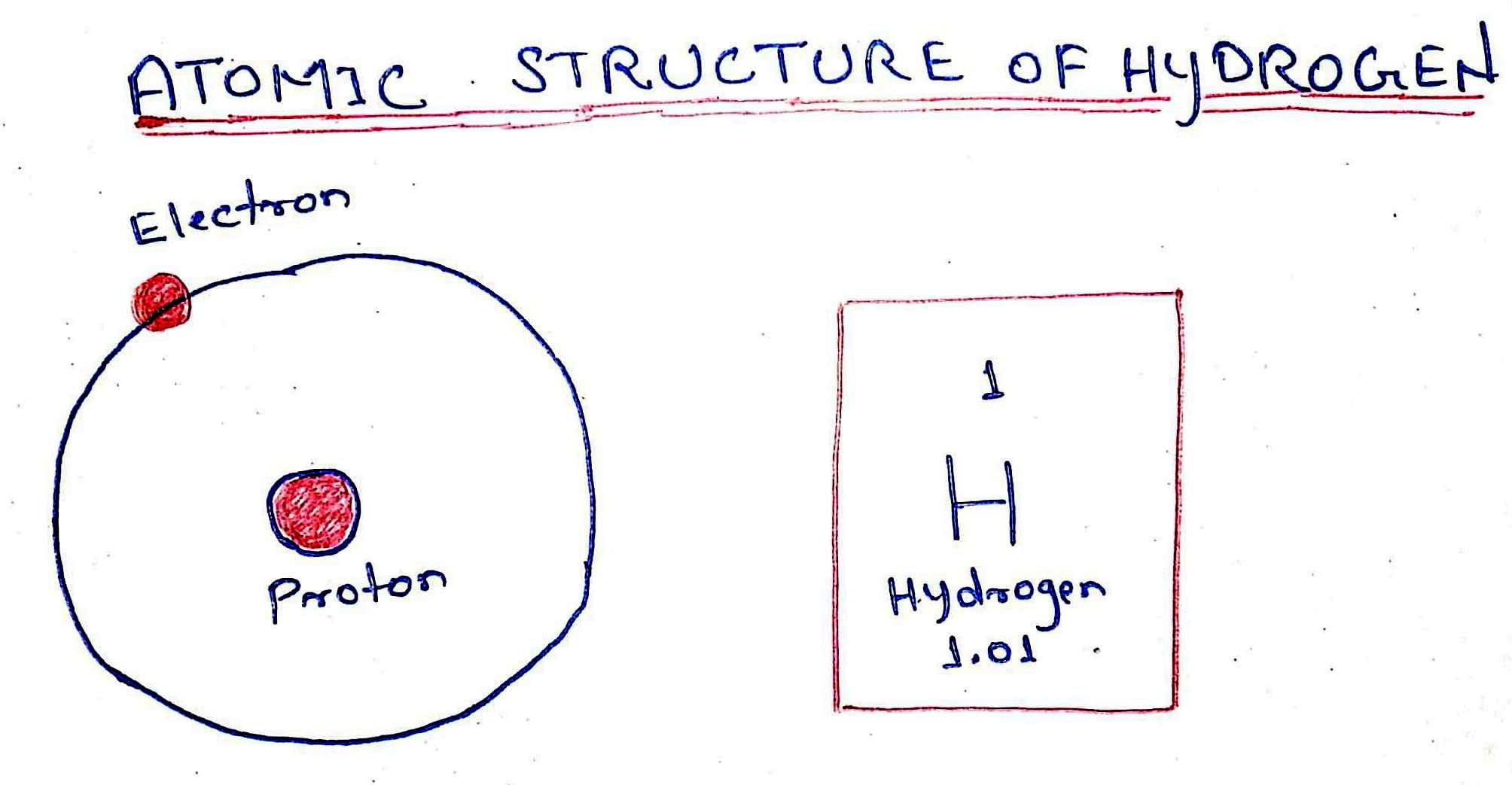
- Hydrogen has atomic number one and has only one electron present in the outermost shell.
- Originally hydrogen is a gas and not a metal.
- The hydrogen ion H+ does not exist in a free state in nature.
- Hydrogen can easily get rid of one electron gas present in it or can also gain one more atom to get a noble gas configuration.
| Table of Content |
Key Terms: Hydrogen, Periodic table, Metals, Alkali, Noble gas, Chemical elements, Noble gas, Atomic number, Mass number, Lithium, Enthalpy
Structure of Hydrogen
[Click Here for Sample Questions]
The structure of hydrogen is similar to that of alkali metals (ns¹) that have 1 electron in their outermost shell.
- Hydrogen can have a noble gas configuration structure and a similar structure to helium by accepting an electron.
- This structure is the same as that of halogens (ns2, np5).
- Hydrogen has one electron less required for the completion of an electron octet in its shell.
- When one electron is gained hydrogen becomes a uni-negative ion, which is similar to hydrogens.
- When an electron is lost, a cation is produced and hydrogen resembles alkali metals.
Also check:
| Related Concepts | ||
|---|---|---|
| Uses of Hydrogen | Periodic Classification of Elements | Modern Periodic Table |
| MCQs on Hydrogen | Trends in the Modern Periodic Table | Preparation of Hydrogen and Its Uses |
Hydrogen in the Periodic Table
[Click Here for Sample Questions]
Coming to the formation of compounds, hydrogen can produce sulfides, oxides, and halides as other alkali metals.
- Different from alkali metals, hydrogen has very high ionization enthalpy due to which it lacks metallic characteristics in normal conditions.
- In terms of ionization enthalpy, hydrogen is more similar to halogens in comparison to alkali metals.
- For example, the ionization enthalpy of lithium is 520 kJ mol-1 for fluorine is 1680 kJ per mol, and lastly, that for hydrogen is 1312 kJ per mol.
- Hydrogen exists as a diatomic molecule that is similar to halogens like chlorine.
- Even if the hydrogen is similar to both alkali metals and halogens, both of them are different.
- That is why special attention is to hydrogen’s position in the periodic table.
- When an electron is lost from a hydrogen atom, its nucleus size reduces to about 1.5 × 10⁻³ pm.
- This size is much smaller than the atomic size of many metals.
- This is why hydrogen ions do not exist freely in nature.
Position of Hydrogen in the Periodic Table
In the periodic table, hydrogen does not have a fixed position. In some tables, it is placed lonely at the top, and in some other tables, it is placed with alkali metals.
- Hydrogen has an electronic configuration of 1s¹ so by rule, it has to be placed at the first position.
- Hydrogen resembles alkali metals in its electronic configuration.
- Hydrogen is also to be placed with alkali metals because it just requires a loss of electrons to form an H+ ion just like other alkali metals.
- However, hydrogen is also very similar to halogens as it can also gain one electron to acquire a noble gas configuration.
- Due to this problem of resembling alkali metals and halogens, the position of hydrogen is still not fixed but it is conventionally placed on the top of the table.

Reasons for Hydrogen Positioning in Both Periodic Table Groups
Hydrogen has only one valence electron in its outermost shell due to which it is similar to alkali metals and hydrogen exists as a diatomic structure like halogens.
- In this way, hydrogen resembles both metals and nonmetals.
- So, hydrogen has been placed in the first as well as a seventeenth group in the modern periodic table.
- This anomaly is the biggest demerit of Mendeleev’s periodic table.
- In the modern periodic table, the hydrogen molecule has the first position which is not in the first or seventeenth group.
Importance of Hydrogen
[Click Here for Sample Questions]
The importance of hydrogen is as follows
- Hydrogen, when present in the human body, keeps it hydrated.
- Water contains hydrogen and oxygen which is absorbed by cells of the body.
- Hydrogen is a crucial element that can be used as fuel, military weapons, etc.
Also check:
Things to Remember
- The periodic table, also known as the periodic table of the elements, is a table that organizes chemical elements into rows and columns.
- The atomic number of Hydrogen is one.
- Hydrogen atoms contain one proton and one neutron.
- Hydrogen resembles Alkali metals and Halogens.
- Hydrogen is present in the 1st and 17th groups in Mendeleev’s Periodic Table.
- Conventionally hydrogen is placed at the first position of the Modern Periodic table.
- Hydrogen keeps our body hydrated and is used as fuel, military weapons, etc.
Sample Questions
Ques. What is the specialty of Hydrogen as an element? (2 marks)
Ans. Hydrogen is the most abundant element present on the Earth. It has the simplest atomic structure. It only consists of a single electron and a proton. Liquid hydrogen is also being used as semiconductors and hydrogen is widely used for rocket fuels. Hydrogen forms various compounds with other elements and the most important among those compounds is water.
Ques. Is hydrogen a metal or gas? Why is hydrogen so important? (3 marks)
Ans. Hydrogen is more often classified as a non-metal. It has more non-metallic properties. Hydrogen is a gas under regular conditions. However, hydrogen is also similar to alkali metals as it can conduct electricity in liquid forms like metals.
Hydrogen, when present in the human body, keeps it hydrated. Water contains hydrogen and oxygen which is absorbed by cells of the body. Hydrogen is a crucial element that can be used as fuel, military weapons, etc.
Ques. Is hydrogen molecule used in real-life applications? (2 marks)
Ans. The hydrogen molecule is used widely in the glass industry to make flat glass sheets. Hydrogen is also used as a flushing gas during the manufacture of silicon chips in the electronics industry. Due to its low density, hydrogen is also used to fill balloons and airships.
Ques. Mention the specialty of Hydrogen. (2 marks)
Ans. Hydrogen is the most abundant element in nature. Hydrogen contains a single electron and a single proton. In the production of semiconductors, liquid hydrogen is used. Hydrogen is also widely used as liquid fuel in rockets. Many other important chemical and natural compounds are produced by a combination of hydrogen.
Ques. Why is hydrogen known as a rogue element? (2 marks)
Ans. Hydrogen is known as a rogue element because it assembles with alkali metals in some cases and halogens in others. Hydrogen is also different from halogens and alkali metals in certain characteristics. That is why it is termed a rogue element.
Ques. From where does the property of forming diatomic atoms come? (1 mark)
Ans. As hydrogen assembles with alkali metals and halogens it has properties of both. The property of hydrogen forming diatomic atoms is basically from halogens.
Ques. Is the reactivity of hydrogen similar to halogens? What is the major demerit of Mendeleev's periodic table? (3 marks)
Ans. Hydrogen has contradictory behavior in terms of reactivity than other halogens. Hydrogen's reactivity property is similar to alkali metals.
Mendeleev's periodic table was unable to identify the proper place for hydrogen. hydrogen was placed in the first and seventeenth groups in Mendeleev's table. This confusion related to the position of hydrogen in the periodic table was the major demerit of Mendeleev's periodic table.
Ques. Why the position of hydrogen in the periodic table is controversial? (2 marks)
Ans. Hydrogen, like halogens (Group 17), can gain one electron and form H-. It, like alkali metals (Group 1), can lose an electron and form H+. As a result, the position of hydrogen in the modern periodic table is controversial.
Ques. Why is hydrogen placed on top of the periodic table? (2 marks)
Ans. Hydrogen is a nonmetal that is positioned above the alkali metals in the periodic table due to its ns1 electron configuration. It differs from the alkali metals in that it creates cations (H+) more reluctantly than the other alkali metals.
Ques. Why could no fixed position be given to hydrogen in Mendeleev's Periodic Table? (2 marks)
Ans. Hydrogen had no fixed position in Mendeleev's Periodic Table since it forms positive ions like alkali metals and diatomic molecules like halogens.
For Latest Updates on Upcoming Board Exams, Click Here: https://t.me/class_10_12_board_updates
Also Read:



Comments