



Education Journalist | Study Abroad Lead
Plasmolysis can be defined as the shrinkage of a plant cell that is eukaryotic in nature. Plant cells contain specialised cellular organelles that have different fundamental factors from animal cells. They generally have a thick cell wall that keeps them upright and supports their shape. The cytoplasm, the plasma membrane, functions together with other cell organelles and helps the plant to stay active. A membrane filled with fluid and bound with organelles, called vacuoles, is inside the cytoplasm, which helps in holding the water in the plant cell. Plasmolysis occurs when the plant cell faces a severe loss of water.
Key Terms: Plasmolysis, Plants, Cell, Protoplasm, Cell Wall, Animal Cell, Plant Cell, Osmosis, Cell Membrane, Solution
What is Plasmolysis?
[Click Here for Sample Questions]
Plasmolysis can be defined as the shrinkage of the protoplasm of a plant cell because of lack of enough water or due to osmosis. As the water moves out of a plant cell, it causes the cell to shrink. Hence, we can also say that plasmolysis is a type of osmosis and is found rarely in nature. The process of plasmolysis does not require any energy and is almost an involuntary process. However, it should be noted that much loss of water can collapse a cell’s wall.
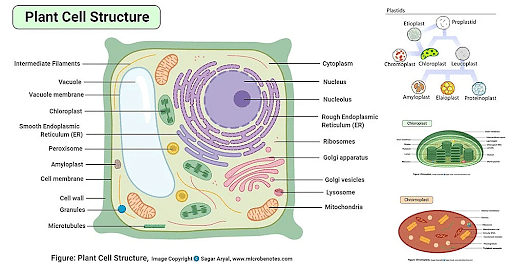
Structure of a Plant Cell
Plasmolysis is rather easy to reverse, which is done by simply putting the plant cell in a hypotonic solution (solution with higher concentration of solutes than plant cell). This process is also called deplasmolysis. Wax and stomata help to retain the water in the plant. It can be compared to the way crenation works in animal cells.
Plasmolysis affects a plant cell in various ways, some of which are the cell wall attachment, the pore size of the cell wall and the protoplasmic viscosity. However, the effects vary as the plant’s age, species, and development stage can be different.
Read More: Difference between Diffusion and Osmosis
Stages of Plasmolysis
[Click Here for Sample Questions]
The process of Plasmolysis is completed in following three stages:
- Incipient Plasmolysis: In this stage, the water starts flowing out of the cell. Due to that, the cell’s volume shrinks and the cell wall becomes detectable.
- Evident Plasmolysis: In this stage, the cell wall gets detached from the cytoplasm as it has reached its limit of contraction.
- Final Plasmolysis: During this final stage, the cytoplasm becomes completely free from the cell wall and stays at the cell’s central part
Read More: Difference between Cytoplasm and Protoplasm
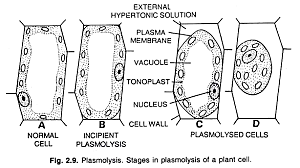
Schematic Representation of Stages of Plasmolysis
Passage of Water through Cell Membrane
[Click Here for Sample Questions]
When the process of Plasmolysis happens within a plant cell, its cell membrane separates the interior part of the cell from its surrounding part (the cell wall). This allows water molecules, ions and some other particular particles to move through the membrane. Water molecules easily travel through the cell and across the cell membranes as water flow is necessary for cells.
Plasmolysis can be shown in the laboratory by taking a living cell and placing it in a concentrated salt solution. The plant cells upon being placed in the concentrated salt solution, notice the flow of water from their cell sap, because of osmosis. In that way, water travels through the cell membrane to the surrounding medium. And at last, the protoplasm gets separated from the cell and takes a spherical shape.
Rheo plant cells, Elodea plants and onion epidermal cells are used normally for this experiment, as these leaves have coloured sap which helps to easily observe and identify them under the microscope.
Types of Plasmolysis
[Click Here for Sample Questions]
Plasmolysis can be categorised into two different types. This classification is done based on the cytoplasm’s final structure.
- Convex Plasmolysis: In convex plasmolysis, both the protoplasm and the cell membrane get completely detached from the cell wall due to the loss of water. After that, the cell wall destroys the cell by collapsing. It cannot be reversed. This Plasmolysis is more complicated than convex plasmolysis.
- Concave Plasmolysis: In concave plasmolysis, both the protoplasm and cell membrane shrink away and detach from the cell wall due to the loss of water. It is a reversible process that can be achieved by placing the shrinked plant cell in a hypotonic solution.

Schematic Representation of Concave and Convex Plasmolysis
Causes of Plasmolysis[Click Here for Sample Questions]
The cause of Plasmolysis is the exosmosis state in which the molecules of water move towards the cell membrane’s highly concentrated areas from the lower concentrated areas. Upon being placed in a hypotonic solution, (a solution with a higher level of the solute’s concentration), the cell starts shrinking. When the plant cell is put in a hypotonic solution, the cell goes through osmosis and it gains water and the high water and pressure levels force the protoplasm to touch the cell walls. This is called turgor, where the plant cells are congested with each other and block other water entrances to the point called full turgor. It also helps plants to stay upright, as the turgor stops the plant cell from overflowing with water. This provides toughness to the plant cells as, without it, the plant might fall from its own weight. However, turgor is slowly lowered when no more air spaces are left around it causing a great osmotic pressure.
Importance of Plasmolysis
[Click Here for Sample Questions]
Plasmolysis is a process utilised by the plant cells when they are contradicted in a hypotonic solution. It is caused when the protoplasm detaches from the surrounding cell wall. The space between the protoplasm and the cell wall gets filled with solutes. The protoplasm’s detachment from its cell wall causes the plant to regain its size by causing the plant to absorb water and using the stomatal machinery to lower water loss. Hence, this is a benefit of plasmolysis.
Examples of Plasmolysis
[Click Here for Sample Questions]
- Shrinkage of blood cells when placed in hypertonic conditions.
- Shrinkage of vegetables in hypertonic conditions.
- Deposition of salt onto land, by the ocean, during extreme coastal flooding.
- The salting of certain plants kills some unwanted plants due to plasmolysis.
- Plasmolysis is used to kill weeds in orchards, agricultural fields and lawns by using chemical weedicides.
Deplasmolysis
[Click Here for Sample Questions]
When the plasmolysed cell is placed in a hypotonic solution, the water flows back into the cell. This happens due to water’s higher concentration outside the cell. The cell swells and becomes turgid as a result. This process is called Deplasmolysis.

Deplasmolysis
Read More:
Things to Remember
[Click Here for Sample Questions]
- Plasmolysis is the process of shrinkage of plant cells due to osmosis.
- Plasmolysis is derived from the Greek and Latin word, i.e, plasma which means the mould and lysis which means loosening.
- Plasmolysis can be shown in the laboratory by taking a living cell and placing it in a concentrated salt solution.
- Plasmolysis is a reversible process which means it can be reversed by placing the plant cell in a hypotonic solution.
- Shrinkage of blood cells when placed in hypertonic conditions, shrinkage of vegetables in hypertonic conditions are few examples of plasmolysis.
Read More: Difference between Photosynthesis and Respiration
Sample Questions
Ques. What is the significance of Plasmolysis? (2 marks)
Ans. Plasmolysis is the process wherein the cells lose water through osmosis when kept in a hypertonic solution. Through this, we can correctly recognize the method of osmosis and distinguish the semi-permeable nature of the cell wall. The protoplasm’s detachment from its cell wall causes the plant to regain its size by causing the plant to absorb water and using the stomatal machinery to lower water loss because of Plasmolysis.
Ques. What are the causes of Plasmolysis? (3 marks)
Ans. The cause of Plasmolysis is the Exosmosis state in which the molecules of water move towards the cell membrane’s highly concentrated areas from the lower concentrated areas. Upon being placed in a hypotonic solution, (a solution with a higher level of the solute’s concentration), the cell starts shrinking. When the plant cell is put in a hypotonic solution, the cell goes through osmosis and it gains water and the high water and pressure levels force the protoplasm to touch the cell walls. This is called turgor, where the plant cells are congested with each other and block other water entrances to the point called full turgor. It also helps plants to stay upright, as the turgor stops the plant cell from overflowing with water.
Ques. How is Plasmolysis essential for food preservation and storage? Why is it harmful for the plant? (2 marks)
Ans. Plasmolysis plays a vital role in food preservation and storage. We use salt to maintain the condition of jam, meat, jellies or pickles, and many others. That amplifies the osmotic pressure of the food, and as a consequence, plasmolyzes the fungi and the bacteria.
Water rushes out of the cell, right after they are positioned in the hypertonic solution, and the cell starts shrinking. These plasmolyzed cells are dehydrated and are then without all physiological features, which sometimes leads to the demise of the plant.Ques. What is turgidity in a Plant Cell? (2 marks)
Ans. Turgidity is when a plant gets swollen and this helps a plant to face upright. Turgidity and plasmolysis are the results of the osmotic motion of water because of a difference in the concentrations of solutes. In simple words, the plant will stand still better if the turgidity is more. Turgidity depends on the plant cells as it happens when the cells go through osmosis and gain water until the cell faces pressure on its cell wall.
Ques. What is the main difference between both types of plasmolysis? (2 marks)
Ans. The two types of plasmolysis are Convex and concave. The main differences between both of them are that they both have different shapes, which the cytoplasm makes once the cell loses water. Another vast distinction is that the concave Plasmolysis is reversible, at the same time the convex Plasmolysis isn't always reversible. Convex Plasmolysis is even more complex than concave Plasmolysis.
Ques. What is osmosis? (2 marks)
Ans. Osmosis can be defined as the process of diffusion of water or other solvents through a semipermeable membrane. This process generally occurs in plants where the water or other solvents move from lower concentration to higher concentration. Osmosis can be stopped by increasing the pressure on the solution to a specific extent. Such pressure is called osmotic pressure. Raisins in water, potato in sugar solution, RBCs placed in freshwater are some of the most common examples of osmosis.
Ques. What is the difference between plasmolysis and flaccidity? (2 marks)
Ans. Plasmolysis is known as the decrease in the size of the protoplasm in contact with the hypertonic solution. However, Flaccidity is the loss of turgor due to the lack of total flow of water in the plant cell. Flaccidity and plasmolysis boh play a role in losing cell turgor that results in the plant’s bending. Both of these processes can be reversed back in the plant cell. However, it must be noted that a flaccid cell is never plasmolyzed or turgid.
Read More:



Comments