



Content Curator
Parenchyma cells are living cells that are mainly composed of nuclei and protoplasts. Their primary functions include storage and photosynthesis.
- Parenchyma is a simple permanent tissue that makes up the majority of ground tissues in plants and is embedded with other tissues such as vascular tissues.
- They are non-vascular and are made up of simple, living, undifferentiated cells that have been modified to perform various functions.
- Parenchyma can be found in the soft parts of plants, such as the Mesophyll in leaves, fruits, flowers, and young stems.
- It is also present in the stem and leaves, as well as the ground tissue.
| Table of Content |
Key Terms: Parenchyma cell, Photosynthesis, Tissues, Pith, Cortex, Shape of Parenchyma cell, Endosperm, Chlorophyllous, Vacuoles, Plastids, Chloroplasts, Chlorenchyma
What are Parenchyma Cells?
[Click Here for Sample Questions]
Parenchyma is a form of tissue consisting of cells that carry out an essential function. Parenchyma, the simple permanent ground tissues, form the bulk of the plant tissues, such as fruit pulp, the tender part of leaves, and other plant organs.
- Parenchyma cells generally come in a variety of shapes, including spherical, oval, round, polygonal, and elongated.
- Their cellulose-based walls are quite thin and might be densely packed or have little intercellular space.
- Photosynthesis, storage, and secretion are all activities performed by the parenchyma tissue.
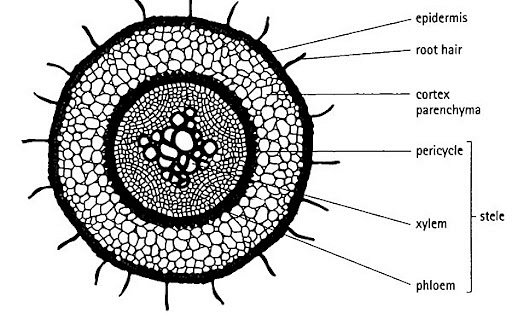
Parenchyma Cells
Also Read:
| Related Articles | ||
|---|---|---|
| Insectivorous Plants | Amino Acids | What are Fossils? |
| Prokaryotic and Eukaryotic Cells | Cotyledon | Peroxisomes |
Characteristics of Parenchyma Cells
[Click Here for Sample Questions]
The following are the characteristics of Parenchyma cells
Origin of Parenchyma Cells
The ground meristem gives rise to the parenchyma cells that make up the main plant body, such as the pith and cortex. The major and secondary conducting tissues' xylem and phloem parenchyma are produced by the procambium and cambium, respectively.
Fragmentation of Parenchyma Cell In Tissue
Parenchyma tissue covers a large portion of all plant organs. Parenchyma cells are living tissues that can divide when they reach maturity. As a result, the needed help in tissue regeneration and repair is provided.
The shape of the Parenchyma Cell
The growth of parenchyma cells generally grows spherical. Due to interaction with surrounding cells, cell aggregates are polygonal and make it into a parenchyma tissue. The most frequent polyhedral cells have fourteen sides, however, cells with 12, 13, 15, 16, or fewer sides can also be found.
Intercellular Space
Mature parenchyma tissues can be packed tightly together with no intercellular gaps between them like endosperm tissue present in seeds. They can also be loosely organized so that well-developed intercellular gaps exist between them.
Structure of Parenchyma Cells
[Click Here for Sample Questions]
Primary walls are common in parenchyma cells i.e., chlorophyllous and storing parenchyma. The storing parenchyma cells of Phoenix, Asparagus endosperm have extremely thick walls.
- Hemicellulose deposition is responsible for the thickness of the wall.
- A living protoplast with one or more vacuoles is usually seen in parenchyma cells.
- They might also contain leucoplasts, chloroplasts, and other plastids.
- The cell sap of parenchyma contains a variety of carbohydrates, nitrogenous, and fatty compounds.
- In the cell sap of sugar beetroots and onion bulb scales, amides, proteins, sugars, and other compounds can be found.
- Protein and starch are found in the parenchyma cells of many leguminous plants' cotyledons.
- Protein and oils are found in the parenchymatous endosperm of Ricinus communis.
- The parenchyma of the potato tuber contains protein and carbohydrates.
- Starch can be found in the endosperm parenchyma, tubers, cortex, fruits, xylem, and phloem, among other places.
- Water can be found in the parenchyma of storage organs and succulents.
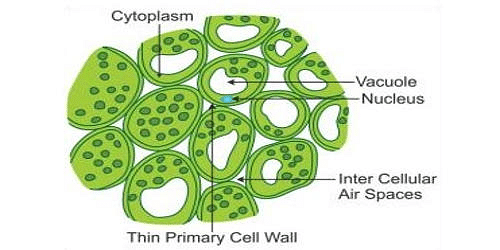
Structure of Parenchyma Cells
Types of Parenchyma Cells
[Click Here for Sample Questions]
The different types of Parenchyma cells are
Chlorenchyma
The mesophyll part of the leaves contains chlorenchyma. Chloroplast can be found in these parenchymal cells. Furthermore, these cells can be discovered in the immature plant cortex of the plant's stem.
- Multiple intercellular gaps are present in these cells, which are loosely packed.
- The stem and aerial roots of plants get their green color from chlorenchyma cells.
- The job of these parenchymal cells is to manufacture food through the process of photosynthesis.
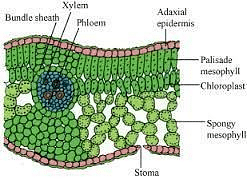
Chlorenchyma
Aerenchyma
The parenchymal tissues are most commonly seen in aquatic plants, where they help the plants maintain their buoyancy.
- These parenchymal cells are loosely packed cells with wide intercellular gaps where air holes or air pockets exist, providing the plant with the necessary buoyancy.
- The plant can also use the gases (oxygen or carbon dioxide) trapped in the aerenchyma.

Aerenchyma
Xylem Parenchyma
The cellulose-based cell walls of xylem parenchyma cells are alive and thin-walled.
- They store carbohydrates, fat, and other compounds such as tannins in the form of food.
- The ray parenchymatous cells transport water in a radial direction.

Xylem Parenchyma
Phloem Parenchyma
Elongated, tapering cylindrical cells with dense cytoplasm and nucleus together makeup phloem parenchyma tissue. Cell walls are made of cellulose and have pits through which plasmodesmata connect between cells.
- The phloem parenchyma stores food material and other substances like resins, latex, and mucilage.
- Phloem parenchyma is absent in most of the monocotyledons.
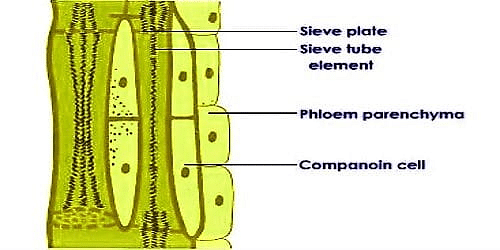
Phloem Parenchyma
Functions of Parenchyma Cells
[Click Here for Sample Questions]
The following are the functions of Parenchyma cells
- All metabolic processes take place in living parenchyma cells.
- Chlorenchyma, or parenchyma cells with chloroplastids, can photosynthesize.
- Meristematic parenchyma can divide cells and so aids in wound healing and regeneration.
- In aquatic plants, aerenchyma, or parenchyma cells that surround the air gaps, aid in aeration, gaseous exchange, and buoyancy, which aids in floating.
- Epidermal parenchyma tissues with their cutinized peripheral walls of various plant organs aid in protection.
- Turgid parenchyma cells provide mechanical stiffness to seedlings and certain hydrophytes.
- Parenchymal tissues are also responsible for the buoyancy of some aquatic plants.
- Storage of elastic materials such as resins, etc.
- Water and nutrients are transported throughout the plant via parenchymal cells in the xylem and phloem.
- The capacity to develop into secondary meristematic cells is present in these cells (for example, cork cambium).
- All meristematic cells are parenchymal cells, it is crucial to remember this.
Things to Remember
- Parenchyma is a form of tissue consisting of cells that carry out an essential function.
- Primary walls are common in parenchyma cells i.e., chlorophyllous and storing parenchyma.
- The storing parenchyma cells of Phoenix, Asparagus endosperm have extremely thick walls.
- The cell sap of parenchyma contains a variety of carbohydrates, nitrogenous, and fatty compounds.
- In the cell sap of sugar beetroots and onion bulb scales, amides, proteins, sugars, and other compounds can be found.
- Protein and starch are found in the parenchyma cells of many leguminous plants' cotyledons.
- The mesophyll part of the leaves contains chlorenchyma.
- Chloroplast can be found in these parenchymal cells.
- The parenchymal tissues are most commonly seen in aquatic plants, where they help the plants maintain their buoyancy.
Also Read:
Sample Questions
Ques. What is the epidermis' function in plants? (1 Mark)
Ans. The epidermis is made up of cells that form a continuous layer with no intercellular gaps. It safeguards all plant components.
Ques. Where can we find Parenchyma? (2 Marks)
Ans. Parenchyma cells are live cells that are mostly composed of nuclei and protoplasts. Their main functions include storage and photosynthesis. Parenchyma can be found in the soft parts of plants, such as the Mesophyll in leaves, fruits, flowers, and young stems. Parenchyma can also be seen in the stem and leaves, as well as the ground tissue.
Ques. Identify the areas where parenchyma tissue can be found. (2 Marks)
Ans. The pith of the roots and stems, to be precise. Chlorenchyma is a substance found in green leaves that includes chlorophyll. The parenchyma of aquatic plants has huge air cavities that let them float. Aerenchyma is the name for this kind of parenchyma.
Ques. When stained, plant tissue revealed the presence of hemicellulose and pectin in the cell walls of its cells. Give the tissue a name. (1 Mark)
Ans. The name of the tissue is Collenchyma Tissue.
Ques. Based on structure and function, distinguish between aerenchyma and collenchyma. (4 Marks)
Ans.
| Aerenchyma | Collenchyma |
|---|---|
| The parenchymatous tissue has a considerable amount of air space. | At the corner of the cells in the collenchyma tissue, there are deposits of cellulose and big pectin. |
| Isodiametric in shape, thin-walled cells, and intercellular space. | Oval and polygon-shaped cells with no intercellular space. |
| The Buoyancy provided to the plants. | Mechanical strength and elasticity are provided to the plants. |
Ques. How phloem tissue elements are analogous to xylem tissue elements? Explain. (3 Marks)
Ans. i. Because both have no nucleus, the sieve components of the phloem are similar to the vessel of the xylem.
- Phloem and xylem fibers are similar in that they both offer tensile strength to the tissue.
- The live components of phloem and xylem, respectively, are phloem parenchyma and xylem parenchyma.
Ques. What exactly is phellogen? (2 Marks)
Ans. The cork cambium is what separates the upper and lower sides of the cells. The periderm is made up of cells from the phellem's upper side, as well as cells from the lower phellogen and phelloderm.
Ques. Name the plant tissue type that has thin-walled cells with 12–140 sides and the ability to divide at maturity. (1 Mark)
Ans. Parenchyma Tissue is a tissue that has thin-walled cells with 12–140 sides and the ability to divide at maturity.
Ques. In mature parenchyma tissue, does plant regeneration differ? (1 Mark)
Ans. Yes, In mature parenchyma tissue, the plant regeneration differentiates.
Ques. What are the four types of parenchyma cells? (4 Marks)
Ans. The four types of parenchyma cells are:
Chlorenchyma: The mesophyll part of the leaves contains chlorenchyma. Chloroplast can be found in these parenchymal cells. Furthermore, these cells can be discovered in the immature plant cortex of the plant's stem. Multiple intercellular gaps are present in these cells, which are loosely packed.
Aerenchyma: The parenchymal tissues are most commonly seen in aquatic plants, where they help the plants maintain their buoyancy. These parenchymal cells are loosely packed cells with wide intercellular gaps where air holes or air pockets exist, providing the plant with the necessary buoyancy.
Xylem Parenchyma: The cellulose-based cell walls of xylem parenchyma cells are alive and thin-walled. They store carbohydrates, fat, and other compounds such as tannins in the form of food. The ray parenchymatous cells transport water in a radial direction.
Phloem Parenchyma: Elongated, tapering cylindrical cells with dense cytoplasm and nucleus together make up phloem parenchyma tissue. Cell walls are made of cellulose and have pits through which plasmodesmata connections between cells can be made.
Ques. What are the functions of parenchyma cells? (4 Marks)
Ans. The functions of parenchyma cells are:
- All metabolic processes take place in living parenchyma cells.
- Chlorenchyma, or parenchyma cells with chloroplastids, can photosynthesize.
- Meristematic parenchyma can divide cells and so aids in wound healing and regeneration.
- In aquatic plants, aerenchyma, or parenchyma tissues that surround the air gaps, aid in aeration, gaseous exchange, and buoyancy, which aids in floating.
- Epidermal parenchyma tissues with their cutinized peripheral walls of various plant organs aid in protection.
- Turgid parenchyma cells provide mechanical stiffness to seedlings and certain hydrophytes. Parenchymal tissues are also responsible for the buoyancy of some aquatic plants.
For Latest Updates on Upcoming Board Exams, Click Here: https://t.me/class_10_12_board_updates
Check-Out:



Comments