



Education Journalist | Study Abroad Lead
Adjacent and vertical angles are different types of angle pairs. They are distinguished based on their positions with respect to each other. Adjacent angles are those angles which have a common vertex and share the same side. On the other hand, vertical angles are present opposite to each other at the intersection of two lines. Except for these two, there are other types of angles as well like alternate interior angles, corresponding angles, linear pair etc.
Key Terms: Adjacent Angles, Vertical Angles, Reflex Angles, Linear Pair, Acute Angles, Obtuse Angles, Intersecting Lines
Adjacent Angles
[Click Here for Sample Questions]
When two different angles have the same vertex and sides, then they are said to be adjacent angles. It is because the vertex of an angle is formed by ray’s ends, which creates the angle’s sides. When adjacent angles have the same vertex and side, they are known as complementary or supplementary angles. Adjacent angles are those which have both a common side and a common vertex. So, if we see two angles that are coming from the same corner but there is another angle in the middle, this means that they do not share any side and thus they are not adjacent.
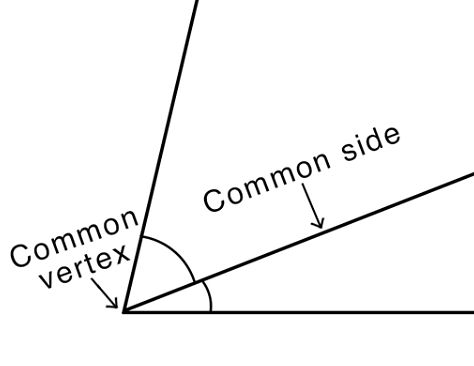
Adjacent Angles
Properties of Adjacent Angles
[Click Here for Sample Questions]
The main properties of adjacent angles are as follows:
- Adjacent angles lie in the same plane.
- They have the same vertex and arm.
- Angles do not intersect with each other.
- There will not exist a common interior point.
- When the angles share the same vertex, they can be complementary or supplementary angles.
- On both sides of the common arm, there must be a non-common arm.
Read Also:
Vertical Angles
[Click Here for Sample Questions]
When two lines intersect with each other, they form four different angles. Vertical angles are those angles which are opposite to each other. Vertical angles theorem states that angles that are opposite to each other formed by two intersecting straight lines are said to be congruent. The four angles formed will be two pairs of non-adjacent angles. In other words, vertical angles are situated across from one another in the corners of the “X” made by two straight lines.
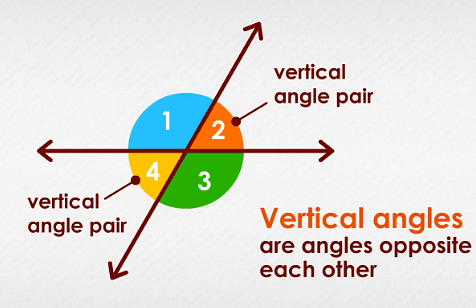
Vertical Angles
Difference Between Adjacent and Vertical Angles
[Click Here for Sample Questions]
The main differences between adjacent and vertical angles are given below:
| Adjacent Angles | Vertical Angles |
|---|---|
| Angles that share a common side and vertex are called adjacent angles. | Angles formed at the intersection of two lines opposite to each other are called vertical angles. |
| They share the same side and vertex. | They share the same vertex but not the same side. |
| They are not necessarily equal in measure. | They are always equal in measure. |
Important Terms
[Click Here for Sample Questions]
Some important terms related to angles are given below:
- Reflex angle: When the measure of an angle is greater than 180°, it is said to be a reflex angle.
- Acute angle: When the measure of an angle is less than 90°, it is said to be an acute angle.
- Right angle: When the measure of an angle is equal to 90°, it is said to be a right angle.
- Obtuse angle: When the measure of an angle is greater than 90°, it is said to be an obtuse angle.
- Linear pair: It is a pair of adjacent angles whose non-common arms are opposite rays such that the sum of their measures is 180°.
- Intersecting Lines: Two lines intersect if they have a common point called the point of intersection.
- Traversal: A line that intersects two or more lines at different points is known as a traversal.
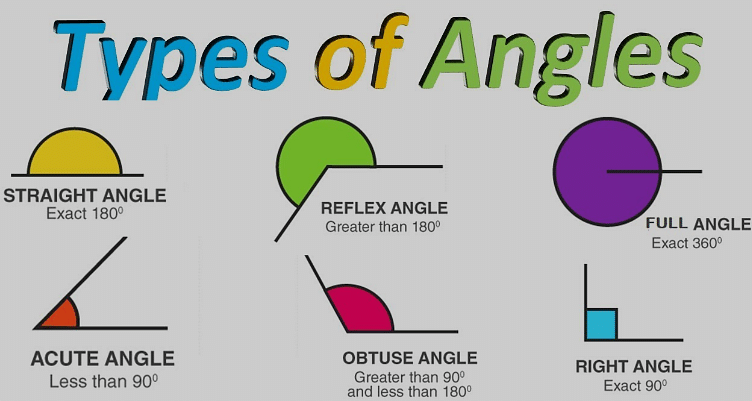
Types of Angles
Read Also:
Things to Remember
- An angle is a space formed between two rays with the same vertex.
- Two angles are said to be adjacent when they share a common side and common vertex.
- Angles that are next to one another are not always necessarily adjacent angles.
- Vertically opposite angles are formed at the intersection of two lines.
- If we have a y° angle, then we can subtract it from 90° to obtain a complementary angle.
- If we have a y° angle, then we can subtract it from 180° to obtain a complementary angle.
Sample Questions
Ques. List down five pairs of adjacent angles from the following figure. (2 Marks)
Ans. Five pairs of adjacent angles are as follows:

∠AOE, ∠EOC
∠EOC, ∠COB
∠COB, ∠BOD
∠BOD, ∠AOD
∠AOD, ∠AOE
Ques. State true or false with respect to the properties of Adjacent Angles.
(a)Adjacent angles are always supplementary.
(b)Adjacent angles always split a common vertex and a common arm with each other. (2 Marks)
Ans. a) The above statement is false as adjacent angles cannot always be supplementary. If any two adjacent angles form a straight line together, then they are known to form supplementary adjacent angles.
b) The above statement is true as adjacent angles always share a common vertex and a common arm with each other.
Ques. If following angles make a linear pair, then find the value of q. (3 Marks)
Ans. According to linear pair formula,

(7q-46)° + (3q+6)° = 180°
7q + 3q - 40 = 180°
10q - 40 = 180°
10q = 180° + 40
10q = 220°
q = 220/10
q = 22°
Hence, the value of q is 22°.
Ques. Find the values of a, b, c from the following figure: (3 Marks)
Ans. Here,
b = 45° (vertically opposite angles)
Angles “b” and “a” forming linear pair,
b + a = 180°
45° + a = 180°
a = 180 - 45
a = 135°
Angles “a” and “c” are forming vertically opposite angles,
a = c = 135°
Therefore, the values of a, b, c are 135°, 45°, 135°.
Ques. Find the values of angles x, y, z in each of the following: (5 Marks)
Ans. (i) From fig1,

∠x = ∠55 (Vertically opposite angles)
∠x and ∠y form adjacent angles,
∠x + ∠y = 180° (Linear Pair)
55° + ∠y = 180°
∠y = 180 - 55
∠y = 125°
Hence, the values of x, y, z are 55°, 125° and 125°
(ii)

25° + x + 40° = 180° (Sum of adjacent angles on a straight line)
65° + x = 180°
x = 180° - 65°
x = 115°
∠y and ∠40 make linear pairs,
40° + y = 180°
y = 180° - 40°
y = 140°
Also, ∠y and ∠z are forming linear pairs,
∠y + ∠z = 180°
140° + ∠z = 180°
∠z = 180° - 140°
∠z = 40°
Hence, the values of x, y, z are 115°, 140° and 40°.
Ques. In the given figure, name the following pairs of angles:
1) Obtuse vertically opposite angles
2) Adjacent complementary angles
3) Equal supplementary angles
4) Unequal supplementary angles
5) Adjacent angles but do not form a linear pair (5 Marks)
Ans.

1) ∠BOC and ∠AOD are obtuse vertically opposite angles
2) ∠AOB and ∠AOE are adjacent complementary angles
3) ∠EOB and ∠EOD are equal supplementary angles
4) ∠EOA and ∠EOC are unequal supplementary angles
5) ∠AOB and ∠AOE, ∠AOE and ∠EOD, ∠EOD and ∠COD are pairs of adjacent angles but these do not form a linear pair.
Ques. An angle is greater than 45°. Is its complementary angle greater than 45° or equal to 45° or less than 45°? (2 Marks)
Ans. Given an angle which measures greater than 45°
Let the given angle be x°.
∴ x > 45
Complement of x° = 90° - x° < 45° [∴ x > 45°]
Therefore, the required angle will be less than 45°.
For Latest Updates on Upcoming Board Exams, Click Here: https://t.me/class_10_12_board_updates
Check More:



Comments