



Content Curator
Growth is a topic covered under CBSE Class 12 Biology Unit 10 Ecology and Environment Chapter 13 Organisms and Populations. As per the CBSE Class 12 Biology Syllabus, Unit 10 Ecology and Environment carries a total weightage of 14 marks
| Table of Content |
Keyterms: Ecology, Environment, Organisms, Populations, Population ecology, Nature, Species
What is a Population?
[Click Here for Sample Questions]
It is uncommon to find solitary individuals of any species in nature. The vast majority live in groups in well-defined geographical regions, sharing/competing for similar resources, and interbreeding (sexually or asexually) to grow their species. These characteristics of a species comprise a Population.
Population ecology is a crucial branch of ecological sciences because it connects ecology with population genetics and evolution. Individual organisms lack certain characteristics that a community does. Births and deaths occur in individuals, while birth and death rates occur in populations.
These rates refer to the number of births and deaths per capita in a population. As a result, the rates are expressed as a change in numbers (growth or decrease) among members of the population.

Population Distribution
Check Organisms and PopulationAge Pyramid
[Click Here for Sample Questions]
Individuals of various ages make up a population at any particular time. The resulting structure is called an age pyramid when the age distribution (percent persons of a specific age or age group) is shown for the population.
In a composite figure, age pyramids represent the age distribution of males and females in the human population.
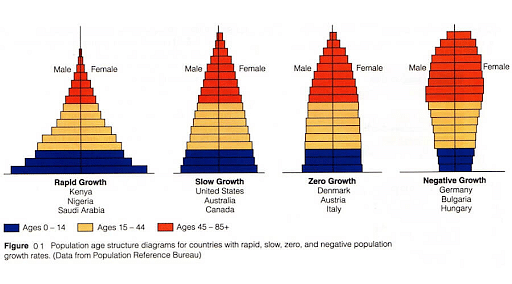
Age Pyramid
The shape of the pyramids represents the population's growth rate -
(a) whether it is growing,
(b) stable or
(c) declining.
Read More:
| Related Topics | ||
|---|---|---|
| Predation | Parasitism | Commensalism |
| Ecology | Environment Protection Act 1986 | Homeostasis |
Population Growth
[Click Here for Sample Questions]
The human population is not a static force. One of the key worries of the modern world is population growth which is accelerating at an alarming rate. Despite the growing global population, the earth's resources remain constant. As a result, maintaining sustainable growth has become a fundamental concern for humanity today.
The population size of any species is not a fixed number. It fluctuates over time, based on a variety of factors such as food supply, predation pressure, and bad weather. In fact, it is these shifts in population density that give us a sense of how the population is doing — whether it is growing or shrinking.
Whatever the ultimate reasons, changes in four basic processes cause population density to fluctuate in a given habitat over time. Two of these processes, i.e. natality and immigration contribute to an increase in population density, while the other two i.e mortality and emigration contribute to a decrease.
Check: Population & its Growth
Factors Influencing Fluctuation in Population
[Click Here for Sample Questions]
The population changes in a specific area are impacted by four key elements, which are as follows:
- Natality – The number of births in a population over a specific period of time is referred to as natality.
- Mortality – Mortality is defined as the total number of deaths in a population over a certain time period.
- Immigration – Immigration is defined as the influx of people from another population into the population under examination over a given length of time.
- Emigration – Emigration is defined as the number of individuals from a group who leave their current habitat and migrate to a new one over a period of time.
Thus, it is evident that Natality (N) and Immigration (I) increase the population, whereas Mortality (M) and Emigration (E) diminish it. The population density (Pt) at any particular moment can be calculated as follows:
Pt =P0 + (N + I) – (M + E)
where, P0 = initial population density.
We have two growth models that describe a population's basic growth trend. These are the following:
Read More: Human Heart
Exponential Growth
[Click Here for Sample Questions]
The availability of resources (food and space) is critical for a population's unrestricted growth. As Darwin discovered in developing his theory of natural selection, when resources in the habitat are unrestricted, each species has the ability to completely realise its innate potential for population growth.The population then rises exponentially or geometrically. If the birth rates (not total number but per capita births) are represented as b and the death rates (again, per capita death rates) are represented as d in a population of size N, then the rise or decrease in N over a unit time period t (dN/dt) will be
dN/dt = (b – d) × N
Let (b–d) = r, then
dN/dt = rN
The r in this equation stands for the 'intrinsic rate of natural increase,' and it is a crucial metric to consider when evaluating the effects of any biotic or abiotic factor on population expansion.
To give you a sense of the magnitude of r values, the Norway rat has a value of 0.015, whereas the flour beetle has a value of 0.12. The r value for India's human population was 0.0205 in 1981.
When plotting N against time, the above equation describes the exponential or geometric growth pattern of a population, resulting in a J-shaped curve. If you have a little understanding of calculus, you can calculate the integral form of the exponential growth equation as follows:
Nt=N0ert
Where, Nt = is the population density at a given point in time t
N0 = is the population density at the beginning of time or zero
r = r denotes the intrinsic rate of natural growth.
e = natural logarithm base (2.71828)
Logistic Growth
[Click Here for Sample Questions]
In nature, no population of any species has unlimited resources to allow exponential growth. Individuals compete for limited resources as a result of this. The ‘fittest' person will eventually survive and reproduce.
Many governments have recognised this truth and have enacted various restrictions in order to curb human population growth. In nature, a habitat's resources are sufficient to support a maximum number of people, after which no further expansion is conceivable. This is the carrying capacity of nature (K) for that species in that habitat.
When a population grows in a habitat with limited resources, it goes through a lag phase, then acceleration and deceleration phases, and eventually an asymptote, which occurs when the population density meets the carrying capacity. A sigmoid curve is formed when N is plotted against time (t). Verhulst-Pearl Logistic Increase is the name given to this type of population growth, which is defined by the equation below:
dN/dt = rN((K-N) /K)
Where N denotes the population density at a given moment
r denotes the intrinsic rate of natural increase.
K stands for the carrying capacity.
Because most animal populations have finite growth resources that eventually run out, the logistic growth model is thought to be more realistic.
Sample Questions
Ques. What is the definition of population growth?
Ans. When a group including all living organisms of a single species in a specific geographical area, at a specific moment, have the ability to interbreed, that is when population increase occurs.
Ques. What are the elements that cause population growth to fluctuate?
Ans. The following are some of the elements that influence population growth:
- Natality
- Mortality
- Immigration
- Emigration
Ques. What can be done to reduce the death rate?
Ans. The death rate can be reduced by taking the following steps:
- Proper public health and sanitation
- Antibiotics and vaccines inventions
- Urbanization and agricultural developments
For Latest Updates on Upcoming Board Exams, Click Here: https://t.me/class_10_12_board_updates
Do Check Out:



Comments