



Education Journalist | Study Abroad Lead
Radical is a term derived from the Latin word “Latex” which means root, the root of a tree. In Mathematics, the term radical means the root of a number. A radical is a mathematical expression that involves the use of the root of a number. There are many components of a radical like radicand, degree, and symbol. All of these, if combined, form a radical. Radical symbol is used to do the opposite of exponentiation. The radical symbol takes the value of exponentiation of a number then yields the result as a number that was exponentiated by multiplying by itself multiple times.
| Table of Contents |
Key Takeaways: Radical, Square Root, Radicand, Degree, Index, Exponent, Whole Numbers, Exponentiation, Root, Radical Form
Radical and Its Symbol
[Click Here for Sample Questions]
A Radical can be defined as an expression that involves a root, usually a square root or cube root. The symbol used to denote the root of a number x is known as the radical symbol. The radical symbol is as follows:
\(\sqrt[n]{x}\)
The symbol of radical √ means “root of”. The length of the horizontal bar matters as it specifies the extent of the expression that has to be operated.
The root can be either square root or cube root or any other degree. The number written just before the radical symbol is called index number or degree number. This number is a whole number represented as an exponent that cancels out the radical. The radical can be of any degree such as square root, cube root, ….nth root. The index helps to understand how many times the number is multiplied by itself to get the value of radicand.
For example: \(\sqrt{25}\) =\( \sqrt{5 * 5}\)= 5
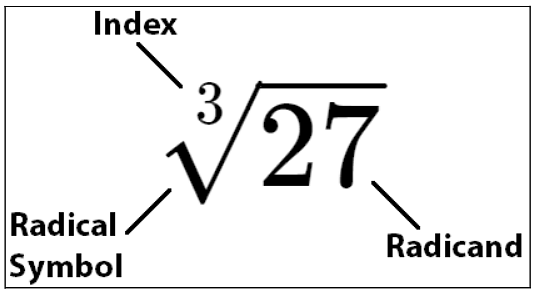
Parts of a Radical
Read More: Difference Between Power And Exponent
Components of Radical
[Click Here for Sample Questions]
There are three components of radical-
- Radicand
- Degree or index
- Symbol
Degree: It indicates how many times a number is multiplied by itself. If the number is not mentioned to the left of the radical symbol, it is assumed to be a square root.
\(\sqrt[n]{x}\)
Here the degree is n.
Radicand: This is the number that is obtained by multiplying another number multiple times. This is the number whose root has to be found.
When it is required to multiply multiple radicals with each other then first the numbers outside of the radical have to be multiplied then the numbers inside the root will be multiplied.
a1√m1 * a2√m2 = a1.a2 .√m1.m2
Symbol: The symbol ‘ √ ’ means the ‘root’. The root of all the numbers should be taken which numbers are under the horizontal line. An equation is a radical equation if the equation contains at least one radical expression.
Read More: Estimating Square Root
Simplest Radical Form of A Square Root
[Click Here for Sample Questions]
Prime factorization is used to express the radical equation in the simplest form. The radicand is taken and it is divided by various prime numbers until the number left is the prime number.
For example- Let the number be 48. When we divide 48 by the smallest prime number 2 it gives 24, when divided by 3 it gives 8, when divides by 2 it gives 4 and at last when divides by 2 it gives 2 (prime). So we can represent the number 48 as
√48 = 3 * 24
After factorising the tuple of that many numbers are taken together as much is the degree. If the degree is 2 (square root) then we have to make the pairs of two. All the numbers in the pair will be taken out and the numbers which cannot form pairs will remain inside the radical.
√48 = √3 * 2 * 2* 2 * 2
Here we can make 2 pairs of 2 but 3 cannot be paired. Only one number can be taken out of a pair in a square root.
Hence we get
√48 = 2*2√3 = 4√3
This is the simplest representable radical form of root 48.
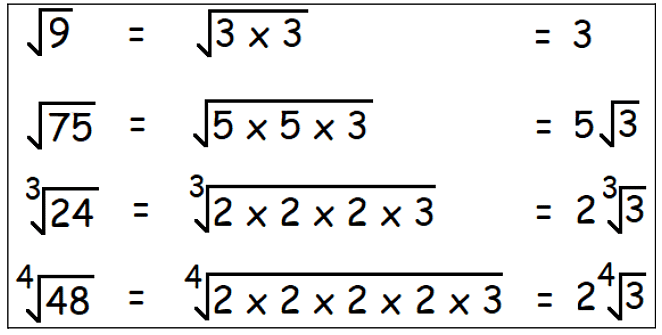
Simplifying Radicals
Read More: Finding Square Roots through Prime Factorization
General Rules Regarding Radicals
[Click Here for Sample Questions]
- The result has the same sign as the radicand. If the number is negative in the radical, the result will be negative. If the result is positive inside the radical, the result is positive.
- If the radicand is negative and the index of radical is an even number, the result will be an irrational number.
- If the index is not mentioned, that implies the index is the square root.
- Multiplication of numbers inside the same degree radical is possible. E.g. 3√5 * 3√6 = 3√30
- The inverse exponent of an index of the radical is the same number. E.g. √7 = √71/2
Read More: Uses of Exponents to Express Small Numbers in Standard Form
Things to Remember
- A radical is a mathematical expression that involves the use of the root of a number.
- The index helps to understand how many times the number is multiplied by itself to get the value of radicand.
- The radical symbol takes the value of exponentiation of a number then yields the result as a number that was exponentiated by multiplying by itself multiple times.
- Prime factorization is used to express the radical equation in the simplest form.
- If the index is not mentioned, that implies the index is the square root.
- The result has the same sign as the radicand.
Sample Questions
Ques. Simplify the equation 2√4 + 2√824 + 28 (3 Marks)
Ans. First, we have to factorise the radicands to the simplest form to proceed forward.
After factorising the number 4 can be written as 2*2
And the number 824 can be written as 23 * 103
2√4+2√824 + 28 = 2√2*2 + 2√2*2*2*103 + 28
= 2*2 + 2*(2)√206+28
= 4 + 4√206 +28
= 32 +4√206
Ques. Express 33/2 in radical form using radical formula. (3 Marks)
Ans. Any expression involving root at least once is called radical form.
As the power rule of exponents say (am)n = (a)mn
So 33/2 can be written as (31/2)3
Now (31/2)3 can be written as (3)3
As we know that the similar factor pairs can come out as a single number,
Similarly to put a number inside the radical, the number has to be squared
And then it can be put inside the radical.
(31/2)3 = √33 = √3*√3*√3 = 3√3
Ques. Solve the expression (6+ √3x)/y where x = 16 and y = 2 (3 Marks)
Ans. Given to us that x = 16 and y = 2
(6+3√x)/y
= (6+3√16)/2 (putting the values)
=(6+3√4*4)/2
=(6+(3*4))/2
=(6+12)/2
=(18)/2= 9
The value of the radical expression is 9.
Ques. Simplify the following expression. √x (4 - 3√x). (3 Marks)
Ans. It is to be noted that only radicals with the same degree can be multiplied.
Given √x(4 - 3√x)
=(4√x - 3√x.√x)
As all the radicals have the same degree, they can be multiplied.
=(4√x - 3√x*x)
=(4√x - 3√x2)
=(4√x - 3√x)
Ques. Multiply the following expression (\(\sqrt[3]{x} + 2 \sqrt[3]{x^2})(4 - \sqrt[3]{x^2}\)). (3 Marks)
Ans. (\(\sqrt[3]{x} + 2 \sqrt[3]{x^2})(4 - \sqrt[3]{x^2})\)
= 4\(\sqrt[3]{x}\) – \(\sqrt[3]{x}\sqrt[3]{x^2}\) + 8\(\sqrt[3]{x^2}\) – 2\(\sqrt[3]{x^2} . \sqrt[3]{x^2}\)
= 4\(\sqrt[3]{x^2}\) – \(\sqrt[3]{x^3}\) + 8\(\sqrt[3]{x^2}\) – 2\(\sqrt[3]{x^4}\)
= 4\(\sqrt[3]{x^2}\) – \(\sqrt[3]{x^3}\) + 8\(\sqrt[3]{x^2}\) – 2\(\sqrt[3]{x^3}.\sqrt[3]{x}\)
= 4\(\sqrt[3]{x^2}\) – x + 8\(\sqrt[3]{x^2}\) – 2x . \(\sqrt[3]{x}\)
Ques. Solve the following equation x = (1 + (\(\sqrt{2x - 2}\))) (5 Marks)
Ans. Given to us the equation – x = ( 1 + (\(\sqrt{2x - 2}\)))
First take all the non-root containing terms to the left.
x – 1 = (\(\sqrt{2x - 2}\)) ----1
Now squaring both sides we get,
(x – 1)2 = (2x – 2)
x2 + 1 – 2x = (2x – 2)
(x2 – 4x + 3) = 0- -----2
Now the quadratic equation has to be split into two linear equations
(x – 1)(x – 3) = 0
We get x = 1,3
Taking x = 1
Putting x in (1)
1 – 1 = \(\sqrt{2(1) - 2}\)
0 = 0 (this is true)
Again putting x = 3
3 – 1 = \(\sqrt{2(3) - 2}\)
2 = 2 (this is true)
Both the solutions are correct.
Ques. Solve the equation : \(\sqrt{2x - 5}\) – \(\sqrt{x - 1}\) = 1. (5 Marks)
Ans. Given, \(\sqrt{2x - 5}\) – \(\sqrt{x - 1}\) = 1
First isolating the roots we get,
=> \(\sqrt{2x - 5}\) = \(\sqrt{x - 1}\) + 1
Now squaring both sides,
=> 2x – 5 = x – 1 + 1 + 2\(\sqrt{x - 1}\) . 1
Again isolating the root we get,
=> (2x – 5 – x) / 2 = \(\sqrt{x - 1}\)
=> (x – 5) / 2 = \(\sqrt{x - 1}\)
squaring both sides,
=> (x – 5)2 / 4 = x – 1
=> (x – 5)2 = 4x – 4 ((a + b)2 = a2 + b2 + 2ab)
Simplifying,
=> x2 – 14x – 29 = 0
Using quadratic formula ( \({-b \pm \sqrt{b^2-4ac} \over 2a}\))
Here a = 1, b = – 14, c = – 29
Putting these value we get the two solution,
x = 2.54 and 11.47
Now putting the value of x in given equation
when, x = 2.54
\(\sqrt{2 * 2.54 - 5} - \sqrt{2.54 - 1} \) ≈ – 1 (Wrong answer)
when, x = 11.47
\(\sqrt{2 * 11.47 - 5} - \sqrt{11.47 - 1} \) ≈ 1 (True)
Hence the correct value of x is 11.47
Ques. Solve the equation: 1 + √1-x = √2x +4 (5 Marks)
Ans. Given => 1 + \(\sqrt{1-x} = \sqrt{2x+4}\)
Squaring both sides,
=> 1 + 2\(\sqrt{1-x}\) + \(\sqrt{(1-x)^2}\) = 2x + 4
=> 2\(\sqrt{1-x}\) = 3x + 2
Squaring again both sides,
=> 4(1 – x) = 9x2 + 12x + 4
=> 9x2 + 16x = 0
Solving this quadratic equation,
=> x(9x + 16) = 0
=> x = 0, – 16/9
Putting x = 0 in given question,
1 + \(\sqrt{1 - 0} = \sqrt{2(0) + 4}\)
1 + 1 = \(\sqrt{4}\) = 2 (true)
when x = – 16/9
1 + \(\sqrt{1 - (-16/9)} = \sqrt{2(-16/9) + 4}\)
8/3 ≠ 2/3
Hence the value of x = 0
Read Also:



Comments