




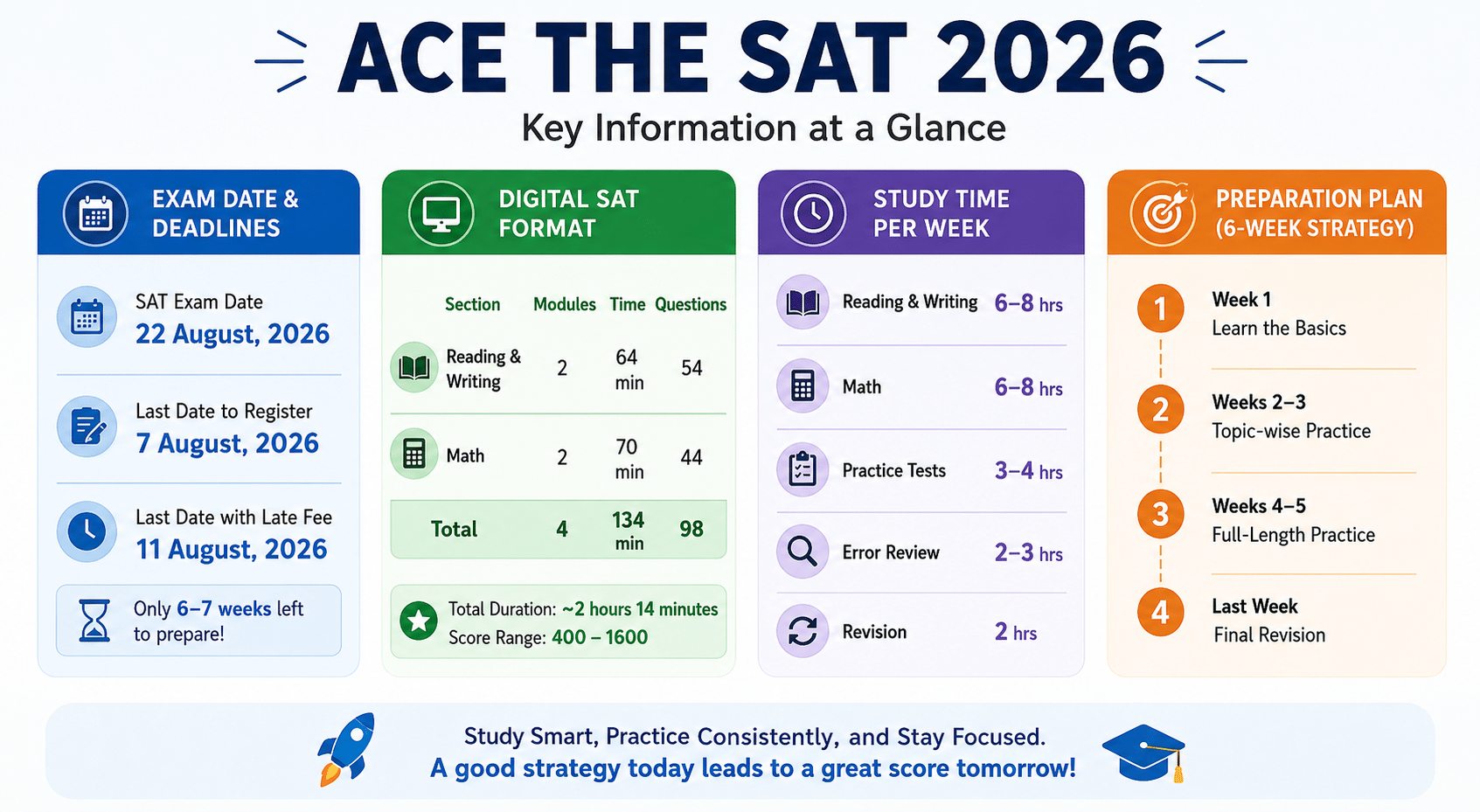
The SAT exam is going to take place on 22nd August, 2026. The last date for registration is 7th August, 2026. The last date to register with a late fee is 11th August, 2026. The applicants are left with only 6 weeks to ace the SAT exam.
The SAT exam has 2 sections: Math and Reading & Writing. The applicants need to prepare for these sections strategically, as the time left with them is too little. They need to manage their weekly and daily time, giving more stress to the SAT Math section.
- How to Ace the SAT: Step-by-Step Preparation Guide 2026
- Understand the Digital SAT Format 2026
2.1 Key Features of the Digital SAT 2026
- Set Your Target SAT Score 2026
- Create an Effective SAT Study Plan 2026
4.1 Weekly Study Plan to Ace SAT Exam Syllabus 2026
- Best Strategies for SAT Reading and Writing 2026
- SAT Math Tips to Improve Accuracy 2026
- Time Management Techniques for the SAT 2026
- Common SAT Mistakes and How to Avoid Them 2026
- FAQs
How to Ace the SAT: Step-by-Step Preparation Guide 2026
Scoring well in the SAT exam is not about studying for long hours, but it is about studying smart. The Digital SAT introduced by the College Board focuses on analytical thinking, reasoning, and problem-solving rather than memorization.
The Digital SAT is adaptive in nature, this means that the difficulty level in module 2 of the SAT exam depends on your performance in module 1. A structured preparation strategy can help you significantly improve your score.
- Step 1: Understand the SAT Exam Pattern- Before beginning your preparation, learn the Digital SAT format, including the sections, question types, scoring system, and adaptive testing. Knowing the exam structure helps you create an effective study strategy.
- Step 2: Set a Realistic Target Score- Research the SAT score requirements of the universities you wish to apply to. Having a clear target score keeps you motivated and helps you track your progress.
- Step 3: Take a Diagnostic Test- Attempt an official full-length SAT practice test before studying. This will identify your strengths and weaknesses in Reading & Writing and Math.
- Step 4: Create a Study Plan- Prepare a weekly study schedule that includes concept learning, topic-wise practice, full-length mock tests, and revision. Consistency is more important than studying for long hours occasionally.
- Step 5: Use Official SAT Resources- Rely on official materials such as the Bluebook™ app, College Board Question Bank, and Khan Academy. These resources contain questions that closely match the actual Digital SAT.
- Step 6: Practice Regularly- Solve questions every day instead of studying only on weekends. Regular practice improves speed, accuracy, and confidence.
- Step 7: Review Every Mistake- After each practice test, spend time understanding why you answered incorrectly. Learning from mistakes is one of the fastest ways to improve your score.
- Step 8: Take Full-Length Mock Tests- Practice under actual exam conditions to improve time management and reduce test-day anxiety.
- Step 9: Revise Weak Areas- Spend additional time on topics where you consistently lose marks instead of repeatedly solving questions you already know.
- Step 10: Prepare for Test Day- Know what to carry, reach the test center early, and get enough sleep before the exam.
Understand the Digital SAT Format 2026
Understanding the SAT exam pattern is the first step toward effective preparation. The Digital SAT uses a multistage adaptive format, meaning the difficulty level of the 2nd module depends on your performance in the 1st module.
| Section | Modules | Time | Questions |
|---|---|---|---|
| Reading and Writing | 2 | 64 minutes | 54 |
| Math | 2 | 70 minutes | 44 |
| Total | 4 | 134 minutes | 98 |
Key Features of the Digital SAT 2026
- Fully computer-based exam
- Multistage adaptive testing
- Shorter passages with one question each
- Built-in graphing calculator for the entire Math section
- Faster score reporting
- Approximately 2 hours 14 minutes in duration
- Total score ranges from 400-1600
Set Your Target SAT Score 2026
Applicants appearing for the SAT exam in August 2026 should practice and prepare according to the scores required for admission. Applicants must check the score requirements of the last admission cycle and should aim 100 or 200 points above the last cutoff.
Applicants are advised to visit the official website of their desired universities and check the score requirements. Aim higher than the required score. Prepare accordingly for admission in the upcoming winter intake.
Create an Effective SAT Study Plan 2026
The next SAT exam is scheduled for 22nd August, 2026. The last date for registration is 7th August, 2026 (with a late fee: 11th August, 2026). The students are left with only 6-7 precious weeks to prepare for the SAT exam.
Follow this 6-week strategy to ace the SAT exam 2026:
| Weeks | Focus | Practice Areas |
|---|---|---|
| Week 1 | Learn the Basics |
|
| Weeks 2-3 | Topic-wise Practice |
|
| Weeks 4-5 | Full-Length Practice |
|
| Last Week | Final Revision |
|
Weekly Study Plan to Ace SAT Exam Syllabus 2026
With less than 2 months until the SAT, each week is precious for preparation. Follow this weekly hours distribution to practice the SAT practice papers.
| Activity | Hours per Week |
|---|---|
| Reading & Writing | 6-8 |
| Math | 6-8 |
| Practice Tests | 3-4 |
| Error Review | 2-3 |
| Revision | 2 |
Best Strategies for SAT Reading and Writing 2026
The Reading and Writing section of the SAT is considered to be easy compared to other English proficiency tests. However, if applicants don’t practice for it, this might impact their overall SAT scores.
Follow these tips and strategies to get good scores in the SAT Reading and Writing section:
- Read the Question First: Read the question before reading the passage. This helps you focus on the information needed to answer correctly.
- Focus on the Main Idea: Identify the main point of the passage instead of reading every detail. This makes it easier to answer comprehension questions.
- Use Evidence from the Passage: Choose the answer that is directly supported by the passage. Avoid making assumptions that are not mentioned in the text.
- Learn Common Grammar Rules: Review grammar topics like punctuation, subject-verb agreement, pronouns, and verb tense. These concepts appear frequently in the SAT.
- Improve Vocabulary in Context: Understand how words are used in a sentence instead of memorizing definitions. Reading newspapers and books regularly can improve this skill.
- Eliminate Incorrect Answers: Cross out answer choices that are clearly wrong before selecting your final answer. This improves your chances of choosing the correct option.
- Practice Every Day: Solve Reading and Writing questions daily to improve speed and accuracy. Consistent practice builds confidence before the exam.
- Review Your Mistakes: Check every incorrect answer after practice tests. Learning from mistakes helps you avoid repeating them on test day.
Also read: Check SAT English Preparation for Non-Native Speakers 2026
SAT Math Tips to Improve Accuracy 2026
The Math syllabus and section are a bit tricky and complex for Indian students. If the applicant is not well aware of the SAT exam pattern, they might find it difficult and score less.
Follow these strategies to improve your performance in the Math section:
- Understand the Concepts: Learn the basic concepts before solving difficult problems. A strong foundation makes complex questions easier to solve.
- Memorize Important Formulas: Remember formulas related to Algebra, Geometry, Trigonometry, and Statistics. Knowing them saves time during the exam.
- Read Questions Carefully: Pay attention to words like NOT, EXCEPT, and maximum. Missing these keywords can lead to careless mistakes.
- Solve Step by Step: Complete each calculation carefully instead of rushing. This reduces errors and improves accuracy.
- Use the Calculator Smartly: Use the built-in graphing calculator only when necessary. Mental calculations are often faster for simple questions.
- Practice Different Question Types: Solve questions from every Math topic instead of focusing only on your strengths. This prepares you for the full exam.
- Check Your Answers: If time is left, review your calculations before submitting the test. Even a quick review can help you catch simple mistakes.
- Maintain an Error Log: Write down the questions you answered incorrectly during practice. Revisiting these mistakes helps strengthen weak areas.
Also read: Download SAT 2026 Math Practice Tests and Maths SATs Questions
Time Management Techniques for the SAT 2026
- Practice Under Timed Conditions: Take full-length mock tests using the official time limits. This helps you become comfortable with the pace of the SAT.
- Don't Spend Too Long on One Question: If a question seems difficult, move on and come back later if time permits. This prevents you from losing valuable time.
- Answer Easy Questions First: Complete the questions you find easier before attempting harder ones. This helps you secure marks quickly and boosts confidence.
- Monitor Your Time: Keep an eye on the clock throughout each module. Staying aware of your pace helps you finish all the questions.
- Use the Process of Elimination: Remove answer choices that are obviously incorrect before making your final selection. This increases the chances of choosing the right answer.
- Stay Calm During the Exam: Do not panic if you face a difficult question. Stay focused and continue with the rest of the test.
- Build Speed Through Practice: Solve practice questions regularly to improve both speed and accuracy. The more you practice, the more comfortable you become with the exam format.
- Avoid Last-Minute Guessing: Leave a few minutes at the end of each module to review your answers. A quick check can help you correct careless mistakes.
Also read: Check How to Effectively Manage Your SAT Preparation Time 2026
Common SAT Mistakes and How to Avoid Them 2026
While preparing for the SAT, Indian students often overlook the basic preparation strategy. This often leads to common mistakes such as poor time management and being unable to perform well in module 2, as they perform too well in module 1. This makes the 2nd module difficult.
Here are some common mistakes students make and how to avoid them for the SAT August 2026:
| Common Mistake | How to Avoid It |
|---|---|
| Skipping the exam pattern | Learn the Digital SAT format before studying |
| Ignoring official practice tests | Use Bluebook and College Board materials regularly |
| Poor time management | Practice under timed conditions every week |
| Guessing without eliminating options | Remove incorrect choices first |
| Not reviewing mistakes | Maintain an error log after every mock test |
| Ignoring weak topics | Spend extra time improving weaker concepts |
| Taking too few mock tests | Attempt several full-length practice tests before the exam |
| Studying only before the exam | Follow a consistent weekly study schedule |
| Overusing the calculator | Solve simple calculations mentally whenever possible |
| Losing confidence after difficult questions | Stay focused and continue with the remaining questions |
Also read: Check SAT Preparation Guide 2026
With only 6-7 weeks left for the SAT on August 22, 2026, a well-planned preparation strategy can make a significant difference in your score. Focus on understanding the Digital SAT format, follow a consistent weekly study plan, and practice full-length mock tests to improve accuracy and time management. Regular revision and learning from your mistakes will help you achieve your target SAT score and strengthen your university applications.
FAQs
Ques. What is the best way to prepare for the Digital SAT 2026?
Ans. The College Board recommends preparing with official Digital SAT practice resources, including the Bluebook™ app and full-length practice tests. Students should also review their performance and focus on improving weak areas
Ques. Is the SAT adaptive?
Ans. Yes. The Digital SAT uses a multistage adaptive format. Your performance in the first module determines the difficulty level of the second module within each section.
Ques. Can I use a calculator throughout the SAT Math section?
Ans. Yes. The Digital SAT includes a built-in graphing calculator that is available throughout the entire Math section. Students may also bring an approved calculator if they prefer.
Ques. What happens if I do not have a device for the Digital SAT?
Ans. If you do not have an approved device for an SAT Weekend test and cannot borrow one, you can request a device from the College Board during registration. Device requests must be submitted at least 30 days before the test date.
Ques. How many questions are there on the Digital SAT?
Ans. The Digital SAT contains 98 questions in total. There are 54 questions in the Reading and Writing section and 44 questions in the Math section.
Ques. Is there negative marking on the SAT?
Ans. No. The College Board does not deduct marks for incorrect answers. Students should answer every question because there is no penalty for guessing.
*The article might have information for the previous academic years, which will be updated soon subject to the notification issued by the University/College.



Comments