



Content Curator
Scandium was discovered by Lars Fredrik Nilson, a Swedish chemist, in the year 1879. He was trying to make pure ytterbia from 10 kilograms of the mineral euxenite ((Y, Ca, Ce, U, Th)(Nb, Ta, Ti)2O6). Scandium is generally found in the minerals such as thortveitite ((Sc, Y)2Si2O7), bazzite (Be3(Sc, Al)2Si6O18), and wiimote. However, the most common method of obtaining Scandium is as a byproduct of uranium refinement. Scandium is a soft, light metal that could be useful in aerospace applications. Scandium is too expensive for general use.
Read More: Bravais Lattices
What is Scandium?
Scandium is also one of the most expensive elements due to its scarcity and limited manufacture. Pure scandium can cost up to $7000 per kilogram and sometimes even more. Scandium chloride is a poisonous chemical with a fatal dose. As a result, this chemical, as well as other scandium compounds, should be treated with caution because they have moderate toxicity.
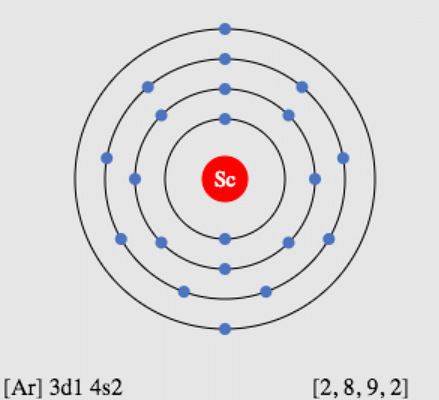
Scandium
Scandium is extracted from a rare mineral found in Scandinavia. When it is exposed to air, it takes on a yellowish or pinkish hue. Scandium tarnishes easily and burns easily if light, which is one of its properties. It will also dissolve in acids and interact with hydrogen gas.
Scandium is produced by heating scandium fluoride (ScF3) with calcium metal. In a home, this rare chemical can be found in glasses, energy-saving bulbs, fluorescent lighting, and televisions. Scandium has been demonstrated to minimize solidification cracking in high-strength aluminum alloys when they are welded. Scandium is becoming more popular, as is the use of a well-suited catalyzer for glass polishing. The aerospace industry and sports equipment are the principal applications for aluminum scandium alloys (like baseball, bikes, etc.) Scandium is a rare element and is only found in little amounts in nature. It is the 50th most prevalent element on the planet, and it may be found in trace amounts in over 800 minerals. Only 50 kilograms of goods will be produced per year.
Read More:
Characteristics of Scandium
- Scandium is thought to have a low toxicity
- Scandium is a soft, light silvery-white metal that when exposed to air takes on a little yellow or pink tint.
- Scandium is near as light as aluminum (low density), but it has a much higher melting point.
- As a result, it has the potential to be utilized in airplanes as a specialized material - scandium will not be employed in general because it is considerably more expensive than aluminum.
- Scandium interacts with a wide range of acids.
- Scandium is commonly found in the trivalent state, Sc3+, in compounds.
- It has a white oxide and the majority of its salts are colorless.
Also Read:
Isotopes of Scandium
Scandium contains 13 isotopes with known half-lives, ranging in mass from 40 to 52. Scandium only has one stable isotope, 45Sc, which is found naturally. Scandium only appears in nature as scandium-45, a stable isotope. Scandium-46 (half-life of 83.79 days) is the most stable of 25 radioactive isotopes with masses ranging from 36 to 61 (excluding nuclear isomers). Scandium-39 is the least stable (half-life of fewer than 300 nanoseconds).
Read More: Clemmesen Reduction Reaction
Scandium Properties
- The mass number of scandium is 44.96 u, which is one of its most essential features. Scandium is found in the periodic table's Group 3, Period 4, and d-block. Scandium has 21 protons and 24 neutrons in its atomic structure. Scandium, being a metal, also has electronegativity qualities. Scandium has a comparatively high electronegativity of 1.36.
- Scandium in the +3 oxidation state is often found on Earth. Scandium has a strong resemblance to other rare metals on Earth when it is in its oxidation state. Some of the behavior and features of scandium are unique among earth elements due to its short ionic radius. Scandium, in its ionic form, is a relatively powerful acid and has a higher tendency to produce complexions for the same reason.
Read More: Cracking
Physical Properties of Scandium
Scandium has several unique features that set it apart from other elements. The following are scandium's physical and chemical properties:
- A silvery-white metal appears to be present.
- It has a medium-soft feel.
- Scandium oxidizes in the atmosphere.
- It's also flammable.
- Scandium is a metal that reacts with water.
- Scandium's electrical configuration is Ar3d14s2.
- The metal's melting point is 1541oC.
- The metal's boiling point is 2836oC.
- The density of scandium is 2.99 grams per cubic centimeter.
Uses of Scandium
- Due to its restricted availability and expensive pricing, this transition metal is thought to have only a few applications.
- Because of its high melting point and low density, it is mostly utilized as an alloying agent in the category of metals (lightweight) for high-performance and military applications.
- Apart from that, this metal is commonly employed as an alloy addition in aluminum-based alloys for the production of high-intensity metal halide lamps and athletic goods.
- Scandium, when alloyed with aluminum and aluminum-based alloys, would reduce high-temperature grain development.
Read More: Specific Heat of Water
Extraction of Scandium
Scandium can be harvested in two different ways.
- The first method is to extract it as a by-product of uranium mill tailings.
- The second way to make scandium is to electrolyze molten scandium chlorides, lithium, and potassium using electrodes made of molten zinc and tungsten wire.
Read More:
Points To Remember
- Scandium is the 50th most plentiful metal on the planet.
- The half-lives of most scandium isotopes are less than two minutes.
- Scandium's color changes to yellow or similar to yellow when it is in an oxidation state, such as Sc2O3. It has a 3+ valency.
- The only concentrated sources of the element are euxenite, gadolinite, and thortveitite. Thortveitite is a scandium silicate with the highest scandium content, at 34 percent. This mineral, like scandium, is extremely rare on Earth.
- Lars Fredrik Nilson, the metal's discoverer, named it after Scandinavia in 1879.
- 99.9% of the metal was not separated until 1960.
- Metal is the planet's fiftieth most prevalent element.
Read More: Standard Hydrogen Electrode
Sample Questions
Ques 1. What is unique about Scandium? (2 marks)
Ans. Scandium is near as light as aluminum (low density), but it has a much higher melting point. As a result, it has the potential to be utilized in airplanes as a specialized material - scandium will not be employed in general because it is considerably more expensive than aluminum. Scandium interacts with a wide range of acids.
Ques 2. Does scandium burn easily? (1 mark)
Ans. A silvery metal that tarnishes in the presence of air, burns easily and interacts with water. Scandium is mostly utilized in scientific research.
Ques 3. What happens when scandium is exposed to air? (1 mark)
Ans. When exposed to air, scandium oxidizes, resulting in a yellow or pink coloration due to the production of scandium oxide on the surface.
Ques 4. How does scandium react with water?
Ans. Scandium metal dissolves in water when finely divided or heated, forming solutions containing the aquated Sc(III) ion and hydrogen gas, H2.
Read More: Weak Base
Ques 5. How does scandium affect the environment? (2 marks)
Ans. Scandium will progressively build in soils and water soils, resulting in higher levels of the element in humans, animals, and soil particles. Scandium induces cell membrane disruption in water animals, which has a number of severe effects on reproduction and nervous system activities.
Ques 6. Does Scandium Have Isotopes? (3 marks)
Ans. Yes, there are isotopes of the element scandium. The element has thirteen (13) different isotopes. Scandium exists in the form of an isotope, 45Sc, which is found in nature. The mass number of these scandium isotopes ranges from 40 to 52. Furthermore, these isotopes' half-lives are known. Scandium possesses radioisotopes as well. So far, twenty-five radioisotopes have been discovered. 46Sc is the most stable radioisotope, with an 83.8-day half-life. 47Sc, 47S,c, and 44Sc are the other common scandium radioisotopes, with half-lives of 3.35 days, 43.7 hours, and 3.97 hours, respectively.
Ques 7. Does scandium conduct heat? (1 mark)
Ans. The thermal conductivity of Scandium is 15.8 W
Ques 8. What are the Common Uses or Applications of the Element Scandium? (5 marks)
Ans. Scandium is a versatile element that can be employed in a range of applications. Some of these applications are listed below:
- Scandium is frequently utilized in scientific studies.
- Scandium is often used as an alloy with aluminum due to its low density and high melting point.
- Fighter jets, high-end bicycle frames, baseball bats, and other military and high-performance applications can all benefit from it.
- Scandium iodine is another popular alloy. Mercury vapor lamps include this alloy. These lights can simulate sunshine in studios, such as those used in the film and television industries, thanks to a scandium alloy.
- Scandium is also employed in the oil refining sector as the radioactive isotope scandium-46.
Ques 9. How is scandium separated? (2 marks)
Ans. Separating scandium from REE necessitates a series of solvent extraction methods followed by precipitation, commonly using oxalic acid. The scandium oxide is then formed by heating the precipitate. REE ores are frequently found in combination with other precious elements as Nb, Ta, and In.
Also Read:



Comments