



Content Writer
Clemmensen Reduction Reaction is used for the reduction of aldehydes or ketones to alkanes with the use of concentrated hydrochloric acid (HCl) and Zinc Amalgam (Zn/Hg alloy). It was named after Erik Christian Clemmensen when he first reported this in 1913.
| Table of Content |
Keyterms: Aldehydes, Ketones, Alkanes, Hydrochloric acid, Zinc Amalgam, electrons, acylation, acyl benzene, alkylbenzene
What is Clemmensen Reduction Reaction?
[Click Here for Sample Questions]
Reaction used for the reduction of aldehydes or ketones to alkanes is known as Clemmensen Reduction Reaction. In a reduction reaction, there is a loss of oxygen atoms from the molecule or gain of electrons.
Clemmensen Reduction Reaction is immensely useful for aryl-alkyl ketones reduction, formed in Friedel Crafts acylation. Acyl Benzene is formed from acylation with the help of Friedel-Crafts acylation. Clemmensen reduction reaction is used for transformation of acyl benzene to alkylbenzene and likewise, reduction of other ketones or aldehydes.

Clemmensen Reduction Reaction
Examples: In the given examples, when acetophenone and benzaldehyde react with a reducing agent (Zn(Hg) & HCl), they form respective hydrocarbons, i.e., ethylbenzene and methylbenzene.
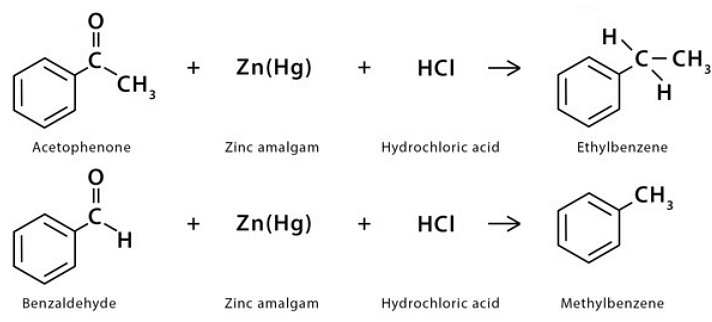
Clemmensen Reduction Reaction
Also Read:
Clemmensen Reduction Reaction: Mechanism
[Click Here for Sample Questions]
Clemmensen reduction reaction mechanism says that when aldehydes and ketones react with zinc amalgam and concentrated hydrochloric acid, then a hydrocarbon is formed due to deoxygenation. The reduction reaction happens on the zinc surface. We still do not have a firm mechanism but two proposals are made as given below:
Carbanionic Mechanism
Carbanionic mechanism is said to have a direct reaction on protonated carbon by zinc.
Carbenoid Mechanism
In the carbenoid mechanism, the reactions on the metal surface of zinc reduce and take place on the surface of the zinc catalyst. This is a radical process.
In the mechanism of Clemmensen reduction reactions, intermediacy of zinc is followed. Deoxygenationation of ketones and aldehydes takes place to form corresponding hydrocarbons. The substrate in this reaction has to be stable strong acid. The Clemmensen reduction is complementary to the Wolff-Kishner reduction, which is performed under very simple conditions.
The reaction equations given below explains Clemmensen Reduction reaction:

Carbenoid Mechanism
Wolf Kishner Reaction is similar to Clemmensen Reaction in following ways:
- Wolf Kishner Reaction involves heating of carbonyl compounds with hydrazine and potassium hydroxide to form alkanes. It is done in boiling solvents like ethylene glycol or diethylene glycol.
- Clemmensen Reaction involves reaction of carbonyl compounds and hydrazine to form hydrazones to finally form alkanes after heating.
Wolf Kishner Reaction is different to Clemmensen Reaction in following ways:
- Wolf Kishner Reaction involves conversion of carbonyl compounds to methylene compounds.
- Clemmensen Reaction involves conversion of ketones or aldehydes into alkanes.
Applications of Clemmensen Reduction
[Click Here for Sample Questions]
- Organic compounds can prepare alkane from alkenyl chloride (halide) which can be further create alkenyl halide
- Conversion of carbonyl group into methyl group
- Polycyclic aromatics and aromatics with unbranched side hydrocarbon chains are made.
- Reduction of aliphatic and mixed aliphatic-aromatic carbonyl compounds.
- Transformation of acyl benzene to alkyl benzene.
Things to Remember
- Reaction used for the reduction of aldehydes or ketones to alkanes is known as Clemmensen Reduction Reaction.
- Clemmensen Reduction Reaction is immensely useful for aryl-alkyl ketones reduction and transformation of acyl benzene to alkyl benzene.
- There are two types of mechanisms proposed for Clemmensen Reduction Reactions- Carbanionic mechanism and Carbeniod mechanism
Also Read:
Sample Questions
Ques 1. Which catalyst is used in chemical reduction reactions and why? (2 marks)
Ans. Zinc catalyst is used in chemical reduction reactions. Alcohols are not postuated as intermediates because in this type of reaction, alcohols cannot form alkanes. Clemmensen reaction includes reduction of ketones or aldehydes in the presence of zinc amalgam and concentrated hydrochloric acid.
Due to this reacting agent, we get release of hydrogen gas. Zinc amalgam traps this active hydrogen and attacks carbonyl compounds instead of hydrogen gas.
Ques 2. Does the Clemmensen Reduction Reaction reduce alcohol? (1 mark)
Ans. Clemmensen Reduction Reaction reduces aryl-alkyl ketones, produced by Friedal-crafts acylation reactions. These alcohols are also firstly converted into benzyl and allylic chlorides/
Ques 3. Does the Clemmensen Reduction Reaction reduce double bonds? (1 mark)
Ans. In a double bond, 2 electron pairs are shared between 2 atoms. As the Clemmensen reaction takes place in the presence of zinc amalgam and hydrochloric acid, there is a possibility that it can accidentally chlorinate a double bond.
Ques 4. Clemmensen reduction of ketone is carried out in the presence of which of the following? (1 mark)
Zn-Hg with HCl
LiAlH4
H2 and Pt as catalyst
Glycol with KOH
Ans. Clemmensen reduction reaction of ketone is carried out in the presence of Zn-Hg with HCl. Zn-Hg + HCl is the reducing agent.
>C = O + Zn-Hg + HCl → >CH2
Ques 5. How is Toluene formed by Clemmenson reduction reaction? (1 mark)
Ans. Clemmensen Reduction Reaction takes place on Benzaldehyde in the presence of zinc amalgam and concentrated hydrochloric acid to form Methyl Benzene, also known as Toluene.
Ques 6. How do you prepare zinc amalgam? (1 mark)
Ans. ZInc amalgam is prepared by mixing zinc metal (Zn) with mercury (Hg).
Ques 7. Is it possible to separate aldehydes and ketones from clemmensen reduction? (1 mark)
Ans. No, it is not possible to separate aldehydes and ketones by clemmensen reduction.
The reason being both ketone and aldehydes react with reacting agents zinc amalgam and concentrated hydrochloric acid forming hydrocarbons. You will also notice that there are no changes seen during or after reaction.
For Latest Updates on Upcoming Board Exams, Click Here: https://t.me/class_10_12_board_updates
Check-Out:



Comments