



Content Writer
The scientific method is a process that is frequently employed by scientists and researchers and that aids them in investigating, verifying, or even occasionally creating an accurate and authentic representation of natural events. In a nutshell, it is a technique designed to gather relevant information and further scientific research.
- The scientific method is a process designed to gather information and advance the study of science.
- Involves a number of steps, primarily the first 8 steps of the scientific process.
- Since the 17th century, this method has been used to advance science.
- The scientific process calls for utilizing observation skepticism since presumptions might distort what we see.
Researchers and scientists use observation to further their theories and conduct numerous experiments related to them. Scientific inquiry is utilized to build a flawless framework for scientific procedures. Scientific results can be both positive and negative when using scientific procedures. There are various actions that must be taken in order to use this strategy.
Read more: Scientific Investigation
| Table of Content |
KeyTerms: Scientific method, Analyzing data, Scientific research, Objectives, Hypothesis, Initial observation
What is Scientific Method?
[Click Here for Sample Questions]
A process used by scientists to investigate, confirm, or develop an accurate and reliable model of any natural event is known as the scientific method. They are carried out by developing an objective framework for scientific inquiry, analyzing the findings objectively, and drawing a conclusion that either confirms or disproves the initial observation.
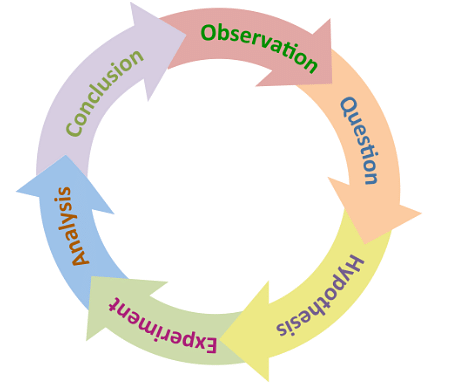
Scientific Methods
- In other words, when a correct investigational approach is used to learn something new about any subject, the procedure is known as the scientific method.
- Any inaccurate or misleading information can cause this entire procedure to be completed incorrectly, changing the outcome.
- Although diverse topics require different strategies and techniques, the fundamental steps will always be the same.
Read more:
| Relevant Concepts | ||
|---|---|---|
| The Scientific Method | Types of events | Scientific Notation formula |
| Methods of Separation | Theoretical Yield Formula | Exponent Rules |
Who invented the Scientific Method?
[Click Here for Sample Questions]
The scientific method was not created by a single individual. It is the outcome of centuries' worth of discussions and disagreements about the best way to learn how the world functions.
One of the first to promote using observation and logic to understand how nature functions was the Greek philosopher Aristotle. Hasan Ibn al-Haytham, an Arab mathematician and physicist, is credited with being the first to discuss the value of experimenting in writing.
Throughout the ages, numerous scientists, including Galileo Galilei, Francis Bacon, Isaac Newton, John Hume, John Stuart Mill, and Thomas Aquinas, have written about the optimal way to conduct science, which has contributed to our current knowledge of the scientific process. The scientific method is constantly changing as modern researchers look into new methods and fields of study.
Read more:
| Relevant Concepts | ||
|---|---|---|
| Uncertainty in Measurement | Analytical Chemistry | Physical and Chemical Classification of Matter |
| Three States of Matter | Mechanical Properties of Fluids | Law of Multiple Proportions |
Scientific Method Steps
[Click Here for Sample Questions]
All scientific approaches have the same objective, which is to analyze the initial observation. Nevertheless, different actions are taken as needed for any specific observation. However, there is a standard progression of steps in scientific procedures. All sciences, including biology, physics, chemistry, geology, and psychology, employ the scientific method. However, because problem-solving is at the basis of all sciences, their fundamental approaches to discovering rational and evidence-based solutions are similar.
Step 1: Observation and formulation of a question:
In a scientific method, this is the initial stage. Any phenomenon or aspect of the universe that may be observed must first be noted, and only then can a question be raised. One can assume "Why is the sky black at night?" or "Why is air invisible?" as examples.
Step 2: Data Collection and Hypothesis:
The next phase in the scientific process is to compile all pertinent information and develop a hypothesis based on the observation. The theory might explain the origin of the phenomenon, how it manifests, or how it relates to other phenomena. Any hypothesis must be put to the test before any form of inference is made. This makes this the most crucial phase in scientific methodology. It requires scientific testing, which is done by scientists using straightforward experiments (Firman, Baedhowi & Murtini, 2018). The goal of doing this is to determine whether the hypothesis agrees or to produce a statement that contrasts with the observation. This stage and the experiments are absolutely necessary for the hypothesis to advance.
Step 3: Testing the hypothesis:
The hypothesis must next be put to the test scientifically. Experiments are used by scientists to accomplish this. These tests are designed to see if the hypothesis supports or refutes the observations made in the real world. Depending on the outcomes of the trials, the degree of confidence in the hypothesis rises or falls.
Step 4: Analysis and Conclusion:
In this step, the experiment's outcomes are determined using appropriate mathematical and other scientific techniques. The study can be used to determine the best course of action moving forward. The hypothesis is accepted if the evidence from the analysis supports it. If not, it is discarded or changed before being reanalyzed.
It is important to keep in mind that one experiment cannot establish or disprove a hypothesis. Once there are no more inconsistencies between the data and the result, it must be repeated. It is recognised as a "theory" when there are no contradictions and the hypothesis is proven.

Scientific Method Steps
Read more:
| Relevant Concepts | ||
|---|---|---|
| Period of function | Difference between hypothesis and theory | Function notation formula |
| Set operations | Types of data analytics | Probability |
Scientific Method Examples
[Click Here for Sample Questions]
Here we provide an example for better understanding of the steps of the Scientific Method:
Situation:- Growing of a normal bean plants

Bean Plant
- Purpose: The main goal of this experiment is to determine whether the bean plant should be kept indoors or outside to monitor its growth rate over a period of four weeks.
- Construction of hypothesis: According to the underlying concept, if scientific methods are applied, the bean plant can grow anyplace.
- Executing the hypothesis and collecting the data: Using the same soil, four bean plants are sown in matching pots. The other two are situated outside, with two put inside. The amount of water and the amount of solar exposure are both identical parameters. All four plant sizes are measured after four weeks have passed.
- Analyze the data: To ascertain whether the environment is more conducive to growing the bean plants, the average height of plants from both locations should be considered while analyzing the data.
- Conclusion: After analyzing the facts, a conclusion is reached.
- Results: Results can be presented in a tabular format for reporting.
Things to remember
- The scientific method is a technique used by scientists to examine, verify, or create a precise and accurate model of any natural occurrence.
- Scientific results can be both positive and negative when using scientific procedures.
- Any hypothesis must be put to the test before any form of inference is made.
- It's critical to remember that a hypothesis cannot be proved correct or false by a single experiment.
- The hypothesis is accepted if the evidence from the analysis supports it.
- The scientific method is a process designed to gather information and advance the study of science.
Sample Questions
Ques. Do researchers adhere to the scientific method? (2 marks)
Ans. Yes, although not precisely how it is said in theory. Scientists test hypotheses and theories using the fundamental tenets of the scientific method, which include observations, experimentation, and data analysis. They use the scientific method, though not necessarily exactly as it is described in the orderly steps that are taught in class. Scientists can alter the scientific process by omitting certain phases, repeating others, or switching back and forth between them since they work under less-than-ideal circumstances.
Ques. What is the hypothesis? (2 marks)
Ans. An assumption based on some evidence is known as a hypothesis. This is where any investigation must begin in order to convert the research questions into forecasts. Variables, the population, and the relationships between the variables are among its constituent parts. A hypothesis used to examine the link between two or more variables is known as a research hypothesis.
Ques. Give an example of a simple hypothesis. (1 mark)
Ans. Obesity is caused by consuming sugary beverages on a regular basis. A simple hypothesis would be like this.
Ques. Define complex hypotheses. (1 mark)
Ans. The relationship between two or more dependent variables and two or more independent variables is demonstrated by a complicated hypothesis.
Ques. Examples of any Hypothesis. (3 marks)
Ans. According to their types, some instances of hypotheses are:
- Simple Hypothesis – Obesity is caused by consuming sugary beverages on a daily basis.
- Null Hypothesis – The null hypothesis states that all lilies have six petals.
- Directional Hypothesis – A person will feel less tired if they sleep for 7 hours than if they sleep for fewer hours.
Ques. What do scientific methods seek to accomplish? (1 mark)
Ans. All scientific methods have the same objective, which is to analyze the initial observation, but different steps are taken depending on the circumstances of any given observation.
Ques. Who created scientific methods? (1 mark)
Ans. Scientific methods were not invented by anyone; it is the product of years of debate and investigation.
Ques. What are the steps in scientific methodology? (2 marks)
Ans. In the course of using scientific procedures, there are four different types of steps. They consist of observation, asking questions, gathering data, analyzing that data, coming to a hypothesis, and drawing a conclusion.
Ques. How are scientific research and scientific techniques related? (1 mark)
Ans. Scientific methods are the fundamental approach that a scientist takes in order to advance a scientific inquiry.
Ques. List and describe the various sorts of hypotheses. (5 marks)
Ans. There are six main types of hypotheses, and they are:
- Simple – A single dependent variable and one independent variable are shown to be related in a simple hypothesis.
- Complex – It depicts the interrelationship of two or more dependent and independent variables.
- Directional – A directional hypothesis demonstrates a researcher's intellectual acumen and dedication to a certain result.
- Non-directional - When there is no underlying theory, a non-directional hypothesis is applied. It asserts the existence of a link between two variables without speculating on its precise nature or its direction.
- Null - A statement that refutes the hypothesis is provided by the null hypothesis. There is no connection between the independent and dependent variables, making it a negative assertion. "HO" stands for the symbol.
- Associative and Causal - Their associative hypothesis will hold true if a change in one variable causes a difference in the other variable. The causal hypothesis additionally suggests a cause-and-effect relationship between two or more variables.
Check out:



Comments