



Content Curator
A seismograph is an apparatus used to track and identify earthquakes. An earthquake is a natural disaster where the Earth’s surface is seen to shake due to the abrupt release of energy in the Earth’s crust.
It causes seismic waves, which are also known as S waves, to generate. Seismic activities that occur in the area help to determine the type and intensity of the earthquake. These seismic activities occurring during the earthquake are measured by using an instrument called the Seismograph.
| Table of Content |
Key Terms: Seismograph, Seismometer, Magnitude, Intensity, Richter Scale
Read More: Four Spheres of Earth
What is Seismograph?
[Click Here for Sample Questions]
A seismograph is a device that monitors and records seismic waves that result from earthquakes as they move through the Earth.
Seismographs are typically equipped with electromagnetic sensors which translate the motion of the ground into electrical voltages.
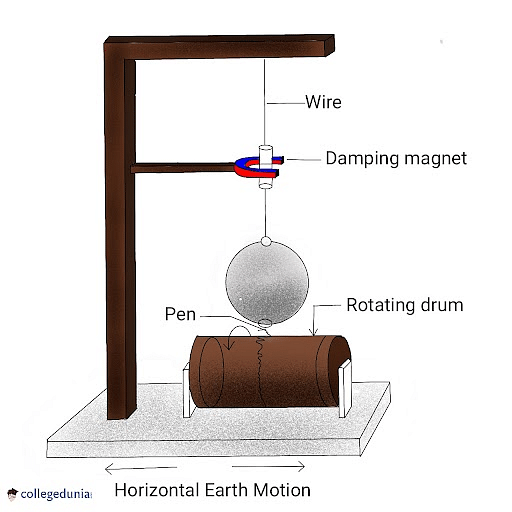
Seismograph Diagram
Seismographs have many functions outside of finding natural earthquakes. These include monitoring volcanic activity, investigating the planet's crust and lower layers, and looking for petroleum.
What is the Use of Seismograph?
A seismograph helps researchers to detect earthquakes and measure numerous aspects of it as well, including:
- The time when the earthquake occurred.
- The epicentre, which is the location on the Earth’s surface below which the earthquake occurred.
- The depth below the Earth’s surface where the earthquake occurred.
- The energy released by the quake.
While the words seismograph and seismometer are sometimes used interchangeably, the seismometer lacks the ability to record seismic occurrences, unlike the seismograph. The term "seismogram" refers to the visual record that a seismograph produces on a monitor.
What is a Seismometer?
[Click Here for Sample Questions]
Early seismic equipment, such as the seismoscope, did not record the duration of ground oscillations; instead, it only signalled that shaking had taken place.
- A seismometer is an equipment which responds to the ground noses and shaking caused by earthquakes, explosions and volcanic eruptions.
- It is typically combined with a piece of timing equipment and a recording device to form a seismograph.
- A seismometer is used to measure the seismic (ground motion) activity caused due to earthquakes.
Seismograph Example
[Click Here for Sample Questions]
The wiggly lines, as shown, represent the seismic waves a seismograph has recorded.
Most waves like these are typically so small that they are negligible in form. Most of these microseisms can be caused because of certain nearby activities, resulting due to heavy traffic or wind, or by the ocean floor’s interactions of waves.

Seismograph example
The P wave, in case of an earthquake, will be the first wiggle typically bigger than the background wiggle since the seismograph records it as the first earthquake waves. The following set of seismic waves on the given seismogram will be the S waves, which is generally more vital than the P waves.
Also Read:
| Related Topics | ||
|---|---|---|
| Difference between Cyclones and Hurricanes | Forest Conservation | Deforestation |
| Ecology and Environment | Hurricanes | P Waves |
How does a Seismograph Work?
[Click Here for Sample Questions]
A seismograph's operation is very simple. Thus,
- A heavyweight hanging from a spring above the base and a solid base make up a simple seismograph.
- A revolving drum with paper is set below to hang from the weight.
- The pen's tip makes contact with the drum.
- The weighted pen travels back and forth when there is an earthquake because seismic waves cause the drum to revolve.
- The movement on the drum is captured by the pen.
- A seismogram is a paper recording of an earthquake.
- On the earth's surface, a seismograph is mounted. The entire unit, without the mass on the spring, trembles when the earth moves.
- Due to its inertia, the heavy mass doesn't move from its current location.
- As the seismograph moves beneath the mass, the recording device on the mass captures the relative motion between itself and the rest of the instrument, capturing the ground motion.
Measurement of Earthquakes
[Click Here for Sample Questions]
A seismographic network documents earthquakes. Each seismic wave in the network gauges the local ground movement.
When a rock block slides over another during an earthquake, energy is released, causing the ground to tremble.
A wave of energy propagates outward from the earthquake hypocentre as a result of that vibration pushing the next piece of ground and causing it to shake.

Earthquake
There are several methods for measuring earthquake characteristics, including:
Magnitude
The size of an earthquake is most frequently determined by its magnitude. It is a measurement of the size of the earthquake's source and always equals one. The USGS no longer uses the Richter scale to determine the size of big, teleseismic earthquakes since it is an old technique.
The Richter scale measures the earthquake's amplitude, while other magnitude scales capture the event's components.
Intensity
The shaking and damage that earthquake causes are measured by its intensity, which varies depending on where it occurs.
Things to Remember
- A seismograph is an apparatus that is used to monitor and identify earthquakes.
- The p-waves and s-waves can be identified by studying seismographs.
- The report generated on seismographs on display or paper print is called seismograms.
- Seismic tomography is the process of creating an image of the Earth's interior using a seismometer.
Read Also:
| Chapter Related Concepts | ||
|---|---|---|
| Cyclones | Environment | Tectonic Plates |
| Atmosphere | Low Pressure and High-Pressure Systems | Greenhouse Effect and Global Warming |
Sample Questions
Ques. What distinguishes a seismometer from a seismograph? (1 Mark)
Ans. An instrument called a seismometer reacts to ground disturbances such as those brought on by earthquakes, volcanic eruptions, and explosions. A seismograph is typically made up of a seismometer, a timing device, and a recording device.
Ques. What type of data does a seismograph record? (1 Mark)
Ans. The seismograph shakes beneath a mass, which causes the recording device on the mass to capture the ground motion and the relative motion between the mass and the rest of the instrument.
Ques. How does a seismograph capture seismic information? (1 Mark)
Ans. The seismograph shakes beneath a mass, which causes the recording device on the group to capture the ground motion and the relative motion between the assembly and the rest of the instrument.
Ques. What distinguishes a Richter Scale from a seismograph? (2 Marks)
Ans. The Richter scale is a logarithmic scale, which is why it is recognised by that name. Consequently, the scale's numerals represent factors of 10. Seismographs are the tools that scientists use to measure earthquakes. This tool aims to capture ground motion during an earthquake.
Ques. Describe the Readings of a Seismograph. (2 Marks)
Ans. A seismograph produces a graph that is known as a seismogram. The energy that is recorded in a seismogram can occasionally come from an explosion or another cause, such as an earthquake. The seismograms may capture a wide range of events as well as a large number of microscopic seismic waves.
Ques. What are the functions of a seismograph and the Richter Scale? (2 Marks)
Ans. Any device that monitors ground motions, including seismic waves produced by earthquakes, volcanic eruptions, and other seismic sources, is referred to as a seismograph. The Richter scale is a measure that ranks earthquake intensity on a range of 1 to 10. The only way to use the Richter Scale is to look at the data that a seismograph offers. They are used to determine an earthquake's size, location, and duration.
Ques. How many seismographs are required to locate an earthquake's epicentre? (2 Marks)
Ans. Theoretically, we require at least 3 stations in order to pinpoint the epicentre of an earthquake. The epicentre may therefore be determined even on paper using the three circles method (also known as triangulation) within a specified range of error. We now employ more advanced techniques.
Ques. How quickly does a seismograph function? (3 marks)
Ans. A seismograph calculates the magnitude of the ground's vibrations. Through the ground, they move at the speed of sound.
- Waves may be divided into two categories waves, which are slower, and P waves are measured.
- The magnitude and location of the earthquake may be determined by understanding the variation in timing between these two waves.
Ques. How does a seismograph measure earthquakes? (5 Marks)
Ans. A seismograph consists of a light, the easily-movable pointer on a stand that travels vertically.
- One end is connected to it via a hinge, and the other end is free.
- Once it is moved, it draws back to its original location.
- The tip of the pointer, which has a marker on it, rests on a blank sheet of graph paper in the centre.
- As the paper is rolled on a cylinder that revolves, more and more blank sheets become visible.
- Different amounts of vibration would result from different earthquake intensities. As a result, the pointer's tip would travel at different speeds while also releasing the paper.
Check Out:



Comments