



Education Content Expert
Unit of Weight in Physics is Newton (N). The unit of weight is sometimes confusing as weight is measured in both the unit of force, i.e. Newton (N) as well as in the standard base unit of Kilogram (kg).
- Weight is defined as the force of gravity acting on a body.
- Thus, the unit of weight is the same as the unit of force.
- The SI Unit of Weight is Newton (N).
- Weight is measured as kg m/s2, which is equal to 1 Newton.
- Weight is commonly measured in kilograms (kg) in markets and is used to determine the heaviness of an object.
Read More: Weight Formula
Key Terms: Weight, Unit of Weight, Force, SI Unit of Weight, Newton, Gravity, Acceleration, Mass, Gravitational Force
What is Weight?
[Click Here for Sample Questions]
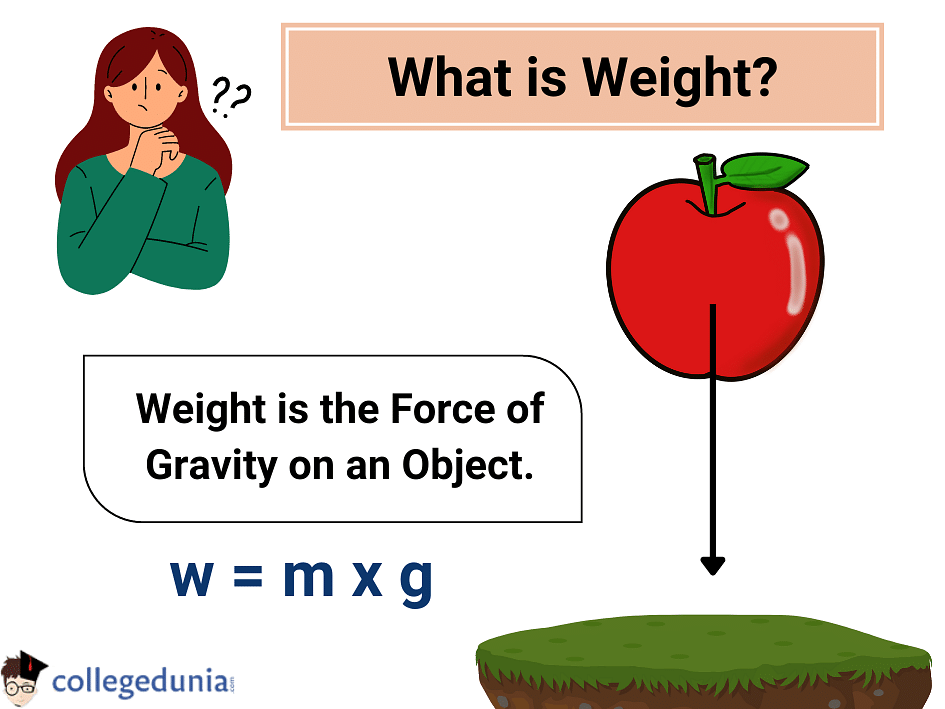
Weight is defined as the force of gravity that acts on all objects near the Earth. In general terms, it is a measure of the heaviness of an object or item. Weight is equal to the product of the mass of the object, and the acceleration due to gravity. Weight is expressed as
| w = mg |
Where
- w: Weight of the Body
- m: Mass of the Body
- g: Acceleration due to Gravity
Read More:
SI Unit of Weight
[Click Here for Previous Years' Questions]
SI units are the standard measurement units that are defined by the International System of Units.
| The SI Unit of Weight is Newton (N). |
- Weight is considered to be a force acting on an object.
- Therefore, the units of Weight and Force are the same.
- Since force is measured in Newtons, the unit of weight is also Newton (N).
- The SI unit of weight is measured in kg m/s2 which is equal to a newton (N).
Units and Measurements Video Lecture
Read More: Fundamental and Derived Units of Measurement
Other Units of Weight
[Click Here for Sample Questions]
Weight can also be measured in various other units apart from its standard unit Newton. Here are the alternative units of weight:
Dimensional Unit of Weight
The dimensional unit of weight is the product of mass, distance, and time and is expressed as MLT-2.
Here
- M refers to Mass.
- L refers to Distance.
- T refers to Time.
CGS Unit of Weight
- CGS unit refers to centimeter-gram-second.
- The CGS unit of weight is Dyne, where weight becomes 1 g cm s-2.
| \(1\:Dyne= {1\:Newton\over 10000}\) |
Base Unit of Weight
- The base unit of weight has the same value as that of the SI unit of weight.
- Thus, the base unit of weight is kg m/s2.
Apart from them, some other units of weight are pound-force (lbf), slug, and gram.
Read More: System of Units
Metric Conversion of Units of Weight
[Click Here for Previous Years' Questions]
Gram is one of the most widely accepted units of weight. The units of weight can be converted using the standard denominations mentioned below:
- 1 g = 0.001 kg
- 1 mg = 0.000001 kg = 0.001 g
- 1 centigram = 0.00001 kg = 0.01 g
- 1 metric ton = 1000 kg
Read More: Unit Conversion
Solved ExampleExample: Which object is heavier: A box with a weight of 45 Kg or A table with a weight of 4500 g? Solution: Given that.
Converting the weight of the box into grams,
So, 45000 g > 4500 g Thus, the weight of the box is heavier than the weight of the table. |
Relationship between Weight and Mass
[Click Here for Sample Questions]
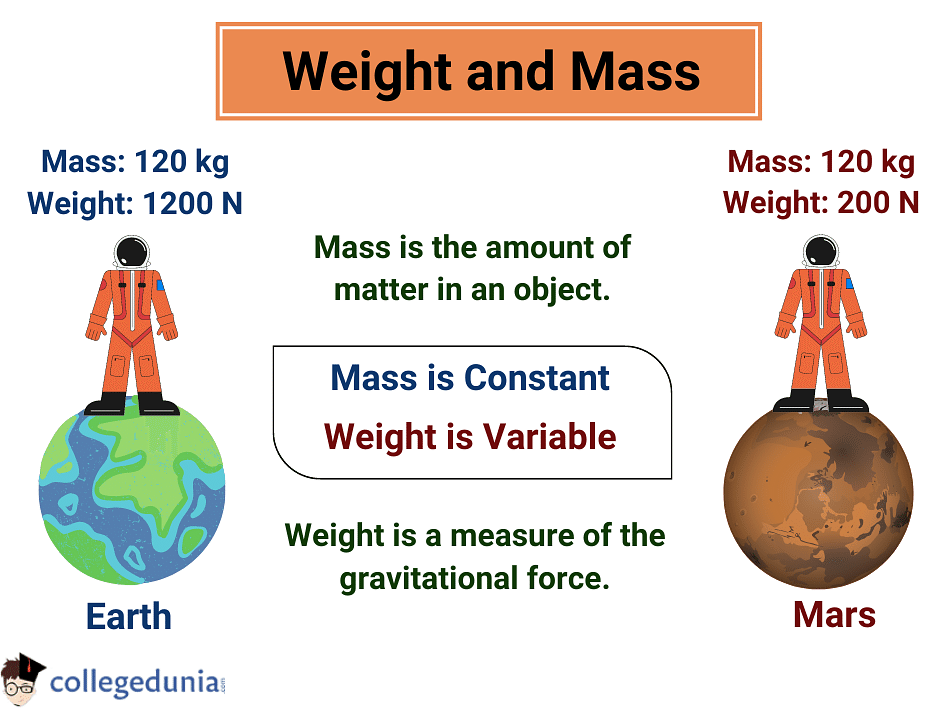
Weight is the force of gravity with which a body is attracted to Earth or other celestial bodies. Mass is the amount of matter in a body. Weight is the product of the mass of an object, and the acceleration due to gravity.
W = mg
Thus, it can be said that
| “Weight of an object is directly proportional to its mass.” |
Check More:
Difference between Weight and Mass
[Click Here for Previous Years' Questions]
Mass and Weight are interrelated terms and are often confused with each other. Both weight and mass are different physical quantities. Here is the main difference between weight and mass.
| Mass | Weight |
|---|---|
| Mass is defined as the amount of matter within an object. | Weight is the force with which an object is pulled toward the center of gravity. |
| The SI unit of mass is kilogram (kg). | The SI Unit of weight is Newton (N) |
| Mass is a scalar quantity as it has only magnitude and no direction. | Weight is a vector quantity as it has direction as well as magnitude. |
| Mass is constant irrespective of the gravitational forces. | Weight changes due to gravitational forces. |
| Mass can never be zero. | Weight can be zero in case the gravitational force is not present. |
| It is measured using beam balance, calibrated balance, or analytical balance. | It is measured using spring balance or compression balance. |
Things to Remember
- Weight is the force acting on the object due to gravity.
- It is the product of mass and acceleration due to gravity.
- Weight is expressed as w = mg, where m is the mass and g denotes acceleration due to gravity.
- The SI unit of Weight is Newton (N).
- Weight also determines the heaviness of an object and is measured in Kilograms (kg).
- Other units of weight are dyne, pound-force, slug, and gram.
- In Physics, weight is directly proportional to the mass of an object.
Previous Years’ Questions
- Weight of a body… (COMEDK UGET 2010)
- The apparent weight of a person inside a lift is… (Punjab PMET 2008)
- A body of weight 72 N moves from the surface of the earth… (NEET 2000)
- The average weight of 25 boys was calculated to be…
- A load of 1kg weight is attached to one end of a steel wire of area… (BITSAT 2008)
- Weight of a body of mass m decreases by 1 when it is raised… (KCET 2003)
- A body has a weight of 90 kg on the earth's surface, the mass… (COMEDK UGET 2004)
- Gravitational mass is proportional to gravitational… (AIIMS 1998)
- Two students X and Y report the weight of the same…
- If G is the universal gravitational constant and… (COMEDK UGET 2000)
Sample Questions
Ques. What is the SI unit of weight? (1 Mark)
Ans. The SI unit of weight is Newton (N). It is derived from the unit of force as weight is defined as the force exerted by an object. The unit is named after Isaac Newton, who was the first person to discover gravitational pull.
Ques. What is Weight? (2 Marks)
Ans. Weight is the force of gravity on the object and may be defined as the mass times the acceleration of gravity. It is expressed as
w = mg
Here, m is the mass of the object and g is the gravitational acceleration.
Ques. What is the CGS unit of Weight? (2 Marks)
Ans. Dyne is the CGS unit of weight. The CGS unit signifies centimeters-grams-second, where weight is measured as 1 g cm/s2. 1 Newton can be converted into dyne by dividing it by 10000.
Ques. What is the base unit of Weight? (2 Marks)
Ans. The base unit of weight is similar to the SI unit of weight which is kg m/s2.
Here
- kg stands for kilogram.
- m denotes meter.
- s stands for seconds.
Ques. List the other units of Weight. (1 Mark)
Ans. The other units of weight apart from the SI Unit and CGS unit are
- Pound-force (lbf)
- Slug
- Gram
Ques. State the relationship between mass and weight. (2 Marks)
Ans. Weight is given as the mass of a body multiplied by the acceleration due to gravity.
w = mg
Thus, it means that weight is directly proportional to the mass of an object.
Ques. Are the units of force and weight the same? Why? (2 Marks)
Ans. Yes, the units of force and weight are the same as weight is also a force in Physics. It is defined as the force with which the gravitational field pulls an object toward the earth's surface. Since the unit of force is Newton, thus, the unit of weight is Newton (N) too.
Ques. What is Mass? Mention the SI unit of Mass. (2 Marks)
Ans. Mass is a physical quantity that refers to the amount of matter inside an object. The mass of an object or a body is constant which means that it does not change over time due to gravitational forces.
Mass = Density x Volume
The SI unit of Mass is Kilogram (kg).
Ques. What is the main distinction between mass and weight? (2 Marks)
Ans. The main distinction between mass and weight is that mass remains constant over time and does not change as a result of gravitational forces. Weight, on the other hand, is not constant and fluctuates due to gravitational acceleration.
Ques. Can weight be zero? (2 Marks)
Ans. Yes, weight can be zero as it is dependent on gravitational forces. The gravitational force acting on a body is not uniform. The weight of an object will be zero when there will be no gravity. For instance, when a body, placed in an elevator, acts as a free fall, then the weight on a weighing machine will show zero.
Check-Out:



Comments