



Education Journalist | Study Abroad Lead
P-wave (primary wave) is one of the two major types of elastic waves, called seismic waves in seismic science. P waves travel faster than other seismic waves and are therefore the first signal from an earthquake. P seismic waves are fast-moving waves. These longitudinal waves can be propagated by both solid and liquid objects on the Earth's interior surface. Therefore, there are two types of seismic waves - body waves and surface waves. To understand the concept of P waves, we need to understand the basics of seismographs and seismic waves.
Key Terms: P waves, S waves, Seismic waves, Seismograph, Earthquakes
P Waves
[Click Here for Sample Questions]
Seismic waves are powerful waves that travel through the Earth's crust and result in earthquakes, volcanic eruptions, magma movements, massive landslides, and massive man-made explosions. The energy waves moving around the earth and causing earthquakes and other events are related to seismic waves.
P Waves
Read More:
There are two types of seismic waves:
- Body waves
- Surface waves
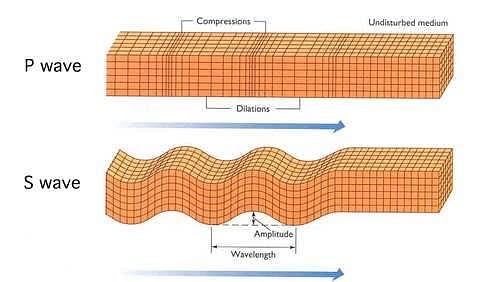
P wave is also known as the pressure wave or main wave. It is a type of elastic body wave and travels faster compared to other seismic waves. They are the first sign we have when an earthquake strikes. They can travel through solids, liquids, and gases. It is of high velocity. In addition, it is the primary wave that is recorded on the seismograph. Alternatively, the S or secondary waves reach after the P waves. S waves are slower and the average speed is 65% of P waves.

Movement of P Waves
P wave is distributed by the internal water layers of the earth. The waves recede as they pass the transition between outer liquid course and semi-solid cap. Therefore, the shadow area of the P wave is between 142 and 103 degrees.
Types of Waves
[Click Here for Sample Questions]
There are 5 types of waves:
- Body waves
- P waves (Primary waves)
- S waves (Secondary waves)
- Surface waves
- Rayleigh waves
- Love waves
- Stoneley waves

Read More:
| Related Topics | |
|---|---|
| Electromagnetic Induction | Lenz law |
| Magnetic Field | Wave Optics |
Properties of the P waves
[Click Here for Sample Questions]
- P wave is the first and foremost wave recorded on a seismograph during an earthquake.
- These are the pressure waves.
- P waves can travel in liquids and solids and gases easily.
- P waves can move inwards towards the broadcast.
- In homogeneous and isotropic solids, the P wave travels in a straight line.
- P waves are also longitudinal waves.
- Sound waves are P waves that move through the air.
Read More: Transverse and Longitudinal waves
Velocity of P waves
[Click Here for Sample Questions]
P waves produce a certain amount of pressure as they move. Solid objects vibrate with the directional axis of the wave motion. The speed of P waves during an earthquake is of velocity 5 - 8 Km/ s. Speed varies according to the interior surface of the Earth. It is less than 6 Km/s on the crust to 13.5 Km/s on the lower mantle and 11 Km/s on the inner path.

P waves through inner surface of the earth
They move around 1.8 times faster compared to the secondary wave or S waves. They can pick up sound waves in the air and can move at the speed of sound waves. However, the average speed is 334 m/s in the air. The P wavelength is estimated to be 1455 m/s in water and 5001 m/s in granite.
Read More:
| Related Topics | |
|---|---|
| Waves | Full Wave Rectifier |
| Electromagnetic Waves | Polarisation of Light |
Things to Remember
- Body waves are waves that can travel across layers of the earth.
- Body waves can travel in all conditions of an object including rocks and molten lava. However, surface waves can only travel over-land or surface.
- P waves of seismic waves are very fast and can travel in solids, liquids, or gas.
- P waves are compression waves.
- The behaviour and movement of both the P-type and the S-type waves on Earth are observed to investigate the internal formation of the Earth.
- The P wave speed during the earthquake is between 5 - 8 km/s.
Read More:
Sample Questions
Ques. What are surface waves? (2 marks)
Ans. Surface waves pass through the surface of the earth. They can be categorized by the type of surface waves which is why they are called surface waves, as they shrink as they move upwards. They are slower than earthquake waves (P and S). In severe earthquakes, surface waves may have an amplitude of certain inches.
Ques. What are rayleigh waves and love waves? (2 marks)
Ans. Rayleigh waves, also known as ground rolls, are surface waves that pass as turbulent waves. While the waves of love are horizontal and shear (SH waves).
Ques. Can human beings feel the presence of P waves? (2 marks)
Ans. Pressure waves travel the earth at varying speeds. P-wave, also known as a primary wave, is a fast wave. Because of its high speed, a person can feel a sensory movement when the wave comes close to the human body. However, dogs are exceptional in this case. As they could sense the movement of P waves much before the earthquake hit the earth’s surface.
Ques. What is the difference between the P wave and the S wave? (2 marks)
Ans.
| P wave | S wave |
|---|---|
| P wave is the first wave recorded on a seismograph. | S wave is the second wave recorded on a seismograph. |
| It can travel in solid, liquid, or gas. | It can only travel through a solid medium. |
| P waves are compression waves. | S waves are shear waves. |
| It shakes the medium in which they travel. | It shakes the medium in the perpendicular direction in which they travel. |
Ques. What is the nature of secondary waves or S waves? (2 marks)
Ans. The secondary waves (S waves) are flexible and shear. As a result of the earthquake, the S wave reaches the seismograph after the P waves. Depending on the direction of transmission, the wave can take over additional structures, for example, in the case of polarized parallel S waves, the ground moves in one direction. S waves can only travel on solid objects, and even liquids and gases do not support shear stress. S waves are much slower than P waves, and the speed is usually about 65% of those P waves.
Ques. How do P and S waves travel on the mantle and core? (2 marks)
Ans. When an earthquake occurs, seismographs can record both P and S waves, but those farther away make it difficult to detect high-frequency waves of the first S-wave. Since shear waves cannot pass through the liquid, this process was a real testament to the well-established theory that the Earth has a liquid outer core, as evidenced by Richard Dixon Oldham.
Ques. Explain the phenomena of earthquakes. (2 marks)
Ans. An earthquake is defined as any sudden movement caused by the passage of seismic waves on the core of the Earth. Seismic waves are produced when a certain type of energy stored on the Earth's crust is suddenly released, often when a massive rock mass is suddenly broken or slips. Earthquakes occur more frequently near fault lines.
Ques. What are the measures to be adopted to protect against an earthquake? (5 marks)
Ans. It is very important that we should take the necessary precautions to protect ourselves from earthquakes:
- By making use of modern building technology, one should design the buildings in seismic prone zones as ‘quake safe’ buildings.
- Mud or timber constructions should be encouraged rather than using heavy construction materials in seismic prone zones.
- All fire fighting equipment should be in working order as the buildings are prone to fire during earthquakes.
- At home, we should take shelter under a table and stay there till the earthquake stops. We should stay away from tall and heavy objects that may fall on us. If we are in bed, we should protect our heads with a pillow.
- If we are outdoors, we should find a clear spot, away from buildings, trees and overhead power lines and drop to the ground. If travelling in a car or a bus, do not come out and drive slowly to a safe spot.
For Latest Updates on Upcoming Board Exams, Click Here: https://t.me/class_10_12_board_updates
Check-Out:



Comments