



Education Journalist | Study Abroad Lead
Aromatic Hydrocarbons are circular structured unsaturated compounds consisting of a sigma bond and delocalized pi electrons between carbon atoms. Aromatic hydrocarbons are also called aryl hydrocarbons or arenes. The general chemical formula of aromatic hydrocarbons is CnHn. Some aromatic hydrocarbons consist of benzene rings termed aromatic rings. This benzene ring is stabilized through resonance, while the pi electrons get delocalized in the ring.
Key Terms: Aromatic hydrocarbons, aromatic compounds, carbon, benzene, pi electrons, Huckel's rule, aromaticity, hydrocarbons.
Explanation of Aromatic Hydrocarbons
[Click Here for Sample Questions]
Aromatic Hydrocarbons are defined as unsaturated hydrocarbons which contain one or more than one six-carbon cycle (ring) called benzene, through which hydrogens are attached. This benzene ring is stabilized through resonance, while the pi electrons get delocalized in the ring. Aromatic compounds that contain benzene rings are called Benzenoids and those not containing them are called non-benzenoids. In contrast, those aromatic hydrocarbons that do not contain benzene rings are called heteroarenes. In heteroarenes, the total number of pi electrons is 4n + 2 (Huckel's Rule), and ‘n’ is +ve integer or zero. Pyridine and Furan are common examples of heteroarenes.
Some examples of aromatic hydrocarbons are given below.
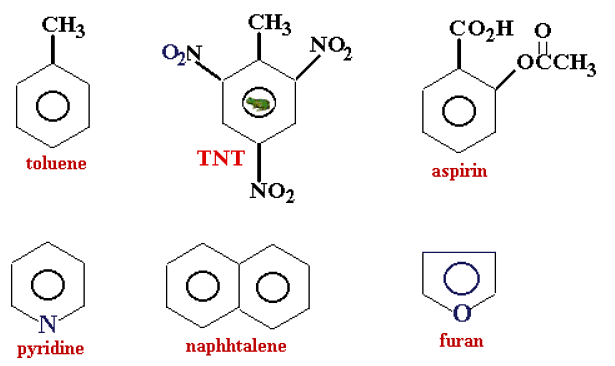
[Examples of Aromatic Hydrocarbons]
From the examples given, it is observed that each compound has a benzene ring in its structure.
Some other examples of aromatic hydrocarbons are
- Phenol (C6H5OH)
- Aniline (C6H5NH2)
- Benzaldehyde (C6H5CHO)
- Benzoic Acid (C6H5COOH)
- Acetophenone (C6H5COCH3)
- Benzonitrile (C6H5CN)
All aromatic hydrocarbons follow the Huckel Rule. That is, the total number of pi electrons is (4n+2)π where ‘n’ can be a positive integer or zero.
Structure of Aromatic Hydrocarbons
[Click Here for Sample Questions]
Aromatic compounds consist of C-C and C-H bonds. Benzene is a ring containing 6 sp2 carbons in the same plane and 6π electrons delocalized in the cyclic structure. As a result, optical and rotational isomerism is not possible in aromatic hydrocarbons. Also, since aromatic hydrocarbons are cyclic structures, therefore, cis/trans isomers are not possible.
Also Read:
Properties of Aromatic Hydrocarbons
[Click Here for Sample Questions]
Benzene was the first compound that was categorized as an aromatic hydrocarbon. Benzene is also considered the complex aryl hydrocarbon. The carbon atom in the benzene has 2 carbon-carbon sigma bonds, one carbon-hydrogen sigma bond, and a double bond.
In the benzene molecule, the delocalization of pi electrons by a solid or dashed circle inside a ring. All the carbon-carbon bonds have a bond order of 1.5. The equivalency of the bond can be observed with the study of the resonance structure of benzene.
Aromatic hydrocarbons exhibit some properties that are given below.
- Aromatic hydrocarbons show Aromaticity (stability property granted by resonance).
- The carbon to hydrogen atoms ratio is relatively high in these compounds.
- Aromatic hydrocarbons undergo nucleophilic aromatic substitution and electrophilic substitution reactions.
- On burning, aromatic hydrocarbons yield sooty and strong yellow flame.
Note: Aromatic hydrocarbons can either be monocyclic or polycyclic compounds.
Also Read: Carbocation Stability
Reactions of Aromatic Hydrocarbons
[Click Here for Sample Questions]
In many chemical reactions, aromatic hydrocarbon is used as a primary reactant. Aromatic hydrocarbons exhibit three kinds of reactions. These types of reactions are
- Aromatic Substitution Reaction
- Coupling Reactions
- Hydrogenation Reactions
Aromatic Substitution Reaction
In an aromatic substitution reaction, one substituent (nucleophile, electrophile, radical) present on the ring is replaced by another substituent concerned with the hydrogen atom as a common atom between two different substituents.
Types of aromatic substitution reactions are given below:-
- Electrophilic aromatic substitution reactions
- Nucleophilic aromatic substitution reactions
- Radical nucleophilic aromatic substitution reactions
The nitration of salicylic acid (C7H6O3) is an example of an aromatic substitution reaction. In this reaction electrophilic substitution takes place. The reaction is shown below.

Nitration of salicylic acid
Also Read:
Coupling Reactions
In coupling reactions, the coupling of two fragments having radical nature takes place using a metal catalyst. A list of bonds formed during the coupling reactions is given below:-
- Carbon-Carbon bonds: These bonds are formed by the coupling reactions between aromatic hydrocarbons and arenes such as alkyl arenes, vinyl arenes, etc.
- Carbon-Oxygen bond: This bond formation occurs in a coupling reaction resulting in the formation of aryloxy compounds.
- Carbon-Nitrogen bonds: This bond results in the formation of products like aniline.
The arylation of perfluorobenzene (C6F6) is an example of a coupling reaction involving aromatic hydrocarbons. The coupled reaction is shown below.

Arylation of perfluorobenzene
- Palladium (II) acetate is used as a catalyst in the above reaction.
Hydrogenation Reactions
Hydrogenation reactions involve arenes that form the saturated ring. An example of a hydrogenation reaction is the reduction of 1-naphthol (C10H8O) into a mixture containing different isomers of decalin-ol.
![[Reduction of 1-naphthol]](https://images.collegedunia.com/public/image/Screenshot_20230213_042504_c707ee3b503bb3980ab8b4dba42fa441.png)
Reduction of 1-naphthol
Another example of a hydrogenation reaction is the hydrogenation of resorcinol (C6H6O2) using spongy nickel and aqueous NaOH. This reaction involves the formation of an enolate and alkylation of this enolate with methyl iodide gives 2-methyl-1,3-cyclohexanedione.

Hydrogenation of resorcinol
Uses of Aromatic Hydrocarbons
[Click Here for Sample Questions]
Aromatic hydrocarbons are used in both biological and synthetic processes. Some uses are given below.
- The amino and nucleic acids present in the human body contain aromatic hydrocarbons.
- The green pigment called chlorophyll found in plants contains aromatic hydrocarbons that are required for food production in plants.
- Methylbenzene (aromatic hydrocarbon) is used as a solvent in model guess.
- Phenanthrene (an aryl hydrocarbon) is used for the synthesis of drugs, dyes, and explosives.
- Naphthalene is an important material used in the production of mothballs.
- Trinitrotoluene (TNT), is a famous aromatic hydrocarbon used for explosive activities.
- Aromatic hydrocarbons have extensive use in Petrochemical and Plastic Industries.
Polycyclic Aromatic Hydrocarbons
[Click Here for Sample Questions]
Polycyclic aromatic hydrocarbons are the hydrocarbons in which an aromatic ring is present in the fused form. These hydrocarbons are found in coal, oil, tar, and some baked foods like burnt toast, smoked fish, etc. These compounds are considered pollutants.
Naphthalene is a common example of polycyclic aromatic hydrocarbon. Some other examples of polycyclic aromatic hydrocarbons are Methylbenzene, Phenanthrene, o-dihydroxybenzene, and Trinitrotoluene (TNT).
Sample Questions
Ques. Which of the following(s) is correct about aromatic hydrocarbons? (3 marks)
Aromatic Compound:
a) Highly reactive
b) The general formula is CnHn-2
c) contains (4n+2)π electrons
d) contains (4n+4)π electrons
Ans. The correct option is c)
Explanation: According to Huckel's rule, a cyclic and planar molecule that has (4n+2) pi electrons is considered an aromatic compound.
Option a) In aromatic compounds all carbon atoms of a ring are a part of the π bond, which results in unusual stability. Thus aromatic compounds are not highly reactive.
Option b) The chemical formula of aromatic compounds is CnHn.
Ques. Check whether the compound is aromatic or non-aromatic? (3 marks)
Ans.

All carbons are Sp2 hybridised and cyclic; 6 electron, satisfying Huckel's rule. Hence they are all aromatic.

Ques. Calculate the number of σ and π electrons in benzene. (2 marks)
Ans. The benzene ring can be represented as

From the figure, it is observed that
(C - C)π = 3
(C - C)σ = 6
(C - H)σ = 6
Hence, 3 π and 12 σ bonds are present in benzene.
Ques. Is the compound given below aromatic? (3 marks)
Ans.

The correct answer is Benzenoid
Aromatic compounds are classified into three categories. First one is benzenoid, second one is non-benzenoid and third one is heterocyclic.
The aromatic compound which has benzene rings in their structure is known as a benzenoid compound.
Ques. How many π electrons does the compound contain? (3 marks)
Ans.

The number of π electrons is 14.
Explanation: 6 double bonds contribute a total of 12 π electrons.
The lone pair of oxygen atoms is sp3 hybridized thus it will resonate with the ring and contribute 2 π electrons.
The nitrogen atom is sp2 hybridized and its lone is also sp2 hybridized making it incapable of π delocalization thus it will not contribute any π electrons. The p-orbitals of nitrogen are overlapped by a double bond.
Ques. Toluene reacts with Cl2 in the presence of FeCl3 giving two products X and Y. Name these products and compare their stability. (3 marks)
Ans. The reaction of Toluene (C7H8) with Cl2 in the presence of FeCl3 is an example of an electrophilic substitution reaction.
In reaction, o-chlorotoluene and p-chlorotoluene are produced predominantly.
The reaction is given by

X Y
The methyl group in toluene is the o/p directing group. Thus only ortho and para chlorotoluene are produced. However, m-chlorotoluene is also produced but the percentage of yield is very low.
p-chlorotoluene is more stable than o-chlorotoluene. In ortho chlorotoluene, Cl is close to the methyl group which will create a steric hindrance. While in para chlorotoluene there is enough gap between Cl and methyl group so there is no steric hindrance. Hence, p-chlorotoluene is more stable than o-chlorotoluene.
Ques. Among the following compounds which one is most reactive towards nucleophilic nitration? (4 marks)
a) Benzoic acid
b) Toluene
c) Benzene
d) Nitrobenzene
Ans. The correct option is b)
Explanation: The presence of electron-donating groups such as CH3, -OH, etc increased the electron density at ortho and para positions and thus make the benzene ring more reactive towards electrophilic nitration.
While, electron-withdrawing groups such as -NO2, -COOH, etc. decrease the electron density and thus decrease the reactivity of benzene towards the electrophilic reaction.
Benzene (C6H6) –

Toluene (C6H5CH3) –

Benzoic Acid (C6H5COOH) –

Nitrobenzene (C6H5NO2) –

Hence, the correct reactivity of compounds towards the electrophilic nitration is given by
Toluene > Benzene > Benzoic acid > Nitrobenzene.
Ques. Which compound from the following will be easily attacked by the electrophile? (4 marks)
a) Chlorobenzene
b) Benzene
c) Toluene
d) Phenol
Ans. Chlorobenzene (C6H5Cl) –

Benzene (C6H6) –

Toluene (C7H8) –

Phenol (C6H6O) –

- Cl atom is ortho and para directing group and deactivated the benzene ring.
- -CH2 and -OH is ortho and para directing group and activates the benzene ring. -OH activate more than -CH3 group.
Thus the -OH group in phenol activates the benzene ring more than any other compound and makes electrophile attack easily.
For Latest Updates on Upcoming Board Exams, Click Here: https://t.me/class_10_12_board_updates
Check out:



Comments