



Exams Prep Master
Sodium Sulfite is a hexagonal white crystalline solid with the chemical formula Na2SO3 and is salty in taste. It is odourless, mildly water-soluble, an anhydrous form and basic in nature. The sulfite decomposes when heated with no specific boiling point. The compound is majorly used across the food and pulp industries and other industries too. Despite being used as a preservative in many food industries, the chemical does not cause any health hazards to the people or the environment. It is safe to say that the chemical is non-eco-toxic.
| Table of Content |
Key Terms: Sodium Sulfite, Chemical, Compound, Food, Anhydrous Form, Oxygen, Decompose
What Is Sodium Sulfite?
[Click Here for Sample Questions]
Sodium Sulfite is an odourless, solid white powder with the chemical formula Na2SO3. It is an inorganic compound and water-soluble solid in its anhydrous form. It contains two sodium cations (Na+) and one sulfite anion (SO32-).
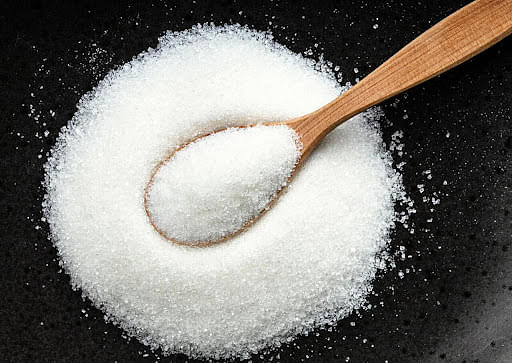
Its saturated solution has a pH value of 9 and undergoes crystallization to yield heptahydrate crystals of Na2SO3. Anhydrous Na2SO3 and its heptahydrate are different from each other in the sense that the anhydrous form is relatively stable towards oxidation. Na2SO3.7H2O gets slowly oxidized to the corresponding sulfate through its contact with atmospheric oxygen.
| Chemical Formula | Na2SO3 |
| Molar Mass/ Molecular Weight | 126.043 grams per mole |
| Density | 2.633 grams per cubic centimetre (Anhydrous) |
| Melting Point | 773K(500â)(Anhydrous) |
| Boiling Point | Decomposes when heated |
| Solubility | Soluble in glycerol Insoluble in ammonia, chlorine |
Also Read:
Structure of Sodium Sulfite
[Click Here for Sample Questions]
According to X-ray crystallography, a sodium sulfite molecule comprises two ionic bonds between the sodium cations and the sulfite anion. The structure of a Na2SO3 molecule is given below.

A sodium ion holds a charge of +1 and the -2 charge on the sulfite ion is displaced due to resonance, resulting in a partial charge of -â on each oxygen atom. Hence, the gross charge on a Na2SO3 molecule is zero.
Preparation of Sodium Sulfite
[Click Here for Sample Questions]
In laboratories, sodium sulfite is prepared from the reaction between the gaseous sulfur dioxide (SO2) and the white crystalline solid sodium hydroxide (NaOH). The chemical equation for this reaction is given below
SO2 + 2NaOH → Na2SO3 + H2O
Na2SO3 is produced from the reaction between sulfur dioxide and sodium carbonate solution industrially. The sodium bisulfite (NaHSO3) formed reacts with sodium carbonate or sodium hydroxide to yield the sodium sulfite product. The overall reaction can be stated as
Na2CO3 + SO2 → Na2SO3 + CO2
Properties Of Sodium Sulfite
[Click Here for Sample Questions]
Physical Properties:
- Anhydrous sodium sulfite exists as an odourless, white solid powder which has a molar mass of this compound is 126.043 grams per mole.
- The density of the compound is 2.633 grams per cubic centimetre and the heptahydrate form has a relatively lower density of 1.561 g/cm3.
- The heptahydrate solution undergoes dehydration when heated to 306.5K (33.4â). But the anhydrous form melts at a temperature of 500â.
- Sodium sulfite decomposes at high temperatures, therefore it does not have a specific boiling point.
- It is moderately soluble in water, its solubility is equivalent to 27g/100mL.
- The crystal structure of anhydrous Na2SO3 is hexagonal in shape whereas the structure of heptahydrate crystals is monoclinic.
Chemical Properties of Sodium Sulfite
- Upon contact with acids, Na2SO3 undergoes decomposition, releasing gaseous sulfur dioxide which is highly corrosive and toxic in nature.
- Sodium sulfite reacts with aldehydes and yields a bisulfite adduct. However, when Sodium Sulfite reacts with ketones sulfonic acids are produced.
- When solutions of sodium sulfite come in contact with atmospheric oxygen, they oxidise resulting in sodium sulfate.
- This compound is insoluble in ammonia and chlorine and soluble in glycerol.
Uses Of Sodium Sulfite
[Click Here for Sample Questions]
The applications of Sodium Sulfite across various industries are:
- The primary use of Sodium sulfite is in the pulp and paper industry. It is also applied in producing medium density fibreboards (MDF) for the thermomechanical conversion of wood to fibres (defibration).
- As an oxygen scavenger agent, it is used to avoid corrosion problems by treating water that is fed to steam boilers.
- In the photographic industry, it prevents developer solutions from deterioration and (as hypo clear solution) to wash fixer (sodium thiosulfate) from film and photo-paper amalgamations.
- In the textile industry, It is used as a reducing agent for bleaching, desulfurizing and dechlorinating swimming pools.
- It is also applied as a preservative to prevent dried fruit from discolouring and for preserving meats and other food products.

Also Read:
Things To Remember
- Sodium Sulfite is an inorganic compound with the chemical formula Na2SO3. It is odourless and available in white crystalline solid.
- The crystal structure of sodium sulfite is hexagonal in shape and moderately soluble in water with its solubility equivalent to 27g/100mL.
- Sodium Sulfite is used in many industries like the food industry, pulp industry, photography industry, textile industry etc.,
- Sodium Sulfite does not have major environmental impacts and only causes mild symptoms to people hyperreactive to the chemical.
Sample Questions
Ques: Write the health hazards of Sodium Sulfites while using it as a food preservative. (3 marks)
Ans: Health Hazards of Sodium Sulfite while using it as a food preservative are:
Sulfites are added to certain foods such as wine, beer and dry fruits as preservatives to increase their shelf life and maintain food colour as they inhibit microbial growth. Those allergic to the chemical can have Digestive issues like diarrhoea, stomach cramps, vomiting, and nausea and show respiratory symptoms - wheezing, difficulty breathing, cough, and chest tightness.
Ques: How is Sodium Sulfite useful for your hair? (2 marks)
Ans: Sodium sulfite performs as a hair-waving/straightening agent. It is deployed in a combination with sodium metabisulfite and sodium sulfate in products used to straighten the hair and in permanent waves to the hair.
Ques: Are Sodium Sulfite and Sodium Sulfate the same? (2 marks)
Ans: No, Sodium Sulfite and Sodium Sulfate are not the same. Sodium Sulfite has a sulphite anion, which has one sulfur atom and three oxygen atoms whereas Sulfate has a sulphate anion, which has one sulfur atom and four oxygen atoms.
Ques: What are the harmful effects of Sodium Sulfites on your skin? (2 marks)
Ans: The harmful effects of Sodium Sulfite on our skin are as follows:
The exposure to sodium sulfite mainly occurs through food and the people hypersensitive to this compound can suffer from red and itchy skin, rashes, and hives.
Ques: What happens to Sodium Sulfite when it is heated? (2 marks)
Ans: When heated, Sodium sulfite decomposes, emitting fumes of sulfur dioxide and sodium oxide. Sulfur dioxide (SO2) is a toxic, choking gas whereas sodium oxide (Na2O) is a strong, corrosive base.
Ques: Are Sodium Sulfites present naturally in foods? If yes name the foods high in sulfites. (2 marks)
Ans: Yes, Sodium Sulfites are naturally present in some foods. The foods high in Sulfites are peanuts, eggs, black tea, vinegar, and some vegetables, including broccoli, cabbage, cauliflower, kale, garlic, onions, chives and leeks. Also, some fermented foods, strawberries, blackberries, plums, coconut and other fruits contain varying amounts of natural sulfites.
Ques: How is Sodium Sulfite basic in nature? (2 marks)
Ans: Sodium sulphite, Na2SO3, is a salt made as a result of a neutralization reaction between a strong base (sodium hydroxide) and a weak acid (sulphurous acid). Therefore, with a pH value slightly greater than 7, the aqueous solution is, distinctly basic in nature.
Ques: Is Sodium Sulfite hazardous to the ecosystem? (2 marks)
Ans: Sodium Sulfite is non-hazardous to the ecosystem which means that it is non-ecotoxic. It is commonly used as a wastewater dechlorination agent. Also, Sodium Sulfite contaminated materials are considered to be non-hazardous.
Also Read:
Also Read:



Comments