



Content Curator
Zinc Carbonate is a colourless white crystalline powder found in nature forming the Smithsonite mineral. It occurs naturally as granular or earthy masses. The chemical formula for Zinc carbonate is ZnCO3 and it is almost insoluble in water, colourless and transparent. ZnCO3 is more frequently coloured by the presence of, manganese, copper, iron etc. The ore smithsonite is called “dry bones” as it contains theoretically 52% of metallic zinc. It is used as a toothpaste to recover dentin in teeth that have been whitening. It even serves to delay the burning of certain fibres, plastics and rubber when they come into contact with the fire.
Read More: Acids, Bases & Salts
| Table of Content |
Key Terms: Zinc Carbonate, Salt, Zinc Spar, Smithsonite, Zinc, Carbonate
Zinc Carbonate Structure
[Click Here for Sample Questions]
The structure of Zinc carbonate consists of a Zn2+ cation and a CO32- anion. The carbon which is in the carbonate ion has an oxidation state of +4. The ion has a flat structure with the three oxygen atoms surrounding the carbon atom.
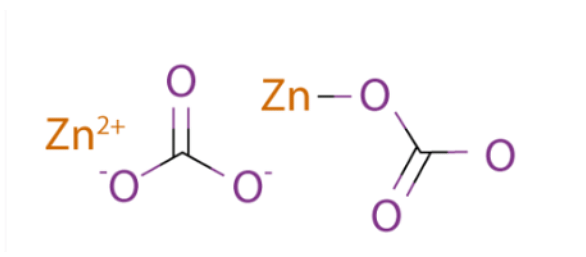
Structure of Zinc Carbonate
Some of the other characteristics properties of ZnCO3 are tabulated below:
| Characteristics of Zinc Carbonate | |
|---|---|
| Chemical Formula | ZnCO3 |
| Molecular Weight/ Molar Mass | 125.38 g/mol |
| Density | 3.5 g/cm3 |
| Boiling Point | 333.6 0C at 760 mm Hg |
| Melting Point | ~ 1970 0C |
| Stability | Stable but not compatible with acids |
Read More: Melting and Boiling Points
Zinc Carbonate Production
[Click Here for Sample Questions]
- Formed as a secondary mineral in Zinc mining deposits.
- Zinc carbonate to form these deposits, must be present at oxidation zones.
- This can be found in sedimentary deposits and directly oxidized products.
- This can be obtained by grinding the Smithsonite mineral, formerly called zinc spar.
Preparation
Zinc Carbonate can be prepared by mixing of a sodium carbonate solution with zinc salt, such as zinc sulphate.
ZnSO4 + Na2CO3 → ZnCO3 + Na2SO4
Zinc carbonate reacts with acids to form zinc chloride and releases carbon dioxide gas.
ZnCO3 + HCl → ZnCl2 + CO2
ZnCO3 + H2SO4 → ZnSO4 + CO2+ H2O
Check Out:
Physical Properties of Zinc Carbonate
[Click Here for Sample Questions]
Some of the other characteristics properties of ZnCO3 are tabulated below:
| Physical Properties of Zinc Carbonate | |
|---|---|
| Odour | Faint Vinegar Smell |
| Appearance | While Crystalline Powder |
| Valency | Zn - 2, C- 4, O- 2 |
| pH | Greater than 10 |
| Oxidation Number | +2 |
| Solubility | Soluble in dilute acids and bases, Insoluble in water |
Read More: Zinc Acetate Salt
Chemical Properties of Zinc Carbonate
[Click Here for Sample Questions]
These are the reactions that take place with zinc carbonate:
ZnCO3 + 2H+ → Zn2+ + H2O + CO2
- It dissolves in bases forming the hydroxide, which partially dissolves forming a zincate ion:
ZnCO3 + 2OH- → Zn(OH)2 + CO32-
Zn(OH)2 + H2O + OH → [Zn(OH)3(H2O)]
- It is not flammable. When heated to decomposition, it produces zinc oxide and carbon dioxide but can emit carbon monoxide (CO).
ZnCO3 + heat → ZnO + CO2
Read More: Zinc Nitrate Salt
Applications of Zinc Carbonate
[Click Here for Sample Questions]
Listed below are the most common uses of ZnCO3:
- Pharmaceutical Use: in ointments and calamine.
- Treatments: applied to patients with skin problems.
- Raw Material: for the production of rayon.
- Industrial: used in the field of chemical fertilizers and pesticides.
- Manufacturing: It is applied in light and astringent latex products as absorbents and for dusting.
- In veterinary applications
- serves as the astringent, antiseptic, and topical wound.
- protects from diseases that are caused by zinc deficiency as it is used as a supplement in the diet of some animals.
- As a Flame retardant
- used as a fireproof filter for rubber and plastics which are exposed to high temperatures.
- used to protect the textile fibres from fire.
- cotton fabrics may contain ZnCO3 in their fibres to make them fire-resistant.
- Use to separate dangerous minerals and arsenic- mineral-rich in arsenic should be separated from others to avoid toxicity to living organisms
Advantages of Zinc Carbonate
[Click Here for Sample Questions]
- Due to the low content of heavy metals i.e., 5 PPM or less, zinc carbonate processes are highly environmentally friendly and efficient.
- Zinc carbonate can efficiently work with materials such as stainless steel and copper etc.
- With the help of hot air-drying method, the products made of zinc carbonate do not contain uniformities when drying.
Health Hazards
|
Things to Remember
[Click Here for Sample Questions]
- Zinc carbonate has a chemical formula as ZnCO3.
- Zinc Carbonate is composed of Zn2+ cation and a CO32- anion.\
- ZnCO3 is not soluble is water and not compatible with acids.
- Zinc Spar is the major source of zinc carbonate production.
- Zinc Carbonate dissolves bases and is not flammable in nature.
- Zinc Carbonate has multiple applications in the field of medicine, manufacturing and production, and other chemical uses.
- Zinc carbonate affects respiration in humans, is a skin irritant and also is known to affect the liver.
Check Out:
Previous Year Questions
- Calculate the pH of the solution? [AMUEEE 2015]
- Give the decreasing order of Lewis acid tendency. [NEET 1990]
- What is the pH of the resulting solution? [AP EAPCET 2019]
- Which of these can be Bronsted acids and bases? [AP EAPCET 2019]
- What will be the pH of N/10 of Acetic acid? [UPSEE 2019]
- If the H+ ion concentration is reduced, what will be the pH. [JIPMER 2003]
- What is the pOH value of the solution? [BITSAT 2012]
- What is the pH of the resulting solution? [BITSAT 2008]
- Choose the correct statement for the assertion and reason. [BITSAT 2008]
- Which is the weakest acid among the following options? [VITEEE 2007]
Sample Questions
Ques. 1. What are the physical properties for ZnCO3 ? (3 marks)
Ans 1. The main properties for ZnCo3 are the following:
- Molecular weight: 125.4 g/mol
- Physical state: Colourless solid or crystalline white. Rhombic crystals.
- Melting point: At 140 ºC it decomposes without melting.
- Solubility: Practically insoluble in water.
- Density: 4.398 g/cm3 at 20 °C.
Ques. 2. What is the safety precaution that one needs to follow when working with Zinc Carbonate? (3 marks)
Ans. 2. There are following points are to be considered while working with ZnCO3:
- After handling this substance, wash your hands with plenty of water.
- It is recommended to specialized suits for skin protection and hand gloves.
- You need to store ZnCO3 n tightly sealed or tightly closed containers that the place is highly dry and avoids humidity or extreme heat.
- If in case this substance is spilled t is recommended to clean the spilled areas with water, then dry and apply a cleaning product or disinfectant to the floor.
Ques. 3. If in case the ZnCO3 is swollen by someone what needs to be done? (2 marks)
Ans.3 If the person who swallowed the zinc carbonate is conscious, give him 2 or 4 cups of milk or water. If the person is passed out or unconscious, call an ambulance for immediate medical attention.
Ques. 4. What needs to be done if ZnCO3 is applied on skin and eyes? (2 marks)
Ans.4. If it is accidently applied on skin or affected in eye, he or she need to Apply neutral soap with plenty of water to the irritated areas and take the person to a health centre for treatment and in case of eyes flush the affected person's eyes with plenty of water for approximately 15 minutes, lifting the victim's upper and lower eyelids from time to time.
Ques. 5. What is the nature of zinc carbonate? (1 mark)
Ans. 5. Zinc carbonate gets dissolves easily in acidic solutions but it is insoluble in water.
Ques. 6. What is the structure of zinc carbonate? (1 mark)
Ans. 6. The structure of zinc carbonate is octahedral, and each carbonate is bound to six zinc centres, resulting in three-coordinate oxygen atoms.
Ques. 7. Is zinc carbonate good for skin? (1 mark)
Ans. 7. It is a common ingredient in cosmetics.
Ques. 8. What is the use of zinc carbonate? (1 mark)
Ans. 8. There are a variety of uses for zinc carbonate as they are used in materials, pigments for painting and agricultural stuff. It also acts as a corrosion inhibitor.
Ques. 9. What is the recovery of zinc from residual effluents? (1 mark)
Ans. 9. Synthetic waters rich in zinc ions discarded by electroplating processes can be treated by fluidized bed technology using sodium carbonate to precipitate ZnCO3.
Ques. 10. What are the different minerals for Zinc carbonate? (3 marks)
Ans. 10. The different compounds that are formed by Zinc are:
- Sphalerite (ZnS)
- Zincite (ZnO)
- Smithsonite (ZnCO3)
- Willemite (Zn2SiO4)
- Hemimorphite (Zn4Si2O7(OH)2.H2O)
Do Check Out:



Comments