



Content Curator
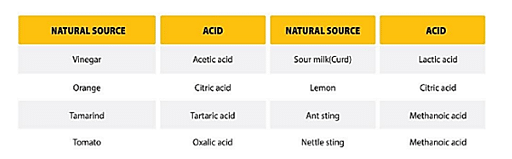
Many acids and bases exist naturally in nature, such as malic acid in apples, hydrochloric acid in gastric fluids, tartaric acid in tamarind, lactic acid in milk and milk products, and citric acid in fruits like lemon and orange.
Lime water, on the other hand, has a lot of bases. Baking soda is used to create cakes and other baked goods, washing soda is used to clean, boric acid is used in laundry, and vinegar or acetic acid is used in the kitchen, among other things.
Many acids and bases, such as HCl, H2SO4, NaOH and KOH are utilised in labs. When these acids and bases are combined in appropriate and precise amounts, salt and water are formed. Some salts, such as NaCl and KCl, are found naturally, like in natural rock formations or in saltwater.
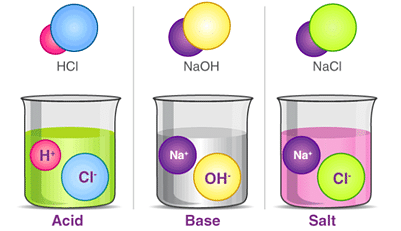
Let's take a deeper look at the characteristics of various acids, bases, and salts.
Read More: VSEPR Theory
Definitions of Acids, Bases and Salts
Acid:- A chemical that neutralises bases, turns blue litmus red, and has a sour taste is characterised as an acid.

Acid is derived from the Latin word 'acere', which means sour. In its aqueous solution, acid is defined as a chemical that produces ionizable hydronium ions (H3O+).
As illustrated in the instances below, acids dissociate in their aqueous solution and give birth to their component ions.
Base:- If a material neutralises acids or turns red litmus blue, and if its aqueous solution tastes bitter, it is called a base. Bases have a soapy texture and a bitter flavour. In aqueous solution, a base produces the hydroxyl ion (OH–). When red litmus paper comes into touch with base, its colour changes to blue.
Salt:- Salt is a tasteless neutral material and in an aqueous solution it has no effect on litmus. Salt is produced by neutralisation between bases and acids. Salts are made up of cations, which are positively charged, and anions, which are negatively charged. In nature, salts are either organic or inorganic. The presence of these ions neutralises the salt's nature.

Salt is formed as a result of the chemical processes depicted in the equations below.
The bases dissociate in aqueous solution to produce component ions, as shown in the examples below.

The pH of a salt solution is determined by the strength of acids and bases mixed in the neutralisation process.
Example:
- NaOH + HCl→ NaCl + H2O
- HCl + NH4OH → NH4Cl + H2O
- CH3COOH + NaOH → CH3COONa + H2O
- CH3COOH + NH4OH → CH3COONH4+ H2O
Table salt, also known as sodium chloride, is made by the combination an acid, hydrochloric acid, and a strong base, sodium hydroxide.
HCl(aq)+NaOH(aq)→NaCl(aq)+H2O(l)
Other examples include:
- Baking soda (NaHCO3) is a common ingredient used while cooking.
- Ammonium nitrate (NH4NO3) and ammonium nitrate (NH4NO3) is used in fertilizers.
- Epsom salt (MgSO4) is a common ingredient in bath salts.
Also Read:
Classification of Acids, Bases and Salts
1. ACIDS:
Acids can be categorised based on their occurence into natural and mineral acids
- Acids obtained from natural sources, such as animal and fruit products, are known as natural acids like tartaric, citric, and lactic acids.
- Mineral Acids are acids that are made from minerals and are commonly used in labs. Sulphuric acid (H2SO4), hydrochloric acid (HCl), and nitric acid (HNO3) are some examples of mineral acids.
Acids are classified as follows based on the number of hydrogen ions in them:
- Monoprotic Acid – Acids that generate one mole of H+ ions per mole of acid, such as HCl.
- Diprotic Acid – Acids that generate two moles of H+ ions per mole of acid, such as H2SO4.
- Triprotic Acid – Acids that generate three moles of H+ ions per mole of acid, such as H3PO4.
Acids are classified as follows based on their ability to donate hydrogen ions:
- Acids that get fully ionised in aqueous solutions are known as Strong Acids. As a result, at equilibrium, the concentration of hydrogen ions is at its highest, while the concentration of acid molecules is at its lowest; for example, HCl, HNO3, and HClO4.
- Weak Acids: Weak acids are only partly ionised in solution at equilibrium. At equilibrium, the concentration of hydrogen ions is lower, and acid molecules, such as HF and CH3COOH, are present in significant amounts.
Also Read:
2. BASES:
- Strong Bases: These are the bases that, when fully ionised in water, create hydroxide ions, such as sodium hydroxide.
NaOH(s)⇔Na+(aq)+OH−(aq)
- Weak Bases: These are bases in which equilibrium is mostly on the side of the reactants and are partly ionised, such as ammonia in water.
NH3(aq)+H2O(l)⇔NH4+(aq)+OH−(aq)
Properties of Acids, Bases and Salts
1. ACIDS
- Acids are chemicals that produce hydrogen ions (H+) when dissolved in water.
HCl + H2O → H+ + Cl-
- Acid is corrosive in nature, with a pH of less than 7 and a sour flavour.
- When acids react with metal, they produce hydrogen gas. For example, when zinc metal interacts with hydrochloric acid, zinc chloride and hydrogen gas are produced.
Zn + 2HCl → ZnCl2 + H2
- When acids react with limestone (CaCO3), carbon dioxide is produced. For example, when HCl interacts with limestone, it produces calcium chloride and carbonic acid.
CaCO3 + 2HCl → CaCl2 + CO2 + H2O
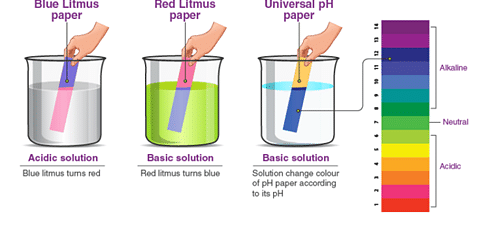
- Acids turn blue litmus to red.
Read More: Gay-Lussac’s Law
2. BASES
Bases have a pH value of more than 7, are caustic, and have a bitter taste. They generally have a soapy feel to them.
- They are excellent electrical conductors.
- When bases react with grease and oils, soap molecules develop.
- Red litmus cahnges to blue litmus by bases.
- When these chemicals are dissolved in water, they produce hydroxide ions (OH– ions).
Examples: Sodium hydroxide [NaOH], milk of magnesia [Mg(OH)2], and calcium hydroxide [Ca(OH)2] are other examples.
Read More: Fehling Test
3. SALTS
Salt is a material with no acid or basic characteristics, the equal number of hydrogen and hydroxyl ions, and no effect on the litmus colour.
- There are no acidic or basic properties in these compounds.
- Their pH levels are close to 7.
- On red or blue litmus paper, neutral chemicals have no impact.
- Pure water has a pH of precisely 7.
- Examples: Common salt, water (NaCl)
Uses of Acid and Bases
1. Acids and Their Applications
Vinegar is a diluted solution of acetic acid that has a variety of uses in the home and is mostly utilised in the food industry as a preservative.
- Lemon and orange juice contain a significant amount of citric acid.
- Sulfuric acid is extensively utilised in batteries and is often found in batteries used to start car motors.
- Sulfuric and nitric acid are used in the industrial manufacturing of explosives, dyes, paints, and fertilisers.
- Many soft drinks include phosphoric acid as a component.
Also Read:
2. Bases and Their Applications
Sodium hydroxide is used in the production of soap and paper. Sodium hydroxide (NaOH) is also utilised in the production of rayon.
- Bleaching powder is made from Ca(OH)2, commonly known as slaked lime or calcium hydroxide.
- Calcium hydroxide is used to create dry mixtures for painting and decorating.
- Magnesium hydroxide, often known as milk of magnesia, is a laxative that is frequently used. It is also used as an antacid since it lowers excess acidity in the human stomach.
- Ammonium hydroxide is a critical reagent used in laboratories.
- Slaked lime can be used to neutralise any excess acidity in soils.
Read More: Electrochemical Cells
Important Topics for JEE MainAs per JEE Main 2024 Session 1, the important topic included in the chapter Acids, Bases and Salts is as follows:
Some memory based important questions asked in JEE Main 2024 Session 1 include: 1. What is the pH of CH3COONH4+? (At 25°C). Given: Ka of CH3COOH = 1.8 x 10⁻⁵, Kp of NH4OH = 1.8 x 10⁻⁵. 2. The Ksp of Mg(OH)2 is 1 x 10-12. Find the limiting pH at 25 °C at which 0.01 M Mg2+ ions will precipitate. |
Things to Remember
- pH scale can be used to determine the quantitative value of a substance's level of acidity or basicity. pH scale is the most widely used and accepted method of determining how acidic or basic a material is. A pH scale ranges from 0 to 14, with 0 indicating the most acidic and 14 indicating the most basic.
- Litmus paper can also be used to determine if a material is acidic or basic. Red and blu are two forms of litmus paper that may be used to detect acids and bases. Under acidic conditions, blue litmus paper turns red, whereas red litmus paper turns blue under basic or alkaline conditions.
Also Read:
Sample Questions
Question: What is the definition of salt? (3 Marks)
Answer: Salt is a chemical compound formed by the interaction of a base and an acid. Salts are made up of acids' negative ions (anions) and bases' positive ions (cations). The neutralisation reaction is the interaction between a base and an acid.
Question: Is NH4Cl a basic salt or not? (3 Marks)
Answer: Because it is a salt of a weak base (ammonium hydroxide) and a strong acid (ammonium chloride), ammonium chloride (chemical formula NH4Cl) is an acid salt (i.e. hydrochloric acid)
Question: What are the two different sorts of acids? (3 Marks)
Answer: There are two types of acids, organic and inorganic acids. In general, inorganic acids are more powerful than organic acids.
Question: Is salt a basic or acidic substance? (3 Marks)
Answer: Salt is neutral in nature. Only when a weak acid combines with base, the salt becomes basic.
Question: What happens when Fe comes into contact with HCl? (3 Marks)
Answer: When dilute hydrochloric acid is added to iron filings, iron chloride and hydrogen are produced. Hydrogen from hydrochloric acid is replaced by iron in this process, resulting in hydrogen gas and iron chloride.
Question: What is the amount of acid present in the human body? (3 Marks)
Answer: There are around 500 amino acids in nature, yet just 20 amino acids make up the proteins found in the human body. Inside the human body, human blood has a pH of about 7.40. There are also many distinct types of acids present in the human body and each has its own function.
Question: How can you tell the difference between acids and bases? (3 Marks)
Answer: By counting the hydrogens on each component before and after the reaction to determine if it is an acid or a basic. The product is acid if the amount of hydrogens is reduced (donates ions of hydrogen). The material is basic if the quantity of hydrogens has increased (accepts hydrogen ions).
Question: What is the primary distinction between an acid and a base? (3 Marks)
Answer: Acids and bases are two types of corrosive chemicals. Acidic materials have a pH value between 0 and 7, while bases have a pH value between 7 and 14. Acids are ionic chemicals that break down in water to produce the hydrogen ion (H+).
Question: What role does acid play in your life? (3 Marks)
Answer: Acids serve an important part in the human body. Hydrochloric acid aids digestion by breaking down big and complex food molecules in the stomach. Protein synthesis is essential for the growth and repair of bodily tissues, and amino acids are required for this.
Also Read:



Comments