



Education Journalist | Study Abroad Lead
Copper II Carbonate, also known as Cupric Carbonate, is classified as a chemical compound for which the structural formula of Copper II Carbonate is given as CuCO3. It is an ionic solid compound when found at ambient temperature. Copper II Carbonate consists of copper (II) cations Cu2+ and carbonate anions CO2−3. It is rarely found because it is difficult to prepare and highly reactive. Given below is the detailed information about Copper II Carbonate, how it is prepared, its physical and chemical properties, structural formula and where it is found.
| Table of Content |
Key Terms: Copper II Carbonate, Cupric Carbonate, Compounds, Ionic Compounds, Cations, Anions, Thermal Reaction, Temperature, Chemical Reaction, Acids, Alkalis
What is Copper II Carbonate?
[Click Here for Sample Questions]
Copper II Carbonate is a chemical compound that is commonly known as cupric carbonate and neutral copper carbonate. This compound is grey in colour and highly reactive. This ionic solid has Copper II cation Cu2+ and carbonate anions CO2−3. Commonly, copper carbonate or cupric carbonate is also referred to as basic copper carbonate like Cu2(OH)2CO3. It is present in nature as mineral malachite or azurite or Cu3(OH)2(CO3)2. This is the reason why a qualifier neutral can be used instead of basic which refers to CuCO3.
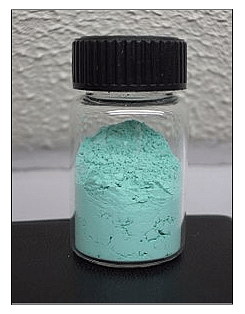
Copper II Carbonate
Here are some important details about Copper II Carbonate:
| Compound Formula | CuCO3 |
| Reactivity | Reacts with water at normal conditions |
| Molecular weight | 123.5549 |
| Other Names | Cupric Carbonate, Neutral/Basic Copper Carbonate |
Also Read: Difference between Cations and Anions
Structural Formula of Copper II Carbonate
[Click Here for Sample Questions]
Here is the structural formula of Copper II Carbonate:

Preparation of Copper II Carbonate
[Click Here for Sample Questions]
A lot of experiments and reactions were done to yield CuCO3, namely
- Solutions of Copper II Sulfate CuSO4 and sodium carbonate Na2CO3 are mixed in ambient conditions. This forms a basic carbonate and CO2 is released. This happens due to the high reactivity of the Cu2+ ion for the hydroxide anion HO−
- Then, there is the thermal decomposition of the basic carbonate, done at atmospheric pressure to yield Copper II oxide CuO instead of the carbonate.
- W. F. T. Pistorius in 1960 made a claim that synthesis by heating basic copper carbonate at 180 °C in a carbon dioxide CO2 (450 atm) atmosphere and water (50 atm) for 36 hours. The bulk obtained was well-crystallized malachite Cu2CO3(OH)2. But a small quantity of a rhombohedral substance was also obtained, which was claimed to be CuCO3. This synthesis was not very reliable, therefore, was discontinued.
- In 1973 by Hartmut Ehrhardt and others, the reliable synthesis of true Copper II Carbonate was reported. The chemical compound obtained was grey in colour and was formed when basic copper carbonate was heated in an atmosphere of carbon dioxide which was produced by the decomposition of silver oxalate Ag2C2O4 at 500 °C and 2 GPa (20,000 atm). The obtained compound was said to have a monoclinic structure.

Preparation of Copper II Carbonate
Physical Properties of Copper II Carbonate
[Click Here for Sample Questions]
The physical properties of Copper II Carbonate are as follows:
- It is a solid compound.
- Monoclinic crystals
- Kept in a sealed dry place at room temperature
Also Read: Copper: Chemical Formula & Properties
Chemical Properties of Copper II Carbonate
[Click Here for Sample Questions]
Given below are the chemical properties of Copper II Carbonate:
- When heated in the air, it breaks down into copper oxide, water and carbon dioxide.
- Also, it is soluble in acid and generates corresponding copper salt.
- Soluble also in the aqueous solution of cyanide, ammonium salt and alkali metal carbonate to form a copper complex.
- Generates brown oxide when boiled in water or heated in an alkaline solution.
- It is very unstable under a hydrogen sulfide atmosphere and can react with hydrogen sulfide to generate copper sulfide.
- Being in the air for a long period makes it release CO2 by absorbing moisture. It then slowly turns into a green malachite composition.
- The stability of dry CuCO3 depends significantly upon the partial pressure of carbon dioxide (PCO2). It can remain stable for months in dry air but will decompose slowly into CuO and CO2 if PCO2 is less than 0.11 atm.
- With water or moist air at a temperature of 25 °C, CuCO3 is only constant for pCO2 which is above 4.57 atmospheres and has a pH between 4 - 8.
- Below the partial pressure, it is highly reactive with water and makes a basic carbonate - (azurite, Cu3(CO3)2(OH)2).
- 3 CuCO3 + H2O → Cu3(CO3)2(OH)2 + CO2
- In highly basic solutions, the complex anion Cu(CO3)22− is alternatively formed.
Things to Remember
[Click Here for Sample Questions]
- Copper II Carbonate is a chemical compound with the formula CuCO3. At ambient temperatures, this compound is an ionic solid (a salt) which consists of Copper II cations Cu2+ and carbonate anions CO2−3.
- It decomposes in a complex manner. Copper II carbonate breaks down into copper oxide which is black in colour and releases carbon dioxide gas.
- “Copper Carbonate”, “Copper II Carbonate”, and “Cupric Carbonate” always refer to the same basic copper carbonate or Copper II Carbonate hydroxide, known as Cu2(OH)2CO3. These occur naturally as malachite or Cu3(OH)2(CO3)2 (Azurite).
- Copper II carbonate is used in making jewellery, copper salts. It is also used in paints, varnishes, pottery and also as a fertiliser and insecticide.
Solved Examples
Ques. Write a brief note on Copper II Carbonate. (3 Marks)
Ans. The chemical compound Copper II carbonate is also known as cupric carbonate or basic copper carbonate. It is a chemical compound with the formula CuCO3. This compound is an ionic solid when found at ambient temperatures. It is rarely found because it is difficult to prepare and highly reactive. In nature, it is present as Azurite or Malachite.
Ques. What is the preparation process of Copper II Carbonate? (3 Marks)
Ans. Harrtmut Ehrhardt, a scientist and others in 1973, talked about the reliable synthesis of true Copper II Carbonate. A chemical compound was obtained. It is formed when basic copper carbonate gets heated in an atmosphere of carbon dioxide which is produced by the decomposition of silver oxalate Ag2C2O4 at 500 °C and 2 GPa (20,000 atm). The obtained compound has a monoclinic structure.
Ques. List physical properties of Cupric Carbonate. (3 Marks)
Ans. The physical properties of Cupric Carbonate are as follows
- Cupric Carbonate is a solid compound.
- It has Monoclinic crystals in structure
- Has to be stored in a sealed dry place at room temperature
Ques. List chemical properties of Cupric Carbonate. (5 Marks)
Ans. Some of the chemical properties of Cupric Carbonate are:
- Cupric carbonate breaks down into copper oxide, water and carbon dioxide when heated in the air.
- It has acid solubility and generates a corresponding salt with it. It is also soluble in the aqueous solution of cyanide, ammonium salt and alkali metal carbonate and forms a copper complex.
- The formula for the carbonate anion CO32− and the charge on the carbonate anion is 2− and that of the Copper II is 2+. This means that the copper 2+ ion and the carbonate ion can balance out as a compound.
- Copper carbonate is bulkier than the oxide form, therefore its tendency is to disperse better and this gives more even results. It melts better and is more reactive chemically.
- Gases are produced as it decomposes and these can cause pinholes or blisters in glazes.
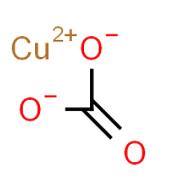
Ques. Draw the structural formula of Copper II Carbonate. (2 Marks)
Ans. Here is the structural formula of Copper II Carbonate:
Ques. What happens when solid Copper II Carbonate is heated? Explain with the chemical equation (including phases) to describe this reaction? (5 Marks)
Ans. When solid Copper II Carbonate is heated, it decomposes to form solid copper II oxide and carbon dioxide gas is released. Word equation for this is:
- Copper II carbonate (solid)→ Copper II oxide (solid)+ Carbon dioxide (gas)
- CuCO3(s)−→ΔCuO(s)+CO2(g)↑
Copper II carbonate and Copper II oxide are ionic compounds and Carbon dioxide is a covalent molecule of oxygen atoms with carbon atoms. It is a balanced equation with respect to charge and mass.
Many carbonates undergo this decomposition reaction when the reaction is supplied with enough heat. We observe the colour change from green to black during the reaction.
Ques. When Copper carbonate is heated it releases a brisk effervescence given by gas? Explain the process and define effervescence. (5 Marks)
Ans. Effervescence is the process of the formation of gas bubbles in a liquid due to a chemical reaction. Copper carbonate is then dissociated into two substances on being heated. Copper carbonate breaks down into Copper oxide and Carbon dioxide on being heated.
CuCO3→CuO+CO2
Hence we can say that the brisk effervescence is due to Carbon Dioxide. This can be proven by shaking the gas released in a container that has lime water. This gas turns the lime water milky. The gas produced can also be passed through acidified Potassium dichromate solution where it wouldn’t produce any observable change.
Ques. Calculate the molar mass of Copper II Carbonate. (2 Marks)
Ans. Copper II Carbonate = CuCO3
Cu = 63.5
C= 12
O = 16
= 63.5 + 12 + 3*16
= 123.5 g/mol
Ques. What are the uses of Copper II Carbonate? (5 Marks)
Ans. There are a number of uses of this compound across a wide variety of industries and products which are mentioned below
- This substance is used for a number of aesthetic purposes, especially in jewellery. This carbonate can be converted to metal copper, which is highly valuable and has many applications. We can achieve this through pulverisation, sizing, conversion and electrolysis.
- We can use this substance to convert into copper salts by mixing it with a stronger acid. If we mix the carbonate with acetic acid it will produce cupric acid, water and carbon dioxide.
- This substance in pure form has a mint green colour. With alkaline components, a tinge of blue will be added to the colour. This is used in paints, varnishes, pottery glazes and even fireworks to give them some colour.
- Small amounts of copper carbonates are used in animal feeds and fertilisers.
- Used in the creation of insecticides and fungicides. It is also used to control the growth and spread of aquatic weeds. A common ingredient in the ammonia compounds used to treat timber.
- Copper carbonate is also used as a blue colouring agent in pyrotechnics.
Ques. What is a chemical reaction? What are the indications it is generally accompanied with? Explain with reference to Copper II carbonate on heating gives Copper oxide and Carbon Dioxide. (5 Marks)
Ans. A chemical reaction is known as a process where one or more substances also known as reactants, are converted to one or more substances different from the reactants, known as products. A chemical reaction is usually accompanied by a change of state, smell, colour, the release of a gas, formation of a residue or precipitate and evolution or absorption of heat.
The heating of Copper II Carbonate is an irreversible reaction. When this chemical compound is supplied with enough heat it breaks down into Copper Oxide and Carbon Dioxide gas. There is a change of colour from green to black as well as a change of state from solid to gas. The products have different chemical properties from the reactant, hence we can prove it to be a chemical reaction.
The equation for the following reaction is:
CuCO3(s)→ΔCuO(s)+CO2(g)↑
Check More



Comments