



Education Journalist | Study Abroad Lead
Sulphate (SO42-) is one of the most common chemical compounds found as naturally occurring minerals on the planet. Due to atmospheric and terrestrial processes, it is usually found in the environment. Sulphur emitted from evaporite deposits, sulfide-containing rocks and minerals, and even volcanoes is a major source of sulphate. Sulphate is a chemical compound made up of sulphur atoms and oxygen atoms. Potassium, sodium, calcium, magnesium, and barium are some of the elements that form salts with sulphate. Sulphate or sulfate is considered an inorganic ion or polyatomic anion in chemistry. It is typically thought to be sulphuric acid salts or esters. Deprotonation of both OH groups of sulphuric acid yields sulphates. It's also an acid derivative for a variety of metals. In this article, we will understand in-depth about sulphate, its structure, properties, and its methods of preparation.
| Table of Contents |
Key Takeaways: Sulphates, Sulphuric Acid, Sulphate Structure, Ions, Electrons, Protons, Bonds, Sodium Sulphate
Sulphates
[Click Here for Sample Questions]
When sulphates are mixed with another organic substance called sulphuric acid, sulphates are considered salts. Its capacity to link together with metals is another distinguishing feature. The sulphate ion will reach out to a metal and establish a bridge or link by employing its oxygen atoms as ligands, or arms. Chelate refers to a chemical substance that forms a bind with a metal. When sulphate is used as a chelating agent, the negatively charged oxygen atoms reach out to grab hold of the metal, iron. As a result, a metal-ion complex known as iron sulphate, or FeSO4, is formed.

Ferrous Sulphate
Because sulphate has so many electrons, it can link to metal using one pair of electrons or several pairs of electrons. A monodentate ligand is one that uses only one pair of electrons. A multidentate ligand is one that uses more than one pair of electrons.
| IUPAC (International Union of Pure and Applied Chemistry) Name | Sulphate |
| Chemical Formula | SO42- |
| Molar Mass | 96.06 g/mol |
| Boiling Point | 623.89 °C |
| Melting Point | 270.47 °C |
Sulphate Structure [SO42-]
[Click Here for Sample Questions]
Sulphur and oxygen atoms make up the majority of the sulphate ion. The central element is sulphur, which is surrounded by four oxygen atoms that are spaced evenly throughout the plane. Two of the oxygen atoms make S=O bonds while the other two form S-O- bonds when it comes to bonding. Because they are in a -2 state, the oxygen atoms are responsible for the anion's negative charge (-2).
When we look at the molecule's structure or form, we can see that it has a tetrahedral geometry, which is based on the VSEPR theory. In simple terms, the geometry of the sulphate ion is star-shaped.

Structure of Sulphate
The atoms are angled at 109.5 degrees.
Properties of Sulphate
[Click Here for Sample Questions]
Sulphate has distinctive chemical and physical properties which distinguish it.
1. Physical Properties of SO42-
The cation that is coupled to the sulphate ion, producing the salt, determines its physical properties in general.
- Many of these salts are solids that are very water soluble.
- The salts generated by cations from group 2 of the periodic table, such as calcium, strontium, barium, radium, and lead, that form insoluble salts with the sulphate anion, are the exceptions.
- During reactions, they tend to form a white precipitate.
2. Chemical Propertiesof SO42-
Sulphate has a unique chemical feature so it can easily bond with metals.
- The oxygen atoms in the sulphate ion act as ligands (arms), and they will attract the metal to form a bridge or link. This chemical substance that forms a bond with a metal is referred to as a chelate.
- The sulphate ion functions as a ligand that connects two oxygen atoms or acts as a bridge between two oxygen atoms. Despite this, sulphate has so many electrons that can bond with a metal via any pair of electrons.
- Take the neutral metal PtSO4, for instance, where the sulphate ion behaves as a bidentate ligand. In sulphate complexes, the metal-oxygen connections have a specific covalent nature.
- HSO-4 (hydrogen sulphate) is a conjugate base of bisulphate ion, whereas H2SO4 is a conjugate base of sulphuric acid. Meanwhile, organic sulphate esters such as dimethyl sulphate are classified as sulphuric acid esters and covalent molecules.

- When cations react with the anion SO42-, sulphate compounds form. Although sulphates can form covalent bonds with most elements, this combination frequently produces an ionic molecule. PtSO4P (C6H5)32 is a metal compound with covalent Pt-O bonding. Dialkyl sulphates, such as dimethyl sulphate, are a type of covalent sulphate that can be distilled.
- Many sulphate salts are very water soluble. Calcium sulphate, strontium sulphate, and barium sulphate are examples of poorly soluble salts. In the gravimetric examination of sulphate, the barium derivative is useful: a solution of, say, barium chloride is added to a solution containing sulphate ions. The presence of sulphate anions is indicated by the formation of a white precipitate, which is barium sulphate.
Preparation of Sulphates
[Click Here for Sample Questions]
Sulphates are normally prepared in two ways:
- The oxidation of metal sulphites and sulphides is the first approach. The creation of sulphate as the final state of oxidation, on the other hand, may be determined by a series of reactions that are highly reliant on other parameters such as the catalyst.
- The second method is to use sulphuric acid to treat metal hydroxide, metal oxide, and pure metal. Let us understand with examples.
Ba (ClO3)2+ H2SO4→ 2 HClO3 + BaSO4
Zn + H2SO4→ ZnSO4 + H2
Cu (OH)2 + H2SO4→ CuSO4 + 2 H2O

Preparation of Sulphates
It's important to remember that sulphuric acid should be deprotonated twice while making sulphate. The hydrogen sulphate ion is formed if it occurs only once.
Read More:
Uses of Sulphates
[Click Here for Sample Questions]
Sulphates are used widely in the industry. Some of its uses are:
- In therapeutic baths, magnesium sulphate, sometimes known as Epsom salts, is employed.
- Detergents, emulsifiers, and foaming agents all contain them.
- Many personal care items, such as toothpaste, body sprays, lotions, make-up, soaps, and shampoos, include sulphate compounds.
- They're strong surfactants that can be found in almost all grease-removal products for heavy machinery.
- Copper sulphate is widely employed in the electrical industry, and barium sulphate is widely used in water treatment.
Things to Remember
- Sulfate is a sulphur oxoanion formed by deprotonation of both sulphuric acid OH groups.
- Sulfur oxoanion, sulphur oxide, inorganic anion, and divalent inorganic anion are all names for the same thing. It's a hydrogen sulfate conjugate
- Approximately six-sevenths of all sulphur generated is processed into sulphuric acid, which is used mostly in the fertiliser industry (phosphates and ammonium sulfate).
- As sulphate particles are part of PM2.5, they have health consequences that are similar to those caused by PM2.5 exposure. Reduced lung function, exacerbation of asthmatic symptoms, and an increased risk of emergency room visits, hospitalizations, and mortality in persons with chronic heart or lung disorders are just a few examples.
- Ionic sulphates come in a variety of forms, many of which are extremely soluble in water.
- When a solution of most barium salts, such as barium chloride, is added to a solution containing sulphate ions, barium sulphate will precipitate out of solution as a yellowish powder. This is a typical laboratory test for determining the presence of sulphate anions.
Sample Questions
Ques. Discuss 5 uses of Sulphate. (5 marks)
Ans: Sulphates play a significant role in both the chemical and biological industries. The following are a few examples:
- Magnesium sulphate as epsom salts for therapeutic baths..
- In Detergents, emulsifiers, and foaming agents
- Many personal care items, such as toothpaste, body sprays, lotions, make-up, soaps, and shampoos, include sulphate compounds.
- They can be found in almost all grease-removal products for heavy machinery.
- Copper sulphate in the electrical industry.
Ques. Discuss environmental effects of Sulphate. (5 marks)
Ans: The environmental effects of sulphates are:
- Sulphates are small particles (aerosols) produced by the burning of fossil fuels and biomass. They raise atmospheric acidity, resulting in acid rain.
- The first direct impact is to scatter light, effectively raising the albedo of the Earth. This impact is reasonably well understood, and it results in a cooling of around 0.5 W/m2 due to negative radiative forcing, partially balancing the larger (about 2.4 W/m2) warming effect of greenhouse gases. The effect is highly spatially non-uniform, with the strongest effects occurring downstream of large industrial centres.
- The Twomey effect is the name given to the first indirect impact. Sulphate aerosols can act as cloud condensation nuclei, resulting in a higher quantity of tiny water droplets. Light is diffused more effectively by a large number of little droplets than by a few bigger drops.
- The second indirect impact is that having more cloud condensation nuclei has greater knock-on effects. The suppression of drizzle, greater cloud height to promote cloud formation at low humidities, and prolonged cloud duration are among the stated benefits. Sulphate may also cause changes in particle size distribution, which can impact the cloud's radiative properties in unknown ways.
- The second indirect effect includes chemical effects such as the dissolution of soluble gases and slightly soluble chemicals, surface tension depression by organic compounds, and accommodation coefficient alterations. As a result, sulphates are linked to global dimming, which may have helped to mitigate some of the consequences of global warming.
Ques. Explain the different steps to draw the Lewis Structure of SO42-. (5 marks)
Ans. The SO42- Lewis structure must be drawn in the following phases:
Total number of electrons in SO42- valence shells
- The VIA group in the periodic table contains both sulphur and oxygen atoms. The valence shell of oxygen and sulphur atoms has six electrons.
- Sulfur atom has 6 total valence electrons.
- Because the SO42- ion has four oxygen atoms, the total valence electrons provided by oxygen atoms are 6 * 4 = 24.
- On the SO42- ion, there is a -2 charge. As a result, two more electrons from the outside contribute to the total valence electrons.
- 6 + 24 + 2 = 32 total valence electrons
Pairs of total valence electrons
- Bonds + lone pairs at valence shells = total valence electron pairs
- The number of total valence electrons is divided by two to get total electron pairs. For example, the total number of electron pairs in the SO42- ion is 16.
Center atom of SO32- ion
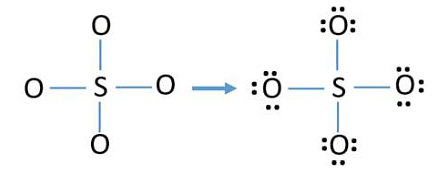
The capacity to have a higher valence is vital for becoming the centre atom. As a result, sulphur has a better chance of being the centre atom (see figure), because sulphur has a valence of 6. Oxygen has a maximum valence of two. So now we can make a SO42- ion drawing.

Atomic lone pairs
- In the diagram above, there are already four S-O bonds. As a result, there are just twelve (16-4 = 12) valence electron pairs left.
- First, on the outer atoms, label those twelve valence electron pairs as lone pairs (on oxygen atoms). Following the octal rule, one oxygen atom will take three lone pairs (an oxygen atom cannot keep more than eight electrons in its valence shell).
- Twelve electron pairs are expended for every four oxygen atoms. All electron pairs have now been used up. On the sulphur atom, there are no electron pairs to label.
Charges on atoms
Following the labeling of electron pairs on atoms, each atom's charge should be marked. Each oxygen atom will be given a -1 charge, whereas each sulphur atom will be given a +2. (-1*4 + (+2)) = -2 is the total charge of an ion.
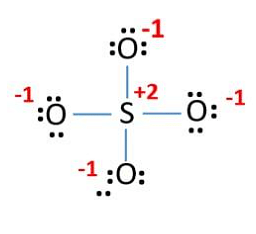
By converting lone pairs to bonds, you may check the stability of atoms and reduce their charges.
- The structure of an ion or molecule is unstable when charges occur everywhere (on atoms). Charges on atoms should be reduced as much as feasible. Now we'll look at how these facts influence the sulphate ion.
- As oxygen has a higher electronegativity than sulphur, its atoms should have negative charges. Otherwise, we can state that oxygen atoms have a greater ability to store negative charges than sulphur atoms.
- Because all atoms have charges, the drawn structure is not stable.
- We should now aim to reduce charges as much as possible by converting lone pairs or pairs to bonds. To make a new S-O bond, convert one lone pair of one oxygen atom.
- A double bond has formed between the sulphur atom and one oxygen atom. Between the sulphur atom and the other three oxygen atoms, there are now three S-O single bonds.
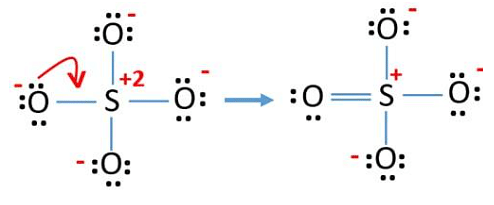
Atomic charges are lowered, as you can see. One oxygen atom now has no charge, and the charge of the sulphur atom has been lowered from +2 to +1. We now have a more stable ion than before.
Ques. Is it true that sulphates are damaging your health? (5 marks)
Ans. Due to their origin, sulphates generated from petroleum are frequently contentious. The most serious worry is the sulphate production's long-term repercussions. Climate change, pollution, and greenhouse gas emissions are all linked to petroleum products. Some plant items contain sulphates as well.
Sulphate Issues
- Long-term use of SLS (Sodium lauryl sulphate) and SLES (Sodium laureth sulphate) can irritate the eyes, skin, and lungs. SLES could also be contaminated with 1,4-dioxane, a chemical that has been shown to cause cancer in experimental animals. During the production process, contamination occurs.
- The loss of tropical rainforests for palm tree plantations has made palm oil contentious. Sulphate-containing products that are washed down the drain could be hazardous to aquatic wildlife. Many consumers and businesses are opting for more ecologically friendly options.
- Many sulphate-containing products are tested on animals to see how much discomfort they cause to people's skin, lungs, and eyes. Therefore, many people are opposed to utilising SLS and SLES in consumer items.
Ques. State the difference between sulphates and sulphites? (5 marks)
Ans: Sulphates and sulphites are both sulfur-containing chemicals. Sulphates are sulphuric acid salts that you undoubtedly come across on a regular basis. Sodium lauryl sulphate, a strong detergent that aids in the removal of grease by binding oil to water, is found in everything from dish soap and floor cleaners to body washes and shampoo; however, some people believe it is too harsh for body products, which is why some shampoos and other products are labelled "sulphate-free." Sulphates are also found in Epsom salts. Although sulphates aren't used in the making of wine, some beer makers employ calcium sulphate, commonly known as brewers' gypsum, to address mineral shortages in the water used in the brewing process.
Sulphites are naturally occurring chemicals found in all wines that work as preservatives by limiting the growth of microorganisms. Sulphites are found in a variety of foods, from molasses to dried fruit, and are generally safe to consume. However, sulphites can cause an allergic reaction in some people, particularly asthmatics, which is why wine labels have a sulfite warning. Unfortunately, because of the warning on the label, people who feel headaches or flushes after drinking wine frequently blame sulphites. It creates a great deal of ambiguity.
Ques. What do sulphates do to your hair? (5 marks)
Ans. Sulfates are responsible for the frothy texture that emerges when a product, such as shampoo, is mixed with water. Some consumers are concerned about the presence of sulphates in their shampoos and cleaning products. Sulfates are generally safe when used properly and in reasonable amounts.
- Because of the foaming action, the shampoo can be dispersed across a larger area of the head. It could also aid the shampoo's active components in working deeper into the hair to eliminate debris and excess oil. Of course, this may imply that the individual uses less shampoo.
- Sodium lauryl sulphate, sodium laureth sulphate, and ammonium laureth sulphate are the most common sulphates found in store-bought shampoos. These chemicals may also be found in minor variations in other goods. Although these are not real sulphates, they serve the same purpose.
- The use of sulphates in shampoo may have significant drawbacks. One disadvantage is that sulphates may be overly successful when it comes to cleaning. Sulfates help in the removal of oil and grime from the hair. A healthy hair must maintain some of its natural moisture and oils. Sulfates may remove too much moisture from the hair, leaving it dry and unhealthy as well as cause the scalp to become dry and irritated.
Ques. Is sulphate an acid? (5 marks)
Ans:
- Acid Equilibrium
SO42-(aq) + H2O (l ) <−−> HSO4−(aq) + OH−(aq)
SO42-(aq) + H2O(l) <−−> HSO4−(aq) + OH−(aq)
With Kb = 1 × 10 − 12 Kb = 1 ×10− 12
HSO4−(aq) + H2O(l) <−−> H2SO4(aq) + OH−(aq)
HSO4−(aq) + H2O(l) <−−> H2SO4(aq) + OH−(aq)
With Kb=1×10⁻¹⁵Kb
= 1×10⁻¹⁵
The ion sulphate is a weak base, but HSO4 is a moderately strong acid, with Ka = 0.01. In an aqueous solution, the sulfate ion undergoes very little hydrolysis since it is such a weak base.
- Solubility
The majority of sulphates, including Na+, K+ and NH4+, are water soluble. White lead (II) sulphate and white barium sulphate are the only insoluble exceptions:
BaSO4(s)<−−>Ba+2(aq)+SO42-(aq)
BaSO4(s)<−−>Ba2+(aq)+SO42-(aq)
with Ksp = 1.4 × 10⁻⁸
Ksp = 1.4 × 10⁻⁸
PbSO4(s) <−−> Pb+2(aq) + SO42-(aq)
PbSO4(s) <−−> Pb2+(aq) + SO42-(aq)
WithKsp = 1.1 × 10⁻¹⁰
Ksp = 1.1 × 10⁻¹⁰
The formation of white BaSO4 when Ba2+ is added to a SO42- solution, even if it is acidic, is a reliable sulphate test. Calcium, strontium, and mercury sulphates are among the other insoluble sulphates (I).
- Oxidation-Reduction
Sulfate has low oxidizing power. The sulphate ion cannot operate as a reducing agent because sulphur is at its maximal oxidation number.
Ques. Explain the significance of sulphate (5 marks)
Ans. In clinical medicine, the sulphate ion is thought to be an end metabolite of cysteine and methionine, two sulfur-containing amino acids. Sulfate has been linked to an increase in body acidity and has been found to cause a decrease in body fluid osmolarity. Despite the fact that sulphate does not have a catalytic activity or play a part in human energy metabolism, there is compelling evidence that it is not a physiologically inactive molecule and plays an important role in life.
- The sulphate ion is the oxidised form of sulphur (S6+) [Latin: sulphur], the 16th element of the Periodic Table, which is surrounded tetrahedrally by four oxygen molecules (O2) to produce the divalent anion SO42. Sulfate is an inorganic molecule found in nature that belongs to the group VI oxyanions, which includes structurally comparable components including selenate, molybdate, tungstate, and chromate. It is an important anion that plays a role in a variety of physiological processes and serves a variety of biosynthetic and pharmacological roles.
- Many endogenous (glycosaminoglycans, cerebrosides, steroids, catecholamines) and exogenous (acetaminophen, isoproterenol, ibuprofen, salicylate, -methyldopa) substances use sulphate in their activation and detoxifying processes. Sulfate can be taken directly from the diet or generated in the body through the oxidation of sulfur-containing amino acids such as cysteine and methionine.
Read More:



Comments