



Education Journalist | Study Abroad Lead
Sonar stands for Sound Navigation and Ranging. It is a navigation system that uses acoustic signals and is used to identify faraway things and underwater communications. Under water, Sonar offers a variety of applications, including submarine contact and route optimization. It has a lot in common with Radar and electro-optical systems. However, detection is dependent on the propagation of waves between the target and the detector once again.
| Table of Contents |
Key Terms: Sonar, Radar, Sound Waves, Electrical Impulse, Energy, Electro-Optical Signals, Echoes, Electromagnetic Radiation
What is Sonar?
[Click Here for Sample Questions]
Sonar is a navigation system that uses acoustic signals for its working. The full name of Sonar is Sound Navigation and Ranging. It is fundamentally different from radar and electro-optics because the energy is delivered by acoustic waves travelling in water. The major application of Sonar is in finding far away things underwater along with other communication purposes.
Working Principle of Sonar
[Click Here for Sample Questions]
The working principle of Sonar is based on the notion of sound waves being reflected, called as echoes. When a sound wave hits or collides with an obstruction, it reflects simultaneously. These vibrations bounce off the obstacle's face, and the Sonar receiver picks up the reflected waves. The equipment then converts the incoming waves into electrical impulses, which it interprets. The time for the waveforms to arrive is recorded and the sound speed is already determined. The obstacle's distance can be calculated using these two factors.
Read More: Huygen's Principle
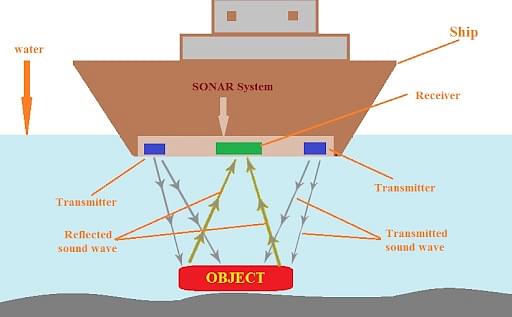
Schematic Representation of Working Principle of Sonar
Types of Sonar
[Click Here for Sample Questions]
There are two types of Sonar technologies as mentioned below:
- Active Sonar
- Passive Sonar
Active Sonar: The characteristics of active sonar are:
- It involves waiting for the reflection to return after emitting a sound wave.
- Active Sonar comprises both receiver and transmitter.
- The transmitter sends high-frequency sound signals in the desired direction and the receiver receives the re-emitted high-frequency sound waves from the target.
- Some animals employ echolocation technology (active sonar) to find the killers and targets. Examples are dolphins, whales and other marine mammals.
Passive Sonar: The characteristics of Passive Sonar are:
- Passive Sonar involves monitoring the noises made by items that are submerged.
- It is just equipped with a receiver.
- It draws attention to the sound generated by submerged items.
- It just detects the sound waves that travel through the receiver and does not emit any of its own.
- Since they don't want to be identified, it's ideal for underwater research missions.
Read More: Frequency and Wavelength
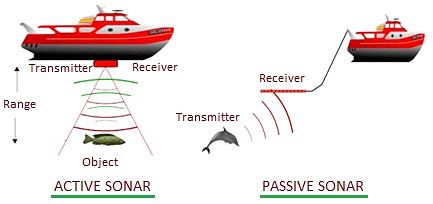
Active and Passive Sonar
Merits of Sonar
[Click Here for Sample Questions]
Mentioned below are some of the merits of Sonar:
- Sonar is the most effective technology for identifying submerged objects. In addition, it is useful for determining the depth of the water and navigating for various reasons.
- Sonar is also used to record a variety of aquatic activities.
- When we compare sonar to radar or light waves, not much in the water diminishes.
Demerits of Sonar
[Click Here for Sample Questions]
Mentioned below are some of the demerits of Sonar:
- The waves created by the Sonar harm aquatic life and endangers whales, dolphins, and other sea creatures.
- It makes a lot of noises based on the noise intensity it produces.
- Sonar technology is reasonably expensive.
Read More About Difference Between Echo and Reverberation
Applications of Sonar
[Click Here for Sample Questions]
Sonar technology finds its applications in a wide range of activities. Mentioned below are some of the most popular applications of Sonar.
Military Applications: The military applications of Sonar are:
- From waterborne boats, planes and permanent stations, modern naval warfare makes substantial use of both passive and active sonar.
- Most contemporary torpedoes include an active/passive sonar system. This can be utilised to strike the target directly, although wake homing torpedoes can also be used.
- Mines can be equipped with sonar to locate, track, and recognize the aim.
- Mine countermeasure (MCM) sonar, also known as ‘Mine and Obstacle Avoidance Sonar (MOAS)’ is a specialised sort of sonar used to discover tiny objects. The majority of MCM sonars are hull-mounted. However, a handful are VDS-style.
Civil Applications: The civil applications of Sonar are:
- Because submarines cannot utilise radar at depth, they rely on sonar larger than surface ships. The sonar arrays can be towed or placed on the hull.
- Remotely operated vehicles and uncrewed underwater vehicles have been modified with small sonars to allow them to use in murky circumstances. These sonars are employed to keep an eye on the vehicle ahead.
- Echo sounding is a method of determining the water depth beneath ships and boats.
- In case of a collision in the water, aeroplanes are equipped with sonars that operate as beacons. In addition, long- and short baseline sonars may be employed to determine the position.
Scientific Applications: The scientific applications of Sonar are:
- Using active sonar methods, identify fish and other marine and aquatic life and estimate their sizes or overall biomass.
- Wave height and duration can be measured with an upward-pointing echo sounder positioned on the bottom or a platform. These metrics can calculate the surface conditions at a specified place.
- Water velocity measurements have been made possible thanks to the development of special short-range sonars.
- Sonars have indeed been created to classify the seabed into sludge, gravel, and sand, for instance.
- Multiple causes can induce gas bubbles to leak from the seafloor or near it. Both passive and active sonar can discover them.
Things to Remember
- Sonar is different from radar and electro-optics because the energy is delivered by acoustic waves travelling in water.
- There are two types of sonar, namely, active and passive sonar.
- Sonar is used mainly underwater because sonar works best in high density mediums.
- Sonar is widely and mainly used for military purposes.
- The intensity of sound produced by sonar is very high but not harmful.
- Aquatic creatures like dolphins and whales use sound waves to locate things. But unfortunately, sonar waves can disturb them.
Sample Questions
Ques. What are the medical and industrial applications of Sonar? (2 marks)
Ans. Sonar is a technology for navigating, communicating, and detecting things on or beneath the water surface, like other boats, by using sound propagation (typically underwater, as in submarine navigation).
Industrial Applications of Sonar include:
- Machinery maintenance and repair
- Metallurgic measurement
Medical applications of Sonar include:
- Sonography
- Auditory research
- Disease diagnosis
Ques. What are the differences between Radar and Sonar? (5 marks)
Ans. Tabulated below are the main differences between Radar and Sonar:
| Radar | Sonar |
|---|---|
| A radar system detects the location and motion of an object by operating in the ultra-high-frequency (UHF) or microwave region of the radio-frequency (RF) spectrum. | Sonar is a technique or equipment for recognizing and finding items, particularly underwater, by sending out sound waves reflected by the objects. |
| Radio signals are used by radar for detection of objects. | Sound signals are used by sonar for detection of objects. |
| The radio signals are generated by electromagnetic radiation. | The sound signals are generated by to and fro motion of water. |
| Radar is used for detection of unwanted objects in air. | Sonar is used for detection of unwanted objects in water. |
| It is mostly used in space, spacecraft and aeroplanes. | It is mostly used in water for communication and ranging purposes. |
Ques. What is the foundation of sonar innovation? Is it possible to get high-definition images? (2 marks)
Ans. Radar is the foundation of sonar technology. The distinction is that while radar utilises electromagnetic pulses to identify objects, sonar employs sound pulses.
Sonar does not provide images. Instead, the target's bearing (direction) is determined via sonar. On occasion, it may also offer frequency data, such as machine sounds or screw speed. Like radar, active sonar sends sound into the ocean to listen for a return, but it completely informs the opponent of your existence.
Ques. What is sonar mapping? Is sonar mapping dangerous for aquatic animals or human beings? (2 marks)
Ans. Sonar mapping is mostly used to map the deep seabed water for a ship to navigate without grounding. Sound waves are used in sonar to measure the mass of objects of various densities. It has not been demonstrated to be detrimental to any animal with our present scientific technologies. Sound waves, it might be assumed, can be damaging depending on their strength. Bats use sound waves to echolocate. The sound helps them navigate by creating a map in their heads.
Ques. Why is sonar primarily utilised underwater? What are its countermeasures? (3 marks)
Ans. With a greater density medium, sonar functions better. The sole reason it's employed underwater is that electromagnetic technologies (radar, optical, GPS, and so on) don't operate in water owing to higher absorption. The counter measures of using sonar are:
- A submarine undergoing assault may be using active (powered) tactics to increase sound levels, create a big decoy focus, and hide the submarine's trace.
- Loud sound-generating gadgets can be installed on isolating equipment as a passive (non-powered) protective measure.
- Submarine hulls with sound-absorbing coverings, such as anechoic tiles.
Ques. What are the major applications of Sonar? (5 marks)
Ans. Some of the wide range applications of sonar are:
- To see and destroy enemy underwater mines
- To communicate using underwater sound as a medium
- To navigate under the ice
- Safe navigation in shallow water
- Determining navigational location
- Measuring sound velocity
- Emergency location beacon
- Machinery repair
- Maritime and Navigation
- Diver communication
- Fish finding
- Wreck location and salvage
- Research
- Animal location and tracking
- Animal communications
- Seismic measurements
- Bottom topography
- Volcanic measurements
- Resource location
Ques. When are the uses of active sonar? (2 marks)
Ans. The two primary uses of active sonar are:
- To detect and track other vessels
- Navigation or obstacle avoidance
In addition to detecting ships and other submarines, active sonars are used to detect ice, mines and seamounts and to determine the distance to the bottom for navigation. Active sonars also ensure signal modulation just like that of a radio for communication purposes. This modulation can be achieved by using a microphone which carries voice to the receiver. The major disadvantage of using an active sonar is that anyone near its detection range can also hear the voice created by it.
Check-Out:



Comments