



Content Curator
Square footage is a unit that is basically used to measure the area of a surface. Be it for a room, tiles or construction project, everything is measured in this unit. Square footage is also called square feet. The formula for calculating square footage varies with surfaces of different shapes. We can calculate this by using various geometry formulas.
| Table of Content |
Key Takeaways: Square footage formula, Square footage, Rectangle, Square, Parallelogram, Circle, Triangle
What is Square Footage?
[Click Here for Sample Questions]
Square footage is a unit used to describe the area of a surface. Square footage is also called square unit. The square footage formula for finding surface area differs from one surface to the other. The measurements are taken in terms of feet (ft). The unit of square footage for any given surface is expressed in square feet or sq. ft or ft2.
Also Read:
Formulas to Calculate Square Footage
[Click Here for Sample Questions]
Square Footage Formula for Squares and Rectangles
If the shape is a square or rectangle, the square footage formula is calculated as the product of length and width. Here the area/surface footage obtained is expressed in terms of feet (ft).
Square Footage Formula for Square
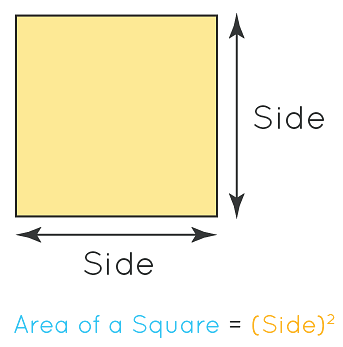
For squares, all sides measure equally. That is, the length of the sides equals the width or breadth. Hence the formula for calculating square feet of a square surface is given as:
| Square Footage formula for square = side x side = (side)2 |
Square Footage Formula for Rectangle
For any rectangular surface, the square footage is measured by multiplying the length with the breadth. That is, the product of the length and width of the rectangular surface provides the square footage or square feet.
| Square Footage formula for Rectangle = Length x width |

Square Footage Formula for Triangle
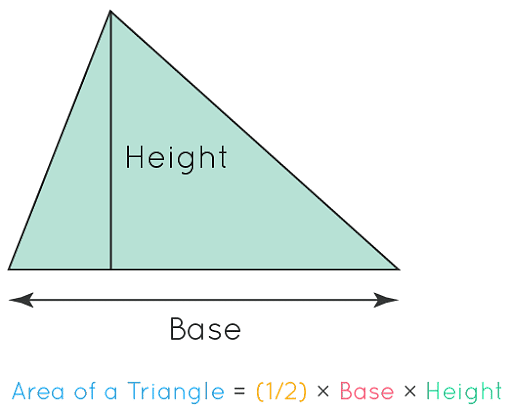
For a triangular surface, the surface footage formula is calculated by multiplying the base width with the height of the triangles. Then the obtained product is divided by 2 or multiplied by half. The formula is as follows:
| Square Footage Formula of triangle = (Base x height)/2 |
Square Footage Formula for Parallelograms
The square footage of a parallelogram is calculated as the product of its base with its height. The formula is:
| Square Footage of a parallelogram = base x height |

Square Footage Formula for Circle
Square footage formula of a circle is calculated by using the radius(r) of the circle. The formula is expressed as:
| Square footage of a circle = r2 |

Also Read:
Steps to Calculate Square Footage or Square Foot
[Click Here for Sample Questions]
Following are the steps:
- Identify the shape of the space or area (whether it is square, rectangle, circle, parallelogram or triangle). Measure its length and breadth (width).
- The measurements should be in feet. If the measurements are in metres, yards or inches, convert them into feet.
- Use one of the formulas (mentioned above), appropriate to the shape and calculate the square feet.
- In order to estimate the cost of materials, multiply the total square feet by the price per square foot.
- If the space is having a complicated shape, break the area into simple, manageable parts, calculate the area of each part separately and then add all the results together. For instance, to measure the floor of a house, calculate the square footage of each room, then add the obtained area measurements to calculate the total square feet.
Also Read:
Points to Remember
Following are some important points:
- Square footage formula is used to express the area of a surface.
- Square footage is also called square unit. The area is calculated in terms of feet (ft).
- Square footage formula of a square = side x side
- Square footage formula of a rectangle = length x breadth
- Square footage formula of a triangle = (½) x base x height
- Square footage formula of a parallelogram = base x height
- Square footage formula of a circle = r2
Also Read:
Sample Questions
Ques: The square footage of a rectangular surface is 140 sq feet. The length of the surface is 14 ft. Calculate its breadth. (2 Marks)
Ans: given,
Square footage = 140 sq ft
Length = 14 ft
The square footage formula for rectangular surface = length x breadth
140 = 14 x breadth
Therefore, breadth = 140/14
= 10 ft
Ques: A hall is in square shape with each of its sides measuring 10 ft. What is its total area in feet? (2 Marks)
Ans: Square footage formula for square = side x side
= 10 x 10
Area = 100 sq ft.
Ques: If the radius r of a circular surface is 7 ft, what is its total area in square feet? (Take π = 22/7) (2 Marks)
Ans: Square footage formula of a circle = π r2
= (22/7) 7 x 7
= 154 sq ft
Ques: The base and height measurements of a parallelogram are 4 ft and 5 ft respectively. Calculate its area or surface footage. (2 Marks)
Ans: according to the formula,
Square footage formula for a parallelogram = base x height
= 4 x 5
Area of parallelogram = 20 sq ft.
Ques: The total area of a triangular surface is 12 sq ft. Its height is given as 6 ft. Calculate its base. (2 Marks)
Ans: given,
The area of the triangular surface = ½ x base x height
Therefore, height = (area x 2)/ base
= (12 x 2)/ 6
= 4 sq ft.
Ques: What are the methods to calculate the area of a parallelogram? (3 Marks)
Ans: Three methods can be used to calculate the area of a parallelogram. They include:
- Area of a parallelogram = b x h
- Area of parallelogram = ab sin(x)
- Area of parallelogram = ½ x d1 x d2 sin(y)
Here,
b stands for Base of the Parallelogram
h stands for Height of the Parallelogram
a stands for Side 1 of the parallelogram
b stands for Side 2 of the parallelogram
d1 stands for the first diagonal of the parallelogram
d2 stands for the second diagonal of the parallelogram
y stands for the angle between the diagonals
x stands for the angle between the sides ‘a’ and ‘b’
Ques: Calculate the area of a square with a 10-meter side. (2 Marks)
Ans: Area of a square with side ‘a’ = a x a = a2
Given, a = 10 m
= (10 x 10) m2
= 100 m2
Ques: If the diameter of a circle is 12m then find the area of the circle? (π=3.14) (2 Marks)
Ans: Given, diameter ‘d’ = 12m
Since radius ‘r’ = d/2 = 12/2 = 6m
Formula for calculating area of circle = πr2
= 3.14×6×6
= 113.04m2
Ques: Calculate the area of a square with a 200-cm perimeter. (2 Marks)
Ans: perimeter of the square =200 cm
Square has got 4 equal sides
Formula for calculating perimeter of square = 4a
(where ‘a’ stands for the sides)
Therefore, 4a = 200
a = 200/4 = 50 cm
hence the area of the square = a x a = a2 = 50 x 50
area A = 2500 cm2
Ques: Find the perimeter of the circle if its radius is 7ft? (π=22/7) (2 Marks)
Ans: We know that,
The formula for calculating perimeter of a circle = 2πr
= 2× 22/7×7
= 44ft.
Also Read:



Comments