



Education Content Expert
Length is a physical quantity that is used to measure the distance between two points. It is the longest dimension of a figure and it determines how long the given object or figure is.
- Length is the measurement or extent of something from one end to another.
- Measurement of Length is a method used to determine the length of any object with the help of measuring tools.
- Length is measured in units like meters, centimeters, kilometers, inches, etc.
- The SI unit of measurement of length is Meter (m).
Read More: NCERT Solutions For Class 11 Physics Units and Measurements
Key Terms: Length, Measurement of Length, Meter, Distance, Centimeters, Metric System, International System of Units, Kilometer
What is Length?
[Click Here for Sample Questions]
Length is the measurement used to identify the size of an object or distance from one point to the other.
- It is considered to be the longest dimension of a geometrical figure.
- It determines how long a given object is.
- Length is a physical quantity with dimension distance in the International System of Units.
- It is usually measured in units such as meters (m), centimeters (cm), kilometers (km), etc.
- Length is measured with the help of measuring tools like a ruler, measuring tape, etc.
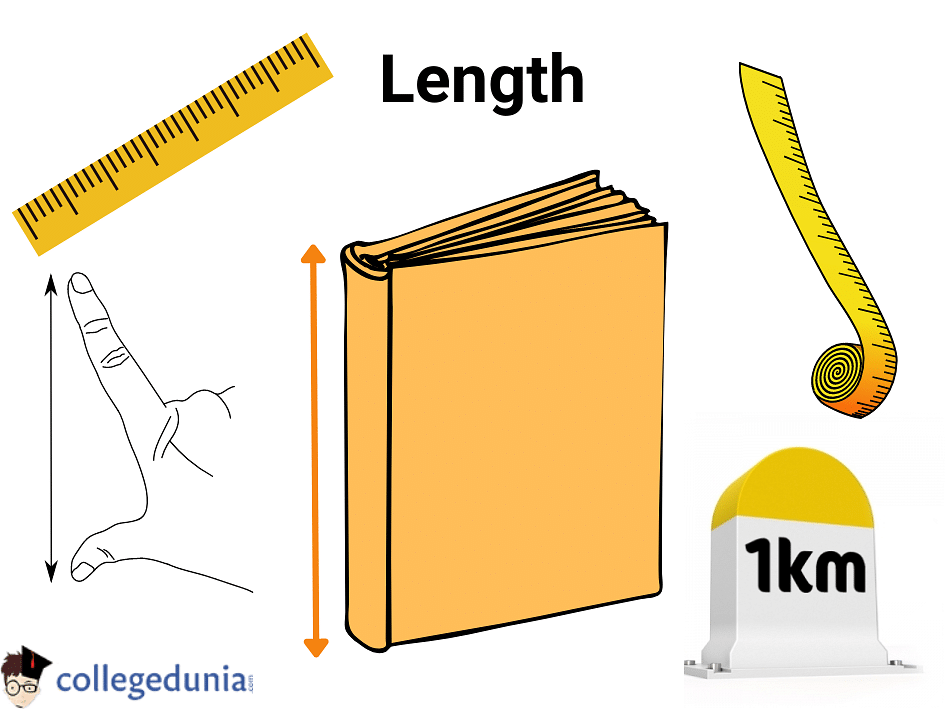
Length
Measurement of Length
[Click Here for Previous Years’ Questions]
Measurement of Length is a method of determining the length of objects in some standard or non-standard units.
- Measurement of Length is a skill that is essential to interact with the environment in a more organized manner.
- Length can be measured in either standard or non-standard units.
- Standard Units are predefined and do not change from person to person or object to object.
- Examples of standard units of measurement of length are centimeters, meters, kilometers, inches, feet, yards, etc.
- Non-standard units do not have any fixed measurement in numbers and vary from person to person and object to object.
- Examples of non-standard units of measurement of length are handspan, foot span, finger width, thread, rope, etc.
Read More:
How to Measure Length?
[Click Here for Sample Questions]
Length is most commonly measured using a Ruler, commonly known as a Scale. There are two sides of a ruler which are centimeters/millimeters and inches. The following steps need to be followed to measure length using a ruler:
- Step 1: Select the unit in which the length needs to be measured.
- Step 2: If length is needed in centimeters, take the centimeters side of the ruler and if it is needed in inches, take the inches side.
- Step 3: Now, place the object alongside the ruler starting from point 0 on it.
- Step 4: Carefully, look at the endpoint and mark the value.
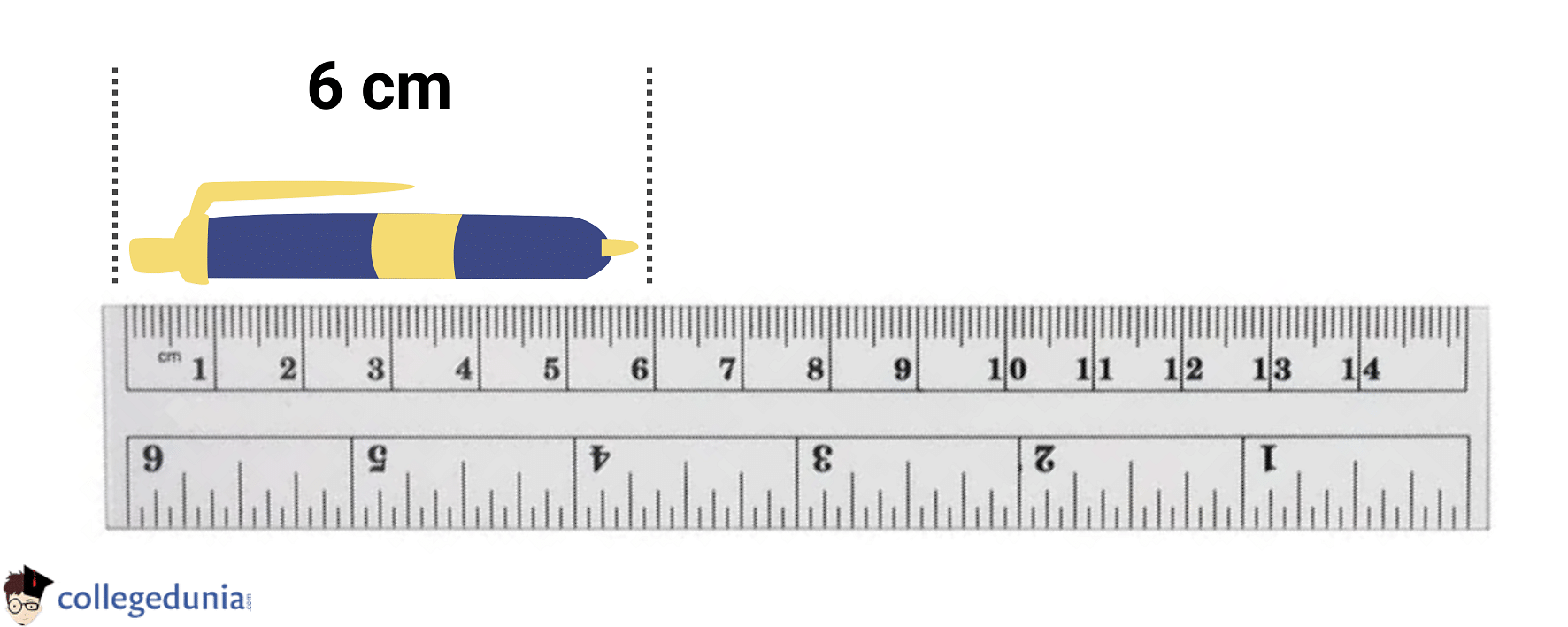
How to Measure Length?
Unit of Length
[Click Here for Previous Years’ Questions]
Length can be measured using both standard and non-standard methods. It is measured in different units such as centimeters, inches, and meters, or by using a handspan, foot span, etc. Measurement of Length can be classified into two methods:
- Standard Units of Measurement of Lengths
- Non-Standard Units of Measurement of Lengths
Units and Measurements Detailed Video Explanation
Standard Units of Measurement of Length
Standard units are pre-defined units of measurement and do not change from person to person or object to object. It means that if two or more people will measure the length of the same object using any standard unit, they will get the same result. Some commonly used standard units of measurement of length are meters, centimeters, inches, feet, yards, etc.
Standard Units are further divided into two types:
- Metric System
- Imperial Units
Metric System
Metric System of measurement of length includes units of kilometer, hectometer, decameter, meter, decimeter, centimeter, and millimeter. The base unit in metric system is Meters (m). There is a relationship of every other unit with the base unit meters as follows:
- 1 kilometer (km) = 1000 meters (m)
- 1 hectometer (hm) = 100 m
- 1 decameter (dam) = 10 m
- 1 decimeter (dm) = 1/10 m = 0.1 m
- 1 centimeter (cm) = 1/100 m = 0.01 m
- 1 millimeter (mm) = 1/1000 m = 0.001 m
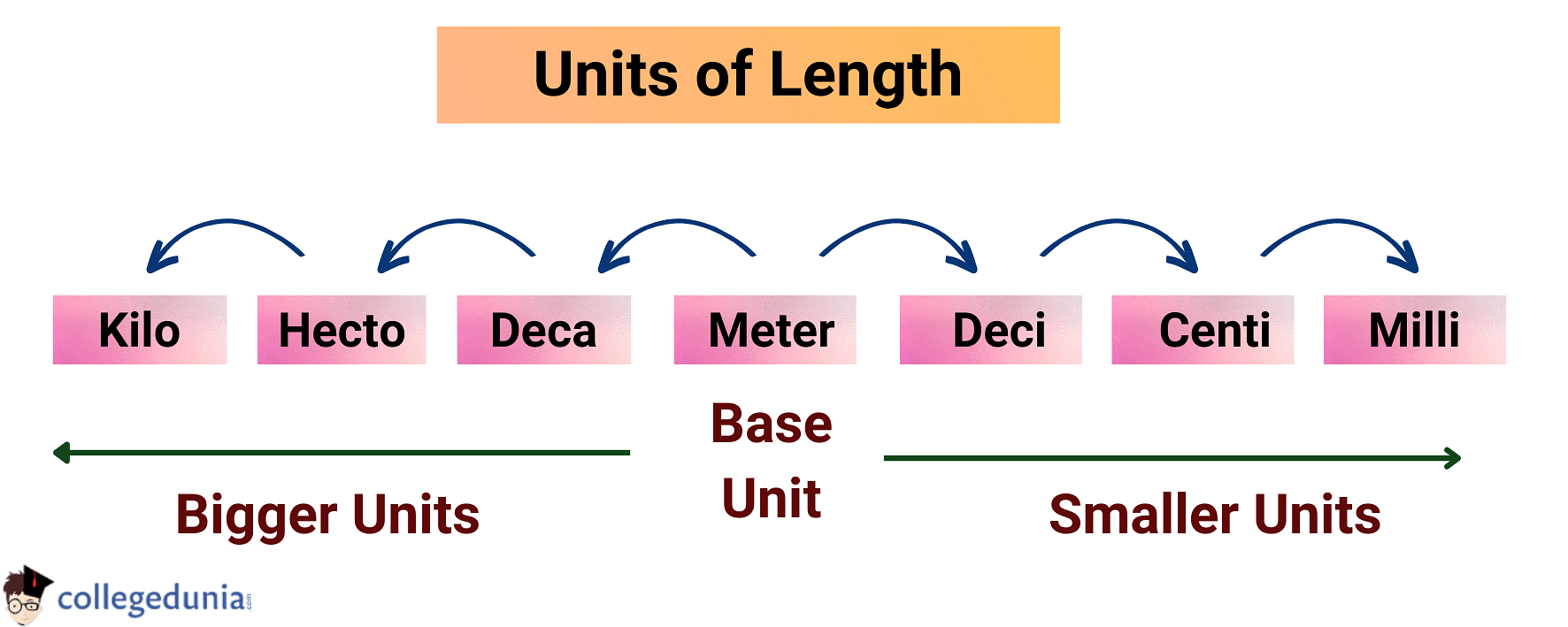
Metric System of Length
Imperial System
Imperial System of Units is the system of units laid by the British to measure different quantities. British Imperial System was established by the Weights and Measures Act of 1824 and the Act of 1878 on the basis of precise definitions of selected existing units. The imperial system includes units such as feet, yards, inches, etc.
Here is a list of units covered under the Imperial System along with their conversion into the metric system:
| Imperial System of Units | ||
|---|---|---|
| 1 Nautical Mile | 1.151 miles | 1852 meters |
| 1 Mile | 1760 yards | 1609 meters |
| 1 Furlong | 220 yards | 201 meters |
| 1 Rod | 5.50 yards | 5.029 meters |
| 1 Fathom | 6 feets | 1.829 meters |
| 1 Yard | 3 feets | 0.9144 meters |
| 1 Foot | 12 inches | 0.3048 meters |
| 1 Inch | 0.083 foot | 0.0254 meters |
Non-Standard Units of Measurement of Length
Non-Standard Units do not have a fixed measurement in numbers. These units vary from person to person and from object to object. The most common examples of non-standard units of length are handspan, foot span, finger width, thread, rope, etc.
- Handspan: It is the maximum distance between the tips of the thumb and the little finger.
- Foot-span: It is the distance between the point of the toe and the heel of the foot.
For instance, if a child and an elder measure the length of a wall using their handspan, it may be that both of them get different measurements as the handspan of a child is smaller than an elder.
Read More: Units and Measurements Important Questions
SI Unit of Length
[Click Here for Sample Questions]
S.I. Unit is an international system of measurements that are used throughout the universe in technical and scientific research to avoid confusion within the units. The SI unit of measurement of Length is Meter (m). Meter is also the base unit of length.
The value of Meter in some other units is given as follows: are given below:
- 1 m = 100 cm
- 1 m = 1000 mm
- 1 m = 0.001 km
- 1 m = 39.37 inches
- 1 m = 1.09361 yards
- 1 m = 3.28 feet
Tools to Measure Length
[Click Here for Previous Years’ Questions]
Different tools can be used for the measurement of the length of different items. The list of the most commonly used tools for measuring length is as follows:
- Ruler
- Tapes
- Yardsticks
- Meter Sticks
- Feet/foot Scale
- Odometer
Check More:
| Related Topics | ||
|---|---|---|
| Unit of Force | Unit of Acceleration | Unit of Velocity |
| Unit of Momentum | Unit of Mass | Unit of Volume |
| Unit of Length | Unit of Electricity | Unit of Weight |
Measurement of Length Chart
[Click Here for Sample Questions]
Measurement of Length Chart is a tabular representation of units of length that helps to convert a unit to another unit easily. It shows the conversion of metric units, imperial units, metric to imperial units, and imperial to metric system units of length.
Measurement of Length Chart is given as follows:
| Measurement of Length Chart | |
|---|---|
| Metric System | 1 cm = 10 mm |
| 1 m = 100 cm | |
| 1 m = 1000 mm | |
| 1 km = 1000 m | |
| Imperial System | 1 feet = 12 inches |
| 1 yard = 3 feet | |
| 1 yard = 36 inches | |
| 1 mile = 1760 yards | |
| 1 mile = 5280 feet | |
| Metric to Imperial System | 1 cm = 0.3937 inches |
| 1 m = 39.37 inches | |
| 1 m = 3.28 feet | |
| 1 km = 3280.84 feet | |
| 1 km = 0.62 miles | |
| 1 km = 1093.61 yards | |
| Imperial to Metric System | 1 inch = 2.54 cm |
| 1 foot = 30.48 cm | |
| 1 yard = 91.44 cm | |
| 1 foot = 0.3048 m | |
| 1 mile = 1.6 km | |
| 1 mile = 1609.34 m | |
| 1 yard = 0.9144 m | |
Things to Remember
- Length is the measurement of an object from one point to the other.
- Measurement of Length is a method to calculate the length of an object.
- Length can be measured using Standard as well as Non-Standard Units of Measurement.
- Standard Units are predefined units that do not change from person to person such as meters, centimeters, etc.
- Non-Standard Units are those units that change from person to person such as handspan, yards, etc.
- Meter (m) is the SI Unit of Length.
- Meters can further be converted into Millimetres (mm), Centimetres (cm), and Kilometres (km).
- Length is measured using various tools such as Rulers, Tapes, Odometers, Yardsticks, etc.
For Latest Updates on Upcoming Board Exams, Click Here: https://t.me/class_10_12_board_updates
Previous Years’ Questions
- In a particular system, the units of length, mass and time are chosen...
- A screw gauge has the least count of 0.01 mm… (NEET – 2020)
- Dimensions of stress are… (NEET – 2020)
- Lumen is the unit of… (UPSEE – 2019)
- A quantity z, to be estimated has a dependency n the variables… (TS EAMCET – 2019)
- A student measured the diameter of a small steel… [NEET – 2018]
- The nearest star to our solar system is 4.3 light years away. The… (AMUEEE – 2018)
- Planck’s constant (h), speed of light in vacuum (c) and... (NEET – 2016)
- A physical quantity of the dimensions of length that can be formed… (NEET – 2017)
- Einstein was awarded the Nobel prize for his work in… (COMEDK UGET – 2014)
- Which of the following is the smallest unit... (UPSEE – 2010)
- A body weighs 22.42 g and has a measured… (WBJEE – 2010)
Sample Questions
Ques. Can a pen of length 350 mm fit inside a pencil box of length 45 cm? (3 Marks)
Ans. Given that,
- Length of Pen = 350 mm
- Length of Pencil Box = 45 cm
The units of the pen and pencil box is different, thus, we will first convert 45 cm to mm.
1 cm = 10 mm
45 cm = 45 × 10 mm = 450 mm
As 350 mm < 450 mm, the pen can easily fit inside the given pencil box.
Ques. What is the standard unit of measuring Length? Can it be converted into other units? (3 Marks)
Ans. The standard unit of measuring length is a Meter (m). Meter is the base unit of length and can be converted into other units using the given conversion method:
- 1 m = 100 cm
- 1 m = 1000 mm
- 1 m = 0.001 km
- 1 m = 39.37 inches
- 1 m = 1.09361 yards
- 1 m = 3.28 feet
Ques. Convert 15 yards to feet. (2 Marks)
Ans. Yards and feet are two popular units of measurement of length in the imperial system of measurement. 1 Yard has 3 feet.
1 yard = 3 feet
15 yards = 15 × 3 feet = 45 feet
Thus, there are 45 feet in 15 yards.
Ques. A swing needs to be built using a rope of a length of 7200 inches. There is only 420 feet of rope available. What will be the length of rope still needed in feet to build the swing? (3 Marks)
Ans. Given that,
- Length of Rope Needed = 7200 inches
- Length of Rope Available = 420 feet
In order to find the length of the rope needed to build the swing, first convert 7200 inches to feet.
1 inch = 1/12 feet
Thus, 7200 inches = 7200/12 feet = 600 feet
Thus, the total length of rope needed in feet is 600 feet from which 420 feet is already available.
Length of Rope Needed = (600 - 420) feet = 180 feet
Thus, the length of rope needed to build the swing is 180 feet.
Ques. What is the unit of Measurement of Length? (3 Marks)
Ans. Length is measured in several nits. The units of measurement of length are classified into two major types namely Standard Units and Non-standard Units.
- Standard units are those units that have a pre-defined value that is fixed and do not change from person to person or object to object. Standard units of measurement of length are centimeters, inches, meters, yards, etc.
- Non-standard units are those units of measurement that vary from person to person. Non-standard units include units such as handspan, foot span, cubit, etc.
Ques. Explain the measurement of very Long Distance and very Short Distance Lengths. (3 Marks)
Ans. Some objects are very far away from the earth such as the sun and stars, and their distance cannot be measured with the help of Scale. Parallax is one of the most important and commonly used methods used to measure long-distance lengths.
To measure very small sizes like molecules, Electron Beams are used. Electron beams can be focused with the use of properly designed electric and magnetic fields.
Ques. Kirti walked 100 yards from her house to the grocery shop and Mahimn walked 300 feet from his house to his friend’s house. Calculate who walked more. (3 Marks)
Ans. Given that,
- Distance traveled by Kirti = 100 Yards
- Distance traveled by Mahimn = 300 Feet
We know that,
1 yard = 3 feet
100 yards = 300 feet
Thus, both Kirti and Mahimn walked the same distance, i.e. 300 feet.
Ques. What are the limitations of measuring the distance using the Parallax Method? (3 Marks)
Ans. Measuring the distance using the Parallax method has a few limitations such as:
- It is very difficult to find out the distance if the value of the parallax angle is less than 0.01 parsecs.
- This method is not suitable for space-based telescopes as they have 0.001 secs.
- The very minute value of the Milky Way which is at 30,000 parsecs distance cannot be determined as the parallax method takes the reciprocal of this distance.
- Another drawback of the parallax method is the usage of Trigonometry because the value cannot be determined without angles.
- The parallax method cannot give accurate results all the time as it is accurate to only some extent.
Ques. A boy moves along a square path of the side 10 m each in 30 seconds. Calculate the total time taken by the boy in order to complete the path. (3 Marks)
Ans. Given that,
- Length of Path = 10 m
- Time Taken = 30 seconds
Assume that the starting point of the boy is A.
Distance Traveled by Boy = A – B – C – D = 4 x 10 m = 40 m
Therefore, the total time taken to cover 40 m = 40 x 30 = 120 seconds.
Thus, the boy covers the complete path in 120 seconds.
Ques. What are the units used for measuring very short values to very long values? (3 Marks)
Ans. Three types of units are used for measuring very short values to very long values which are as follows:
- Nanometre: It is a unit for measuring length in a metric system. There are one billion nanometres in meters.
- Centimeter: It is another for measuring length in the metric system. One meter consists of 100 centimeters.
- Gigametre: There are 1 Million meters in one gigameter.
Check-Out:



Comments