



Content Curator
Straight angle is an angle with the sides opposite to the vertex in the same straight line that equals two right angles. A straight angle measures 180° (half a revolution, two right angles, or π radians). The angles form a straight line that passes through the vertex. A straight angle is also known as a 'flat angle.'
| Table of Content |
Key Takeaways: Straight angle, Angle, Liens, Straight lines, Vertex, Line segments
Also read: Isosceles Triangle Theorems
Straight Angle Measurement
[Click Here for Sample Questions]
A straight angle is similar to a straight line and has an angle measurement greater than an obtuse angle. The measurement of 180° creates a straight angle between the two intersecting lines. Straight angles can be formed by connecting three points on any straight line, each of which has a coordinate value. The outside points are the endpoints of two line segments, and the middle point is the vertex where these two lines intersect at an angle of 180°.
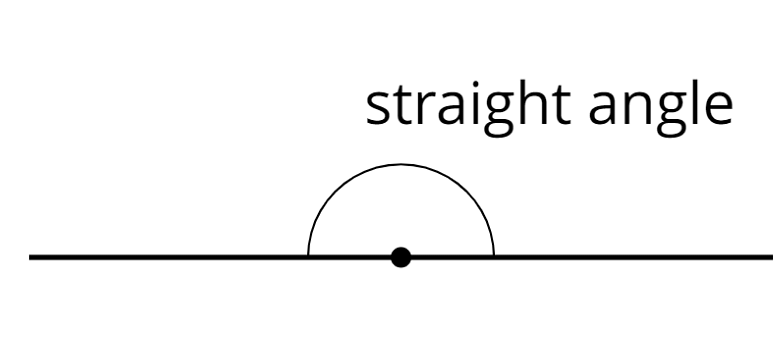
Straight Angle
The video below explains this:
Straight Angle Detailed Video Explanation:
Properties of Straight Angles
[Click Here for Sample Questions]
Straight angles have the following important properties:
- Both sides of a straight angle are perpendicular to each other.
- Half of the rotation is completed by the straight angle.
- The degree of straightness is 1800.
- Straight angles can be created by joining two right angles together.
Also read: Collinear points
Straight Angle Theorems
[Click Here for Sample Questions]
According to the straight angle theorem, all straight angles are 180 degrees. A straight angle is formed when the legs of an angle point exactly in opposite directions. A straight angle is denoted by the symbol 180 (in degrees) or (in radians).
In geometry, one good example is a line segment, the endpoints of which extend in the opposite direction.
Construction of Straight Angle
[Click Here for Sample Questions]
The steps for making a Straight Angle are as follows:
- Using a ruler, draw a straight line OB with an arrowhead at B.
- Place the protractor on this line so that the protractor's baseline is adjusted over OB. Point B should be oriented towards the protractor's 0°.
- Mark the point starting at 0° and working your way up to 180°. When you reach 180°, make a mark on the paper with the letter A.
- Now connect the vertex of the OB line to the marked point A. The arrowhead on the second ray OA should be at A.
Also read: Minors and Cofactors
Things to Remember
- Straight angles appear to be straight lines, but they have two arms. A straight line, on the other hand, has only one arm that points in one direction.
- When the sum of an acute angle and an obtuse angle is equal to a straight angle, those angles are considered supplementary.
- When we look at the angles within a circumference, we can see that they divide the circle into two equal halves and correspond to the circumference's diameter.
- It is the boundary between convex (acute, right, and obtuse angles) and concave angles.
- When you stretch your arms or a dancer stretches their legs you can see straight angles.
Also read: Properties of Determinants
Sample Questions
Ques: Find the value of angle C in ∠ABC where ∠ A=25°and ∠B=90° (3 marks)
Ans: Given ∠ A=25°and ∠B=90°
We know that,
The sum of interior angles of a triangle is 180°
Thus, ∠A+ ∠B+∠C = 180°
or, 25°+ 90° + ∠C = 180°
Or, ∠C = 180°- 115°
or, ∠C= 65°
Ques: Find the value of angle D in a Quadrilateral ABCD, where∠ A=100°, ∠B=60° and ∠C=35° (3 marks)
Ans: ∠A= 100°
∠B=60°
∠C= 35°
Here, we need to find the value of D
Therefore,
∠ A+∠B+∠C+∠D= 360°
Or, 100°+60°+35°= 360°
Or, 195°+ ∠D = 360°
Or, ∠D= 165°
Ques: ∠AOB is a straight angle, ∠AOC = (3x+20)° and ∠ BOC =(4 x-36)°. Find the value of the x. (3 marks)
Ans: As given that∠ AOC = (3x + 20)° and ∠BOC = (4x- 36) °and AOB is a straight angle.
We know that straight angle measures 180°
Therefore,
∠AOB= ∠AOC +∠BOC
180° = (3x+20)°+ (4x- 36)°
180°= 7x-16
7x= 196°
x= 28°
Ques: Find the angle complementary to the angle 50°. (3 marks)
Ans: The given angle is 50°
Here, we need to find the complementary of it
We know that two angles are complementary when they add up to 90°
Let the complementary angle be x
Now
x= 90°-50°=40°
Ques: find the supplementary of the angle 120° (2 marks)
Ans: The given angle is 120°
Here , we need to find the supplementary of it,
Let supplementary angle be x,
x= 180°-120°=60°
Ques: ∠AOB is a straight angle, ∠AOC = 68°, and ∠BOC= x°. Find the value of the x. (2 marks)
Ans: As given that ∠AOC =68° AND ∠AOB is a straight angle
We know that straight angle measures 180°
Therefore,
180°=68°+x
x=112°
Ques: The difference between the two complementary angles is 180°. Find the measure of the angle. (3 marks)
Ans: Let one angle be of measure x°,
Then complement of x= (90-x)°
difference= 18°
Therefore,(90-x)°-x° =18°
Or, 90°-90°-2x= 18°-90°
Or, x=72/2
x= 36°
Also, 90°-x= 54°
Therefore the two angles are 36° and 54°
Ques: The measure of two supplementary angles are (3x + 15)° and (2x + 5)°. Find the value of x. (3 marks)
Ans: According to the problem (3x-15)° and (2x-5)° are complementary
(3x-15)° + (2x+5)° = 180°
Or, 3x+15+2x+5= 180°
Or, 5x+20°= 180°
Or, 5x= 160/5
x= 32°
Also Read:



Comments