



Exams Prep Master
Division line segments are some of the most useful things to learn when it comes to segments and line segments in mathematics. Line segments can be divided into many parts. But these parts may or may not be equal. However, while performing the division of line segments, our focus is on dividing the line segments into equal parts. Let us learn more about division line segments with their construction steps and some solved examples.
| Table of Contents |
Key takeaways: line segments, Division line segments, division of line segments, construction, dividing a line segment, dividing the line segment internally.
What is a Line Segment?
[Click Here for Sample Questions]
When some points or dots are connected along a straight path, it is known as a line. Moreover, it doesn't have endpoints and can be extended to infinity in both directions. So, a line is a 1-dimensional figure which has no starting and ending points. A line always has length but no width or height. Now, a line segment is a part of any line between both the endpoints of that line.
For example, if there is a straight line named CD and two points are marked in between that line as a part of the same then it is a line segment.
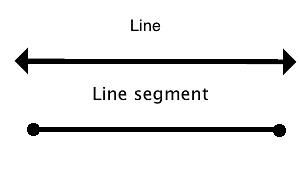
Therefore, division line segments are related to line segments. In other words, part of a line and not the entire line actually. A line segment can never be indefinite as being a part of a line, it has a starting and an ending point.
Read more: Line Segment and Ray
What is Division of Line Segments?
[Click Here for Sample Questions]
We can divide each and every line segment into 'n' number of equal parts. 'N' is a natural number there. So, as clear by the name itself, the division line segment is nothing other than dividing the line segment. For instance, one can divide a line segment of length 10 cm into two equal parts by using a ruler. The first step would be to mark a point 5 cm away from one end of the line segment. Therefore, 10 cm is divided into two 5 cm line segments. Likewise, if we have to divide a line segment of length 18 cm. It can be divided in the ratio of 2:1 as follow, CD is the line segment of length 18 cm. A is the point that divides the line segment in the ratio 2:1.

Let AC = x, then AD = 2x
(Given: AD+AC =18)
Putting the values in the formula,
AD + AC = 2x + x = 18, x = 6
AD = 12 cm and AC = 6 cm.
Mark point A, 12 cm away from C in the Line Segment.
So, that was about when we can measure the length of a line segment. But, what if one cannot measure the lengths precisely or at all? The point will not be marked correctly. No worries, there is a better way to mark a point while division line segments are done in a provided ratio. But, first, we will look at the internal and external division of the line segment.
Internal and External Division Line Segments
[Click Here for Sample Questions]
If a point performs the division of a line segment into two parts that may or may not be equal, one can use the section formula. This formula helps to find that point if the line segment's coordinates are known, and we can also use this formula to find the ratio in which the point divides a line segment only if the point's coordinates are provided. The use of this formula is determined by the position of the dividing point whether it is dividing the line segment internally or externally.
Formula of Division of Line Segments
[Click Here for Sample Questions]
Division of line segments can be done internally as well as externally. We have different formulas for both tasks.
The formula of Internal Division of Line Segment
This formula is used for the internal division of line segments i.e. when the line segments are divided in the ratio of m:n internally. In this one, point C lies anywhere between points A and B. Therefore, the coordinates of point C will be,
(px2+qx1)/(p+q), (py2+qy1)/(p+q)
Here, X coordinates are,
(px2 + qx1)/ (p + q)
Y coordinates are,
(py2 + qy1) / (p + q)
The Formula of External Division of Line Segment
This formula is used for external division of the line segments i.e. when we divide the line segments in the ratio of a: b externally. In this one, point P lies on the external parts of the line segment. Therefore, the coordinates of point P will be,
(ax2+bx1)/(a−b),(ay2+by1)/(a−b)
Here, X coordinates are,
(ax2 - bx1)/ (a - b)
and Y coordinates are,
(ay2 - by1) / (a - b)
Construction Steps of Division of line Segments
[Click Here for Sample Questions]
With the purpose of dividing a line segment internally in a given ratio m: n, where both m and n are positive integers,
We follow the following steps:
STEP OF CONSTRUCTION:
(i) Firstly, draw a line segment AB of a given length by using a line gauge or ruler.
(ii) Then, draw a ray AX that makes an acute angle with line segment AB.
(iii) Along AX mark off (m + n) points A1, A2,..., Am+n in a way so that AA1 = A1A2 = ....=Am+n+Am+n.
(iv) Join B to Am+n
(v) Now, draw a line parallel to Am+n B through the point Am by making an angle equal to the division of line segment Am.
Presume this line segment meets AB at a point P.
The point P therefore obtained is the required point that divides AB internally in the ratio m:n.
Things to Remember
- A line segment can be divided into 'n' number of parts. 'N' will always be a natural number there.
- Division of line segments can be done internally as well as externally.
- The above-provided division of line segments in mathematics is especially helpful when the ratio is provided and we cannot measure the line segment precisely.
Solved Questions
Ques: If a line segment is divided in the ratio of 2:3, how many parts is it divided into? (2 marks)
(a) 6
(b) 2
(c) 3
(d) 5
Ans: (d) 5
Reason: If a line segment is divided in the ratio of 2 : 3, then line is divided into 5 parts because 2 added to 3 is 5. As any line segment can be divided into 'n' number of parts. The 'n' here is 5.
Ques: What will be the length of the line segment if the coordinates A and B are (2,2) and (9,11) respectively? (3 marks)
(a) 11.4
(b) 13.4
(c) 15.4
(d) 17.43
Ans: (a) 11.4
Solution: Distance between the two points are
√(x2 – x1 )2 + ( y2 – y1 )2
Points are A(2, 2) and B(9, 11)
AB = √(9 – 2 )2 + ( (11 – 2 )2
AB = √(72 + ( 9 )2
AB = √ 49 + 81
AB = √ 130
Therefore, AB = 11.4
Ques: A line segment can be drawn by joining (1 marks)
(a) Two points
(b) Three points
(c) Four points
(d) More than 3 points.
Ans: (b) Three points
Reason: A line segment is when we join two points between a line. It is definite and made only after joining 2 points. That is why it is called a line segment.
Ques: To divide a line segment AB in the ratio 3:4, we draw a ray AX, so that angle BAX is an acute angle. And then mark the point on ray AX of equal distance. What is the minimum number of points this line segment can be divided into? (2 marks)
Ans: 7 is the minimum number of points that are required to divide a line segment AB in the ratio 3:4. As 3 added to 4 is 7 and any line segment can be divided into 'n' number of parts. The 'n' here is 7.
Ques: To divide the line segment AB in the ratio 5 : 6, draw a ray AX such that ∠BAX is an acute angle. Then draw a ray BY parallel to AX and the point A1, A2, A3… and B1, B2, B3… are located at equal distances on ray AX and BY respectively. Which points should be joined? (2 marks)
Ans: A5 and B6.
Explanation: given the ratio: 5 : 6
A5 and B6 would be marked in the same ratio according to the construction steps. Therefore, A5 and B6 should be joined.
Ques: To divide a line segment AB in the ratio p : q (p, q are positive integers). Draw a ray AX so that ∠BAX is an acute angle and then mark points on ray AX at equal distances such that the minimum number of these points is… (2 marks)
(a) greater of p and q
(b) p + q
(c) p + q – 1
(d) pq
Ans: (b) p + q
Explanation: number of points is always equal to the sum of two numbers provided in the ratio. In this case, the ratio is p : q, therefore, the answer should be p + q.
Ques: To divide a line segment AB in the ratio 5 : 7, first a ray AX is drawn so that ∠BAX is an acute angle and then at equal distances points are marked on the ray AX such that the minimum number of these points is: (2 marks)
(a) 8
(b) 10
(c) 11
(d) 12
Ans: (d) 12
Explanation: The minimum number of points is always equal to the sum of two numbers provided in the ratio. In this case, the ratio is 5 : 7, therefore, the answer should be 5 + 7 = 12. 12 is the minimum number of points for this division of line segment.
Ques: How many endpoints does a line segment have..? (1 marks)
(a) 5
(b) 3
(c) 2
(d) 4
Ans: (c) 2
Explanation: A line segment always has two endpoints which are marked in between of any line. The number of endpoints of line segments remains two only.
Ques: Line segment is a: (2 marks)
(a) One dimensional figure
(b) Two-dimensional figure
(c) Three-dimensional figure
(d) None of these
Ans: (a) One dimensional figure
Explanation: A line segment, just like a line, has no more than one dimension. Therefore, it is a one-dimensional figure.
Ques: Which theorem criterion we are using in giving the justification of the division of a line segment by the usual method? (2 marks)
(a) Pythagoras Theorem
(b) Basic Proportionality Theorem
(c) Angle Bisector Theorem
(d) Area Theorem
Ans: (b) Basic Proportionality Theorem
Explanation: Basic Proportionality Theorem is about proportions and division only. Therefore, we use this theorem in order to give the justification of the division of a line segment by the usual method.
Ques: Draw a line segment of length 6.3 cm & divide it in the ratio 3:4. Measure the two parts. (2 marks)
Ans: We will follow some steps here,
Step 1. Firstly, draw a line segment AB of length 6.3 cm.
Given in the question,
3x+4x = 6.3 cm
x=0.9 there.
Step 2. Now, mark 7 arcs of equal length of 0.9 cm
Therefore, AC=3×0.9 = 2.7 cm
and BC=4×0.9 = 3.6 cm.
Ques: Draw a line segment of length 7.6 cm and divide it in the ratio 5:8. (4 marks)
Ans: For this division of line segment, we will follow some steps of construction which are as follows...
1: Firstly, draw a line segment AB of length 7.6 cm using a rule.
2: Then, draw a ray AC having an acute angle with line segment AB.
3: Mark 13 (8+5 = 13) equidistant points on ray AC, A1,A2,A3,...A13.
â??
4: Join A13 to B.
5: Now, draw A5P parallel to A13B. There, Point P divides AB in the ratio of 5:8. If we measure the lengths, we will get AP=2.9 cm and PB=4.7 cm.
Mathematics Related Links:



Comments