



Exams Prep Master
Stomate, plural stomata, or stomas, any of the microscopic apertures or pores in the epidermis of leaves and young stems. Stomata are generally found on the underside of leaves. They allow gases to be exchanged between the outside air and the leaf's branched system of interconnecting air canals. It is forced to open and close by the internal pressure of two sausage-shaped guard cells that surround a stomate. Compared to the outer wall, the inner wall of a guard cell is thicker. When the guard cell is filled with water and becomes turgid, the outer wall expands, pulling the inner wall with it and expanding the stomata. Here, we will discuss the study of stomatal distribution in the lower and upper levels of leaves in detail along with some important questions.
| Table of Content |
Key takeaways: stomata, plants, leaves, pores.
Aim
[Click Here for Sample Questions]
To study the distribution of stomata in the lower and upper levels of leaves.
Theory
[Click Here for Sample Questions]
Pfeffer discovered Stomata, and Malphigii gave it the name Stomata. Stomata cover 1% to 2% of the leaf surface. It's a tiny pore found in the plant's sensitive aerial portions. Stomata are absent in algae, fungus, and submerged plants.
(a) Stomata are elliptical-shaped minute pores made up of two specialized epidermal cells termed guard cells.
(b) In dicotyledon, the guard cells are kidney-shaped, but in monocotyledon, they are dumbell-shaped.
(c) The guard cell wall surrounding the pore is thick and inelastic, despite the fact that the rest of the guard cell walls are thin, elastic, and semi-permeable.
(d) Each guard cell has a central vacuole with a cytoplasmic lining. It has a single nucleus and a large number of chloroplast in its cytoplasm. Because of the lack of RUBISCO enzyme, the chloroplast of guard cells can only do very weak photosynthesis.
(e) Guard cells are surrounded by modified epidermal cells called subsidiary cells or accessory cells, which help guard cells migrate.
Also read: Difference between T Cells and B Cells
Types of Stomata
[Click Here for Sample Questions]
On the surface of a single leaf, the number of stomata can range from a few thousand to hundreds of thousands per square cm. Stomata can be found on both the upper and lower surfaces of a leaf, but they are more common on the upper surface. Restricted to the bottom portion of the surface Stomata are only found in floating leaves.
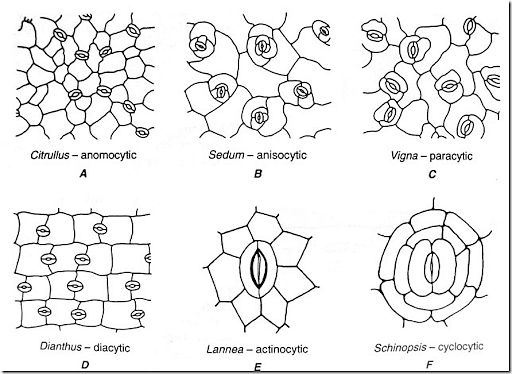
Located on the leaf's top surface.
- Topographical or Morphological Classification:
Vesque was the first to classify dicotyledon stomata into four categories.
- Ranunculaceous type: Stoma mother cell is separated from mature stomata by a simple U-shaped wall; mature stomata are surrounded by many unevenly arranged epidermal cells.
- Cruciferous type: Three or more cell walls inclined at an angle of about 60° cut off the stoma mother cell in the primordial cell; mature stomata are surrounded by three subsidiary cells, one of which is smaller than the other two.
- Caryophyllaceous or Labiateous type: Stoma mother cell is cut off from primordial cell by two U-shaped cell walls oriented in opposite directions.
- Rubiaceous type: Two parallel walls cut off the mother cell of the stoma in the primordial cell; mature stomata are accompanied by two subsidiary cells parallel to the pore's long axis.
Materials Required
[Click Here for Sample Questions]
- Blade
- Forceps
- Dropper
- Glycerine
- Coverslip
- Compound microscope
- Glass Slide
- Distilled water
- Needle and brush
- Safranin solution
- Four O’clock plant
- Watch glass
Also read:
Procedure
- This experiment uses one fresh leaf from a four-o'clock plant.
- Pour some distilled water into two watch glasses.
- Using an oblique slit, slit the leaf.
- Peel a portion from the upper surface of the leaf using forceps.
- Set this portion into one of the water-filled watch glasses.
- Peel another portion of the leaf from the lower surface with forceps.
- Place this part on a second watch glass that is also filled with water.
- Drop a few drops of safranin solution into both watch glasses with a dropper.
- With the use of a brush, apply transparent glass slides on each of the peels one at a time.
- With the use of a blade, cut a square or rectangular piece from each of the peels.
- Using a dropper, apply one drop of glycerine to each of the slides.
- Place a coverslip on the peel with the help of a needle.
- Under the microscope, examine each of the glass slides.
- The presence of stomata in each of the peels of the four-o'clock leaf's lower and upper epidermis should be noted and counted.
Observation and Conclusion
The number of stomata is substantially higher in the lower epidermis of the leaf taken from the four-o'clock plant, whereas just a few are discovered in the upper epidermis.
Also read:
Things to Remember
- Stomate, plural stomata, or stomas, any of the microscopic apertures or pores in the epidermis of leaves and young stems.
- The internal pressure of two sausage-shaped guard cells that surround a stomate causes it to open and close.
- The evaporation of water occurs through stomata in stomatal transpiration.
- The guard cell wall surrounding the pore is thick and inelastic, despite the fact that the rest of the guard cell walls are thin, elastic, and semi-permeable.
- Stomata are more found on the underside of leaves.
- Guard cells are surrounded by modified epidermal cells called subsidiary cells or accessory cells, which help guard cells migrate.
Sample Questions
Ques: What is the stomatal apparatus? (2 marks)
Ans: The subsidiary cells surround the guard cells. The epidermal cells that surround the guard cells are called specialized epidermal cells. The stomatal apparatus is made up of the pores, guard cells, and subsidiary cells.
Ques: Write about the size of the stomata. (2 marks)
Ans: They are present in the epidermis of plants and are auxiliary cells to guard cells. They exist between guard cells and epidermal cells and serve to protect epidermal cells when guard cells grow during stomatal opening. The typical number of stomata per square mm of the leaf surface is around 300.
Ques: What are the types of stomata? (4 marks)
Ans: There are four types of stomata:
- Ranunculaceous type: Stoma mother cell is separated from mature stomata by a simple U-shaped wall; mature stomata are surrounded by many unevenly arranged epidermal cells.
- Cruciferous type: Three or more cell walls inclined at an angle of about 60° cut off the stoma mother cell in the primordial cell; mature stomata are surrounded by three subsidiary cells, one of which is smaller than the other two.
- Caryophyllaceous or Labiateous type: Stoma mother cell is cut off from primordial cell by two U-shaped cell walls oriented in opposite directions.
- Rubiaceous type: Two parallel walls cut off the mother cell of the stoma in the primordial cell; mature stomata are accompanied by two subsidiary cells parallel to the pore's long axis.
Ques: What is a transpiration process in stomata? (2 marks)
Ans: Transpiration is the mechanism through which plants lose water vapour through their stomata. When the weather is particularly hot, the loss of water vapour from the plant cools the plant, and water from the stem and roots flows upwards or is 'drawn' into the leaves.
Ques: What is a four O clock plant? (3 marks)
Ans: The four-o'clock plant (Mirabilis jalapa), also known as the Peruvian marvel or the beauty-of-the-night, is a beautiful perennial plant of the Nyctaginaceae family endemic to tropical America. Four-o'clock is a fast-growing plant with oval leaves on short leafstalks that grows up to one metre (three feet) tall. At the joints, the stems are enlarged. The plant gets its name from the fact that its flowers, which range in colour from white to yellow to pink and red and are often striped and mottled, open in the late afternoon (and close by morning). Mirabilis is a genus of herbs with 45 species.
Ques: What is a stomatal index? (1 mark)
Ans: The ratio of the number of stomata to the total number of stomata and epidermal cells is the leaf's stomatal index.
Biology Related Links:



Comments