



Education Journalist | Study Abroad Lead
S Block Elements, of the modern periodic table, are the ones in which the last electron enters the outermost s-orbit. Since s-orbit only takes up to 2 electrons, hence only two groups, Group 1 and Group 2 belong to the s-block of the periodic table. S block is mainly divided into two blocks namely s1 and s2 according to the electronic configuration they take up. It comprises mainly 14 elements namely hydrogen (H), lithium (Li), helium (He), sodium (Na), beryllium (Be), potassium (K), magnesium (Mg), rubidium (Rb), calcium (Ca), caesium (Cs), strontium (Sr), francium (Fr), barium (Ba), and radium (Ra).
| Table of Contents |
Key Takeaways: S Block Elements, Group 1 Elements, Group 2 Elements, Electronic Configuration, Elements, Electrons, S-orbit, Alkali Metals, Alkaline Earth Metals, Atom, Hydroxides
What are S Block Elements?
[Click Here for Sample Questions]
Elements with their last electron in the S-orbit are called S-block elements. They are mainly categorized into two groups s1 and s2 according to the number of electrons they have in their S-orbit.
s1 groups have one electron in their s-orbit while s2 has two electrons in their s-orbit. s-block elements that have only one electron in their s-orbital are called group one or alkali metals whereas the s block elements that have two electrons filling their s-orbital are known as the group two or alkaline earth metals.
The number of electron present in an atom occupy sub-orbitals of different available energy level in the order of increasing energy. The determination of any element to which group it will be placed depends upon the shell in which the last election will be placed.
S-Block has the following elements - hydrogen (H), lithium (Li), helium (He), sodium (Na), beryllium (Be), potassium (K), magnesium (Mg), rubidium (Rb), calcium (Ca), caesium (Cs), strontium (Sr), francium (Fr), barium (Ba), and radium (Ra).
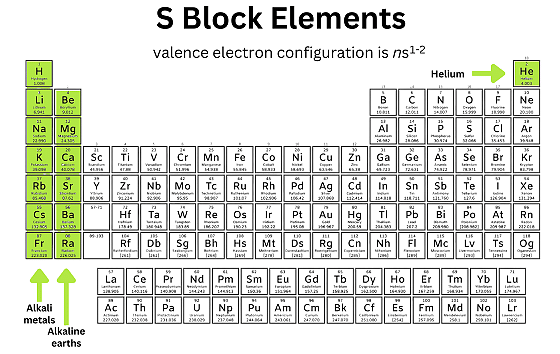
S Block Elements
Read More: The d-block Elements
Electronic Configuration of S-Block Elements
[Click Here for Sample Questions]
All the elements have either 1 or 2 electrons in their valence shell. The electron distribution takes place according to the atomic number, the shell, and different energy levels. The electron distribution in the S-orbit is of the form ns(1-2) where n is the number of the energy level or shell where the electron is found. The value of ‘n’ can vary between 1 to n. It has to be positive, non-zero, and integer. Alkali elements consist of a single valence electron in their outmost shell and the electron is loosely held thus the electropositive force is very weak which makes them unavailable in the fee state in nature.
- Group 1 Elements
s1 group of the S-Block elements contains 1 electron in their s-orbital. They are called alkali metals because they form hydroxides on their reaction with water which are strongly alkali in nature. The S-block Group1 contains the following elements.
Group 1 contains lithium, sodium, potassium, rubidium, caesium, and francium. They are collectively known as Alkali metals. Among all the elements sodium and Potassium are abundant in nature and lithium, caesium and rubidium have much lower abundance. Also, Francium is highly radioactive.
The electronic configuration of the Group 1 of S Block Elements is as follows:
| Element | Symbol | Electronic Configuration |
|---|---|---|
| Lithium | Li | 1s22s1 |
| Sodium | Na | 1s22s22p63s1 |
| Potassium | K | 1s22s22p63s23p64s1 |
| Rubidium | Rb | 1s22s22p63s23p63d104s24p65s1 |
| Cesium | Cs | [Xe]6s1 |
| Francium | Fr | [Rn]7s1 |
- Group 2 Elements
Group 2 of the S-Block elements contains 2 electrons in their S-orbital. They are called alkaline earth metals except for beryllium. They are referred so as their oxides and hydroxides are alkaline and these metal oxides are found in the earth’s crust. s2 group contains Beryllium, Magnesium, Calcium, Strontium, Barium, Radium.
Of the Alkaline Earth metals, calcium and Magnesium rank fifth and sixth in abundance, respectively, of the Alkaline Earth metals in the earth’s crust. Strontium and Barium have lower abundances. Beryllium is rarer and Radium is the rarest of all with only 10-10 per cent of igneous rock.
| Element | Symbol | Electronic Configuration |
|---|---|---|
| Beryllium | Be | [He]2s2 |
| Magnesium | Mg | [Ne]3s2 |
| Calcium | Ca | [Ar]4s2 |
| Strontium | Sr | [Kr]5s2 |
| Barium | Ba | [Xe]6s2 |
| Radium | Ra | [Rn]7s2 |
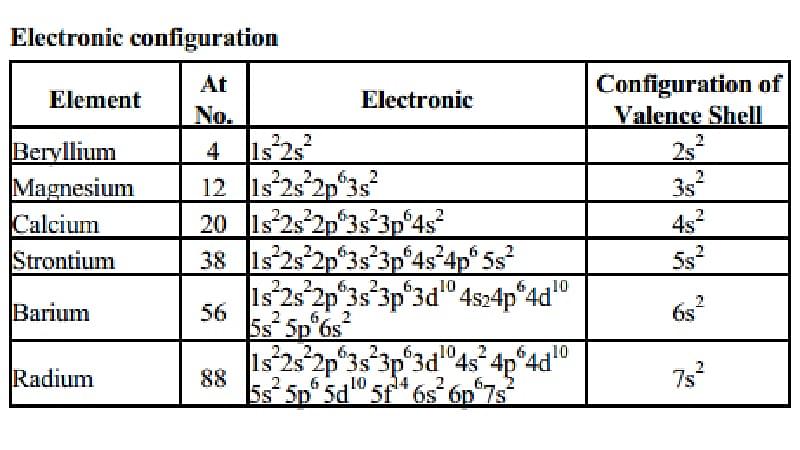
Electron Configuration of S Block Elements
Read More: The Electronic Configuration of First 30 Elements
Properties of S-Block Elements
[Click Here for Sample Questions]
The total number of elements present in the S-Block is 14. The alkali and alkaline earth elements display a regular gradation in their properties among their respective group elements. The first member of both S block elements, Lithium and Beryllium differ much from the rest of the elements, however, at the same time, they resemble more with the diagonal element present in the next column.
The reasons for the anomaly of these S-block elements are as follows:
- Low atomic and ionic size
- Greater charge density
- Greater polarization
- Absence of d-orbitals
Due to the greater polarization of s block elements, the first element is more covalent and differentiates them from the rest that is ionic.
They resemble the element diagonally placed in the next group due to the similarity in size and charge density. The physical and chemical properties of s-block elements change in a particular trend as the atomic number of the elements increases.
Here are the chemical and physical properties of S-Block Elements:
Properties of Group 1
- Electronic Configuration: All the Alkali metals have one electron in their s-orbit and are loosely held, making them the most electropositive metal. They readily lose, an electron and are never found in a free state in nature.
- Atomic and Ionic Radii: The alkali metal has the largest size in a particular period .with an increase in the atomic number the atom becomes large. the atomic and ionic radii increase as we move down the group.
- Ionization Enthalpy: Alkali metal has low ionization enthalpy, because of the increase in the size the nuclear charge increases.
- Hydration Enthalpy: There is a decrease in hydration enthalpies with an increase in ionic size. Li+ > Na+ > K+ > Rb+ > Cs+
- Alkali metals are white silvery, soft, and light metals. These elements have low density due to their large size which increases as we go down the group. the melting and boiling point of alkali metals are low and thus have a weak metallic bond. The alkali metal has their salt which eventually helps to impart characteristics of colour to an oxidizing flame. Thus alkali metal can be detected by respective flame test and can easily be determined by photometry or spectroscopy.
Properties of Group 2
- Electronic Configuration: The elements have 2 electrons in their s-orbital of the valance shell. The general configuration is ns2 and is predominantly ionic.
- Atomic and Ionic Radii: These elements have a size smaller than the corresponding alkali metal, because of the increase in nuclear charge
- Ionization Enthalpies: Due to the large size of the atom alkali earth metals have low ionization enthalpies. atomic size increases as we go down the group and ionization enthalpy decrease.
- Hydration Enthalpies: Like alkali metal ions, the hydration enthalpies decrease with strontium and barium impart characteristics, brick red, crimson, and apple green colour. Inflame the electrons are excited to a higher energy state and energy is emitted in the form f visible light. The flame test is helpful for Ca, Sr and Ba.
Read More: Ionic Bond (Electrovalent Bond)
Diagonal Relationship Between S Block Elements
[Click Here for Sample Questions]
A unique diagonal relationship exists between the adjacent elements of the second and third periods of the periodic table. Example Beryllium from Group 1 second period shows similarities with Aluminium with the third group from the third period. Likewise, lithium of group 1 and 2nd period shows similarity with the properties of magnesium which is located in 2nd group and 3rd period.
Similarities between Lithium and Magnesium
[Click Here for Sample Questions]
Given below are some similarities between Lithium and Magnesium:
- The hardness of lithium and magnesium is harder as compared to the other elements.
- Lithium and Magnesium form nitrides in the presence of Nitrogen.
- The formation of superoxides does not take place even with excess oxygen.
- When carbonates of magnesium and lithium react carbon dioxide forms oxides.
- When reacting with water they react gently and their oxides and hydroxides are less soluble.
Read More: Difference between Cations and Anions
Things to Remember
- Group 1 and Group 2 elements of the modern periodic table are called S-block elements. Group 1 elements have 1 electron in their s-orbital while Group 2 has 2 electrons in their s-orbital.
- S-Block has the following elements - hydrogen (H), lithium (Li), helium (He), sodium (Na), beryllium (Be), potassium (K), magnesium (Mg), rubidium (Rb), calcium (Ca), caesium (Cs), strontium (Sr), francium (Fr), barium (Ba), and radium (Ra).
- All s-block elements are metal, have low ionization enthalpies, and lose outermost electrons to form cations. Metallic characteristics increase down the group.
- S-Block elements are soft metals and have low melting and boiling point. They have a low value of ionization energies and hence they are highly electropositive.
- Beryllium and Magnesium have a characteristic colour of flame. Lithium and Magnesium form nitrides when reacting with nitrogen. The elements can form complexes.
Also Read:
Sample Questions
Ques. Why does the solubility of alkaline earth metal hydroxide in water increase down the group and the solubility of alkaline earth metal carbonates and sulphates in water decrease down the group? (3 Marks)
Ans. Among all the alkaline earth metals, the anion being common the cationic radius will influence the lattice enthalpy since there is a decrease in lactic enthalpy the ionic size increases, and solubility increases.
The lattice enthalpy will remain almost constant within a particular group as the size of anions is much larger as compared to cations. As the hydration enthalpy decreases down the group, the solubility will decrease as found for alkaline earth metal carbonates and sulphates.
Ques. Why are alkali metals not found in nature? (3 Marks)
Ans. Due to low ionization enthalpy value and they lose their valence electron very easily and have high reactivity. Hence they are found in an elemental state. In combined states, they are found in the form of halides, oxides, nitrates, borates, and silicates. These metals are never found in nature uncombined as they are unstable and they react fast to other elements easily by losing the electron. Alkali metals bond well with all elements except noble gases.
Ques. Why are the melting point and boiling point of alkali metal low? (3 Marks)
Ans. Because of the presence of only one valence electron their metallic bond is weak which is due to the bigger atomic size and hence they have low melting and boiling points. In simpler terms, alkali metals have only one valence electron per metal atom due to which the binding energy of alkali metal ions in the close-packed metal lattices are weak. Hence, they are soft and have a low melting point.
Ques. What do you mean by the diagonal relationship in the periodic table? (3 Marks)
Ans. There exists a diagonal relationship in S block elements between adjacent elements which are located in the second and third periods of the periodic table. For instance, Lithium of Group 1A and second-period display similarity with the properties of magnesium which are located in the 2nd group and 3rd period. In the same manner, the properties of beryllium, located in the 2nd group and 2nd period show a similarity with properties of aluminium which is located in the third period and third group.
Ques. Give the reason why the S-Block elements never occur in the free state/naturally? What is the usual mode of occurrence and how they are generally prepared? (3 Marks)
Ans. The Alkali and Alkali earth metals of the S-block elements of the periodic table are highly reactive because of their low ionization energy They are highly electropositive and form positive ions or called cations. Hence they are never available in a free state. In nature, they widely occur in the combined states in the forms of oxides, chlorides and silicates, and carbonates. They are extracted from their respective combinations. Generally, they are extracted based on their nature by the process of electrolysis.
Ques. What are the reasons that the first member of the s-block elements differs from the rest of their members? (3 Marks)
Ans. The first members of the s-block family, i.e, Lithium and Beryllium, differ from the rest of the members. This anomaly of these elements is because of the given reasons:
- Low atomic and ionic size
- Greater charge density
- Greater polarization and
- Absence of ’d’ orbitals
The first element form covalent compounds because of greater polarization, compared to the rest, which are ionic.
Ques. Why is covalent beryllium sulphate soluble in water while ionic barium sulphate is insoluble in water? (3 Marks)
Ans. The solubility of a compound depends on two factors:
- The breaking of bonds to form ionic entities
- The energy of solvation of the entities through ionic interactions
Beryllium sulphate, a covalent compound has a higher enthalpy of dissociation than ionic barium sulphate. However, the smaller entities like beryllium have higher charge density, resulting in higher solvation and thus leading to the release of hydration enthalpy, larger than the dissociating energy.
Therefore, that is the reason why BeSO4 is more soluble than ionic BaSO4.
For Latest Updates on Upcoming Board Exams, Click Here: https://t.me/class_10_12_board_updates
Check-Out:



Comments