



Content Curator
Sodium carbonate is a white-colored inorganic chemical compound formed by the combination of two elements, sodium, and carbon. Sodium carbonate is also known by the name of Washing Soda or Soda Ash.
- Soda ash is extracted from trona, which is a double salt containing sodium carbonate and sodium hydrogen carbonate formed as a result of the series of evaporation processes taking place at lakes.
- It usually has a strong alkaline taste.
- Each molecule of sodium carbonate has 2 sodium atoms, 3 oxygen atoms and 1 carbon atom.
- Each sodium cation possesses a charge of +1, while the polyatomic carbonate anion has a net magnitude charge of -2.
- Sodium carbonate is a neutrally charged molecule.
Sodium carbonate is an inorganic compound that is often used as a moderately strong base. It is a white crystalline solid, but appears as a fine powder. It generally has a slihtly salty, alkaline taste, which resembles the taste of washing soda.
Read More: Number of Moles Formula
| Table of Content |
Key Terms: Sodium Carbonate, Sodium, Carbon, Oxygen, Compound, Organic Compound, Inorganic Compounds
What is Sodium Carbonate?
[Click Here for Previous Year Questions]
Sodium carbonate is a white-colored inorganic compound. It is also known by the name of Washing Soda or Soda Ash.
- It is manufactured in the industries using Solvay’s extraction process.
- Sodium Carbonate is considered as one of the most important chemicals among all the existing basic heavy chemicals.

- Sodium carbonate is a diazonium salt of carbonic acid.
- The chemical formula of Sodium Carbonate (also known as the soda ash formula) is Na2CO3.
- Sodium Carbonate is known by the name of Soda crystals, soda ash, or washing soda.
- Sodium Carbonate is water-soluble and when dissolved in water, it gives rise to carbonic acid and sodium hydroxide.
- It is a white powder and odourless when in its pure form.
- Sodium Carbonate is a strong base and serves as an antacid.
Read Also: Phosphine
Formula of Sodium Carbonate
[Click Here for Sample Questions]
Sodium carbonate belongs to the diazonium salt family of carbonic acid. The chemical formula of Sodium Carbonate is:
| Na2 CO3 |
- Sodium Carbonate can be identified by comparing the color of the pH paper.
- The pH of Sodium Carbonate is eleven (11).
- Na2CO3 is also the washing soda formula.
- Sodium carbonate is commonly used to neutralise acidic solutions in several fields.
Structure of Sodium Carbonate
The structure of Sodium Carbonate is:
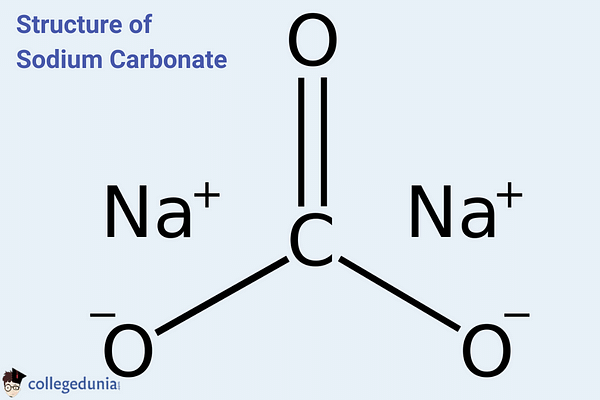
Structure of Sodium Carbonate
- Each molecule of sodium carbonate has 2 sodium atoms, 3 oxygen atoms and 1 carbon atom.
- Each sodium cation possesses a charge of +1, while the polyatomic carbonate anion has a net magnitude charge of -2.
- The Na2CO3 chemical name is Sodium Carbonate.
Read more: Bohr Model of Hydrogen Atom
Synthesis of Sodium Carbonate
[Click Here for Previous Year Questions]
Sodium carbonate is generally extracted through the following four processes:
- Solvay Process
- Labnac Process
- Dual Process
- Electrolytic Process
Among all the four the most common and the most used process is the Solvay process.
- In the Solvay process, carbon dioxide and ammonia are together passed through a cold saturated solution of sodium chloride.
- By this reaction, the formation of sodium hydrogen carbonate takes place which is very slightly soluble is the presence of sodium ions.
- Thus, it precipitates and is filtered, then finally ignited to get sodium carbonate.
- The ingredients involved in the extraction of sodium carbonate by the Solvay process are cheap and easily accessible.
- The Ingredients involve, Sodium chloride or Salt Brine (NaCl), ammonia (NH3), and Calcium carbonate or limestone (CaCO3).
- Calcium chloride (Cacl2) is an important byproduct in the process.
The reactions taking place can be represented as,
| 2NH3 + H2O + CO2 → (NH4)2CO3 (NH4)2CO3 + H2O + CO2 → 2NH4HCO3 |
- After that, add some amount of sodium chloride or common salt to the solution.
- This addition to the NH4+ and HCO3- solution leads to the formation of Sodium hydrogen carbonate which is not at all soluble.
| NH4HCO3 + NaCl → NH4Cl + NaHCO3 |
- Hence, it is removed by the process of filtration.
- The obtained product that is sodium bicarbonate is then heated to get sodium carbonate which is our desired compound.
- The Carbon dioxide so obtained in the below reaction is reusable. Thus,
| 2NaHCO3 → Na2CO3 + CO2 + H2O |
The anhydrous sodium carbonate is dissolved in the water and recrystallized to obtain the sodium carbonate crystals. The sodium carbonate crystals obtained by doing so contain 10 molecules of water crystallization.
Chemical Properties of Sodium Carbonate
[Click Here for Sample Questions]
Anhydrous sodium carbonate is seen to be stable towards heat. However, it melts without decomposition at a temperature of 852°C.
Aqueous solutions of sodium carbonate are tested to be mildly alkaline due to hydrolysis, thus releasing OH–(aq) ions.
Na2CO3(s) + 2H2O(l) → H2CO3(aq) + 2Na+(aq) + 2OH–(aq)
An aqueous solution of sodium carbonate is seen to absorb carbon dioxide from the air, thus forming sodium hydrogen carbonate.
Na2CO3(aq) + H2O + CO2(g) → 2NaHCO3(aq)
Sodium carbonate reacts with acids. For example, weak vegetable acids, like lime juice releasing carbon dioxide.
Thus,
⇒ Na2CO3(aq) + 2H+(aq) → 2Na+(aq) + H2O(l) + CO2(g)
⇒ Na2CO3(aq) + 2HCl(aq) → 2NaCl(aq) + H2O(l) + CO2(g)
Read more:
| Topic Related Concepts | ||
|---|---|---|
| Born-Haber Cycle | Dinitrogen | Sodium Hydrogen Phosphate Formula |
| Sodium Nitrate Formula | Sodium Cyanide | Reducing Agent |
Properties of Sodium Carbonate
[Click Here for Previous Year Questions]
Some of the important propeties of Sodium Carbonate are:
| Type | Property of Na2CO3 |
|---|---|
| Formula | Na2 CO3 |
| Molar mass | 105.9888 g/mol |
| Density | 2.54 g/cm3 |
| Boiling point | 1600°C |
| Melting point | 851°C |
Uses of Sodium Carbonate
[Click Here for Sample Questions]
There are various uses of Sodium carbonate. Some include:
- It is used for the manufacturing of soap, washing powder or detergents, papers, and some sodium compounds like, sodium silicate, borax, and sodium phosphate.
- Sodium carbonate is used for the production of rayon polymers.
- Sodium carbonate is used for the purpose of food additive, as in anticaking agent, raising agent, stabilizer etc.
- It is used as a wetting agent in the brick formation.
- It acts as a good pH modifier.
- It is also a well-known water softener.
- As a laboratory reagent to simplify acids and also as an analytical reagent.
Read more:
| Chapter-Related Concepts | ||
|---|---|---|
| Oxoacids of Sulphur | Atomic Spectra | Magnetic Quantum Number |
| Sulphuric Acid | Alkali Metals | Alkali Metals |
Things to Remember
- Sodium carbonate is a white-colored inorganic compound.
- It belongs to the diazonium salt family of carbonic acid with its chemical formula being Na2CO3.
- It is an outstanding laboratory reagent and also a well-known base.
- It is manufactured in the industries by the process of Solvay process, Labnac process, dual process, an electrolytic process. Among which Solvay process is the most commonly used.
- Its molar mass is 105.988 g/mol. It acts as a good pH modifier.
- It is also used for the manufacturing of soaps, detergents, papers as well as so many sodium compounds.
Previous Year Questions
- The boiling point of this solution ….[NEET 2016]
- An aqueous solution of a protein contains ….[NEET 2011]
- Sodium formate on heating gives … [JCECE 2007]
- 25.3g of sodium carbonate (Na2CO3) Is dissolved … [NEET 2010]
- The highest osmotic pressure is exhibited by 0.1 M solution ...[NEET 1994]
- Find out the molecular weight of the ...[NEET 1999]
- 1 M and 2.5 litre NaOH solution mixed with ….[NEET 1980]
- A 0.1 molal aqueous solution of a weak acid ...[NEET 2011]
- For an ideal solution, the correct option ….[NEET 2019]
Sample Questions
Ques: Is Sodium Carbonate Acid or a Base? (1 mark)
Ans: Sodium Carbonate is a basic salt and it has a strong alkaline taste.
Ques: What is the volume of distribution of Sodium Carbonate? (1 mark)
Ans: The Volume of Distribution in Sodium Carbonate occurs naturally and is confined to the systemic circulation.
Ques: Discuss sodium carbonate in detail. (2 marks)
Ans: Sodium carbonate is a white-colored inorganic compound widely used in the chemistry field to carry out several reactions. It holds the molecular formula is Na2CO3. It is a well-known base, used as a laboratory reagent, pH modifier, and for so many other purposes. It is also known by the name of soda ash, Washing Soda, and soda crystals.
Ques: What is anhydrous sodium carbonate and how it can be converted to sodium carbonate crystals? (Marks 2)
Ans: Anhydrous sodium carbonate is obtained when the Sodium bicarbonate is filtered and ignited. It holds the formula Na2CO3.nH2O. It is passed through water and recrystallized to convert it into Sodium carbonate crystals.
Ques: Discuss the hazards of sodium carbonate. (2 marks)
Ans: Although being a useful reagent in the laboratories and chemical industry, Sodium carbonate holds sufficient hazards as well. It is dangerous for the health and wellness of a human being. If inhaled, it causes problems for the lungs. It causes shortness of breath, irritation in the nasal cavity, continuous coughing, and so on. So it should be dealt with carefully.
Ques: Mention the sites where sodium carbonate can be found. (2 marks)
Ans: Other than being manufactured in the industries through several processes, sodium carbonate is also known to be found in the lake brines of California. It is found in big deposits in Wyoming. It has been used and manufactured equally for several purposes among which the top use remains the manufacturing of glass.
Ques: Discuss the properties of sodium carbonate (3 marks)
Ans: Some properties of sodium carbonate are:
- Formula- Na2CO3
- Molecular mass- 105.988 g/mol
- Melting point- 851°C
- Boiling point- 1600°C
- Density- 2.54 g/cm3
Ques: State the uses of sodium carbonate. (4 marks)
Ans: Some important uses of sodium carbonate are:
- It is used in the formation of soap, washing powder or detergents, papers.
- Used for the manufacturing of many sodium compounds such as borax, sodium silicate, etc.
- Acts as an outstanding laboratory reagent and analytical reagent.
- It is a good pH modifier.
Ques: Discuss the synthesis of sodium carbonate. (5 marks)
Ans: The sodium carbonate is obtained by mainly four types of process that are,
- Solvay process,
- Dual-process,
- Electrolytic process, and
- Labnac process.
Out of all the four Solvay processes is the most prominent process that is generally used for the extraction of sodium carbonate. In this, the Ammonia and the carbon dioxide are passed through a saturated solution of sodium chloride where we get the sodium bicarbonate.
The obtained sodium bicarbonate is completely precipitated and then filtered out and finally ignited to obtain the anhydrous sodium carbonate. The anhydrous sodium carbonate is crystallized through water which then turns into sodium carbonate crystals. The carbon dioxide that evolved out is reusable.
Read More:



Comments