



Content Curator
The difference between Monot and Dicot leaf occurs in terms of their anatomy where the monocot leaf exhibits a narrow and elongated structure with venation whereas the dicot leaf exhibits a short and rounded structure with reticulate venation. The major differences between a monocot and a dicot leaf are seen in their shape, size, coloration, venation, stomata, Intercellular spaces, Motor cells, Epidermis, and mesophylls. Based on the number of embryonic or cotyledon leaves, plants are divided into two categories – Monocots and Dicots. The number of cotyledons in dicots, and monocots exhibit different other characteristics of roots, flower parts, stems, and leaves that differentiate them from each other.
- 'Monocot' consists of only one cotyledon in flowering plants.
- “Dicot' consists of two cotyledons in flowering plants.
Also Read: Difference Between Dicot and Monocot Root
| Table of Content |
Key Terms: Monocot Leaf, Dicot Leaf, Germination, Plants, Flowers, Cotyledon, Difference between Monocot and Dicot Leaf
Monocot Leaf
[Click Here for Previous Year Questions]
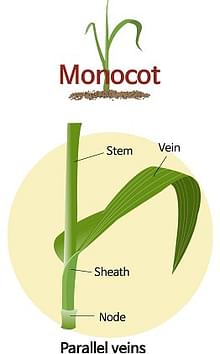
Monocot or Monocotyledonous leaf refers to flowering plants with seeds that consist of only one embryonic leaf or cotyledon.
- 60,000 species of monocots are found all over the world.
- Monocot leaves are elongated and slender with parallel veins.
- The size of veins is small with even small veins connecting them, in parallel venation compared to other forms of veins.
- Monocots have three sets of flower parts.
- Monocot roots are fibrous. For eg., Palm trees, Bananas, Water Plantains, Grass, Orchids, and Lilies.
Also Read: Protoplasm
Dicot Leaf
[Click Here for Sample Questions]
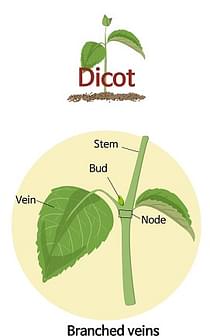
Dicot or Dicotyledonous leaf refers to flowering plants with seeds that consist of two embryonic leaves or cotyledon.
- Dicot consists of around 1,75000 known species.
- Dicot plant leaves have distributed veins in net-like or reticulated patterns.
- Throughout the leaf blade, the veins seem like a finely branched network in such leaves with thin veins associated between the major veins.
- In Dicots, the flower parts are pentamerous or tetramerous i.e in multiples of 4 or 5.
- Dicots with long deep primary roots have a tap root system that grows into finer secondary branches.
- For eg., Elms, Oaks, Maples, Mango, Papaya, Rose, Castor, Radish, and Guava.
Difference between Monocot and Dicot Leaf
[Click Here for Previous Year Questions]
Monocot and Dicot leaves differ in shape, color, etc. The difference between both monocot and dicot leaves are mentioned in the table below:
| Properties | Monocot Leaf | Dicot Leaf |
|---|---|---|
| Shape | The shapes of Monocot Leaf are narrow and elongated. | The shape of the Dicot Leaf is typically wider and round. |
| Leaf color | The color of the lower and upper surface of a Monocot leaf is green. | The color of the lower surface of a dicot leaf is light green, whereas the color of the upper surface of a dicot leaf is generally dark green. |
| Venation | Monocot leaves have equal veins. They are parallel venation | Dicot leaves have veins that spread out from one vein-like web. They are reticulate venation |
| Stomata | The shape of the stomata of the Monocot leaves is a dumbbell shape. | The shape of the stomata of the Dicot leaves is Kidney-bean shaped. |
| Distribution of Stomata | Monocot leaves are amphistomatic. On both the lower and upper epidermis, the stomata are found. | Dicot leaves are Hypostomatic. Only on the bottom of the leaf, the stomata are found. |
| Mesophyll | Monocot leaves have one layered mesophyll. | Dicot leaves have two mesophylls- Spongy mesophyll and Palisade mesophyll. Under the Palisade mesophyll, Spongy mesophyll is located, whereas, beneath the upper epidermis leaves, Palisade mesophyll cells are located. |
| Arrangement of Stomata | On both the surfaces of the leaf, the stomata are uniformly distributed and arranged in parallel rows. | On the epidermis, the stomata are randomly arranged in dicot leaves. |
| Intercellular spaces | Due to the compact arrangement of mesophyll cells, the intercellular space is small in the Monocot leaf. | Due to the existence of loosely packed mesophyll cells, the intercellular space is big in Dicot leaves. |
| Bulliform or Motor Cells | On the upper surface of the Monocot leaf, the bulliform cells are present. They are empty, big, and colorless, and their existence is found in the mid-vein region of the leaf. | In Dicot leaves, Motor cells are absent. |
| Vascular Bundles | In the Monocot leaf, many large and small size vascular bundles are present in equal patterns. | In dicot leaves, vascular bundles are generally big. |
| Nature of Orientation | The nature of orientation in the Monocot leaf is Isobilateral. Due to the existence of one type of mesophyll cells, the surface is similar on both sides of a leaf. | The nature of orientation in Dicot leaves is Dorsiventral. Due to the existence of two types of mesophyll cells, the two surfaces of the leaves vary from each other in structure and appearance. |
| Protoxylem | As protoxylem lacuna, the elements of protoxylem are distinguishable in monocot leaves. | Dicot leaves do not show distinction into the elements of protoxylem. |
| Bundle Sheath | Due to the existence of chloroplasts, monocot leaves may have one or two layers of bundle sheath that are formed of colored cells. | In dicot leaves, the bundle sheath is formed of colored cells and is generally one-layered. |
| Silica Deposition | On the wall of an epidermal cell, monocot leaves have a large deposition of silica. | On the wall of an epidermal cell, dicot leaves do not have a deposition of silica. |

Things to Remember
- Monocot leaf are the flowering plants with seeds that consists of only one embryonic leaf or cotyledon
- Plants are divided into two categories: Monocots and Dicots.
- Monocot leaves are elongated and slender with parallel veins.
- Dicot plant leaves have distributed veins in net-like or reticulated patterns.
- Dicot leaves are Hypostomatic.
- In Monocot leaves, the mesophyll is one layered.
- In Dicots, the flower parts are pentamerous or tetramerous.
Check Out:
Previous Year Questions
- In the diagram of T.S. of Stele of Dicot Root … (KCET 2004)
- The cells of the quiescent centre are characterised by … (NEET 2003)
- The chief water conducting elements of xylem in gymnosperms are … (NEET 2010)
- What is true about a monocot leaf? … (NEET 1990)
- A major characteristic of monocot root is the presence of … (NEET 2015)
- As compared to a dicot root, a monocot root has … (NEET 2012)
- Vascular bundles in monocotyledons are considered closed … (NEET 2015)
- Two cross - sections of stem and root appear simple...(AMUEEE 2005)
- The diagram represents the L.S. of monocot seed….(KEAM)
- Duramen is present in…
- Conjunctive tissue is present between...(KCET 2008)
- Organs of aquatic plants are made of a...(KCET 2012)
- Passage cells help in…. (WBJEE 2015)
- Assertion: Libriform fibres are true fibres...(MU OET 2010)
Sample Questions
Ques: Name the leaves which show reticulate venations? (1 mark)
Ans: The leaves which show reticulate venations are dicot leaves.
Ques: Mention three characteristics of monocot leaves? (2 marks)
Ans: The characteristics of monocot leaves are:
- In monocot leaves, secondary growth is absent.
- Monocot leaves have embryos with one cotyledon.
- The root of monocot leaves is adventitious.
Ques: What is the general difference between monocots and dicots? (1 mark)
Ans: The general difference between monocots and dicots is that monocots have a single cotyledon whereas dicots have two cotelydons.
Ques: Give some examples for monocot leaves? (1 mark)
Ans: Some of the examples of monocot leaves include grass, rice, orchids, lillies, etc.
Ques: Give some examples for dicot leaves? (1 mark)
Ans: Some of the examples of dicot leaves include mango, oak, peepal, radish, guava, etc.
Ques: Mention some differences between monocot and dicot stem. (2 marks)
Ans: Monocot Stem:
- There is a sclerenchymatous bundle sheath on the outside of the vascular bundle of a monocot stem.
- Monocot stems do not have trichomes.
Dicot stem:
- There is no bundle sheath on the outside of the vascular bundle of a dcot stem.
- Dicot stems have trichomes.
Ques: What are the similarities between monocot and dicot leaf? (1 mark)
Ans: The similarities between monocot and dicot leaf are seen in the presence of venation, mesophyll, stomata, vascular bundles, protoxylem, etc. The difference lies in the structure and arrangement.
Ques. Point out the differences between a maize leaf and a peepal leaf. (3 marks)
Ans. The difference between maize and peepal leaf is given below.
| Maize leaf | Peepal Leaf |
|---|---|
| Maize leaf is a monocot leaf | The Peepal leaf is a dicot leaf |
| It is Isobilateral | It is dorsiventral |
| The stomata are present on both surfaces of the leaf | The stomata are usually present on the lower side |
| It has dumbell shaped guard cells | It has bean-shaped guard cells |
| The mesophyll is not differentiated | Mesophyll is differentiated |
| Bulliform cells are present | Bulliform cells are absent |
Do Check Out:



Comments