



Exams Prep Master
In chemistry, the Elements in the periodic table are classified based on the properties they carry. The alkali metals are one of the elements of the periodic table. They are Group1 elements of the periodic table. It depends on the nature of the reaction of the metals that they display, have different names some of these metals are called alkali metals. Alkali metals are the most reactive metals and all the elements of alkali metals are very soft. Here we are going to learn everything about The elements, alkali metals. To learn we need to understand first how they are placed in the periodic table and how one element is different from the other one. Let’s know everything about the alkali metals.
| Table of Content |
Keywords: Alkali metals, properties of Alkali Metals, list of Alkali metals, applications of the alkali metal periodic trends, The periodic table.
Read More: Number of Moles Formula
What are The Alkali Metals?
[Click Here for Sample Questions]
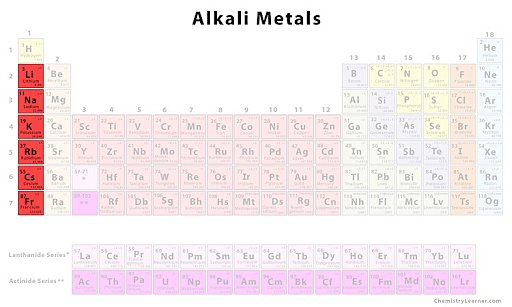
The alkali metals are the Group 1A elements and that group lies in the S-block of the periodic table of elements. They have a soft structure and due to this, it is easy to cut them. They have a surface that discolors instantly in the air. You should put them under the oil to avoid response with air. They react with water. They have a wide range of uses. The alkali metals are silvery white-color metals. All the alkali metals are highly reactive. Their high reactivity is due to the presence of electrons in their outermost shell. They can easily lose it if they need to attain high stability. They all have strong basic qualities. The electronic configuration of the alkali metals is ns1. All the alkali metals are different from each other based on their properties but they all are very reactive. All the alkali metals are good conductors of heat.
The video below explains this:
The Alkali Metals Detailed Video Explanation:
Also read:
List of the Alkali Metals
[Click Here for Sample Questions]
The Alkali metals are as follows:
Lithium (Li)
Lithium is a silvery, soft and highly reactive element. Lithium is used as a heat transfer medium in various alloys and optical forms of glass. the symbol of Lithium is Li. Lithium is discovered in 1817.
Sodium(Na)
Sodium is a light, soft and extremely malleable silvery-white element of metal. Sodium reacts explosively with water. Sodium is used in the production of industrially important compounds. The symbol of Sodium is Na. Sodium is discovered in 1807.
Potassium (K)
Potassium is a silvery-white and soft element. It is a highly reactive element of metal. Potassium oxidizes rapidly in the air and tarnishes quickly. The symbol of potassium is K. potassium is discovered in 1807.
Rubidium (Rb)
Rubidium is a soft and silvery-white element of metal. Rubidium ignites spontaneously in the air. It reacts violently with water. The symbol of Rubidium is Rb. Rubidium is discovered in 1861.
Cesium (Cs)
Cesium is a ductile, soft and silvery-white element of metal that is liquid at room temperature. It reacts explosively with water. The symbol of Cesium is Cs. Cesium is discovered in 1860.
Francium (Fr)
Francium is a short-lived radioactive element. Francium is an extremely radioactive element. It exhibits a very shot-life. The symbol of Francium is Fr. Francium is discovered on 7th January 1939.
Also read:
Properties of Alkali Metals
[Click Here for Sample Questions]
The properties of alkali metals can be separately understood with the following table:
| Element | Symbol | Atomic number | Atomic mass | Melting point | Boiling point | No. Of protons | No. Of neutrons | Crystal structure | Density | Color |
|---|---|---|---|---|---|---|---|---|---|---|
| Lithium | Li | 3 | 6.941 amu | 180.54°C – 453.69°K | 1347.0°C – 1620.15°K | 3 | 4 | Cubic | @293 K: 0.53 g/cm3 | Silver |
| Sodium | Na | 11 | 22.9877 amu | 97.8°C – 370.95°K | 552.9°C – 826.05005°K | 11 | 12 | Cubic | @293K: 0.971 g/cm3 | Silver-white |
| Potassium | K | 19 | 39.0983 amu | 63.65°C – 336.8°K | 774.0°C – 1047.15° K | 19 | 20 | Cubic | @293 K: 0.862g/cm3 | Silver-white |
| Rubidium | Rb | 37 | 85.4678 amu | 38.89°C – 312.04°K | 688.0°C - 961.15° K | 37 | 48 | Cubic | @293 K: 1.532 g/cm3 | Silvery-white |
| Cesium | Cs | 55 | 132.90546 amu | 28.5° C – 301.65°K | 678.4°C – 951.55005°K | 55 | 78 | Cubic | @293 K: 1.873 g/cm3 | Silvery-white |
| Francium | Fr | 87 | 223.0 amu | 27.0°C – 300.15°K | 677.0°C – 950.15° K | 87 | 136 | Cubic | @293 K | Unknown |
Uses of The Alkali Metals
[Click Here for Sample Questions]
- Lithium is used in the form of lithium carbonate and in batteries. It is also used to control certain mental disorders and glass.
- Sodium is used as sodium nitrate and as table salt. Sodium nitrate is an ingredient of gunpowder. Sodium is important for all living organisms.
- Potassium is used as a potassium hydroxide and it is used in fertilizers. Potassium hydroxide is used in detergents and potassium bromide is a chemical that is used in photography.
- Cesium is used in glassmaking and detection of radiation equipment.
- Francium is used in research because it is one of the rarest and radioactive elements.
Also read:
Reactions of The Alkali Metals
[Click Here for Sample Questions]
Here we are listing some reaction equations of alkali metals;
Reaction with oxygen
It reacts with oxygen to form oxides. Oxide has a dull appearance and its reactivity is low. They are less reactive than pure metals.
The chemical equation is:
4Ms+ O2g→ 2M2O
The reaction of oxide with water
When oxide reacts with water, it reacts vigorously and forms a hydroxide. Then the hydroxide of these elements dissolved completely in water and form some strongest bases like Sodium Hydroxide.
The chemical equation is as follows:
M2Os+H2O→2MOHaq
Reaction with water
The alkali metal can directly react with water if it is a pure alkali metal. The metal of pure alkali metal is basic anhydride. The hydrogen that is released is gaseous hydrogen and it is flammable.
The chemical equation is as follows;
2Ms+2H2O→2MOHaq+H2g
Reaction with Halogen
If we expose an alkali metal to a halogen then it will cause an extremely exothermic reaction & as result, we get ionic salt. the alkali metals are soluble in water. Due to their ionic nature, they form conducting solutions.
The chemical solution is as follows;
2Ms+Cl2g→2MCls
Oxides with water
The metals & their oxides react with water to yield hydroxides;
- Li2O+H2O→2LiOH
- Na2O2+2H2O→2NaOH+H2O2
- 2KO2+2H2O→2KOH+H2O2+O2
Carbonates and Bicarbonates
When the hydroxide reacts with carbon dioxide to carbonate.
The equation is as follows;
2NaOH+CO2→Na2CO3+H2O
The Periodic Table
[Click Here for Sample Questions]

Things to Remember
- Potassium has a lesser density in comparison to the density of sodium.
- Lithium & magnesium reacts slowly with water to liberate hydrogen.
- Lithium is the hardest among all the alkali metals.
- All the alkali metals have an electron in their valence shell.
- The alkali metals are the most electromotive elements & they are never found In a pure state.
- The electronic configuration of the alkali metals can be given by ns1.
Read More:
Sample Questions
Ques: Describe the density of The Alkali Metals? (2 marks)
Ans: The Alkali metals have the largest radius and they also have the largest volume but they have the lowest density. The alkali metals are so soft. You can easily cut them using a knife. Among all the alkali metals lithium, sodium and potassium are the lightest in water. Potassium has the lowest density among all the alkali metals.
The density order of alkali metal is;
Li<Na<K<Rb<Cs
Ques: Describe the atomic radius of the alkali metals through a table. (3 marks)
Ans:

Ques: What is the Electronic configuration of the alkali metals? (3 marks)
Ans: The electronic configuration of the alkali metals can be classified as follows;

Ques: What are the periodic trends of The Alkali Metals? (3 marks)
Ans: The Alkali metals lie in the S-block. They have their outermost electron in the s-orbital. The alkali metals are the best example of the group trends in properties under the periodic table. They have elements with exhibiting properties. When you move down the periodic the table is shown;
- You will see the increasing atomic radius.
- There is a decreasing electronegativity.
- There is always an increasing reactivity.
- Their boiling & melting points are in decreasing order.
Ques: What is the use of Alkali metals in everyday life? (4 marks)
Ans: here we are listing some of the uses of the alkali metals in everyday life ;
- Lithium is used to treat people with bipolar disorders.
- Lithium is also used for removing carbon dioxide from the environment.
- Sodium clothe ride is known as table salt that is used by all of us in the kitchen.
- Sodium vapors are used in the streetlights.
- There are so many foods that have potassium, that help the body to manage muscle contractions.
- Potassium prevents plants from getting yellow & stops their poor growth.
- Cesium is used in the atomic clock because measures the necessary resonant frequencies.
- Cesium is also used in solar cells & it helps to convert sunlight into electricity.
Ques: Describe the reactivity of Lithium, Sodium & Potassium with water. (4 marks)
Ans: when alkali metals react with water they produce an Alkaline
Solution. There are three different equations for the reactivity of alkali metals with water.
- Lithium+water→lithium
hydroxide +hydrogen
2Lis+2H2O1→2LiOHaq
H2g
- Sodium+water→ sodium
hydrixide+hydrogen
2Nas+2H2O1→2NaOH
aq+H2g
- Potassium+water→potassium
hydroxide+hydrogen
2Ks+2H2O1→2KOHaq +H2g
Ques: Describe melting & Boiling points. (2 marks)
Ans: Melting point- When a substance changes its state & converts itself from solid to liquid. It is called the melting point of the substance. The melting point of a substance is the temperature where a solid is converted into a liquid.
Boiling point- when a substance is changed from liquid to gas it is called the boiling point of the substance. It is the temperature at which the pressure is exerted by the surroundings upon a liquid that is equaled by the pressure. The heat results in the transformation of liquid into gas.
Read More:



Comments