




TIFR GS 2027 is also known as the Tata Institute of Fundamental Research Graduate School Admissions test. TIFR GS 2027 is conducted for admission to PhD, Integrated PhD and MSc programmes at TIFR Mumbai and its national centres. The TIFR GS 2027 application form will be available from 26 September 2026 on the official website tifr.res.in.
- The TIFR GS 2027 written test will be held on Sunday, 13 December 2026 in CBT mode with most papers running 3 hours and Mathematics PhD at CAM 2 hours.
- The TIFR physics exam pattern has 40 MCQs for 150 marks split into 25 questions of Section A and 15 questions of Section B of 5 marks each.
- The TIFR mathematics exam pattern sets 20 MCQs and 20 true/false questions for 80 marks while the separate CAM PhD paper carries 60 marks.
- The TIFR computer science exam pattern has 45 questions in three parts but only 30 questions count towards the CS or LIDS score.
- TIFR GS Chemistry carries 40 MCQs for 120 marks under the TIFR GS marking scheme while Biology JGEEBILS has 60 MCQs across four sections for 80 marks.
- In TIFR GS paper pattern for Science Education candidates need to attempt any 50 MCQs out of 80 MCQs for 100 marks and have a 50 marks descriptive section.
- TIFR GS negative marking ranges from 0 to 4 marks per wrong answer with Physics Section B and Science Education Section I carrying no deduction.
Related Articles:
Key Summary
- TIFR GS morning papers run from 9:00 AM to 12:00 PM for Science Education & Mathematics (PhD at CAM) while the afternoon session runs from 2:00 PM to 5:00 PM.
- TIFR GS Biology Subjective Assessment is not scored and candidates must answer one question from Q61 to Q63 along with the mandatory Q64 and Q65.
- TIFR GS total marks are calculated section by section with no sectional time limit and unattempted questions carry 0 marks in every subject paper.
- Unlike GATE, IIT JAM and CSIR NET where total marks stay fixed at 100 or 200 while TIFR GS total marks shift between 60 and 150 depending on the subject.
TIFR GS Exam Pattern 2027 Overview
TIFR holds one national test every December and the TIFR GS exam pattern for 2027 is expected to retain the GS-2026 structure.
| Particulars | Details |
|---|---|
| Exam Name | TIFR GS (Graduate School Admissions) |
| Conducting Body | Tata Institute of Fundamental Research (TIFR) |
| Mode | Computer-Based Test (CBT) |
| Language | English |
| Duration | 3 hours (slight variation by subject/session) |
| Frequency | Once a year (usually December) |
| Question Types | Primarily MCQs; True/False (Mathematics); occasional subjective |
| Total Questions / Marks | Varies by subject (typically 40–80+ questions; 80–150 marks) |
| Negative Marking | Yes (subject-dependent) |
| Mathematics | Part A: 20 MCQs (+2/–1)Part B: 20 True/False (+2/–2)Total: 40 Q |
| Physics | Sec A: 25 MCQs (+3/–1)Sec B: 15 MCQs (+5/0)Total: 40 Q |
| Chemistry | 40 MCQs (+3/–1) |
| Biology (JGEEBILS) | 60+ MCQs + subjective assessment |
| Computer Science & LIDS | ~45 questions across parts (typically +4/–1) |
| Science Education | ~80 MCQs (attempt max 50) + descriptive |
| Selection Process | Stage 1: Written test → Stage 2: Interview(s)/further test |
| Official Website | tifr.res.in |
Ques. Is TIFR GS exam online or offline?
Ans. The TIFR GS exam is conducted online as a computer-based test (CBT) at designated examination centres across India. The test is MCQ-based, with candidates appearing at the allotted centre.
You can watch the YouTube video "All About TIFR GS 2027 Complete Guide | Eligibility, Pattern & Strategy" by VedPrep to understand the TIFR GS exam pattern for PhD and Integrated PhD aspirants.
The video covers subject-wise eligibility, the Physics, Chemistry, Mathematics, Biology and CS marking scheme, the CBT and interview selection stages, fellowship details and career options after TIFR.
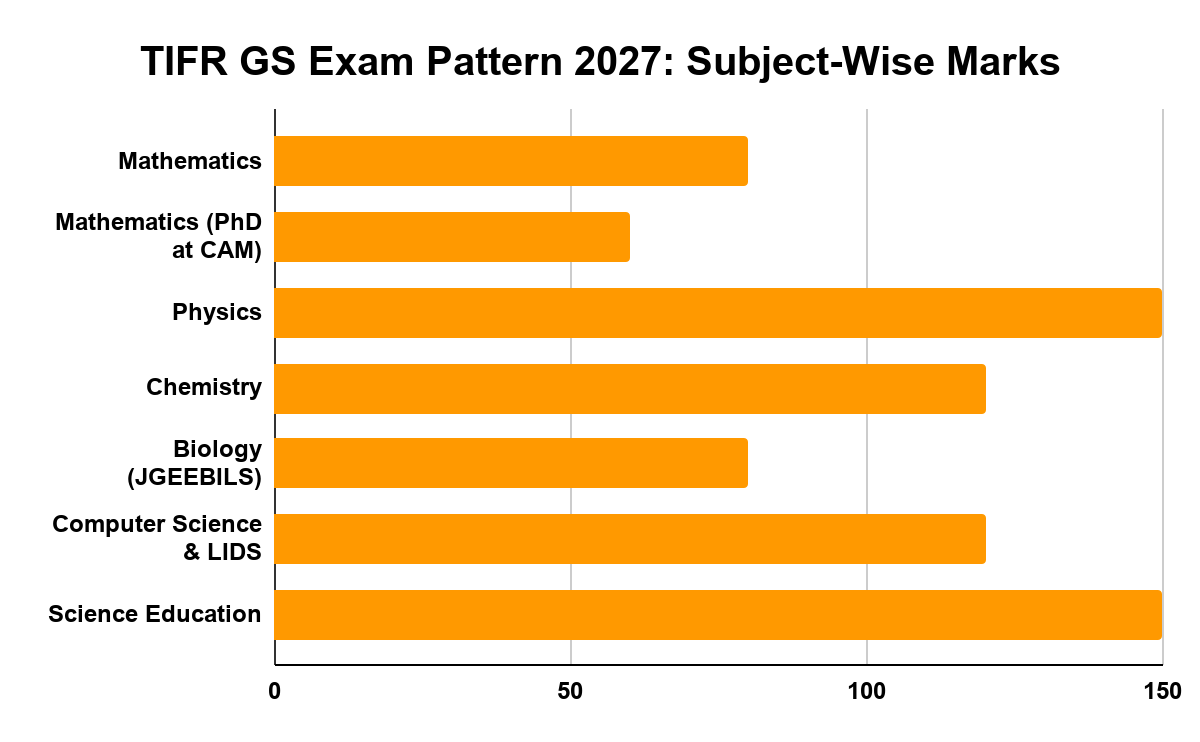
TIFR GS Exam Pattern 2027: Subject-Wise Questions and Marks
TIFR GS Exam Pattern 2027 allows CS and LIDS candidates to attempt Parts B and C with only programme-specific scores counted.
- TIFR GS Science Education allows over 50 of 80 MCQs to be attempted with scores normalised to a 50 question maximum.
| Subject Paper | Total Questions | Total Marks | Duration |
|---|---|---|---|
| Mathematics | 40 | 80 | 3 hours |
| Mathematics (PhD at CAM) | 20 | 60 | 2 hours |
| Physics | 40 | 150 | 3 hours |
| Chemistry | 40 | 120 | 3 hours |
| Biology (JGEEBILS) | 60 MCQs + Subjective Assessment | 80 | 3 hours |
| Computer Science & LIDS | 45 (15 + 15 + 15) | 120 | 3 hours |
| Science Education | 80 MCQs (max 50 counted) + Descriptive | 150 | 3 hours |
Ques. How many questions are there in TIFR GS exam?
Ans. The number of questions varies by programme, ranging from 20 questions in Mathematics PhD at CAM to 80 questions in Science Education. Physics and Chemistry have 40 questions each in the TIFR GS exam.
TIFR GS Physics Exam Pattern 2027
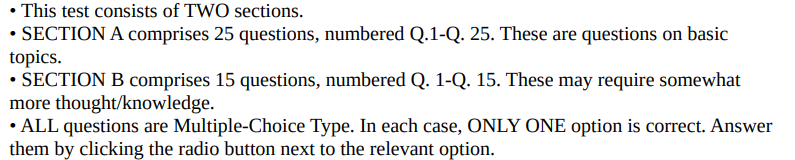
TIFR GS Physics Exam Pattern 2027 has 25 basic MCQs in Section A for 75 marks and 15 advanced questions in Section B for 75 marks.
- The TIFR GS Physics paper has 40 questions for 150 marks with a total exam duration of three hours.
| Section | Question Type | No. of Questions | Marks for Correct Answer | Negative Marking | Maximum Marks |
|---|---|---|---|---|---|
| Section A | MCQ (Basic) | 25 | +3 | –1 | 75 |
| Section B | MCQ (Advanced) | 15 | +5 | 0 | 75 |
| Total | — | 40 | — | — | 150 |
Source: TIFR GS Physics Official
Ques. Is there negative marking in TIFR GS Physics Section B?
Ans. No, TIFR GS Physics Section B has no negative marking. Each correct answer carries 5 marks, while an incorrect or unattempted answer receives 0 marks.
TIFR GS Mathematics Exam Pattern 2027
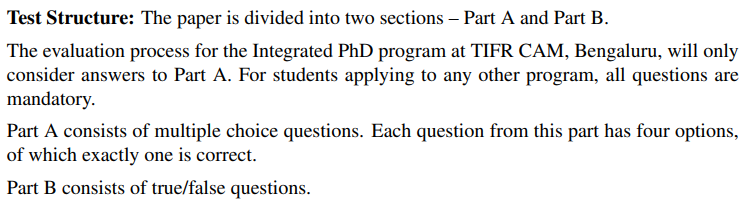
TIFR GS Mathematics Exam Pattern 2027 has 20 MCQs in Part A and 20 true or false questions in Part B with 40 questions overall.
- Part A and Part B carry 40 marks each, making the total 80 marks for the TIFR GS Mathematics paper.
| Section | Question Type | No. of Questions | Marks for Correct Answer | Negative Marking | Maximum Marks |
|---|---|---|---|---|---|
| Part A | Multiple Choice (4 options, exactly one correct) | 20 | +2 | –1 | 40 |
| Part B | True / False | 20 | +2 | −2 | 40 |
| Total | — | 40 | — | — | 80 |
Source: TIFR GS Mathematics Official
Also Check:
Ques. How many marks is the TIFR GS Mathematics paper?
Ans. The TIFR GS Mathematics paper carries 80 marks, with 40 questions divided equally between Part A and Part B. Part A has 20 MCQs carrying 2 marks each, while Part B has 20 True/False questions carrying 2 marks each.
TIFR GS Mathematics (PhD at CAM) Exam Pattern 2027
TIFR GS Mathematics PhD at CAM Exam Pattern 2027 has two parts with 10 MCQs each, making 20 questions for 60 marks.
- The TIFR GS Mathematics PhD at CAM paper has a two hour duration and carries 60 marks in total.
| Section | Question Type | No. of Questions | Marks for Correct Answer | Negative Marking | Maximum Marks |
|---|---|---|---|---|---|
| Part A | Multiple Choice (exactly one correct) | 10 | +2 | −2 | 20 |
| Part B | Multiple Choice (exactly one correct) | 10 | +4 | −4 | 40 |
| Total | — | 40 | — | — | 60 |
TIFR GS Computer Science Exam Pattern 2027
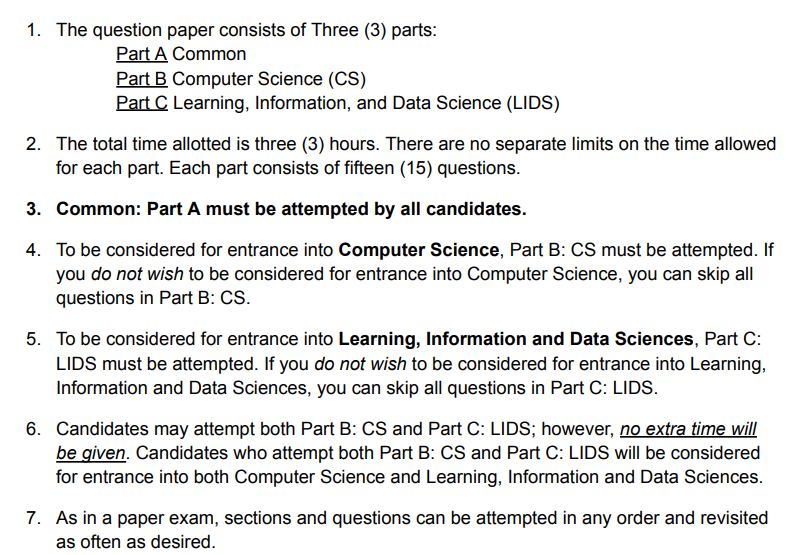
TIFR GS Computer Science Exam Pattern 2027 requires all candidates to attempt Part A which is mandatory.
- For Computer Science admission, marks from Part A and Part B are counted while Part C is not considered.
- For LIDS admission, marks from Part A and Part C are counted while Part B is not considered.
- Candidates can attempt Parts B and C without extra time and can be considered for both Computer Science and LIDS programmes.
- All TIFR GS Computer Science questions carry equal marks while unanswered questions get 0 marks.
| Section | Question Type | No. of Questions | Marks for Correct Answer | Negative Marking | Maximum Marks |
|---|---|---|---|---|---|
| Part A (Common) | Multiple Choice | 15 | +4 | −1 | 60 |
| Part B (Computer Science) | Multiple Choice | 15 | +4 | −1 | 60 |
| Part C (LIDS) | Multiple Choice | 15 | +4 | −1 | 60 |
| Total (for one stream) | — | 30 | — | — | 120 |
Source: TIFR GS Computer Science Official
Also Check:
Ques. Do Part C marks count for TIFR Computer Science admission?
Ans. No. For TIFR Computer Science admission, only marks from Part A (Common) and Part B (Computer Science) are considered. Part C (LIDS) marks are ignored for Computer Science admission.
TIFR GS Chemistry Exam Pattern 2027
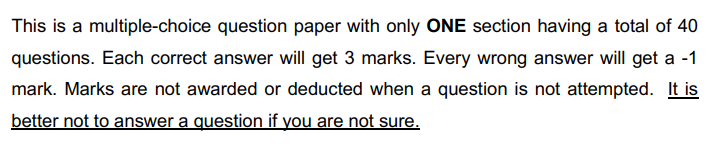
TIFR GS Chemistry Exam Pattern 2027 has 40 MCQs in one section, carrying 120 marks in total.
- The TIFR GS Chemistry paper has a fixed duration of three hours with all 40 questions in a single section.
| Section | Question Type | No. of Questions | Marks for Correct Answer | Negative Marking | Maximum Marks |
|---|---|---|---|---|---|
| Single Section | Multiple Choice (one correct option) | 40 | +3 | −1 | 120 |
Source: TIFR GS Chemistry Official
Also Check:
Ques. How many sections are in the TIFR GS Chemistry paper?
Ans. The TIFR GS Chemistry paper has one section, consisting of 40 multiple-choice questions. The paper carries 120 marks, with 3 marks for each correct answer and 1 mark deducted for each wrong answer.
TIFR GS Biology Exam Pattern 2027 (JGEEBILS)
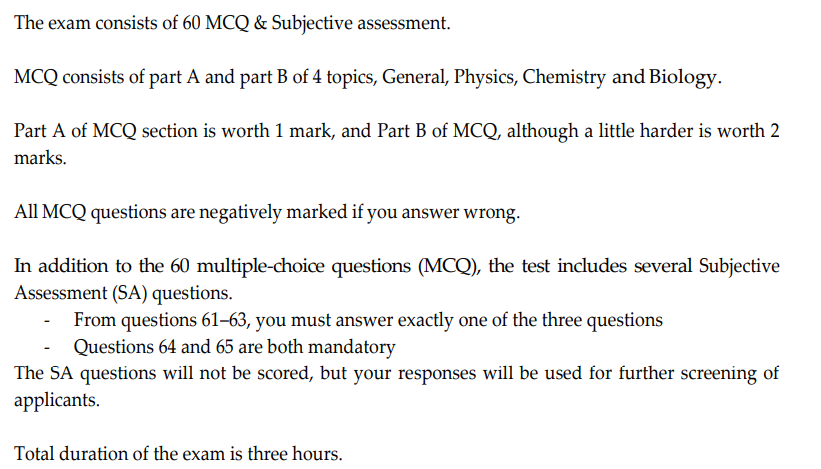
TIFR GS Biology Exam Pattern 2027 has 60 MCQs across General, Physics, Chemistry and Biology with 15 questions per section.
- JGEEBILS has 60 scored MCQs for 80 marks while the additional Subjective Assessment responses are unscored and used for screening.
| Section | Sub-section | No. of Questions | Marks per Correct Answer | Maximum Marks |
|---|---|---|---|---|
| General | A | 10 | +1 | 10 |
| B | 5 | +2 | 10 | |
| Physics | A | 10 | +1 | 10 |
| B | 5 | +2 | 10 | |
| Chemistry | A | 10 | +1 | 10 |
| B | 5 | +2 | 10 | |
| Biology | A | 10 | +1 | 10 |
| B | 5 | +2 | 10 | |
| Total (MCQ) | - | 60 | - | 80 |
TIFR GS Biology Exam Pattern 2027: Subjective Assessment (SA)
- TIFR GS Biology Exam Pattern 2027 requires candidates to answer exactly one question from Questions 61-63 in the Subjective Assessment.
- Questions 64 and 65 are mandatory in the TIFR GS Biology Subjective Assessment section.
Source: TIFR GS Biology Official
Also Check:
Ques. Is Physics asked in the TIFR GS Biology exam?
Ans. Yes. The TIFR GS Biology exam includes basic Physics questions, along with Chemistry, Mathematics and Biology. TIFR states that the Biology test has four sections covering the basics of Physics, Chemistry, Biology and Mathematics.
TIFR GS Science Education Exam Pattern 2027
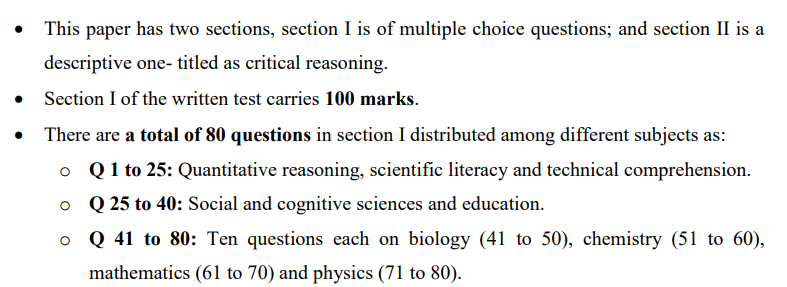
TIFR GS Science Education Exam Pattern 2027 has 80 MCQs in Section I with candidates allowed to attempt any 50 for 100 marks.
- Section II has three descriptive critical reasoning questions worth 50 marks, taking the total paper to 150 marks.
| Section | Question Type | No. of Questions | Marks for Correct Answer | Maximum Marks | Notes |
|---|---|---|---|---|---|
| Section I (MCQ) | Multiple Choice (4 options) | 80 | +2 | 100 | Attempt any 50; excess normalized |
| Section II (Critical Reasoning) | Descriptive | 15 | — | 50 | Q81: 20 marks; Q82 & Q83: 15 marks each |
TIFR GS Science Education Exam Pattern 2027: Question Distribution in Section I
- Q 1–25: Quantitative reasoning, scientific literacy and technical comprehension
- Q 26–40: Social and cognitive sciences and education
- Q 41–50: Biology
- Q 51–60: Chemistry
- Q 61–70: Mathematics
- Q 71–80: Physics
Source: TIFR GS Science Education Official
Also Check:
Ques. Can I copy and paste in the TIFR Science Education descriptive section?
Ans. No. In the TIFR Science Education descriptive section, Ctrl+C, Ctrl+X and Ctrl+V are disabled in the text boxes. TIFR states that using these keys, accidentally or otherwise, can erase the text already entered.
TIFR GS Marking Scheme 2027 and Negative Marking
According to the TIFR GS marking scheme, unanswered questions carry 0 marks in every subject paper.
- TIFR GS negative marking applies in Mathematics, Computer Science & LIDS and Chemistry so candidates should avoid random guesses.
- In the Mathematics PhD at CAM paper, Part B awards +4 marks for a correct answer and deducts 4 marks for a wrong one.
- Science Education Section I has no negative marking so candidates can attempt up to 50 questions without losing marks.
- For Biology (JGEEBILS), TIFR has 0.25 marks in section A and 0.50 in section B deducted for a wrong answer.
| Subject / Paper | Section / Type | Correct Answer | Wrong Answer | Unanswered |
|---|---|---|---|---|
| Mathematics (Main) | Part A (MCQ) | +2 | −1 | 0 |
| Part B (True/False) | +2 | −2 | 0 | |
| Mathematics (PhD at CAM) | Part A (MCQ) | +2 | −2 | 0 |
| Part B (MCQ) | +4 | −4 | 0 | |
| Physics | Part A | +3 | -1 | 0 |
| Part B | +5 | 0 | 0 | |
| Computer Science & LIDS | Part A / B / C (MCQ) | +4 | −1 | 0 |
| Chemistry | Single Section (MCQ) | +3 | −1 | 0 |
| Biology (JGEEBILS) | Sub-section A (MCQ) | +1 | − 0.25 | 0 |
| Sub-section B (MCQ) | +2 | − 0.50 | 0 | |
| Science Education | Section I (MCQ) | +2 | 0 | 0 |
| Section II (Descriptive) | As marked | - | - |
Ques. Is there negative marking in TIFR GS exam?
Ans. Yes, negative marking is applicable in the TIFR GS exam, but the marking scheme varies by subject and question type. For example, the Mathematics paper deducts marks for wrong answers, while some numerical-type questions in Physics do not carry negative marking.
TIFR GS Total Marks Calculation with Examples
The TIFR GS total marks depend on the number of correct and wrong answers in each section of the selected subject paper.
- Candidates need to calculate section-wise marks first as 5 of 7 TIFR GS papers change the marks or deduction between sections.
| TIFR GS Total Marks Formula: Total Marks = (Correct Answers × Marks per Correct Answer) − (Wrong Answers × Marks Deducted per Wrong Answer), calculated for each section and then added |
Suppose a Physics candidate attempted 15 questions in Section A with 11 correct and 4 wrong answers. In Section B, the candidate attempted all 15 questions with 9 correct and 6 wrong answers.
TIFR GS Physics Score = (11 × 3) − (4 × 1) + (9 × 5) − (6 × 0) = 33 − 4 + 45 = 74
Hence, the candidate's TIFR GS Physics score is 74 out of 150, as wrong answers in Section B carry no deduction.
Ques. Do unattempted questions reduce TIFR GS total marks?
Ans. No, unattempted questions do not reduce TIFR GS total marks. They carry 0 marks, while negative marking applies only to incorrect answers where specified in the respective subject's marking scheme.
TIFR GS Exam Duration and Session Timings 2027
TIFR GS Exam Duration 2027 are three hours for most papers while Mathematics PhD at CAM lasts two hours.
- Candidates can take multiple TIFR GS subject tests on the same day if the morning and afternoon sessions do not overlap.
| Session | Timing | Duration | Subjects Covered |
|---|---|---|---|
| Morning Session | 9:00 am – 12:00 pm | 3 hours | Physics, Chemistry, Computer Science & LIDS, M.Sc. (Wildlife Biology & Conservation) |
| Morning Session | 9:00 am – 11:00 am | 2 hours | Mathematics (PhD at CAM only) |
| Afternoon Session | 2:00 pm – 5:00 pm | 3 hours | Biology (JGEEBILS), Mathematics (all other programs), Science Education |
Ques. Is there a sectional time limit in TIFR GS?
Ans. No, the TIFR GS exam does not have a separate sectional time limit. However, the overall exam duration varies by programme, with Physics, Chemistry and Computer Science scheduled for 3 hours, while the Mathematics PhD at CAM has 2 hours.
TIFR GS Exam Pattern 2027 vs GATE, IIT JAM, CSIR NET and JEST
TIFR GS total marks change from 60 to 150 by subject whereas GATE, IIT JAM and JEST Physics carry 100 marks and CSIR NET carries 200.
- TIFR GS Physics and Chemistry have 40 questions in 3 hours, the same count as JEST Physics while GATE sets 65 and IIT JAM sets 60.
- TIFR GS is the only exam here with true/false and descriptive questions while GATE, IIT JAM and JEST include numerical answer questions.
- GATE and IIT JAM deduct only 1/3 or 2/3 mark on MCQs whereas TIFR GS negative marking in Mathematics Part B takes away the full 2 marks.
| Parameter | TIFR GS | GATE | IIT JAM | CSIR NET | JEST |
|---|---|---|---|---|---|
| Mode | CBT | CBT | CBT | CBT | CBT |
| Duration | 2–3 hours (varies by subject) | 3 hours | 3 hours | 3 hours | 3 hours |
| Total Questions | 20–80 (subject-dependent) | 65 | 60 | 60–75 (varies by subject) | 50 |
| Total Marks | 60–150 (subject-dependent) | 100 | 100 | 200 | 100 |
| Question Types | MCQ, True/False, Descriptive (varies) | MCQ, MSQ, NAT | MCQ, MSQ, NAT | MCQ only | Mostly MCQ |
| Negative Marking | Yes (varies: −1 to −4) | Yes (MCQ only: −1/3 or −2/3) | Yes (MCQ only: −1/3 or −2/3) | Yes (varies by part) | Yes (−1 typically) |
| Sections | 1–3 (highly subject-specific) | GA + Subject | 3 (A, B, C) | 3 (A, B, C) | Single / few parts |
| Frequency | Once a year (December) | Once a year (February) | Once a year (February) | Twice a year | Once a year (February/March) |
| Primary Purpose | PhD / Integrated PhD at TIFR centres | M.Tech / PSU / some PhD | M.Sc. / Integrated PhD | JRF / Lectureship / PhD | PhD / Integrated PhD at research institutes |
| Difficulty Level | Very High (conceptual & research-oriented) | High | Moderate to High | High to Very High | High to Very High |
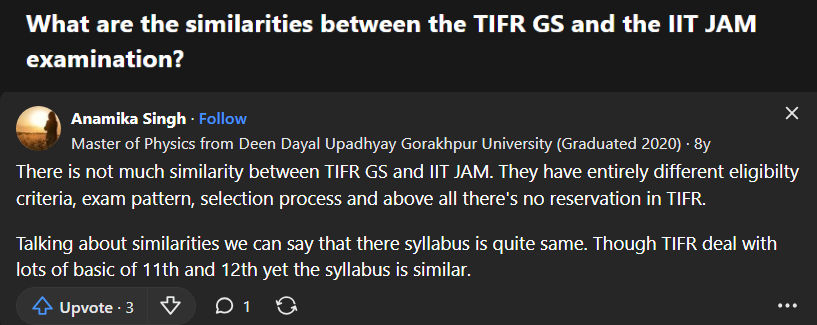
According to a Quora discussion, TIFR GS and IIT JAM have different eligibility, exam patterns and selection processes, with limited similarities. The discussion noted that their syllabi are quite similar, although TIFR GS includes basic Class 11 and 12 concepts.
Source: Quora
TIFR GS Exam Pattern 2027: Frequently Asked Questions
Ques. Is the TIFR GS exam tough?
Ans. The TIFR GS exam is considered challenging because it tests strong conceptual understanding and problem-solving skills in subjects such as Physics, Chemistry, Mathematics and Computer Science. The difficulty also varies by subject and programme.
Ques. Which is better, IIT or TIFR?
Ans. IITs and TIFR serve different academic purposes. IITs offer a wider range of engineering, technology and science programmes, while TIFR focuses strongly on fundamental research and postgraduate research programmes.
Ques. Does TIFR accept IIT JAM?
Ans. IIT JAM is not a general admission route for TIFR GS. TIFR primarily uses its GS entrance test and, for selected programmes, accepts qualifications such as GATE, JEST and national-level NET/JRF exams.
Ques. What is the stipend for TIFR GS students?
Ans. TIFR PhD students receive ₹37,000 per month, increasing to ₹42,000 after PhD registration. I-PhD students receive ₹25,000 in the first year, followed by ₹37,000 and then ₹42,000 after registration.
Ques. Is TIFR private or not?
Ans. TIFR is not a private institute. It is an autonomous research institute under the Department of Atomic Energy, Government of India, and is also recognised as a deemed-to-be university.



Comments