



Content Curator
Two stroke engine is an internal combustion engine that takes two strokes of a piston to complete a power cycle. Parts of two stroke engine are counter weight, piston, flywheel, inlet ports, spark plug, outlet ports, connecting rod, and crankshaft. Two stroke engine cycle consists of two strokes: an up stroke and a down stroke. In up stroke, the movement of piston is from bottom dead center to top dead center. In down stroke, the movement of piston is from top dead center to bottom dead center.
| Table of Content |
Key Terms: Two Stroke Engine, Up Stroke, Down Stroke, Engine, Piston
Also read: Reversible and Irreversible Processes
Introduction to Two Stroke Engine
[Click Here for Sample Questions]
Internal combustion engine that takes two strokes of piston to complete a power cycle is called two stroke engine. These strokes are taken during a single crankshaft revolution. The internal combustion engine that takes four strokes of piston to complete a power cycle is called four stroke engine. The number of strokes makes these engines different from each other.
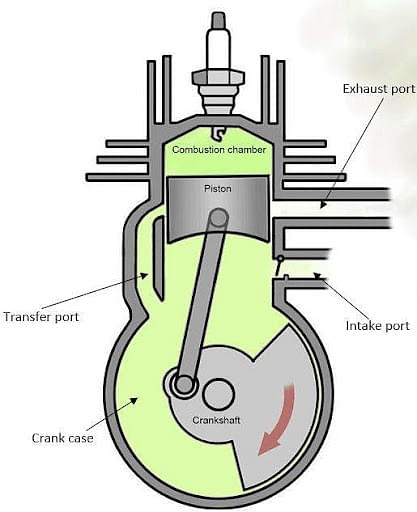
Two Stroke Engine
The video below explains this:
Two Stroke Engine Detailed Video Explanation:
Construction of Two Stroke Engine
[Click Here for Sample Questions]
A two stroke engine consists of piston, inlet ports, spark plug, outlet ports, crankshaft, flywheel, counter weight, and connecting rod.
- Crankshaft: Two stroke engine needs a rotational motion which is aided by crankshaft.
- Flywheel: The energy is stored in a mechanical device called flywheel.
- Counter Weight: The imbalances in the rotating assembly cause vibrations which can disturb the working of the engine. A counter weight is used to reduce such vibrations.
- Inlet and outlet ports: The entrance and exit of fresh air from the cylinder is aided by inlet and outlet ports.
- Connecting rods: The connecting rod acts as a lever arm by allowing transfer of motion from piston to crankshaft.
- Piston: Mechanical rotation needs a force of gases. These gases are passes through connecting rod by the piston.
- Spark plug: The expansion in gases is caused by ignition of air-fuel mixture. The combustion chamber receives electric current through spark plug.
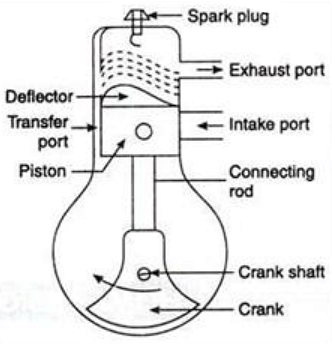
Construction of Two Stroke Engine
Two Stroke Engine Cycle Up Stroke and Down Stroke
[Click Here for Sample Questions]
The two stroke engine cycle consists of two strokes: an up stroke and a down stroke.
- Down Stroke: In down stroke, the rotation of crankshaft is 180 degree. The crankcase allows flow of air fuel mixture into the combustion chamber. The fresh air is the chamber is aided by movement of piston from top dead center to bottom dead center.
- Up Stroke: In up stroke, the movement of piston is from bottom dead center to top dead center. The rotation of crankshaft is 180 degree. The fuel air mixture is ignited by the spark plug. This mixture then goes to combustion chamber.
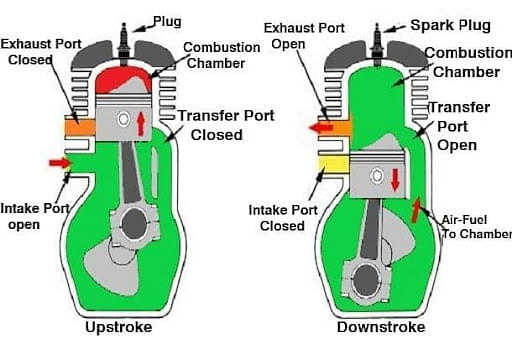
Upstroke and Downstroke Engine Cycle
Two Stroke Engine Applications
[Click Here for Sample Questions]
Several applications of two stroke engines are:
- Dirt bikes, motorcycles and other small scale propulsion applications make use of two stroke engines.
- When the priorities of engine design are lightweight and mechanical simplicity, two stroke engines are preferred.
- Chainsaw and other hand held tools require two stroke engines. This is because their energy reservoir is not dependent on gravity.

Two Stroke Engine Applications
Things to Remember
- A two stroke engine is an internal combustion engine that takes two strokes of piston to complete a power cycle. These strokes are taken during a single crankshaft revolution.
- A two stroke engine consists various parts such as connecting rod, piston, inlet ports, spark plug, outlet ports, crankshaft, flywheel, and counter weight.
- An up stroke and a down stroke make up a two stroke engine cycle. Both strokes involve rotations of 180 degree.
- Up stroke involves movement of piston from bottom dead center to top dead center. Down stroke involves movement of piston from top dead center to bottom dead center.
- Two stroke engines are used in chainsaws, dirt bikes, motorcycles, etc.
Also read:
Sample Questions
Ques. Mention the First Law of Thermodynamics. (2 Marks)
Ans. First Law of Thermodynamics states that energy can neither be created nor be destroyed; it can only be transferred from one form to another. Rudolf Clausius and William Thomson stated the first law of thermodynamics. When heat is provided to a system, the system uses it in changing the internal energy of the system and in doing work. The transfer of energy that takes place during the process is quantified by the first law.
Ques. Write a note on Second Law of Thermodynamics. (2 Marks)
Ans. Second law of thermodynamics states that there will always be a decrease in the entropy of an isolated system. This law restricts the efficiency of heat engine and direction of heat transfer. In a closed system, there are a number of factors that can increase the entropy of the thermodynamic system.
Ques. Write a note on Heat Engines. (2 Marks)
Ans. The device that enables the conversion of heat to work is called a heat engine. A heat engine discharges heat energy into sink by taking heat from a reservoir. There are two types of heat engine:
- Internal combustion engine (example: a steam engine)
- External combustion engine (example: a car engine)
Ques. Write a note on Carnot Engine. (3 Marks)
Ans. Carnot Engine is named after Leonard Carnot. It is a theoretical thermodynamic cycle. It estimates the maximum efficiency a heat engine can possess. A closed thermodynamic cycle, that is reversible, is called a Carnot cycle. The four steps involved in a Carnot cycle are:
- Isothermal expansion
- Adiabatic expansion
- Isothermal compression
- Adiabatic compression
Ques. Write a note on Entropy Change. (3 Marks)
Ans. Entropy Change refers to the change in degree of disorder in the system. The difference between initial and final state of a system aids in determining Entropy Change. The path of heat exchange and heat conversion does not affect the change in entropy. In an ideal situation for entropy change, the change in entropy should be greater than zero.
Higher entropy means that the system is more disordered. The movement of molecules increases when heat is added to the process. Entropy change is inversely proportional to the temperature of the system. The entropy of the universe keeps increasing. The entropy change is zero during adiabatic process.
Ques. What are the branches of Thermodynamics? (3 Marks)
Ans. The four branches of thermodynamics are:
- Classical Thermodynamics: Under classical thermodynamics, properties are calculated using temperature and pressure.
- Statistical Thermodynamics: Under statistical thermodynamics, properties and interaction of molecules is examined to characterize the behavior of molecules.
- Chemical Thermodynamics: During chemical reactions, the work and heat relationship is studied under chemical thermodynamics.
- Equilibrium Thermodynamics: In equilibrium thermodynamics, transformation of matter as it approaches the state of equilibrium is studied.
Ques. Write a note on the thermodynamics process. (3 Marks)
Ans. A thermodynamic system undergoes a thermodynamic process whenever there is a change in energy within thermodynamic system. A unique property characterizes each thermodynamic process. There are four types of thermodynamic processes:
- Isothermal Process: In isothermal process, the temperature remains constant.
- Isobaric Process: In isobaric process, the pressure remains constant throughout the process.
- Adiabatic Process: No transfer of heat occurs in the system in adiabatic process.
- Isochoric Process: The volume remains constant in isochoric processes.
Ques. What is System? What are the different systems of Thermodynamics? (3 Marks)
Ans. Thermodynamic System refers to part of matter on which the attention is focused. This matter is within a definite boundary. There are three types of thermodynamic system, isolated system, open system, and closed system.
- Isolated System: Isolated system is a system that cannot exchange energy and mass with its surrounding.
- Open System: Open system is a system that allows transfer and exchange of energy and mass.
- Closed System: Closed system is a system that allows exchange of energy but does not allow exchange of mass.
Also check:



Comments