



Content Curator
Carnot engine is a reversible engine that operates between two temperatures T1 (source) and T2 (sink). It gives an estimate of the maximum possible efficiency that a heat engine can have in successful heat conversion between the two temperatures. Carnot engines can be found in refrigerators and air conditioners. Carnot equation can be used in understanding the working process of heat and internal energy change in adiabatic as well as isothermal processes.
Also read: Difference Between Work and Energy
| Table of Content |
Key Terms: Carnot cycle, Carnot Theorem, Carnot Engine Formula, carnot vapour cycle, carnot heat engine
Carnot Engine Definition
[Click Here for Sample Questions]
Carnot engine, as proposed by Nicolas Léonard Sadi Carnot in 1824, is the one that operates on reversible thermodynamics. It has been named after its invention by Carnot. It is an analytical engine that gives the maximum efficiency that a heat engine can have while between two working reservoirs, it is in the process of conversion of heat into work and conversely.
Carnot Engine Video Explanation
Thermodynamic Carnot Engine was developed to describe conversion of heat to work. A Carnot engine in its reverse operation can also work as a model for heat pumps (refrigerators).

Carnot Engine Activity
Carnot Theorem
[Click Here for Sample Questions]
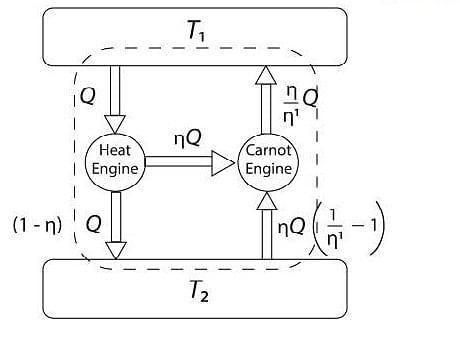
The Carnot theorem states that ‘The systems working between the two temperatures T1 (hot reservoir) and T2 (cold reservoir), cannot have more efficiency than the Carnot engine that is working between the same two reservoirs.’
The efficiency of this engine depends on the temperature of the hot and cold reservoirs and is independent of the nature of the working substance.
Carnot Cycle
[Click Here for Sample Questions]
The Carnot cycle is an ideal reversible closed thermodynamic cycle, which involves four stages of operations.
The stages are:
- isothermal expansion,
- adiabatic expansion,
- isothermal compression, and
- adiabatic compression.
Through these operations, the expansion and compression of substances can be done to the desired point and back to the initial state.

Steps Involved in Carnot Cycle
For an ideal gas operating inside a Carnot cycle, the following are the steps involved:
Step 1:
Isothermal expansion: The ideal gas is taken from P1, V1, T1 to P2, V2, T2. Q1 amount of heat is absorbed from the reservoir at temperature T1. The gas then expands and isothermal. Thus the total internal energy change is zero, and the amount of heat absorbed by the gas is equal to the work done by it on the environment.
This is given by the equation: W1→2=Q1=μ*R*T1 *ln(v2/v1)
Step 2:
Adiabatic expansion: The gas incurs an expansion of adiabatically from P2, V2, T1 to P3, V3, T2.
The work done by the gas is given by: W2→3=μR/(γ−1) *(T1−T2)
Step 3:
Isothermal compression: The gas is then compressed isothermally from(P3, V3, T2) to (P4, V4, T2).
Here, the work done by the environment on the gas is given by: W3→4=μRT2ln(v3/v4)
Step 4:
Adiabatic compression: In this step, the gas is compressed adiabatically from(P4, V4, T2) to (P1, V1, T1).
Hence, the work done on the gas by the environment is given by: W4→1=μR/(γ−1) * (T1−T2)
Hence, the total work done is given by:
W= W1→2+W2→3+W3→4+W4→1
W = [μRT1ln(v2/v1)] − [μRT2ln(v3/v4)]
Net efficiency=Net work done by the gas / heat absorbed by the gas
Net efficiency=W/Q1=(Q1−Q2)/Q1 = 1−(Q2/Q1) = 1−(T2/T1) (lnv3/v4) / (lnv2/v1)
Since step 2→3 is an adiabatic process, we can write T1V2Y-1-1 = T2V3Y-1-1
Or,
v2/v3=(T2/T1)1/γ−1
Similarly, for process 4 →1, we can write
v1/v2= (T2/T1)1/γ−1 ⇒ v2/v3 = v1/v2
Hence, net efficiency can be given as Net efficiency=1−(T2/T1)

Steps Involved in Carnot Cycle
Applications of Carnot Cycle
[Click Here for Sample Questions]
Carnot Cycle is used in the various fields like
- thermal devices
- heat pumps
- refrigerators
- steam turbines
- Combustion engine
- Reaction turbines of airplane
Limitations of Carnot Cycle
[Click Here for Sample Questions]
- The equation states that the efficiency of the cycle is directly proportional to the range of temperature.
- The maximum cycle temperature T1 is limited to 900 K (627°C). This limit is known as a metallurgical limit.
Carnot Engine Formula
[Click Here for Sample Questions]
Let us derive the formula for efficiency of Carnot Engine:
In Isothermal process
P1V1=P2V2.......(a)
As B(V2,P2) and C(V3,P3) lies on same adibatic:
P2γV2γ=P3γV3γ.........(b)
Again C and D lie on same isotherm:
P3γV3γ=P4γV4γ.........(c)
Finally, D and A lies on same adiabatic:
P4γV4γ=P1V1γ.........(d)
Multiplying (a), (b), (c) and (d):
V2γ−1γ+V4γ−1γ=V1γ−1γ+V3γ−1γ
V2V4=V1V3
V1γV2=V4V3γ
logeV1V2=logeV4V3
Now, dividing (d) by (b):
\(\frac{Q_2}{Q_1}\)= \(\frac{KT_2log_e[V_3/V_4]}{KT_2log_e[V_1/V_2]}\)
\(\frac{Q_1}{Q_2}=\frac{T_2}{T_1}\)
η= 1−\(\frac{T_2}{T_1}\)

Carnot Engine Formula
Carnot Engine: Things to Remember
[Click Here for Sample Questions]
- Carnot Engine is a theoretical thermodynamic cycle proposed by Leonard Carnot
- This engine gives the maximum possible efficiency that a heat engine can give during the process of conversion of heat into work while working between two reservoirs
- There cannot be an engine more efficient than the Carnot Engine
Sample Questions
Ques 1. What is the first step involved in the Carnot Cycle? (1 Marks)
Ans. Isothermal Expansion is the first step involved in Carnot Cycle.
The Carnot Cycle consists of 4 operations: Isothermal Expansion, Adiabatic Expansion, Isothermal Compression, and Adiabatic Compression. Among them, the first operation is Isothermal Expansion
Ques 2. A student says that the efficiency of a heat engine that operates at 127°C source temperature and 27°C is the sink temperature, is 26%. Is this situation possible? (1 Marks)
Ans. It is impossible
ηmax=(1−T1)/T2 = (1−127+27)/327-273= (1−400)/300 = 25%
Hence, 26% is impossible.
Ques 3. What type of process is a Carnot Cyclic Process? (1 Marks)
Ans. The Carnot Cyclic Process is a Reversible Cyclic Process.
Ques 4. What will be the increase in temperature of the source to increase the efficiency of a Carnot engine if the efficiency of it is 50%, and the temperature of the sink is 7? (2 Marks)
Ans. n= (T1−T2) / T1
=50/ 100
=T−260/ T
=½
=1− (266/T)
⇒266/ T = ½
Ts= 532K
Now,
ΔTsource=866.66−532K
ΔTsource=354.66
Ques 5. What will be the coefficient of the Carnot refrigerator which is working between 30°C and 0°C? (3 Marks)
Ans. Given that
T2=00C=273K
T1=300C=273+30=303K
Formula to be used:
β=T2/T1
=273/303−273
=273/30
=9.1
∴coefficient of performance(β) of a Carnot refrigerator is 9.1
Ques 6. A steam engine delivers 5.4 x 10⁸ J of work per minute and services 3.6 x 10⁹J of heat per minute from its boiler. What is the efficiency of the engine? How much heat is wasted per minute? (3 Marks)
Ans.

Ques 7. A perfect Carnot engine utilizes an ideal gas. The temperature of the source is 500 K and that of the sink is 375 K. If the k engine takes 600 Kcal per cycle from the source, then calculate the efficiency of the engine. (3 Marks)
Ans. Given that, T1 = 500 K
T2 = 375 K
Q1 = heat absorbed per cycle = 600 Kcal
Let η = thermal efficiency of the Carnot engine,
then η = (T1−T2 )/T1
= (500−375)/500
= 125/500 = 0.25
∴ η = 0.25 × 100 = 25%
Ques 8. A Carnot engine has the same efficiency when working:
(a) between 100 K and 500 K and
(b) between 180 K and T K.
Calculate the temperature T of the source in case (b). (3 Marks)
Ans. Given that:
(a) Temperature of source = T1 = 500 K
Temperature of sink = T2 = 100 K
(b) Temperature of source = T’1 = T K = ?
Temperature of sink = T’2 = 180 K
Let η and η’ be the efficiency in case (a) and (b) respectively.
As Given, η = η’

Ques 9. A Carnot-type engine is designed to operate between 480 and 300 K. Assuming that the engine actually produces 1.2 K J of mechanical energy per kilo cal of heat absorbed, compare the actual efficiency with the theoretical maximum efficiency. (3 Marks)
Ans. Given that: T1 = 480 K
T2 = 300 K
W = 1.2 K J
Q1 = heat absorbed =1 K cal = 4.2 K J
If ηa be its actual efficiency, then
ηa % = Energy output / Energy input × 100
= W/Q1 × 100
= 1.2/4.2 × 100
= 28.57%
Also, let ηm be its maximum theoretical efficiency,

That is, ηa is nearly 3/4th of ηm.
Ques 10. A Carnot's engine working between 400 K and 800 K has a work output of 1200 J per cycle. Find the amount of heat energy supplied to the engine from the source in each cycle. (2 Marks)
Ans. The amount of heat energy is:

Ques 11. Two identical metal wires of thermal conductivities K1 and K2 respectively are connected in series. Find the effective thermal conductivity of the combination. (3 Marks)
Ans. Req = R1 + R2

Ques 12. A polyatomic ideal gas has 24 vibrational modes. What is the value of γ? (2 Marks)
Ans. f = 3T + 3R + 24V = 30

Get Live Updates on Board Exams 2023: https://t.me/class_10_12_board_updates
Also read:



Comments