



Content Curator
Log function is known as the logarithmic function which is used in mathematical problems and numericals in physics. Logarithm is an important application which is used to lower the complexity of problems, therefore reducing multiplication into addition operation and similarly, division into subtraction operation by using the properties of logarithmic functions. Hence, the method to determine the logarithm function is given with the help of the value of log infinity.
| Table of Content |
Key Takeaways: Log infinity, Log function, Natural log function, Log formulas, Types of logarithms
What is Infinity?
Infinity is an idea of something which has no limited boundaries. Infinity specifies a state of endlessness in terms of space, time or other quantities. Let’s take an example of log infinity as log(y). If we increase the value of y gradually till infinity, then the value of log(y) will also increase till infinity. We can denote infinity by the symbol ‘∞’.
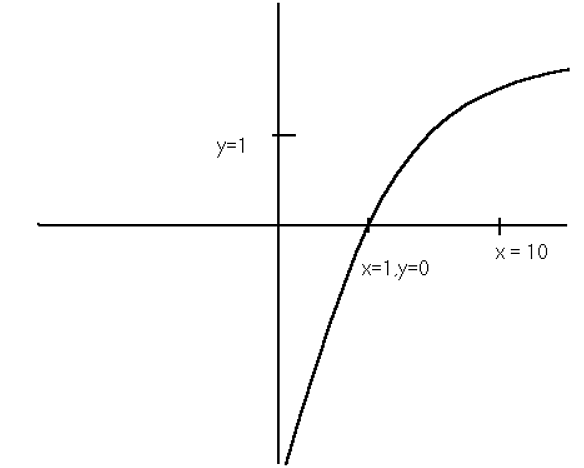
Log Infinity graph
Also read:
Types of logarithms
There are two types of logarithmic functions.
- Common logarithmic functions: The log function which is having the base 10 is known as common logarithmic function.
- Natural logarithmic functions: The log function which is having the base e is known as natural logarithmic function.
The logarithmic function is defined with the help of the formula as given below.
If
logab = x
Then,
ax = b
Also read: Derivation of log 0 value with base e

Types of Logarithm
Properties of Common Logarithms
There are four laws of common logarithms which help in solving complex problems.
- Product rule law: loga (MN) = loga M + loga N
- Quotient rule law: loga (M/N) = loga M - loga N
- Product rule law: loga Mn = n loga M
- Change of base rule law: loga M = logb M x loga b
Also read: Value of log 1 to 10 for log base 10
Value of log10 infinity
There are two ways of denoting the log of infinity to base 10: log10 ∞ and log ∞.
As per the definition, it can be said that base, a = 10 and 10x = ∞.
For calculating the value, let’s consider that at 10∞ = ∞.
As the value of base approaches infinity, the value of x also tends to infinity. Therefore,
log10 infinity = ∞
Also Read:
Properties of Natural Logarithms
The properties of natural logarithms are almost the same as other logarithmic values.
- Product rule: Ln (ab) = Ln(a) + Ln(b)
- Quotient rule: Ln (a/b) = Ln(a) - Ln(b)
- Reciprocal rule: Ln (1/a) = -Ln(a)
- Power rule: Ln (ab) = b Ln(a)
Also read: Applications of Ln and Log
Value of loge infinity
The natural log function of infinity is specified as “loge ∞”. It is also called the log function of infinity to the base e. The natural log of ∞ is also represented as ln (∞)
Loge ∞ = ∞
Or
ln (∞) = ∞

Value of Natural log infinity
Also read: Derivation of log 0 value with base 10
Things to Remember
- Infinity is an idea of something which has no limited boundaries.
- As the value of base approaches infinity, the value of x also tends to infinity. Therefore the value of log infinity is infinity.
- The natural log function of infinity is specified as “loge ∞”.
- The value of the natural log function of infinity is also infinity.
Also Read:
Sample Questions
Ques. What is the best way to read a log table? (2 Marks)
Ans. First, we have to look for the first two digits of the number, without considering the decimal. Then, we should check for the column number that is relative to the number’s third digit. To calculate the final number, we need to consult the mean difference table.
Ques. By using the property of logarithms, solve for the value of x for log3 x = log3 4 + log3 7. (2 Marks)
Ans. By using addition rule,
Log3 4 + log3 7 = log3 (4*7)
Log3 (28), thus x = 28.
Ques. Solve (3 + log7 x)/(4 - 2 log7 x) = 2 (2 Marks)
Ans. 3 + log x = 8 - 4log7 x
5 log7 x = 5
Log7 x = 1
x = 7 1 = 7
Ques. Solve for x, if (log 225/log 15) = log x (2 Marks)
Ans. log x = (log 225/log 15)
log x = (log (15*15)/log 15)
log x = log 152/log 15
log x = 2log 15/log 15
log x = 2
Or
Log 10x = 2
102 = x
x = 10*10
x = 100
Also read: Value of log 1 to 10 for log base e
Ques. If the value of log10 7 = a, then log10 (1/70) is equal to? (2 Marks)
Ans. log10 (1/70) = log10 1 - log10 70
-log10 (7*10)
-(log10 7 + log10 10)
-(a+1)
Ques. Find the value of (1/log3 60 + 1/log4 60 + 1/log5 60) (2 Marks)
Ans. Given, (1/log3 60 + 1/log4 60 + 1/log5 60)
= log60 (3*4*5)
= log60 60
= 1
Ques. What is the value of log 9 when log 27 is equal to 1.431? (3 Marks)
Ans. Given, log 27 = 1.431
log(33) = 1.431
3*log(3) = 1.431
log(3) = 1.431/3
log 3 = 0.447
log 9 = log(32)
log 9 = 2*log 3
log 9 = 2*0.447
log 9 = 0.954
Ques. Given that the value of log10 2 = 0.3010, find the value of log10 80? (3 Marks)
Ans. log10 80 = log10 (8*10)
Log10 8 + log10 10
Log10 23 + 1
3* log2 + 1
3* 0.3010 + 1
0.9030 + 1
1.9030
Also read: Logarithm formulas



Comments