



Content Curator
Logarithm formulas play a vital role in mathematics as well as physics as all the values in physics in exponential form to get accurate values final computation is only done by using logarithm values. These are extensively used in all fields of science, these also play a major role in surveying and navigation purposes.
| Table of Content |
Keyterms: Log, Logarithm, Exponential functions, Integer, Base, Logarithm functions, Natural logarithmic functions, Common logarithmic functions
Also Read: Types of Probability
What is a Logarithm?
[Click Here for Sample Questions]
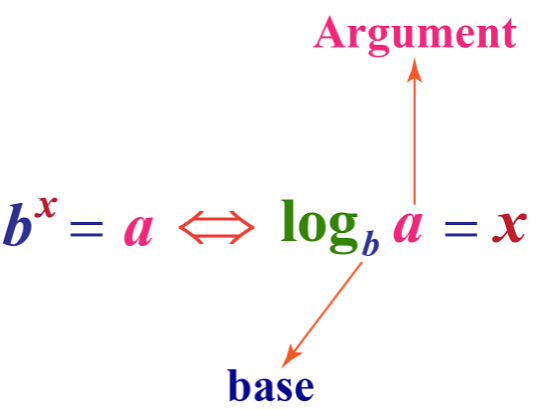
A logarithm is defined as the exponent or power up to which the base value should be raised. These are simply stated as,
am= n
Which states that m is the logarithm of n to base a.
Basic representation am= n can be written as m= logan
Example : 33 = 27 or log3 27 = 3
Logarithm
Also Read:
| Related Articles | ||
|---|---|---|
| Value of Log 0 | Value of Log 1 | Value of Log 1 to 10 |
| Logarithm questions | Logarithmic Differentiation | Value of log infinity |
Types of Logarithm
[Click Here for Previous Year Questions]
Logarithm is of two types namely,
- Common Logarithm
- Natural Logarithm
Common Logarithm
The common logarithm defines the number of times the value has to be multiplied by 10. It is simply called base 10 logarithms and can be represented as log or log10.
Example: log (100) = 2 or log 10 (100) = 2
| Common Log | Natural Log |
|---|---|
| log10x = log x | logex = In x |
Natural Logarithm
Logarithms to the base e are called natural logarithms and are represented as ln n or loge where e is an Euler’s Constant and is approximately equal to 2.718.
Example: ln (78) or loge = 4.357
Also Read: Permutations and Combinations
Logarithm Rules
[Click Here for Sample Questions]
Let us look at the various rules in Logarithm.
Logarithm Product Rule
The logarithm of the product of two values is equal to the total sum of individual values.
It is represented as
logn(ab) = logn a + logn b
Logarithm Division Rule
Logarithm division of any two values is equal to the difference between the logarithm of individual values. It is represented as
logn(a/b) = logn a - logn b
| Exponent Rules | Logarithm Rules |
|---|---|
| \(a^m \times a^n = a^{m+n}\) | log(mn) = logm + logn |
| \(\frac{a^m}{a^n} = a^{m-n}\) | \(\log \frac{m}{n} = \log m - log n\) |
| (am)n = amn | log mn = nlogm |
Logarithm Power Rule
the logarithm of a positive value a to the power of b is equivalent to the product of b to the logarithm of a. It is represented as
logn(ab) = b logn(a)
Logarithm Zero Rule
The logarithm value of 1 is equivalent to zero. It is represented as
logn (1) = 0
Logarithm Identity Rule
If the logarithm value and its base value are equal then it is equal to 0. It is represented as
logn (n) = 1
Logarithm Exponential Rule
The logarithm of m with a rational exponent is equal to the exponent times its logarithm. It is represented as
Logb (mn) = n logb m
Change of Base Rule
The logarithm of a value with a given base can be expressed in terms of the ratio with the same base that is different from the original base. It is represented as,
Logb m = loga m/ loga b
Also Read: Pascal’s Triangle
Logarithm Formulas
[Click Here for Previous Year Questions]
Here are some logarithm formulas with which we can solve a number of combinations of logarithms.
| S.no | Formula |
|---|---|
| 1 | logn (1) = 0 |
| 2 | logn (n) = 1 |
| 3 | logn (0) = -∞ if a>1 = ∞ if a<1 |
| 4 | logn(a/b) = logn a - logn b |
| 5 | logn(ab) = logn a + logn b |
| 6 | logn(ab) = b logn(a) |
| 7 | lognn√x = 1/n logn(x) |
| 8 | logn n = 1/logn a |
| 9 | a logn(x) = x |
| 10 | loge(x) = ln x |
Also Read:
| Related Articles | ||
|---|---|---|
| Logarithm | Arithmetic Progression | Geometric Progression |
| Geometric Mean | Straight Lines | Angle Between Two Lines |
Things to Remember
- A logarithm is defined as the exponent or power up to which the base value should be raised.
- Logarithms are used to make approximations for exact quantities
- Small differences can be effectively calculated from these logarithms.
- Chemical property can be determined effectively.
- Logarithm is of two types namely common logarithm and natural logarithm.
- The common logarithm defines the number of times the value has to be multiplied by 10. It is simply called base 10 logarithms.
- Logarithms to the base e are called natural logarithms.
Previous Year Questions
- The differential coefficient of f (Sinx) w.r.t. x where f(x)=logx is….[KCET 2004]
- The differential coefficient of log10x with respect to logx10 is….….[KCET 2016]
- If log72=?, then the value of log49(28) is….
- The derivative of y = xsinx is...[UPSEE 2016]
- The derivative of (logx)x with respect to log x is….
- The sum of the divisors of 24⋅33⋅53 is…..
- The value of =dxd[xnlogaxex]=…
- The value of dxd[xnlogaxex] is...[JKCET 2013]
- If a=log23,b=log25,c=log72, then log14063 in terms of a, b, ca,b,c is…...[BITSAT 2007]
- The general value of the real angle θ, which satisfies the equation,...[WBJEE 2019]
Sample Questions
Ques. Solve log 32 (2 marks)
Ans. Since 32 can be expressed in terms of 25 = 2*2*2*2*2
25 = 32
Hence 5 is the exponent value
So log32 = 5
Ques. Solve log3(x+1) = 3 (2 marks)
Ans. We can rewrite the above one as (x+1) = 33
(x+1) = 27
X = 26
Therefore the solution for log3(x+1) = 3 is 26
Ques. log(x+3) + log(x-1) = 1 (2 marks)
Ans. log[(x+3)(x+1)] = 1
log(x2+4x+4) = 1
(x2+4x+4) = 101
(x2+4x+4) = 0
(x+3)(x+1) = 0
Therefore x =-3, -1
Ques.Solve 6 2x = 4 (2 marks)
Ans. It can be written in the form of log 6 2x = log 4
2x log 6 = log 4
X = log 4/2 log 6
= 0.6020/2*0.7781
= 1.0823
Therefore the solution is 1.0823
Ques. Prove that log2(x+2)+ log2(4) = log (16) for x = 2 (2 marks)
Ans. Substitute 2 in the above equation we get
LHS = log2(x+2)+ log2(4)
= log2(2+2)+ log2(4)
= log2(4)+ log2(4)
= log2(16)
= RHS
Therefore LHS= RHS
Hence proved
Ques. Find the x value from the given equation log2(2x) = log2(4x+7) (2 marks)
Ans. Given log2(6x) = log2(4x+2)
6x= 4x+2
2x = 2
X =1
The value of x in the equation log2(2x) = log2(4x+7) is 1.
Ques. Solve log(4x-3)-log(x-4) = log 5 (2 marks)
Ans. The above equation can be written in the form of
log(4x-3/x-4) = log 5
4x-3/x-4 = 5
4x-3 = 5x-20
X = 17
The x value of the above equation is 17
Ques. Solve 42x+1 = 21 and find the value of x (2 marks)
Ans. For the above equation apply log on both sides
Log 42x+1 = log 21
(2x+1) log 4 = log 21
2x+1 = (log 21)/(log 4)
= (1.3222)/(0.6020)
2x+1 = 2.19634
2x = 1.1963
X = 0.598
The value of x by solving the above equation is 0.598
Ques. Solve log5(x-10) = 1 (2 marks)
Ans. The above equation can be written in the form of 5-1 = x-10
5-1 = x-10
5 = x-10
The value of x by solving the above equation is 15
Ques. Express 3logx+8log y = log b in Logarithmic free form. (2 marks)
Ans. Given 3logx+8log y = log b
Log x3 + log y8 = log b
log(x3 y8) = log b
x3 y8 = b
The above equation in logarithm free form is x3 y8 = b
Ques. Express log10(3)+1 in the form of log10 x (2 marks)
Ans. The above expression is written in the form of
= log10(3)+1
= log10(3)+ log10(10)
= log10(3*10)
= log10(30)
The above expression in the form of log10 x is log10(30)
Ques. Express \((\frac{1}{3})^4 = \frac{1}{8}\) in logarithmic form. (2 marks)
Ans. By taking log of base \(\frac{1}{3}\) on both sides, we get
\((\frac {1}{3})^4 = \frac {1}{81}\)
⇒ \(log_{\frac{1}{3}}(\frac {1}{3})^4 =log_{\frac{1}{3}} \frac {1}{81}\)
⇒ \(4log_{\frac{1}{3}}(\frac {1}{3}) =log_{\frac{1}{3}} \frac {1}{81}\) (Since logban = n logba)
⇒ 4 = \(log_{\frac{1}{3}} \frac {1}{81}\) (Since logbb = 1)
⇒ \(log_{\frac{1}{3}} \frac {1}{81}\) = 4
Ques. Find the value of x satisfying log10 (2x + x – 41) = x (1 – log10?). (2 marks)
Ans. We have, log10 (2x + x – 41) = x (1 – log10?)
→ log10(2x + x – 41)
→ x log102= log10 (2x )
→ 2 x + x – 41 = 2x
→ x = 41.
Check-More:



Comments