



Content Curator
Common Logarithm of a number is the power of 10, which is referred to as the base, increased to yield that number. Logarithm Table is used in mathematics to discover the value of the logarithmic function. The log table is the easiest approach to get the value of a given logarithmic function.
| Table of Content |
Keyterms: Log, Logarithm, Exponential functions, Integer, Base, Logarithm functions, Natural logarithmic functions, Common logarithmic functions
Also Read: Permutations and Combinations
What is a Logarithm?
[Click Here for Sample Questions]
Before we offer you with the logarithm table from which you will obtain all of the numbers, let us first define the Logarithmic Function. The inverses of exponential functions are logarithmic functions.
The following is the definition of a log function:
For x, b > 0, and b1, f(x) = logb x, if x = by Base e and base 10 are the most often used bases in log operations.

Logarithm
Common Logarithm[f(x) = log10x]: The logarithm to base 10 (b = 10) is known as the common logarithm, and it has several uses in science and engineering.
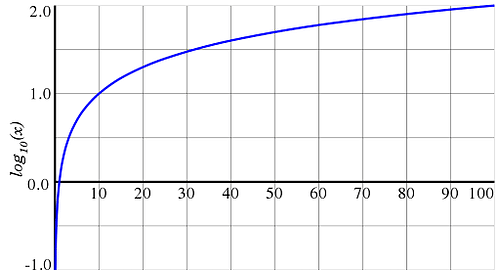
Graph of Common Logarithm
Binary Logarithm [f(x) = log2x]: The binary logarithm is frequently used in computer science and utilises base 2 (that is, b = 2).

Binary Logarithm
In logarithmic form, an exponential function may be represented. Similarly, all logarithmic functions may be expressed in their exponential versions.
Also Read:
| Related Articles | ||
|---|---|---|
| Logarithm Formula | Arithmetic Progression | Geometric Progression |
| Geometric Mean | Straight Lines | Angle Between Two Lines |
How to Use Logarithm Table?
[Click Here for Previous Year Questions]
Logarithm table should be used to calculate the logarithm of an integer. Let's go over how to find a logarithm step by step.
Step 1: Select the Appropriate Table
To obtain the value of log X, use the base -‘a' table. If a=10, the base-10 table should be used as the log table.
Step 2
In scientific notation, write the number. 31.62, for example, is represented as 3.162 X 101. As a result, the power of ten is now one. As a consequence, 1 is the distinguishing feature of the resultant logarithmic value.
Step 3
Locate the cell at the position where the associated row is labelled with the first two digits of a number and the corresponding column header is labelled with the third digit of a number. As a result, for the value 31.62, disregard the decimal point and examine the cell in row 31 and column 6. The answer is 0.4997.
Step 4
Because the number 31.62 has one more digit, we must stay in the same row and determine the value of the cell at MEAN DIFFERENCE column number 2 because it is the 4th digit of the 31.62. The answer is 3. Now multiply this by 0.4997 to obtain 0.4997 + 3 = 0.5000. This is known as the mantissa portion.
Now add the characteristic and mantissa parts together to get the logarithm of the number.
As a result log1031.62 = 1 + 0.5000 = 1.5000
The Characteristic is the integer portion of the number's logarithmic form, while the Mantissa is the fractional part of that number's logarithmic form.

An Example of Characterisitc and Mantissa
Figure of Logarithm
[Click Here for Sample Questions]
The following is the figure for Logarithms:
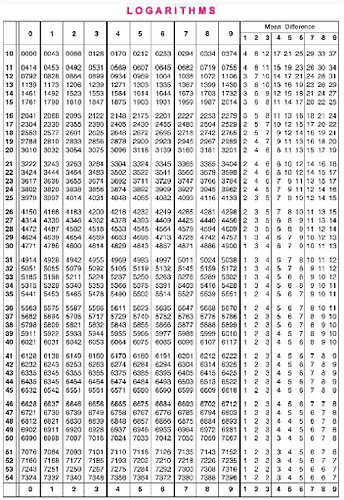
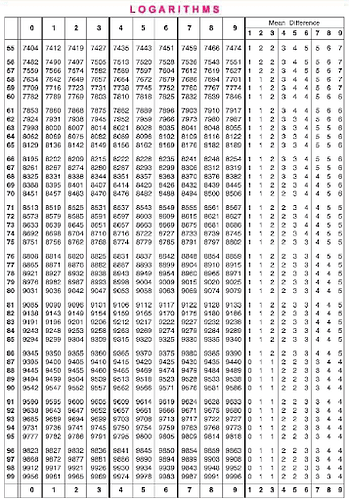
Properties of Logarithm Table
[Click Here for Previous Year Questions]
We have included all of the key laws and characteristics related to logarithms in this section.
Theorem 1: The logarithm of the product of two numbers, say a and b, equals the total of their logarithms. Both numbers should have the same base.
logx(ab) = logxa + logxb
Theorem 2: The antilog of the difference of logarithms of two numbers equals the division of the two numbers.
In other words, the logarithm of the division of two integers, say a and b, equals the difference of their logarithms. Both numbers should have the same base.
logx(\(\frac {a}{b}\)) = logxa + logxb
The “quotient rule for logarithms” is another name for this theorem.
Theorem 3: The logarithm of a number to every other base may be calculated by calculating the logarithm of the same number to any given base.
logax = logbx X logab
logbx = logax X logab
Theorem 4: The index of the power multiplied by the logarithm of the number equals the logarithm of the number raised to a power. Both have the same foundation.
logbxn = n logbx
These are the four logarithmic characteristics. You will be able to rewrite a logarithmic equation using the logarithmic power rule, product rule, or quotient rule.
Also Read:
| Related Articles | ||
|---|---|---|
| Value of Log 0 | Value of Log 1 | Value of Log 1 to 10 |
| Logarithm questions | Logarithmic Differentiation | Value of log infinity |
Things to Remember
- The logarithm table is used in mathematics to discover the value of the logarithmic function.
- In logarithmic form, an exponential function may be represented. Similarly, all logarithmic functions may be expressed in their exponential versions.
- The logarithm of a number to every other base may be calculated by calculating the logarithm of the same number to any given base.
- The index of the power multiplied by the logarithm of the number equals the logarithm of the number raised to a power. Both have the same foundation.
Previous Year Questions
- The differential coefficient of f (Sinx) w.r.t. x where f(x)=logx is….[KCET 2004]
- The differential coefficient of log10x with respect to logx10 is….….[KCET 2016]
- If log72=?, then the value of log49(28) is….
- The derivative of y = xsinx is...[UPSEE 2016]
- The derivative of (logx)x with respect to log x is….
- The sum of the divisors of 24⋅33⋅53 is…..
- The value of =dxd[xnlogaxex]=…
- The value of dxd[xnlogaxex] is...[JKCET 2013]
- If a=log23,b=log25,c=log72, then log14063 in terms of a, b, ca,b,c is…...[BITSAT 2007]
- The general value of the real angle θ, which satisfies the equation,...[WBJEE 2019]
Sample Questions
Ques. What is the best way to read a log table? (1 Mark)
Ans. Look for the row with the first two digits of the number, regardless of the decimal. Next, check for the column number that corresponds to the number's third digit. To obtain the final number, you may also need to consult the mean difference table.
Ques. Solve for x, if (log 225/log15) = log x. (2 Marks)
Ans. log x = (log 225/log15)
log x=[log(15×15)/log15]
log x = log 152/log 15
log x = 2log 15/log 15
log x = 2
Or
log10x=2
102=x
x=10×10
x=100
Ques. Prove that: 2log(15/18)-log(25/162)+log(4/9)=log2. (3 Marks)
Ans. 2log(15/18)-log(25/162)+log(4/9)=log2
Taking L.H.S.:
| ⇒log(15/18)2-log(25/162)+log(4/9) |
| ⇒log(225/324)-log(25/162)+log(4/9) |
| ⇒log[(225/324)(4/9)]-log(25/162) |
| ⇒log[(225/324)(4/9)]/(25/162) |
| ⇒log(72/36) |
| ⇒log2 (R.H.S) |
Ques. Find the value of x, if log(x+5)+log(x-5)=4log2+2log3.(3 Marks)
Ans. Given,
log(x+5)+log(x-5)=4log2+2log3
log(x+5)(x-5) = 4log2+2log3 [log mn=log m+log n]
log(x2-25) = log24+log32
log(x2-25) = log16+log9
log(x2-25)=log(16×9)
log(x2-25)=log144
x2-25=144
x2=169
x=±√169
x=±13
Ques. If log xy^3=m and log x^3 y^2=p, find log (x^2 ÷ y) in terms of m and p. (3 Marks)
Ans. log xy3 = m
logx + logy3 = m
logx + 3logy = m…….(1)
Iogx3y2 = p
logx3 + logy2 = p
3logx + 2logy = p…….(2)
After solving simultaneous equations, you will get
values of logx and logy
log(x2/y)= logx2 - logy
= 2logx - logy
Put it in the above equation.
Ques. Determine the value of log10 2.872.(3 Marks)
Ans. Following steps are followed to determine the value:
Step 1: The characteristic portion is 2 and the mantissa part is 872.
Step 2: Examine rows 28 and 7 in the table. As a result, the resulting value is 4579.
Step 3: Examine the mean difference value for row 28 and mean difference column 2. The value for the row and column is 3.
Step 4: Adding the numbers from steps 2 and 3, we get 4582. This is the mantissa section.
Step 5: Because the number of digits to the left of the decimal part is one, the characteristic part is less than one. As a result, the characteristic component is 0
Step 6: Finally, join the characteristic and mantissa parts. As a result, it becomes 0.4582.
As a result, log 2.872 equals 0.4582.
Ques. Express log(75/16)-2log(5/9)+log(32/243) in terms of log 2 and log 3. (4 Marks)
Ans. log(75/16)-2log(5/9)+log(32/243)
Since, nlogam=logamn
⇒log(75/16)-log(5/9)2+log(32/243)
⇒log(75/16)-log(25/81)+log(32/243)
Since, logam-logan=loga(m/n)
⇒log[(75/16)÷(25/81)]+log(32/243)
⇒log[(75/16)×(81/25)]+log(32/243)
⇒log(243/16)+log(32/243)
Since, logam+logan=logamn
⇒log(32/16)
⇒log2
Check-More:



Comments