



Exams Prep Master
In mathematics, logical reasoning is used in a variety of problem-solving procedures. On the basis of facts and the application of mathematical concepts, it is simple to draw the conclusions of some problems. When two statements are connected by a 'AND' gate, we can say they have conjunction. Only the combined compound statement is true when both assertions are true for conjunction. Different logical connectors are used in mathematics to connect two simple mathematical and logical assertions to generate compound statements. The following are some of the most commonly used logical connectives: Negation, Conjunction, Disjunction, Implication, Equivalence. Further, we will discuss in detail Conjunction with its definition, rules, truth table, and examples.
| Table of Content |
Key takeaways: Conjunction in maths, Rules, Conjunction truth table, examples
Read More: Trigonometry Table
What is Conjunction in Maths?
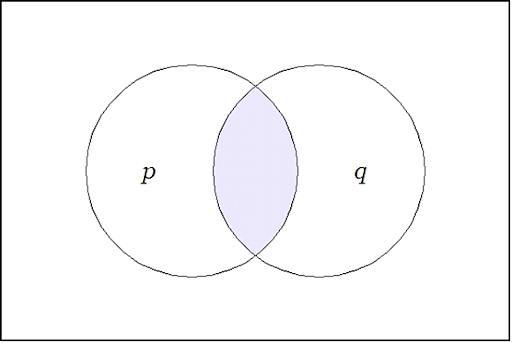
A conjunction is a statement made up of two statements joined by the AND connector. The conjunction symbol is ‘∧’ which can be interpreted as 'and'. The conjunction will be expressed symbolically as p ∧ q when two statements p and q are combined in a statement. This statement will be true if both combining assertions are true; else, it will be false.
The intersection of A and B is depicted in the diagram below:
Rules of Conjunction
- The new statement generated after adding the conjunction connector "and" will be true only if the individual statements were true before adding the conjunction connector "and"; otherwise, the new statement will be false.
- The conjunction sign is "," which is a logical connective that stands for "AND."
- When it comes to statements, we represent them with alphabetical letters. Let's use the following example to define conjunction: p and q are two statements. The statement becomes a compound statement after the conjunction connector is added, and it is written as "p q," which is read as "p and q."
Also read:
Conjunction Truth Table
The truth table is particularly useful for determining how the end values of compound statements are determined by the values of component assertions. This conjunction truth table covers all conceivable combinations. The letter "T" stands for true value, while the letter "F" stands for a false value.
Read More:
The Truth table for conjunction (“AND”)
| Statement p | Statement q | Statement p ^ q |
|---|---|---|
| T | T | T |
| T | F | F |
| F | T | F |
| F | F | F |
Also read: Greatest Integer Function
Conjunctions Examples
According to the Truth Table, the value of the compound statement "p^q" will only be true if both statements p and q have true values individually. The value of "p q" will be false in all other circumstances.
Example 1:
P: Ann is on the softball team
Q: Paul is on the football team.
Solutions: Statement P states that Anna is on the softball team, and statement q represents the sentence, "Paul is on the football team." The symbol ^ represents "and" logical connective. As a result, the compound phrase p q stands for the sentence "Ann plays softball, and Paul plays football." A conjunction is the statement P^Q.
Read More:
Example 2:
A: A square is a quadrilateral
B: Harrison Ford is an American actor
Construct a truth table for the conjunction "A and B."
Solutions:
| a | b | a^b |
|---|---|---|
| T | T | T |
| T | F | F |
| F | T | F |
| F | F | F |
Read More:
Things to Remember
- The conjunction symbol is ‘∧’ which can be interpreted as 'and'. The conjunction will be expressed symbolically as p ∧ q when two statements p and q are combined in a statement.
- The conjunction statement will be true only if both the combining statements are true otherwise, it will be false.
- It is similar to an AND gate that is used under the topic Gate logic.
- If we assume p and q to be the two statements. The compound statement p ∧ q is called the conjunction of p and q.
- The symbol “∧”, that denotes the conjunction, is read as “and” which is the logical connective.
Also Read:
Sample Questions
Ques: What is Conjunction in Maths? (2 Marks)
Ans: A conjunction is a composite statement made up of two statements joined by the AND connector. p q represents the conjunction "p and q." When both of its parts are true, conjunction is true; otherwise, it is false.
Read More:
Ques: What are the Rules of Conjunction? (3 Marks)
Ans: There are three rules of conjunction
- A sentence formed after adding the conjunction "and" connector becomes true only if the individual sentences are initially true. Otherwise, the new assertion generated will be false.
- The conjunction symbol is "^", a logical connection representing the word "AND".
- For sentences, use the alphabet to express them. Let's define conjunction as follows: Let's say the two sentences are p and q. After adding the conjunction, the operator becomes a compound word, written as "p q" and read as "p and q".
Read More:
Ques: What is a conjunction Truth Table? ( 2 Marks)
Ans: A truth table is especially useful for determining how the final value of a compound sentence is determined by the value of its component sentences. This linked truth table contains every imaginable combination. The letter "T" indicates a true value and the letter "F" indicates a false value.
Read More:
Ques: If the number ‘x’ is odd and the number ‘x’ is prime. Can we list all truth values for r^s in a truth table? Why or why not? (4 Marks)
Ans: The truth value of r^s will rely on the value of variable x because each statement in this example is an open sentence. We can't put all truth values for r^s in a truth table since there are an unlimited number of alternative values for x. However, as demonstrated below, we can find the true value of r s for the given x values.
If x = 3, then r is true, s is true. The conjunction r^s is true.
If x = 9, then r is true, s is false. The conjunction r^s is false.
If x = 2, then r is false, s is true. The conjunction r^s is false.
If x = 6, then r is false, s is false. The conjunction r^s is false.
Read More:
Ques: Assume that a: x is greater than 9 and that b: x is a prime number. Is there conjunction between the values of a and b? (4 Marks)
Let a: x be a prime number and b: x be greater than 9. Is there a connection?
Ans: We don't know the value of x because it's a variable. Let's set a limit for a and b.
To find the range, try a few different x numbers.
Both a and b are untrue for x = 6. As a result, the statement a b is false.
A is untrue when x equals 3, while b is true. A b, on the other hand, is untrue.
A is true when x equals 10, but b is false. A b, on the other hand, is untrue.
A and b are true when x = 11. As a result, the answer is a b.
As a result, the conjunction a and b is true only when x is a prime number bigger than 9.
Read More:
Ques: If 4 be a rational number and let 7 be a prime number. Is this a conjunction? (2 Marks)
Ans: Let p = 4 is a rational number, ,
Statement p is true.
And q= 7 is a prime number
Statement q is true
According to the truth table, if p is True and q is likewise True, then "p q" is True.
In our situation, the conjunction "p q," which means "4 is a rational number and 7 is a prime number," is true.
Read More:
Ques: Following are the given data: (3 Marks)
P: The number 11 is Prime. (True)
q: The number 17 is Composite. (False)
r: The number 23 is Prime. (False)
For each conjunction below, write a sentence and indicate if it is true or false.
Ans.
- p^q: The number 11 is prime and the number is composite = False
- p^r: The number 11 is prime and the number 23 is prime = True
- q^r: The number 17 is composite and the number 23 is prime = False
Also Read:



Comments