



Content Curator
A 'one size fits all' approach doesn't go well with the MBA program. There are people who can pursue a full-time MBA, but on the flip side, the one who wants to gain management skills with a job go for an Executive MBA or EMBA.
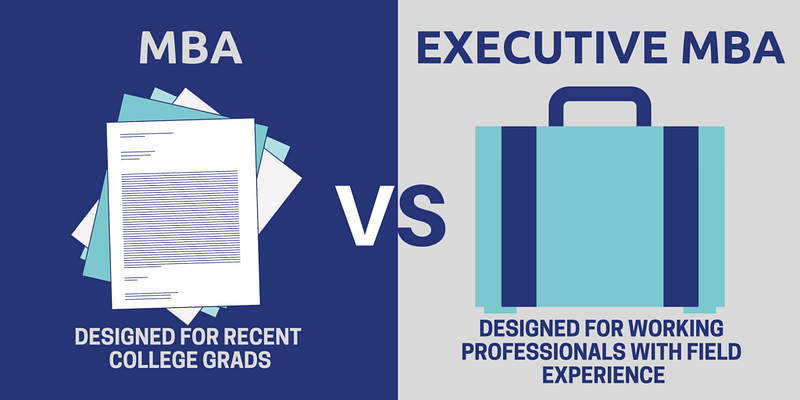
However, an EMBA requires higher experience and the potential to get into an elite B-school. There are certain disparities that can help you understand the difference between a regular MBA and an Executive MBA, which are listed in the article below.
Also Read IIM A, IIM B, IIM C, and FMS - Which Management College to choose? Check Here
Admission Procedure: MBA Vs EMBA
|
MBA |
Executive MBA |
|
The top-notch management colleges of India accept the score of entrance exams like CAT, XAT, MAT, CMAT, CET, IIFT, etc. |
Some of the Indian B-Schools accept the CAT score for EMBA admission. The score of GMAT or GRE is also counted by some B-Schools. |
|
Some Institutes also conduct their own management tests for admission in MBA program, like - NMAT for admission in NMIMS SNAP for admission in Symbiosis Institute |
Some institutes demand a minimum of 2 years of experience, while some ask for a minimum of 5 years of work experience, varying from institute to institute. |
|
International Institutes accept the score of GMAT and GRE for MBA admission. |
Like MBA, GMAT and GRE score is considered for international EMBA. However, they also ask for IELTS or TOEFL as mandatory exams. |
Syllabus: MBA Vs EMBA
The syllabus for both the MBA variants is almost the same, the online distinctive line is the pace of covering the curriculum.
|
MBA |
Executive MBA |
|
Duration: 24 months i.e 2 years (within India) |
Duration: 1 or 2 years (both within/ outside India) |
|
A traditional MBA program covers both theoretical and practical aspects. |
EMBA focuses majorly on practical knowledge to enhance decision-making and problem-solving skills. |
|
Classes are conducted on a regular basis within the academic session. |
Classes are held on weekends only so that it becomes feasible for working aspirants to attend the sessions. |
Also Read GMAT vs. GRE: The Ultimate Choice for MBA
Recruitment and Package Offered: MBA Vs EMBA
The package offered depends entirely upon the B-School. The best advantage of traditional MBA is the network building with the batch mates, faculty and industry experts. Whereas in the executive MBA, the recruiting service is generally less than usual. Campus recruiting services are almost exclusively geared towards full-time MBA students.
The best advantage of EMBA is the exposure of discussion/learning with the mid-senior positions, which is equivalent to what you learn from professors itself. Things are tough for relatively senior students going for a full-time MBA, the peer network will be less useful and might face disappointment on the recruitment front as well.
The aforementioned points clearly state the difference between MBA and Executive MBA. The choice should be made on the basis of experience and what time and expectations are set from the course.
Also Read IIM Ahmedabad Witnesses Rise in Arts Graduates in New MBA and MBA FABM Programme









.jpeg?h=40&w=40&mode=stretch)


.jpeg?h=40&w=40&mode=stretch)


.jpeg?h=40&w=40&mode=stretch)
.jpeg?h=40&w=40&mode=stretch)



Comments