



| Updated On - Jul 27, 2026
IELTS exam primarily tests the speaking and listening skills of an applicant. Pronunciation is one of the main testing areas in the test. To get a high score, one must practice and focus on improving their verbal skills.
Indian applicants often score less due to poor verbal skills. To improve it, you can practice some speaking topics daily. The IELTS exam centers on pronunciation and not the accent. Even your Indian accent should have proper pronunciation.
- Why Pronunciation Matters in IELTS Speaking 2026
- IELTS Pronunciation Band Descriptors
- How Do IELTS Examiners Assess Pronunciation in 2026?
- Common Pronunciation Mistakes Made by Indian Students in 2026
- How to Improve IELTS Pronunciation in 2026?
- Best Daily IELTS Pronunciation Practice Routine 2026
- Is an Indian Accent Accepted in IELTS in 2026?
- British vs American Pronunciation: Which Should You Use?
- Frequently Mispronounced IELTS Words
- FAQs
Why Pronunciation Matters in IELTS Speaking 2026
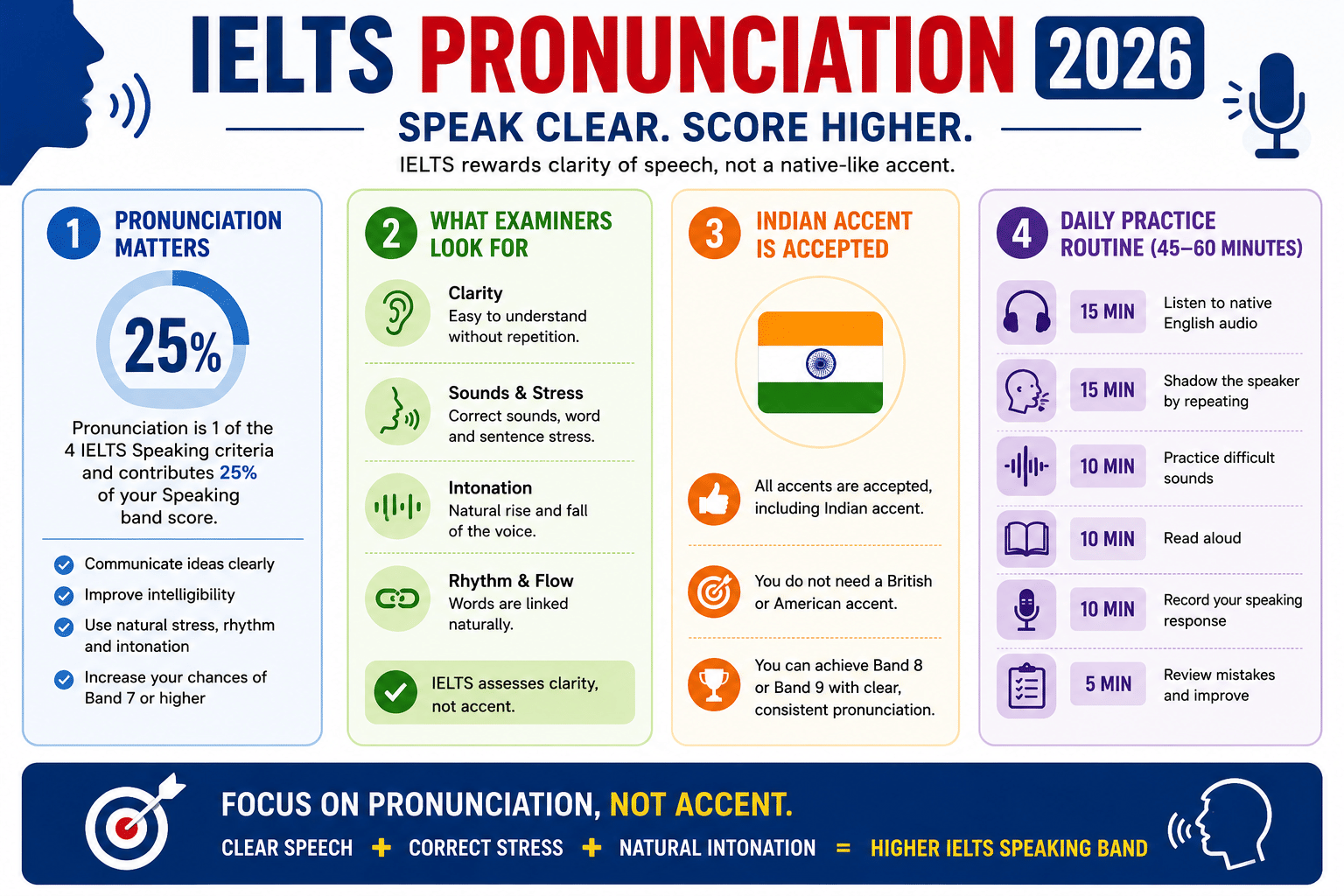
Pronunciation is one of the four assessment criteria in the IELTS Speaking test, alongside Fluency and Coherence, Lexical Resource, and Grammatical Range and Accuracy. It contributes 25% of your Speaking band score. IELTS examiners assess whether your speech is easy to understand, rather than whether you have a British, American, or Australian accent.
Good pronunciation helps you:
- Communicate ideas clearly without repeating yourself.
- Improve intelligibility so the examiner can understand you easily.
- Use natural stress, rhythm, and intonation.
- Increase your chances of achieving Band 7 or higher in Speaking.
- Sound confident and fluent during the interview.
Poor pronunciation may result in:
- Frequent requests from the examiner to repeat your answers.
- Misunderstanding of key words.
- Lower scores in the Pronunciation criterion, even if your grammar and vocabulary are strong.
Insight: IELTS rewards clarity of speech, not a native-like accent.
IELTS Pronunciation Band Descriptors
| Band | Pronunciation Performance |
|---|---|
| Band 9 | Uses a full range of pronunciation features naturally. Speech is effortless to understand throughout. |
| Band 8 | Uses a wide range of pronunciation features effectively with only occasional lapses. Rarely causes misunderstanding. |
| Band 7 | Shows positive features of pronunciation, including appropriate stress and intonation. Mostly easy to understand despite minor errors. |
| Band 6 | Uses a mix of pronunciation features with some effective control. Mispronunciations occur but generally do not reduce understanding. |
| Band 5 | Limited control over pronunciation. Errors in sounds, stress, or intonation sometimes make speech difficult to understand. |
| Band 4 | Frequent pronunciation problems reduce clarity. Listeners must often make an effort to understand. |
| Band 3 and below | Serious pronunciation difficulties make communication very limited or impossible. |
How Do IELTS Examiners Assess Pronunciation in 2026?
In the IELTS Speaking Band Descriptors, pronunciation is assessed based on how clearly and naturally a candidate speaks. Examiners do not expect a native accent. Instead, they evaluate whether your pronunciation allows your ideas to be understood without difficulty.
| Assessment Criteria | What the Examiner Looks For | Tips to Score Well |
|---|---|---|
| Clarity (Intelligibility) | Speech is easy to understand without frequent repetition. | Speak at a moderate pace and pronounce every word clearly. |
| Individual Sounds | Correct pronunciation of English vowel and consonant sounds. | Practice commonly confused sounds such as /v/ and /w/, /s/ and /sh/. |
| Word Stress | Correct emphasis on the stressed syllable of words. | Learn stress patterns of common IELTS vocabulary. |
| Sentence Stress | Important words are naturally emphasized in a sentence. | Stress content words (nouns, verbs, adjectives) instead of every word equally. |
| Intonation | Natural rise and fall of the voice while speaking. | Avoid speaking in a flat tone; use rising and falling intonation appropriately. |
| Rhythm & Connected Speech | Words are linked naturally, making speech sound fluent. | Listen to native speakers and practice shadowing exercises. |
Common Pronunciation Mistakes Made by Indian Students in 2026
Indian applicants often lose marks due to simple pronunciation errors which are easily avoidable. The following are the common mistakes that affect the IELTS result. Check the table below how to improve and how these common mistakes affect your result:
| Common Mistake | Why It Affects Your Score | How to Improve |
|---|---|---|
| Confusing /v/ and /w/ | Can change the meaning of words. | Practice minimal pairs like vest-west and vine-wine. |
| Incorrect word stress | Makes familiar words difficult to recognize. | Learn the correct stress for new vocabulary using dictionaries. |
| Pronouncing silent letters | Results in unnatural pronunciation. | Learn common silent-letter patterns and practice them regularly. |
| Long and short vowel confusion | Changes the meaning of words. | Listen to native pronunciation and repeat minimal pairs. |
| Dropping word endings | Makes grammar and meaning unclear. | Clearly pronounce -ed and plural -s endings. |
| Flat intonation | Makes speech sound robotic and less engaging. | Practice speaking with natural rises and falls in your voice. |
| Speaking too fast | Causes unclear pronunciation and skipped sounds. | Slow down and pause naturally between ideas. |
How to Improve IELTS Pronunciation in 2026?
Improving pronunciation requires consistent practice rather than trying to imitate a native speaker. These expert-recommended strategies can help you sound clearer and more natural in the IELTS Speaking test.
- Listen to native English daily: Spend at least 15-20 minutes listening to BBC Learning English, IELTS Speaking samples, podcasts, or TED Talks. Pay attention to how words are pronounced, stressed, and linked together.
- Practice shadowing: Listen to a short audio clip and immediately repeat it by copying the speaker's pronunciation, rhythm, and intonation. This improves natural speech patterns and confidence.
- Record and review your speech: Record your answers to IELTS Speaking questions and compare them with model responses. Identify unclear words, incorrect stress, and pronunciation errors.
- Focus on word stress and intonation: Learn which syllables are stressed in common IELTS vocabulary and avoid speaking in a flat tone. Natural stress and intonation make your speech easier to understand.
- Practice difficult English sounds: Work on sounds that Indian learners commonly confuse, such as /v/ vs /w/, /θ/ (think), /ð/ (this), and long versus short vowel sounds.
- Read aloud every day: Read newspapers, magazines, or IELTS sample answers aloud for 15 minutes daily. This helps improve clarity, confidence, and sentence rhythm.
- Get regular feedback: Practice speaking with an English teacher, study partner, or AI pronunciation tool. Feedback helps identify mistakes that are difficult to notice on your own.
Also read: How to Prepare for IELTS Exam 2026
Best Daily IELTS Pronunciation Practice Routine 2026
Applicants preparing for IELTS must practice IELTS Speaking topics daily for 45-60 minutes to achieve fluent proficiency. Here’s a daily practice routine to get a fluent pronunciation:
| Time | Activity |
|---|---|
| 10 minutes | Listen to native English audio (BBC, IELTS Speaking samples, podcasts). |
| 15 minutes | Shadow the speaker by repeating sentences with matching pronunciation. |
| 10 minutes | Practice difficult sounds and minimal pairs. |
| 10 minutes | Read an IELTS article or sample answer aloud. |
| 10 minutes | Record a 2-minute IELTS Speaking response. |
| 5 minutes | Review mistakes and repeat difficult words. |
Is an Indian Accent Accepted in IELTS in 2026?
IELTS accepts all native and non-native English accents, including Indian, British, American, Australian, Canadian, South African, and others.
The examiner does not award higher scores for sounding British or American. Instead, they assess whether your pronunciation is:
- Clear
- Consistent
- Easy to understand
- Supported by appropriate stress and intonation
An Indian accent will not reduce your score as long as your speech remains intelligible. You do not need to imitate a foreign accent to achieve Band 8 or Band 9.
Also read: Check How to Get a 9 Band Score on IELTS Speaking 2026
British vs American Pronunciation: Which Should You Use?
Many IELTS candidates worry whether they should speak with a British or American accent. The answer is simple, you can use either accent. IELTS accepts all standard English accents, including British, American, Australian, Canadian, New Zealand, South African, and Indian English.
The most important requirement is consistency and clarity. Switching between different pronunciation styles during the test may sound unnatural.
Frequently Mispronounced IELTS Words
Indian applicants mostly lose marks due to mispronunciation of simple words. This affects the overall IELTS score band. Here are some common words that are commonly mispronounced:
| Word | Common Incorrect Pronunciation | Correct Tip |
|---|---|---|
| Comfortable | Pronouncing all four syllables | Usually spoken as COMF-ter-bul (3 syllables). |
| Vegetable | Veg-e-ta-ble | Usually pronounced as VEJ-tuh-bul (3 syllables). |
| Environment | Incorrect stress on the first syllable | Stress the VI syllable: en-VI-ron-ment. |
| Development | Stressing the first syllable | Stress the VEL syllable: de-VEL-op-ment. |
| Opportunity | Wrong stress placement | Stress the TU syllable: oppor-TU-ni-ty. |
| Education | Saying every syllable equally | Stress the KA sound: ed-u-KA-tion. |
| Entrepreneur | Stressing the first syllable | Stress the final syllable: entrepre-NEUR. |
| Career | Equal stress on both syllables | Stress the second syllable: ca-REER. |
| Library | Say "Lie-berry" | Pronounce all syllables clearly: LI-brar-y. |
| February | Pronounce every "r" separately | Say it naturally as FEB-roo-air-ee or FEB-yoo-air-ee depending on your accent. |
Also read: Check IELTS Books Preparation Books for 2026
Pronunciation accounts for 25% of your IELTS Speaking score, making it one of the most important scoring criteria alongside fluency, vocabulary, and grammar. IELTS examiners assess clarity, intelligibility, stress, rhythm, and intonation, not whether you speak with a British or American accent. By following a 45-60 minute daily practice routine, avoiding common pronunciation mistakes, and focusing on clear, natural speech, Indian applicants can significantly improve their chances of achieving a Band 7 or higher in the IELTS Speaking test.
FAQs
Ques. Does pronunciation affect the IELTS Speaking band score?
Ans. Yes. Pronunciation is one of the four assessment criteria in the IELTS Speaking test and contributes 25% of your overall Speaking band score. Examiners assess how clearly and easily your speech can be understood, along with your use of stress, rhythm, and intonation.
Ques. Does IELTS require a British or American accent?
Ans. No. IELTS does not require candidates to speak with a British or American accent. Examiners are trained to understand a wide range of international accents, and your score depends on how clearly you communicate rather than the accent you use.
Ques. Can I score Band 8 or Band 9 with an Indian accent?
Ans. Yes. An Indian accent does not reduce your IELTS Speaking score. You can achieve Band 8 or Band 9 if your pronunciation is clear, your speech is easy to understand, and you use appropriate stress, rhythm, and intonation consistently.
Ques. What pronunciation features do IELTS examiners assess?
Ans. IELTS examiners assess whether your speech is intelligible and easy to follow. They evaluate pronunciation of individual sounds, word stress, sentence stress, rhythm, connected speech, and intonation rather than whether you sound like a native English speaker.
Ques. Will small pronunciation mistakes reduce my IELTS Speaking score?
Ans. Not necessarily. Minor pronunciation errors are acceptable if they do not affect communication. Candidates can still receive high band scores when their overall speech remains clear and understandable throughout the test.
Ques. Is pronunciation more important than grammar or vocabulary in IELTS Speaking?
Ans. No. Pronunciation carries equal weight with the other three Speaking assessment criteria: Fluency and Coherence, Lexical Resource, and Grammatical Range and Accuracy. Each criterion contributes equally to the final Speaking band score.
Ques. What is the difference between pronunciation and accent in IELTS?
Ans. According to IELTS, accent is your natural way of speaking based on your language or region, whereas pronunciation refers to how clearly you produce sounds, stress words, and use rhythm and intonation. IELTS assesses pronunciation—not accent.


1787567517.png?tr=w-305,h-145,c-force?h=175&w=350&mode=stretch)



Comments