



| Updated On - Aug 14, 2026
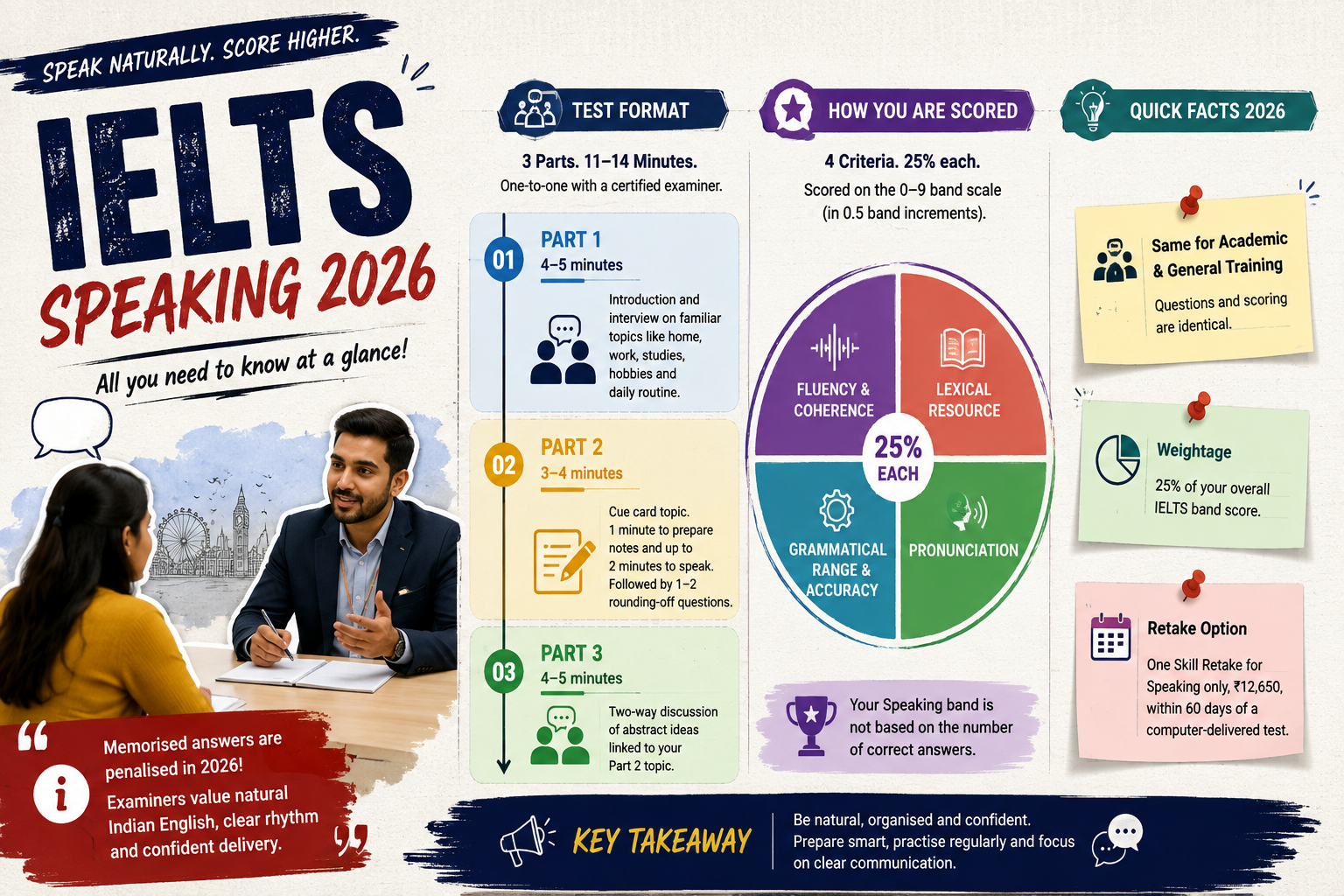
IELTS Speaking is an 11-14-minute face-to-face interview with a certified examiner, conducted in 3 parts and scored on the 0-9 band scale. In Part 1, applicants need to introduce themselves, in Part 2, they are given a topic and need to speak for 2 minutes; and in Part 3, the examiner engages in a discussion with the applicant.
- IELTS Speaking band score criteria: IELTS examiners score you on 4 criteria weighted equally at 25% each: Fluency and Coherence, Lexical Resource, Grammatical Range and Accuracy, and Pronunciation. Your Speaking band is not based on the number of correct answers.
- Memorised answers are penalised in 2026: Examiners are trained to spot rehearsed templates. A natural Indian English speaker with clear stress and rhythm outscores a candidate reciting memorised phrases.
IELTS Speaking Quick Facts 2026
- Duration: 11-14 minutes, 3 parts, one-on-one with a live examiner
- Scoring: 4 criteria at 25% each, reported in 0.5 band increments on the 0-9 scale
- Same for Academic and General Training: Yes, questions and scoring are identical
- Weightage: 25% of your overall IELTS band score
- Retake option: One Skill Retake for Speaking only, ₹12,650, within 60 days of a computer-delivered test
- IELTS Speaking Test Format 2026
- How do I speak for 2 minutes in IELTS Speaking Part 2?
- IELTS Speaking Band Descriptors: How Examiners Score You
- IELTS Speaking Topics 2026
- IELTS Speaking Tips by Scoring Criterion
- Common IELTS Speaking Mistakes by Indian Students
- IELTS Speaking Practice Resources 2026
- FAQs
IELTS Speaking Test Format 2026
The IELTS Speaking test is a recorded, semi-formal interview with a trained examiner, in a private room or over a secure video call at some IDP centres. Each part tests your hold on language and proficiency. The exam pattern is set to test applicants' fluency in the language in different conditions. Here’s an overview of all the 3 parts of the Speaking test:
| Part | Duration | What Happens | Skill Tested |
|---|---|---|---|
| Part 1: Introduction and Interview | 4-5 minutes | The examiner asks questions on familiar topics like your work, studies, home, hobbies, and daily routine | Giving opinions and information on everyday topics |
| Part 2: Long Turn (Cue Card) | 3-4 minutes | You get a cue card, a pencil and paper, 1 minute to prepare notes and up to 2 minutes to speak. The examiner may ask 1-2 rounding-off questions | Speaking at length with logically organised ideas |
| Part 3: Discussion | 4-5 minutes | A two-way discussion of abstract ideas linked to your Part 2 topic | Explaining opinions, analysing and speculating on issues |
IELTS Speaking remains a live examiner interview even after IELTS in India becomes fully computer-based from September 2026. Only Listening, Reading and Writing move on-screen. Speaking format remains the same.
How do I speak for 2 minutes in IELTS Speaking Part 2?
Use your 1 minute of preparation to note 4-5 keyword prompts covering each bullet on the cue card, then expand each prompt with a reason and an example. Candidates who skip the notes usually run dry at the 60-second mark.
- Use the cue-card points as your structure: Address each bullet point instead of trying to memorise a complete answer.
- Write keywords, not sentences: During the 1-minute preparation, note short phrases in English so you can quickly refer to them while speaking.
- Add details to every point: Give a reason, example, description, or personal experience after introducing each main idea to extend your response naturally.
- Use a simple story flow: Start with what followed by when/where, then describe the incident in detail, giving your interpretation of how you felt/result to keep your answer organised.
- Don't stop when you finish the cue-card bullets: Add relevant details, explanations, or personal reactions if you still have speaking time.
- Practise with a timer: Start with shorter speaking periods and gradually work towards the real 1-minute preparation + 2-minute speaking format. IELTS specifically recommends progressively increasing speaking time during practice.
- Don't memorise model answers: IELTS Speaking is designed to assess spontaneous spoken communication, so memorised responses can make your delivery less natural.
- Use your notes as a safety net: Keep your notes in the same order as your answer so you can quickly glance at them if you forget your next point.
Insider Tip: The test is recorded for your protection
Every IELTS Speaking interview is recorded for moderation. If you apply for a remark, this recording is what gets re-evaluated, so speak clearly towards the examiner throughout.
IELTS Speaking Band Descriptors: How Examiners Score You
Examiners assess the whole interview against 4 criteria, each worth 25%. Applicants need to prove their command and fluency in spoken English. The speaking test makes up 25% of the IELTS score. As it is a face-to-face exam, applicants are advised to be natural rather than going with any memorised script. Here’s an overview of all the 4 criteria of the Speaking test:
| Criterion | Weightage | What the Examiner Listens For |
|---|---|---|
| Fluency and Coherence | 25% | Natural pace, relevant answers, logical sequencing and the ability to keep going without frequent word-searching pauses |
| Lexical Resource | 25% | Range, precision and flexibility of vocabulary, including paraphrasing and topic-specific words used correctly |
| Grammatical Range and Accuracy | 25% | A mix of simple and complex sentences with few errors across tenses and structures |
| Pronunciation | 25% | Clarity, word stress, rhythm and intonation. Examiners assess intelligibility, not accent |
Also read: Check Easy to Learn Idioms for IELTS Speaking
What is the difference between Band 6 and Band 7 in IELTS Speaking?
A Band 7 candidate speaks at length with only occasional hesitation, flexible vocabulary, and infrequent grammar errors. A Band 6 candidate communicates effectively but with more repetition, hesitation, and noticeable errors.
The difference between Band 6 and Band 7 is mainly about consistency, flexibility, precision, and control, rather than simply using “better English.” IELTS Speaking is assessed across four equally important criteria: Fluency & Coherence, Lexical Resource, Grammatical Range & Accuracy, and Pronunciation. Here’s a detailed breakdown of the difference:
| IELTS Speaking Criteria | Band 6 | Band 7 |
|---|---|---|
| Fluency & Coherence | Can speak at length, but repetition, hesitation or self-correction may sometimes affect coherence | Can produce long turns without noticeable effort; hesitation may occur but generally does not affect coherence |
| Vocabulary | Has enough vocabulary to discuss topics at length and generally paraphrases successfully | Uses vocabulary flexibly across topics; can use some less common/idiomatic language and paraphrase effectively |
| Grammar | Uses a mix of simple and complex structures, but with limited flexibility; frequent errors in complex structures | Uses a range of structures flexibly; simple and complex sentences are used effectively, with frequent error-free sentences |
| Pronunciation | Generally understandable, though mispronunciation may occasionally cause momentary difficulty for the listener | Has all the positive features of Band 6 plus some features of Band 8, indicating stronger control and intelligibility |
Pro Tip:
Unlike Listening and Reading, Speaking is not converted from a count of correct answers. The examiner scores how you say things, so a confident wrong opinion beats a hesitant memorised one.
Also read: IELTS Speaking 9 band score tips.
IELTS Speaking Topics 2026
The Speaking skill has a different test format, duration, and topics. Part is 4-5 minutes long, where the applicant introduces themselves, followed by some questions from the examiner. Part 2 is 3-4 minutes long, where you need to speak for 2-3 minutes. Part 3 is 4-5 minutes long, where the examiner discusses a topic with you.
The following are some of the latest topics that are asked in the IELTS Speaking test:
| IELTS Speaking Part | Duration | Topics You Can Expect | What You Need to Do |
|---|---|---|---|
| Part 1 | 4-5 minutes | Home, family, studies, work, hobbies, food, holidays, sports and other familiar topics | Give short, clear answers based on your personal experiences, opinions and everyday life |
| Part 2 | 3-4 minutes | A person, place, object, experience, activity or situation | Use the cue card to organise your ideas, prepare for 1 minute, then speak for up to 2 minutes |
| Part 3 | 4-5 minutes | Broader and more abstract issues related to the Part 2 topic | Explain and justify opinions, discuss causes/effects, compare ideas and speculate about future developments |
Common IELTS Speaking topic areas in 2026 include work and studies, home, family, hobbies, holidays, food, friends, sports, technology, travel and everyday experiences. IELTS does not provide a guaranteed annual list of Speaking questions, so candidates should prepare by topic areas rather than memorising predicted questions.
Must read about IELTS Speaking parts and topics:
IELTS Speaking Tips by Scoring Criterion
The fastest way to raise your IELTS Speaking band is to train against the same 4 criteria the examiner uses.
Fluency and Coherence
Answer the question first, then add a reason, an example, or a consequence. Use simple signposts like "for example", "however" and "as a result" only where they genuinely connect ideas. Record 1-minute answers daily and note where you stop or restart; those breaks cost more marks than small grammar slips.
Lexical Resource
Build vocabulary around recurring topic areas such as work, education, technology and environment, and practise each new word in several different sentences. A word usable only in one rehearsed sentence signals memorisation. Paraphrase the examiner's question instead of repeating it word for word.
Grammatical Range and Accuracy
Mix simple and complex sentences. A frequent Indian English slip is the present continuous for permanent situations: say "I live in a flat", not "I am living in a flat". Fix your 3 most repeated errors before learning new structures.
Pronunciation
Intonation beats accent. Focus on word stress, natural pauses, and a rising tone for questions rather than imitating a British or American accent. Examiners assess whether you are easy to understand, not where you sound like you are from.
Not sure what IELTS Speaking band your target university needs? Get a free profile evaluation from Collegedunia Study Abroad counsellors and a realistic band target for your course and country.
Common IELTS Speaking Mistakes by Indian Students
Applicants often lose marks in the speaking test due to silly mistakes which can be easily avoided. Applicants must know how they should answer, how much they should answer, and they should not speak in an American or British accent. These mistakes are easily identifiable and this leads to low marks. The following are some of the common mistakes applicants make during the Speaking test:
- One-word and one-line answers in Part 1: "Yes, I like it" gives the examiner nothing to score. Extend every answer with a reason or example.
- Memorised templates and scripted openings: Rehearsed monologues sound unnatural and are marked down. Prepare ideas, not scripts.
- Skipping notes in the Part 2 preparation minute: Speaking without notes routinely runs dry before the 2-minute mark.
- Faking an accent: Mother-tongue influence on clarity is the real issue, not the Indian accent itself. Slow down and stress key words instead.
- Going silent on abstract Part 3 questions: Think aloud with phrases like "That's an interesting question" while you organise a view, and back opinions with reasons and examples.
Tips: You can ask the examiner to repeat or rephrase a question without any penalty. Answering the wrong question because you did not ask costs far more marks than asking does.
India-Specific: One Skill Retake covers Speaking
If Speaking alone pulls your band down, the IELTS One Skill Retake lets you redo only the Speaking interview for ₹12,650 within 60 days of your computer-delivered test. Confirm acceptance first, since some top universities and visa routes do not accept OSR scores.
IELTS Speaking Practice Resources 2026
Simulate the interview, not just the questions. Practise the 3 parts in one timed sitting, record yourself and score the recording against the 4 criteria.
| Free IELTS Speaking Practice Tests 2026 (PDF) | ||
|---|---|---|
| IELTS Speaking Practice Test 1 | IELTS Speaking Practice Test 2 | IELTS Speaking Practice Test 3 |
Pair the PDFs with a routine of daily 1-minute recordings, 2 timed cue card turns per day, and 1 weekly Speaking practice test.
Must read about IELTS Speaking preparation:
IELTS Speaking rewards natural, extended, and clearly organised English, not memorised vocabulary or a foreign accent. Train against the 4 criteria, prepare the 2026 topic areas with your own examples, and rehearse the full interview under timed conditions. Book your IELTS exam dates at least 2-3 months before your application deadline.
FAQs
Ques. How long is the IELTS Speaking test?
Ans. The IELTS Speaking test lasts 11-14 minutes. Part 1 takes 4-5 minutes, Part 2 takes 3-4 minutes including 1 minute of preparation, and Part 3 takes 4-5 minutes.
Ques. Is IELTS Speaking the same for Academic and General Training?
Ans. Yes, the IELTS Speaking test is identical for Academic and General Training candidates. Only the Reading and Writing sections differ between the two test types.
Ques. How is the IELTS Speaking band score calculated?
Ans. The IELTS Speaking band score comes from 4 equally weighted criteria: Fluency and Coherence, Lexical Resource, Grammatical Range and Accuracy, and Pronunciation. Each carries 25%, and the four scores are averaged into a band reported in 0.5 increments.
Ques. What happens in IELTS Speaking Part 2?
Ans. In IELTS Speaking Part 2, you receive a cue card, paper, and a pencil, get 1 minute to prepare notes, and speak for up to 2 minutes on the topic. The examiner may ask 1-2 short follow-up questions before Part 3.
Ques. Can I ask the examiner to repeat a question in IELTS Speaking?
Ans. Yes, you can politely ask the examiner to repeat or clarify a question in IELTS Speaking without penalty. Guessing a misheard question is riskier than asking.
Ques. Does my Indian accent reduce my IELTS Speaking score?
Ans. No, an Indian accent does not reduce your IELTS Speaking score. Examiners assess intelligibility, meaning clarity, stress, and rhythm, not accent.
Ques. Are memorised answers penalised in IELTS Speaking?
Ans. Yes, memorised answers are penalised in IELTS Speaking. Examiners are trained to recognise rehearsed templates, which sound unnatural and fail to answer the specific question asked. Prepare ideas, then speak spontaneously.
Ques. Will IELTS Speaking be on a computer in India from September 2026?
Ans. No, IELTS Speaking stays a live interview with a certified examiner even after IELTS in India goes fully computer-based from September 2026. The computer-based change applies to Listening, Reading and Writing. At some centres, the Speaking interview happens over a secure video call with a live examiner.
Ques. Can I retake only the Speaking section of IELTS?
Ans. Yes, the IELTS One Skill Retake lets you retake only Speaking for ₹12,650 within 60 days of your computer-delivered test. Not all universities and visa authorities accept OSR scores.



Comments