



| Updated On - Jul 10, 2026
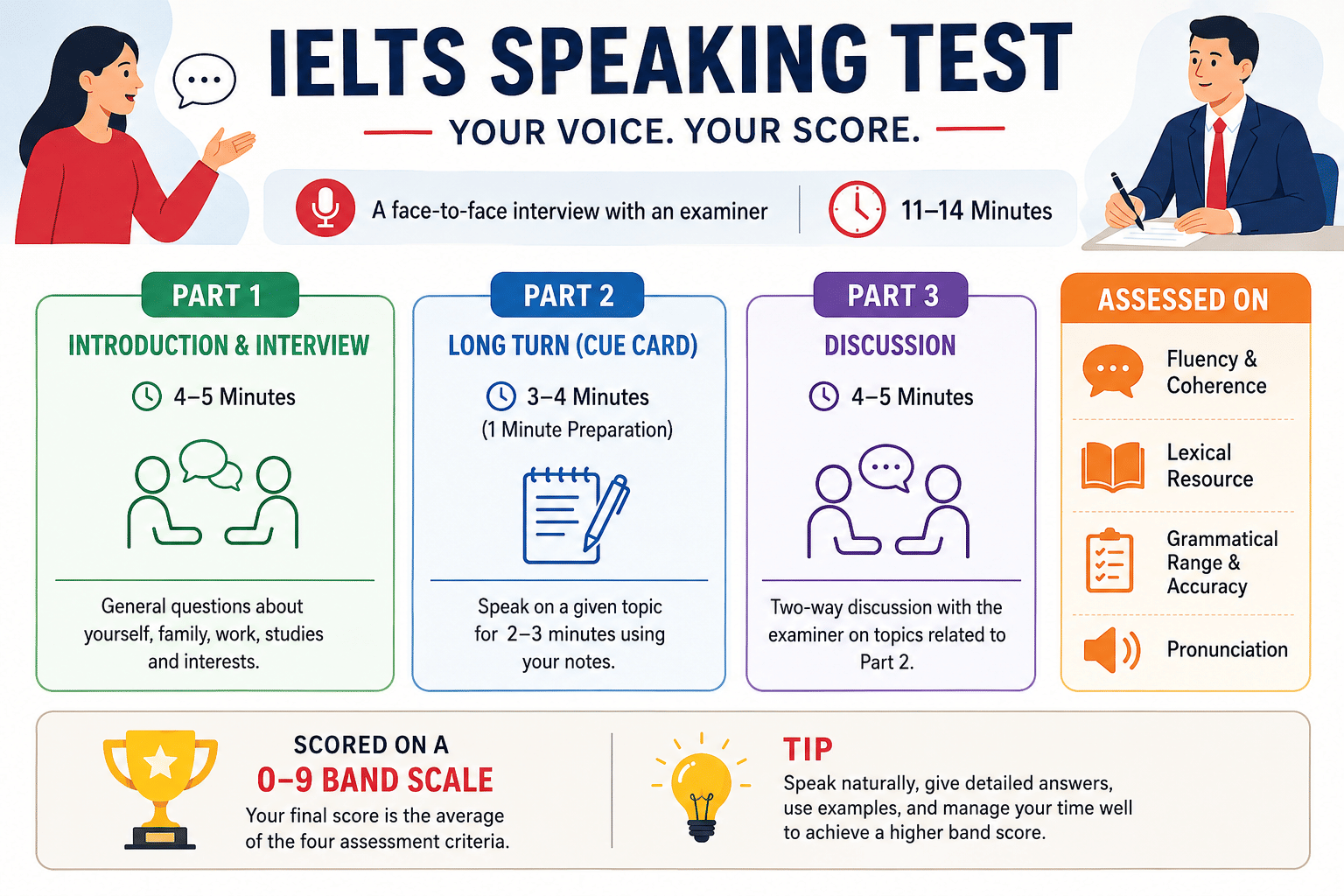
IELTS Speaking is an 11-14 minute test in the IELTS exam. This test specifically examines verbal fluency in the English language. It is conducted in 3 parts: Introduction, Cue Card, and Discussion.
The general Speaking topics are themed on:
- House
- Personal life
- Hobbies
- Current general issues
- Education
The applicants need to introduce themselves first. After the introduction, they need to speak on these topics in the 2nd (Cue Card) and 3rd (Discussion) parts of the test. In the 2nd part, applicants get 1-2 minutes of preparation time, after which they speak on the given topic for 2-3 minutes. In part 3, the applicant and the examiner discuss similar topics for 3-4 minutes.
- IELTS Speaking Part 1 Topics 2026
1.1 IELTS Speaking Part 1 Sample Answer
- IELTS Speaking Part 2 Cue Card Topics 2026
2.1 IELTS Speaking Part 2 Cue Card Sample Answer
- IELTS Speaking Part 3 Discussion Topics 2026
3.1 IELTS Speaking Part 3 Discussion Sample Answer
- Recent IELTS Speaking Topics 2026
- Topic-wise Vocabulary for IELTS Speaking 2026
- Band 7-9 Answer Strategies 2026
- Common Mistakes to Avoid in 2026
- IELTS Speaking Tips to Improve Your Score 2026
- FAQs
IELTS Speaking Part 1 Topics 2026
The first part of the Speaking test has a 3-4 minute introduction round in which applicants need to introduce themselves, and following it, the examiner might ask some questions to the applicant on their hobbies, hometown, education, and career plans.
Topics for the introduction round are as follows:
| Question Topic | Types of Questions |
|---|---|
| Hometown |
|
| Work or Studies |
|
| Reading |
|
| Free Time |
|
| Family |
|
| Food |
|
| Dreams |
|
IELTS Speaking Part 1 Sample Answer
Sample answer for part 1 introduction rounds are as follows:
| Question | Answer |
|---|---|
| Where is your hometown? | I come from Lucknow, a fairly historic city in northern India known for its Mughal-era architecture and its distinctly refined culture. |
| What do you like most about your hometown? | Honestly, it's the food culture. Lucknow is famous for its kebabs and biryani, and there's a real sense of hospitality woven into everyday life there that you don't find everywhere. |
| Has your hometown changed much since you were a child? | Quite a bit, actually. When I was younger, it felt a lot more laid-back, but over the last decade it's become noticeably more urbanised, with malls and IT parks springing up where there used to be open fields. |
| Would you say it's a good place for young people to live? | To some extent, yes, the cost of living is low, and the pace of life is relaxed, but I'd say job opportunities are still fairly limited compared to bigger metros, so a lot of young people end up moving away for work. |
| Do you work or are you a student? | I currently work in digital marketing, focusing mainly on SEO and content strategy for an education-based platform. |
| What do you like about your job/subject? | What I find most rewarding is the analytical side of it, figuring out why a page isn't ranking and then watching the changes I make actually move the needle is genuinely satisfying. |
| What are your plans for the future in your career/studies? | Long-term, I'd like to move into a more strategic role, perhaps leading a team, since I enjoy mentoring as much as the hands-on work itself. |
| What kind of books do you like to read? | I'm drawn to non-fiction, particularly books on behavioural psychology and business, since I like applying those ideas to my work. |
| Do you prefer reading physical books or e-books? | I lean towards physical books for leisure reading, there's something about the tactile experience that keeps me more engaged, but I use e-books for anything work-related simply for convenience. |
| Do you enjoy reading? | I do, though I'll admit my reading habits are a bit sporadic. I go through phases where I devour a book a week and then don't pick one up for a month. |
IELTS Speaking Part 2 Cue Card Topics 2026
The latest IELTS Speaking Cue Card topics are generic and primarily require an individual analysis of the topic and opinion. As the world is currently changing to AI integration, the IELTS Cue Card topic can be:
People
- Describe a person who inspired you.
- Describe your best friend.
- Describe a family member you admire.
- Describe a famous person you would like to meet.
- Describe a teacher who influenced you.
- Describe someone who helped you.
- Describe a successful person you know.
- Describe a person with an interesting job.
- Describe someone who makes you laugh.
- Describe a child you know.
Places
- Describe a beautiful place you have visited.
- Describe your favourite tourist destination.
- Describe a historical place.
- Describe a park or garden you enjoy visiting.
- Describe your hometown.
- Describe a city you would like to visit.
- Describe a beach you have visited.
- Describe a place where you like to relax.
- Describe your dream travel destination.
- Describe a crowded place you have been to.
Experiences
- Describe a memorable journey.
- Describe a time when you were happy.
- Describe a difficult decision you made.
- Describe a time when you helped someone.
- Describe a time you learned something new.
- Describe an exciting event you attended.
- Describe a competition you participated in.
- Describe a celebration you enjoyed.
- Describe a time when you were late.
- Describe a challenge you overcame.
Objects & Things
- Describe a useful piece of technology.
- Describe something you bought recently.
- Describe a gift you received.
- Describe your favourite book.
- Describe a photograph you like.
- Describe a piece of clothing you wear often.
- Describe an important document.
- Describe a toy you liked as a child.
- Describe a work of art you admire.
- Describe something you lost and found.
Hobbies & Interests
- Describe a hobby you enjoy.
- Describe a sport you like.
- Describe your favourite movie.
- Describe your favourite song.
- Describe a TV programme you enjoy.
- Describe a game you like playing.
- Describe a website you often use.
- Describe a skill you would like to learn.
- Describe an outdoor activity you enjoy.
- Describe an indoor activity you enjoy.
Education & Work
- Describe your favourite subject.
- Describe a useful course you attended.
- Describe your dream job.
- Describe an important project you completed.
- Describe a workplace you would like to work in.
- Describe a school event you remember.
- Describe an online class you attended.
- Describe a skill that helped you at work or school.
What points should be covered while answering the questions of the IELTS Cue Card?
The Answer should include points such as:
- what the skill is
- how and when you learned it
- how difficult it was to learn
- and explain why you think it will be useful in the future
IELTS Speaking Part 2 Cue Card Sample Answer
One skill I picked up relatively recently that I believe will only grow in importance is data analysis, specifically learning how to use tools like Google Analytics and Excel to interpret trends rather than just look at raw numbers.
I started learning it about two years ago, mostly out of necessity, because my job increasingly required me to justify content decisions with data rather than intuition. I began with free online tutorials and gradually started applying what I learned directly to real projects at work, which I think accelerated things considerably compared to just studying in the abstract.
I won't pretend it was easy. The learning curve was fairly steep at first, particularly when it came to understanding statistical concepts like correlation versus causation. I made plenty of embarrassing mistakes early on, like concluding data that was, in hindsight, far too limited. That said, once the fundamentals clicked, it became less about memorising formulas and more about developing an intuition for what the numbers were actually telling me.
As for why it'll be useful going forward, I genuinely think data literacy is becoming as fundamental as basic computer skills were a decade ago. Almost every industry, from healthcare to marketing, is becoming more data-driven, and being able to interpret and act on information, rather than relying purely on instinct, is going to be a significant advantage no matter what field someone ends up in.
IELTS Speaking Part 3 Discussion Topics 2026
The IELTS Speaking Part 3 is a discussion round in which applicants and the examiner speak to each other and discuss a topic for 4-5 minutes. The applicants need to answer the examiner's questions of the examiner. This part examines the grammar, structure, and coherence of the answer.
The latest IELTS Speaking discussion round topics can be
- What skills do you think are most important for young people to learn today?
- Do you think schools teach enough practical skills, or mostly theoretical knowledge?
- Do you think automation and AI will replace the need for certain human skills?
- Is it better to learn a skill through formal education or through self-study?
- Do you think older people find it harder to learn new skills than younger people? Why?
Download the PDF for More Latest IELTS Speaking Practice Questions.
IELTS Speaking Part 3 Discussion Sample Answer
Sample answers for part 3 discussion round are as follows:
| Question Which Can Be Asked in Discussion | How to Answer the Questions in Discussion Round |
|---|---|
| What skills do you think are most important for young people to learn today? | I'd argue adaptability is right up there, the specific tools change so quickly that the ability to learn something new on the fly matters more than mastering any single piece of software. Alongside that, I think critical thinking is essential, particularly given how much misinformation people are exposed to online. |
| Do you think schools teach enough practical skills, or mostly theoretical knowledge? | In my experience, education systems still lean quite heavily towards theory, which isn't necessarily a bad thing since it builds a foundation, but there's a real gap when it comes to practical application. Students often leave school knowing formulas but not how to, say, manage a budget or write a professional email. |
| Do you think automation and AI will replace the need for certain human skills? | To some degree, yes — repetitive, rule-based tasks are almost certainly going to be automated. That said, I don't think it eliminates the need for human skills so much as it shifts what's valuable; things like emotional intelligence, creativity, and complex judgement calls are proving surprisingly resistant to automation. |
| Is it better to learn a skill through formal education or through self-study? | I don't think it's an either-or situation, to be honest. Formal education tends to offer structure and accountability, which self-study often lacks, but self-directed learning allows for a level of flexibility and relevance to real-world problems that traditional curricula can struggle to match. Ideally, it's a combination of both. |
| Do you think older people find it harder to learn new skills than younger people? Why? | There's a common assumption that they do, but I'm not fully convinced it's about age itself. I think it has more to do with exposure and confidence, older generations sometimes didn't grow up surrounded by rapidly changing technology, so there's more of a psychological barrier, rather than any real cognitive limitation. |
Recent IELTS Speaking Topics 2026
Download free IELTS Speaking test topics PDFs. The latest topics in the IELTS test focus on personal information such as hobbies, likes, and dislikes.
Download free IELTS Speaking test PDFs from the table below:
Also read: Check More IELTS Speaking Test Sample Practice Questions 2026
Topic-wise Vocabulary for IELTS Speaking 2026
While speaking on topics of hometown, technology, or travelling, applicants can use these words to enhance their speaking ability and vocabulary. The tables below have words and phrases that can be included in conversation to enhance their skill.
Hometown
| Word or Phrase | Meaning | Example |
|---|---|---|
| bustling | busy and full of activity | My hometown is a bustling city. |
| close-knit community | people who know each other well | We live in a close-knit community. |
| residential area | area where people live | I grew up in a peaceful residential area. |
| urban development | city expansion | Urban development has changed the city. |
| local landmarks | famous places | There are many historical landmarks nearby. |
Technology
| Vocabulary | Meaning | Example |
|---|---|---|
| cutting-edge technology | The latest and most advanced technology | AI is considered cutting-edge technology. |
| digital literacy | The ability to use digital devices and the internet effectively | Digital literacy is an important skill in today's world. |
| automation | The use of machines or software to perform tasks automatically | Automation has improved productivity in many industries. |
| artificial intelligence (AI) | Technology that enables machines to perform tasks requiring human intelligence | Artificial intelligence is transforming healthcare and education. |
| user-friendly | Easy to understand and use | This language-learning app is very user-friendly. |
Travel
| Vocabulary | Meaning | Example |
|---|---|---|
| scenic destination | A place known for its beautiful natural views | Kashmir is a scenic destination. |
| off-the-beaten-path | A place that is less crowded or less commonly visited | I enjoy exploring off-the-beaten-path locations. |
| cultural immersion | Fully experiencing the local culture and traditions | Cultural immersion makes travelling more meaningful. |
| sightseeing | Visiting famous or interesting places | We spent the whole day sightseeing. |
| public transportation | Transport services available for everyone, such as buses and trains | I usually use public transportation while travelling abroad. |
Band 7-9 Answer Strategies 2026
Applicants preparing for the IELTS exam should strategise to get good IELTS scores. Applicants are advised to practice daily for 1-2 hours. This will help them build confidence and enhance their vocabulary.
Here’s a daily plan to practice all the parts of the IELTS Speaking test:
| Activity | Time |
|---|---|
| Speak on one IELTS topic | 10 minutes |
| Record and review your answers | 10 minutes |
| Learn new vocabulary and collocations | 15 minutes |
| Practise one Part 2 cue card | 15 minutes |
| Answer Part 3 discussion questions | 15 minutes |
| Read an English article aloud for pronunciation | 10 minutes |
Common Mistakes to Avoid in 2026
Indian applicants often make silly mistakes in the IELTS Speaking exam, such as grammatical errors and replying with 1 or fewer words. These mistakes heavily impact their overall score. While practicing, they need to keep these mistakes in mind and improve these issues.
Here’s a list of common mistakes and their solution:
| Mistake | Solution |
|---|---|
| Giving one-word answers | Explain your ideas with reasons and examples. |
| Memorizing scripts | Respond naturally to the examiner's questions. |
| Speaking too fast | Maintain a comfortable and clear pace. |
| Repeating the same vocabulary | Paraphrase and use synonyms where appropriate. |
| Using difficult words incorrectly | Prefer accurate, natural vocabulary over complicated words. |
| Overusing idioms | Use idiomatic language only when it fits the context naturally. |
| Ignoring grammar | Mix sentence structures while maintaining accuracy. |
IELTS Speaking Tips to Improve Your Score in 2026
Indian students planning to study abroad in 2026 should follow these tips and suggestions to score 8.0-9.0 in IELTS Speaking. Here are the IELTS Speaking tips:
- Answer every question in detail by giving reasons, explanations, or examples instead of responding with only one or two words.
- Speak fluently and naturally without memorising answers, as examiners can easily identify rehearsed responses.
- Use a wide range of vocabulary and grammar to demonstrate your language ability, but only use words and structures you are comfortable with.
- Pronounce words clearly and maintain a steady pace, as clear communication is more important than having a native English accent.
- Organise your Part 2 (Cue Card) response using the one-minute preparation time to note key points and speak for the full two minutes.
- Stay calm and keep speaking even if you make a mistake, as occasional self-corrections are natural and do not significantly affect your score.
- Practice common IELTS Speaking topics regularly, such as education, work, travel, technology, environment, and hobbies, to improve confidence and fluency before the test.
Also read: How to Score 8.0-9.0 in IELTS Speaking in 2026
The IELTS Speaking test is an 11-14 minute face-to-face interview divided into three parts and is scored on the IELTS 0-9 band scale. A high band score depends on fluency, vocabulary, grammar, pronunciation, and the ability to organise ideas effectively. Practising the latest Speaking topics, Cue Cards, and discussion questions regularly can help candidates perform confidently and improve their overall IELTS Speaking score.
FAQs
Ques. Are memorised answers recommended in the IELTS Speaking test?
Ans. No. IELTS advises candidates to answer naturally. Examiners are trained to recognise memorised responses, which may not allow candidates to demonstrate their actual speaking ability.
Ques. Is the IELTS Speaking test the same for Academic and General Training?
Ans. Yes. The format, timing, assessment criteria, and Speaking band descriptors are the same for both IELTS Academic and IELTS General Training.
Ques. Does my accent affect my IELTS Speaking score?
Ans. No. Candidates are not required to have a British, American, or Australian accent. Examiners assess whether your pronunciation is clear and easy to understand.
Ques. Can I make notes during the IELTS Speaking Part 2 Cue Card?
Ans. Yes. In Part 2, you are given one minute to prepare before speaking. During this time, you may make notes on the paper provided and use them while giving your response.
Ques. Is the IELTS Speaking test recorded?
Ans. Yes. The IELTS Speaking test is recorded to ensure quality assurance and consistency in the assessment process.
Ques. Is the IELTS Speaking test conducted on a computer?
Ans. No. Even if you choose IELTS on Computer, the Speaking test is still conducted with a trained examiner in a face-to-face interview. For IELTS Online, the Speaking test is conducted via a live video call with an examiner.



Comments