



Study Abroad Expert | Updated On - Sep 28, 2026
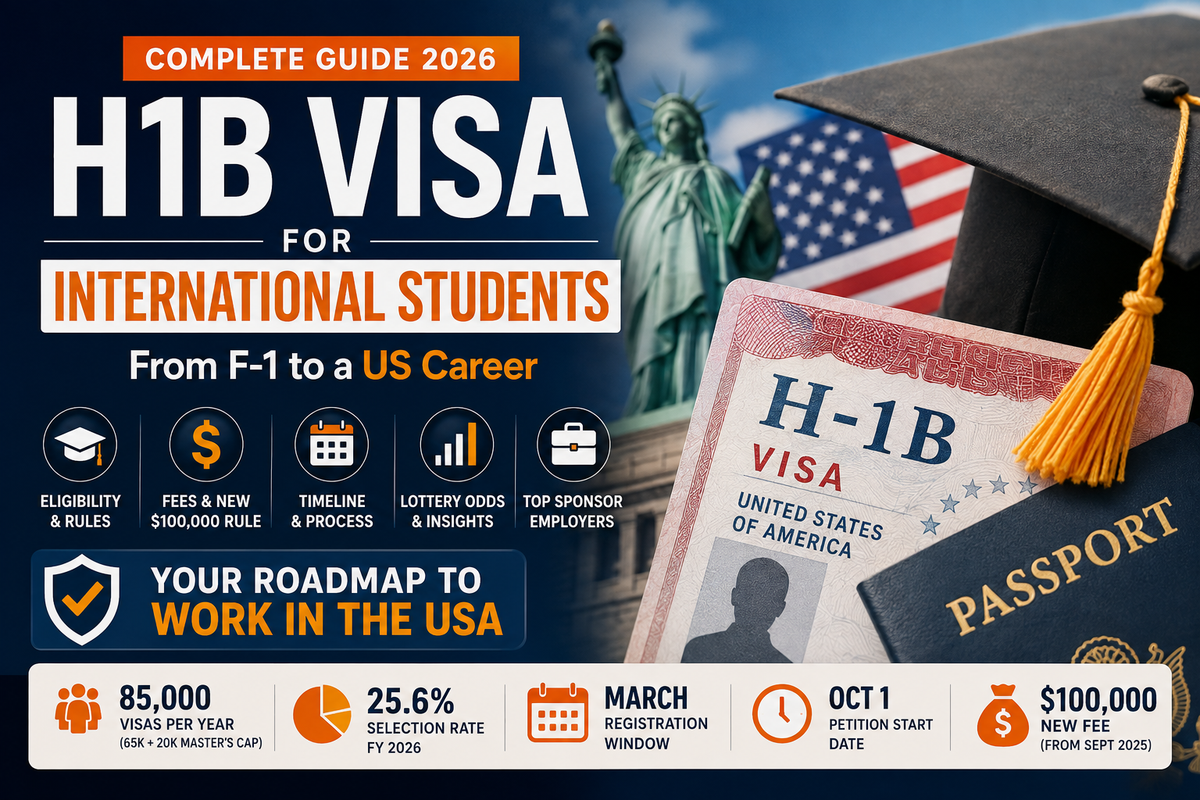
The H1B visa for international students is the main work visa that lets F-1 graduates stay and work in the US after their OPT ends. It runs for 3 years, extends to 6, and is the standard bridge from a US degree to a US career. The rules changed sharply in September 2025 when a new USD 100,000 fee began to reshape who employers now sponsor.
- Employer sponsorship matters more than your university’s rank once you finish your degree.
- The US master’s route gives you a real, not marginal, edge in the lottery.
- Timing is everything: missing the March window costs a full year, not the visa itself.
- The new fee hurts fresh grads outside the US far more than students already on OPT.
Check OPT Rules and STEM Extension for Indian Students in USA
The Fiscal Year 2026 cycle selected about 120,141 registrations from 470,342 eligible entries. Selection odds fell to nearly one in four. The new proclamation fee makes those odds harder to translate into an actual job offer.
This matters because your route to a US career hinges on picking the right employer, filing on time and reading the new rules correctly.
Quick Facts on H1B Visa for Students
| Parameter | Detail |
|---|---|
| Regular annual cap | 65,000 visas |
| US master’s cap (extra) | 20,000 visas |
| FY 2026 selection rate | Around 25.6% |
| Initial validity | 3 years (extendable to 6) |
| Registration fee | USD 215 (INR 19,000) |
| Standard USCIS filing fees | USD 1,700 to USD 6,700 (varies by employer) |
| New proclamation fee (Sept 2025) | USD 100,000 (around INR 88.5 lakh) on new petitions from outside the US |
| Registration window | March each year |
| Petition start date | October 1 (US fiscal year start) |
Source: USCIS H-1B FY 2026 selection data; USCIS fee schedule effective April 2024; Presidential Proclamation dated September 19, 2025.
- What Is H1B Visa for International Students?
- H1B Eligibility for International Students
- H1B Visa Fees After the $100,000 Rule
- F1 to H1B Cap-Gap Route Explained
- H1B Lottery Odds for 2026 Cycle
- H1B Application Timeline for Students
- Top Employers Sponsoring H1B Visas
- H1B vs OPT vs STEM OPT
- H1B to Green Card Pathway
What Is H1B Visa for International Students?
The H1B visa for international students is a US work visa for specialty jobs that need at least a bachelor’s degree. It is the standard next step for Indian students finishing an F-1 degree and their OPT period.
The visa is tied to one employer. That employer must file the petition on your behalf. You cannot self-petition. This is different from the UK Graduate Route or the German Job Seeker Visa, both of which let you look for a job first.
The H1B is capped at 85,000 new visas each year. It runs for three years, then extends to six. Beyond six, you need an approved green card petition (called an I-140) to keep extending.
Why students should care
- It is the only mainstream visa that converts an F-1 into US employment long-term.
- Universities, non-profits and research bodies are cap-exempt, meaning no lottery for their hires.
- The visa is dual-intent, so you can apply for a green card while holding it.
Key Insight: The H1B is a lottery, not a merit selection. A Stanford PhD has the same random pick chance as a state-university master’s graduate once both meet the base rules.
H1B Eligibility for International Students
You qualify for the H1B if your job is a specialty occupation and you hold at least a US bachelor’s degree or its foreign equivalent. Most Indian students meet the degree bar easily.
USCIS checks three things. Your role must need a specific degree. Your degree must match the role. Your employer must be real, financially sound and willing to pay the prevailing wage.
Core eligibility checklist
- A bachelor’s degree or higher in a field tied to the job.
- A job offer from a US employer for a specialty role.
- An approved Labor Condition Application (LCA) from the Department of Labor.
- Employer must pay the prevailing wage for the role and location.
- Employer must file a Form I-129 petition with USCIS.
Specialty occupations include software engineers, data scientists, financial analysts, mechanical engineers, doctors, architects and researchers. Roles that any bachelor’s holder can do (like general management trainees) often get rejected.
Source: USCIS H-1B Employer Data Hub; DOL prevailing wage guidance.
H1B Visa Fees After the $100,000 Rule
Total H1B costs for a new petition from outside the US now reach around USD 105,000, including the new proclamation fee. The employer pays almost all of it, not the student.
The Presidential Proclamation dated September 19, 2025 added a one-time USD 100,000 fee on new H1B petitions filed for people outside the US. It does not apply to renewals, extensions or people already on H1B inside the country.
Full fee breakdown
| Fee Type | Amount (USD) | INR Equivalent |
|---|---|---|
| Electronic registration | USD 215 | INR 19,000 |
| Form I-129 filing (small employer) | USD 460 | INR 40,700 |
| Form I-129 filing (large employer) | USD 780 | INR 69,000 |
| ACWIA training fee (26+ workers) | USD 1,500 | INR 1.33 lakh |
| Fraud prevention fee | USD 500 | INR 44,250 |
| Asylum program fee | USD 600 | INR 53,100 |
| Premium processing (optional) | USD 2,805 | INR 2.48 lakh |
| Proclamation fee (new offshore petitions) | USD 100,000 | INR 88.5 lakh |
Conversions based on a USD-INR rate of INR 88.50 as of September 24, 2026. Rates fluctuate; check the current rate before financial planning.
Key Insight: Students already on OPT in the US are not hit by the new USD 100,000 fee. The proclamation targets fresh hires from outside the country, which pushes employers to prefer F-1 grads who are already local.
F1 to H1B Cap-Gap Route Explained
Cap-gap is a rule that keeps your F1 status active until October 1 if your H1B petition is pending or approved. Without it, thousands of students would lose status between OPT end and H1B start.
Your OPT usually expires between May and September. The H1B fiscal year starts October 1. Cap-gap covers this window automatically.
How cap-gap works in practice
- You must be in valid F1 status or OPT when your employer files the H1B.
- Your employer must request a change of status, not a consular process.
- You can stay in the US but cannot work once your OPT ends until October 1.
- If the petition is denied, your cap-gap ends immediately.
What cap-gap gives you: legal stay through the gap and work rights that resume October 1. What it does not cover: international travel, family visa applications or job switches during the gap.
Source: USCIS Cap-Gap Extension for F-1 Students guidance.
H1B Lottery Odds for 2026 Cycle
The FY 2026 cycle picked about 25.6% of eligible registrations, up from 14.6% the year before. The new beneficiary-centric rule cut duplicate entries and improved real odds.
USCIS received 470,342 unique-beneficiary registrations for FY 2026. It selected 120,141 in the initial draw and ran a second selection round in August 2025 to hit the cap.
Recent lottery selection rates
| Cycle | Eligible Registrations | Selected | Odds |
|---|---|---|---|
| FY 2024 | 780,884 | 110,791 | 14.2% |
| FY 2025 | 470,342 | 120,603 | 25.6% |
| FY 2026 | 343,981 | 120,141 | 34.9% |
Source: USCIS H-1B Registration data, 2023 to 2025.
The odds jumped because USCIS now counts each beneficiary once. Earlier, a single candidate could be entered by multiple employers, gaming the system. The new rule ended that.
Key Insight: US master’s students still get two lottery pulls: one in the master’s cap of 20,000 and, if unpicked, a second in the regular 65,000. That doubles real selection odds for MS grads.
H1B Application Timeline for Students
The full H1B cycle runs from March registration to October 1 start date, with most steps handled by your employer. You mainly need to give your documents on time and pass the visa stamping if you are outside the US.
Month-by-month timeline
| Month | Action |
|---|---|
| January to February | Employer confirms sponsorship, collects your documents |
| March 1 to 17 | Electronic registration window opens on USCIS site |
| Late March | USCIS runs lottery and notifies employers of selection |
| April 1 to June 30 | Selected employers file Form I-129 petitions |
| May to September | USCIS adjudicates; premium processing takes 15 business days |
| August to September | Visa stamping at US consulate (if applying from outside US) |
| October 1 | H1B validity begins; you can start work |
If your OPT runs out before October 1 and cap-gap covers you, you must stop working the day OPT ends. Your paychecks restart only from October 1.
Source: USCIS FY 2026 cap season announcements; US Department of State visa appointment data.
Top Employers Sponsoring H1B Visas
Amazon, Google, Microsoft, Meta and Apple stayed the largest H1B sponsors in FY 2025, together filing over 25,000 petitions. Indian IT services also feature heavily but their share has been falling since 2020.
FY 2025 top H1B sponsors
| Employer | Approved Petitions | Sector |
|---|---|---|
| Amazon | 9,265 | Tech / e-commerce |
| Cognizant | 6,321 | IT services |
| 5,364 | Tech | |
| Meta | 4,844 | Tech |
| Microsoft | 4,725 | Tech |
| Apple | 3,873 | Tech |
| Tata Consultancy Services | 3,708 | IT services |
| Infosys | 3,411 | IT services |
Source: USCIS H-1B Employer Data Hub, FY 2025.
What large sponsors give you: known process, legal team, higher lottery-entry volume. What they do not cover: guaranteed selection, quick promotions or salary bumps just for H1B holders.
H1B vs OPT vs STEM OPT
OPT and STEM OPT are work permits tied to your F1 status; H1B is a separate work visa with its own filing. All three often stack in one career.
Quick comparison
| Feature | OPT | STEM OPT | H1B |
|---|---|---|---|
| Duration | 12 months | +24 months | 3 + 3 years |
| Employer sponsorship | No | Yes (E-Verify) | Yes |
| Lottery | No | No | Yes |
| Green card pathway | No | No | Yes |
| Cost to student | USD 470 filing | USD 470 filing | Usually zero |
Most Indian STEM grads use all three back to back: OPT year one, STEM OPT years two and three, then H1B if the lottery clicks. That gives you up to three attempts at the visa.
Key Insight: Non-STEM majors like MBA or finance get only the 12-month OPT. They have one shot at the H1B lottery. That is why Indian STEM enrolment in US MS programmes stays high.
H1B to Green Card Pathway
The H1B is dual-intent, meaning you can apply for a US green card while holding it. Most Indian H1B holders start the process within their first two years.
The employer files a PERM labour certification, then a Form I-140 immigrant petition, then a Form I-485 adjustment of status. For Indians in the EB-2 or EB-3 categories, current backlogs stretch beyond 50 years due to per-country limits.
Common green card categories for Indian H1B holders
- EB-1 for people with extraordinary ability (fastest, no PERM).
- EB-2 for advanced degrees or exceptional ability.
- EB-2 NIW (National Interest Waiver) where you self-petition without an employer.
- EB-3 for skilled workers with a bachelor’s degree.
H1B extensions beyond six years are allowed only if your I-140 is approved and your priority date is not current. That is how most Indians stay in the US legally for over a decade while waiting.
Source: US Department of State Visa Bulletin, September 2026; USCIS Green Card guidance.
Also Check:
| MS in USA Complete Guide | MBA in USA for Indian Students | USA Scholarships for Indians |
| Education Loans for USA Study | Jobs After MS in USA | Ivy League Universities Overview |
The H1B remains the single most important visa for Indian students who want to build a US career. The September 2025 fee change hits fresh hires from outside the US the hardest, so students already on OPT now hold a real advantage. Pick your employer with intent, treat the March window as fixed, and stack OPT and STEM OPT to give yourself three lottery attempts. The rules keep shifting; check USCIS directly before every filing.
FAQs
Ques. Who is eligible for an H1B visa as an international student?
Ans. Any international graduate with a US bachelor’s degree or foreign equivalent and a job offer in a specialty role qualifies. Your employer files the petition. Fields like tech, engineering, finance, medicine and research usually meet the specialty test.
Ques. How much does the H1B visa cost after the new $100,000 rule?
Ans. Total costs for a new offshore petition now reach around USD 105,000 (INR 92 lakh). This includes the USD 100,000 proclamation fee plus USCIS filing fees. Students already in the US on OPT do not face the new fee.
Ques. What are the H1B lottery odds for Indian students in 2026?
Ans. FY 2026 selection odds were around 34.9%, the highest in five years. The new beneficiary-centric rule cut duplicate entries. US master’s grads get two lottery attempts, effectively doubling their odds.
Ques. Can I apply for an H1B visa without an employer?
Ans. No. The H1B is employer-sponsored. You cannot self-petition. Your employer must file Form I-129 and complete a Labor Condition Application first. This is why picking a sponsoring employer is the single biggest step.
Ques. What is the cap-gap extension for F1 students?
Ans. Cap-gap keeps your F1 status active until October 1 if your H1B is pending or approved. You can stay in the US but cannot work after OPT ends. Work rights resume automatically on October 1.
Ques. How long does H1B visa processing take?
Ans. Standard processing takes 2 to 6 months. Premium processing costs USD 2,805 extra and takes 15 business days. Consular stamping in India adds another 4 to 8 weeks depending on appointment availability.
Ques. How many years can I stay on an H1B visa?
Ans. The H1B runs for 3 years initially and extends to 6. Beyond six, you can keep extending only if you have an approved I-140 green card petition and no available priority date.
Ques. What is the difference between OPT and H1B?
Ans. OPT is a work permit tied to your F1 student visa and runs for 12 months. STEM OPT adds 24 more. The H1B is a separate work visa with a 6-year limit and a green card pathway. Most students use both back to back.
Ques. Which employers sponsor the most H1B visas for Indian students?
Ans. In FY 2025, Amazon, Cognizant, Google, Meta and Microsoft led all sponsors. Together they filed over 30,000 approved petitions. Big tech and Indian IT services remain the most reliable route for fresh grads.
Ques. Does an H1B visa lead to a US green card for Indian students?
Ans. Yes. The H1B is dual-intent, so you can apply for a green card while holding it. But Indian applicants in EB-2 and EB-3 face backlogs of 50 years or more due to per-country caps. EB-1 and EB-2 NIW are the faster routes.
Ques. Can I change employers while on an H1B visa?
Ans. Yes. This is called H1B transfer or portability. Your new employer files a fresh Form I-129 petition. You can start working with the new employer as soon as USCIS receipts the petition. You do not need to re-enter the lottery.
Ques. What happens if I do not get selected in the H1B lottery?
Ans. You continue on OPT or STEM OPT if you have time left. You can re-enter the next lottery in March. Alternatives include the O-1 visa, cap-exempt roles at universities, or moving to Canada under the H1B-to-Canada open work permit route.



Comments