


.jpg?h=35&w=35&mode=stretch)
Study Abroad Content Specialist
Indian students studying in USA on an F-1 visa can work full-time during summer break. It offers an opportunity to earn money, and gain valuable work experience. You can work on or off campus, with certain restrictions on the type, hours, and location of work. Students are allowed to work in the USA for a maximum of 20 hours per week during sessions. However, during summer break, you can work full-time either in an on or off-campus setting. Students can also pursue OPT or CPT in USA before or after completion of your program.
Also Check: CPT vs OPT
You should be informed about employment options, compliance, and reporting requirements. On campus employment generally does not require any authorization. Generally for off-campus employment during vacations, you will require authorization from USCIS. If your work is approved, USCIS will send you a Form I-766, Employment Authorization Document (EAD) specifying the dates you are allowed to work off-campus. You cannot start working until the form is pending with USCIS. Working without proper authorization can lead to visa issues.
Read More: US Student Visa Rejection Reasons
USA Summer Break Employment Types
Students on a F1 visa in USA can work both on and off campus during summer break. The various types of employment available to students on such US student visa are as follows:
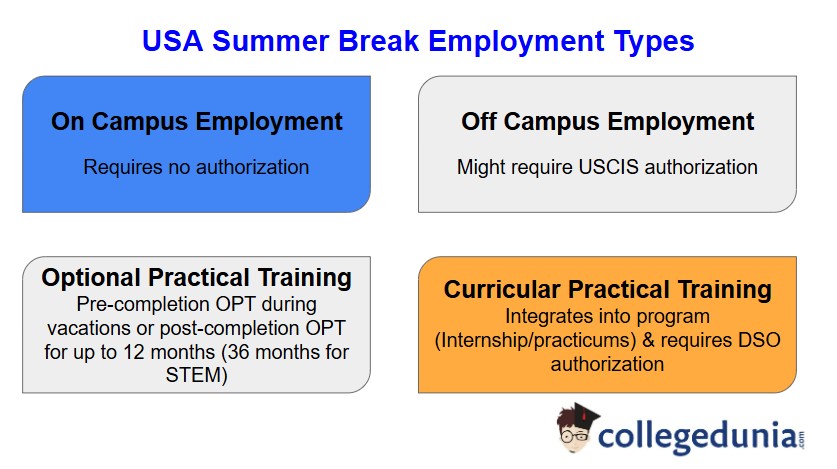
- On-Campus Employment: F-1 students are allowed to work on campus for up to 20 hours a week without special authorization. This can include positions in the library, cafeteria, research labs, or bookstores within the campus.
- You can work full-time (more than 20 hours) during breaks.
- Positions may be directly for the university or a business that provides services to students.
- Off-Campus Employment: Off-campus work in USA generally requires prior authorization. However, you may qualify for off-campus employment for practical training purposes during summer breaks.
- Off-campus work authorization during breaks:
- Economic Hardship: Students facing severe economic hardship may apply for off-campus employment authorization.
- Employment with International Organizations: With specific authorization, students can work with international organizations like the Red Cross or WHO.
- Off-campus work authorization during breaks:
- Optional Practical Training (OPT):
- OPT allows F-1 students to gain work experience in their field of study.
- OPT is especially helpful for students looking to build long-term career skills.
- Pre-completion OPT: Work during summer vacations or while enrolled.
- Post-completion OPT: For graduates, allowing work in the field for up to 12 months (36 months for STEM graduates).
- Curricular Practical Training (CPT):
- CPT is a type of off-campus work that integrates into a student’s program (e.g., internships or practicums).
- Requires authorization from a Designated School Official (DSO).
Note: CPT must relate directly to the student’s course and academic program.
Summer Employment in USA: Document Requirements
Students moving to USA on an F1 visa needs the following documents ready to secure employment during vacations:
- Valid passport and US student visa
- Form I-20 (signed by the DSO)
- Proof of enrollment
- Financial support documentation
- Receipt for I-901 SEVIS Fee
| Type of Work Period | Work Hours Allowed |
|---|---|
| While school is in session | Up to 20 hours per week |
| During annual summer break | Full-time |
| When your US university is not in session | Full-time (if planning to enroll full-time in next session) |
Exceptions to Weekly Work Limits
Students are allowed to work for more than 20 hours a week during the following exceptional circumstances:
- On-campus employment exceptions: F-1 students may work more than 20 hours a week on campus during summer or winter breaks.
- Emergent Circumstances: The U.S. Department of Homeland Security may lift restrictions temporarily for certain students facing economic hardship.
Also Check: Part Time Jobs in USA
Tips to Secure Summer Employment in USA
Here are some practical advices for prospective students planning to work in USA during summer breaks:
- Plan Ahead: Begin looking for on-campus jobs early in the semester, as the positions may fill up quickly.
- Leverage University Resources: Many universities offer career counseling and workshops that help students find jobs. Try to attend such sessions to increase your job opportunity.
- Consider Internships: Summer internships can provide valuable experience and may also align with CPT requirements.
- Apply for a Social Security Number (SSN): F-1 students need an SSN for tax purposes. You should apply for a SSN if you have plans to work in USA as a student.
- File Taxes: Students with an income in the USA must file taxes. You should seek guidance from the university or use tax preparation software for students.
Know More: Job Opportunities in USA
Here are a few etiquettes you should maintain to work in USA during summer breaks:
- DSO Consultation: Always discuss with the DSO before taking any off-campus job. DSOs can help confirm eligibility, ensure compliance, and assist in obtaining the necessary authorizations.
- Avoid Unauthorized Work: Unauthorized employment can lead to serious visa issues, including termination of F-1 status.
- Reporting Requirements: Report employment information, including work hours, type of work, and location to the DSO.
Students should ensure compliance with visa regulations for on and off campus work in USA during summer vacation. Understanding the rules and work options will help you to make informed decisions for a safe and productive summer in the USA.
FAQs
Ques. Can F-1 students work full-time during the summer break in the USA?
Ans. Yes, F-1 students can work full-time during the summer break on or off campus, provided they meet eligibility requirements and, if working off-campus, have the required authorization.
Ques. What documents are required for summer employment for F-1 students?
Ans. F-1 students should have a valid passport and visa, signed Form I-20, proof of enrollment, financial support documents, and the I-901 SEVIS Fee receipt. For off-campus work, they need additional authorization such as Form I-766 (Employment Authorization Document) from USCIS.
Ques. What is the difference between OPT and CPT for F-1 students?
Ans. OPT allows students to gain work experience in their field either during or after their program, lasting up to 12 months (36 months for STEM fields). CPT is required for work that is directly related to their course and academic program and must be authorized by the Designated School Official (DSO).
Ques. What are the rules for on-campus work for F-1 students during summer break?
Ans. F-1 students can work on campus for more than 20 hours per week during summer break without additional authorization, provided the employment is directly for the university or a campus-related business.



Comments