




The Class 10 History Chapter 2 Nationalism in India previous year questions set collects 16 real CBSE board questions worth 42 marks, and it is free to download as a 26-page PDF. Every question is printed exactly as the board set it, with the year and set code sitting under it, the questions are ordered by marks band, and every one of them is then worked out step by step in the Detailed Solutions half of the file.
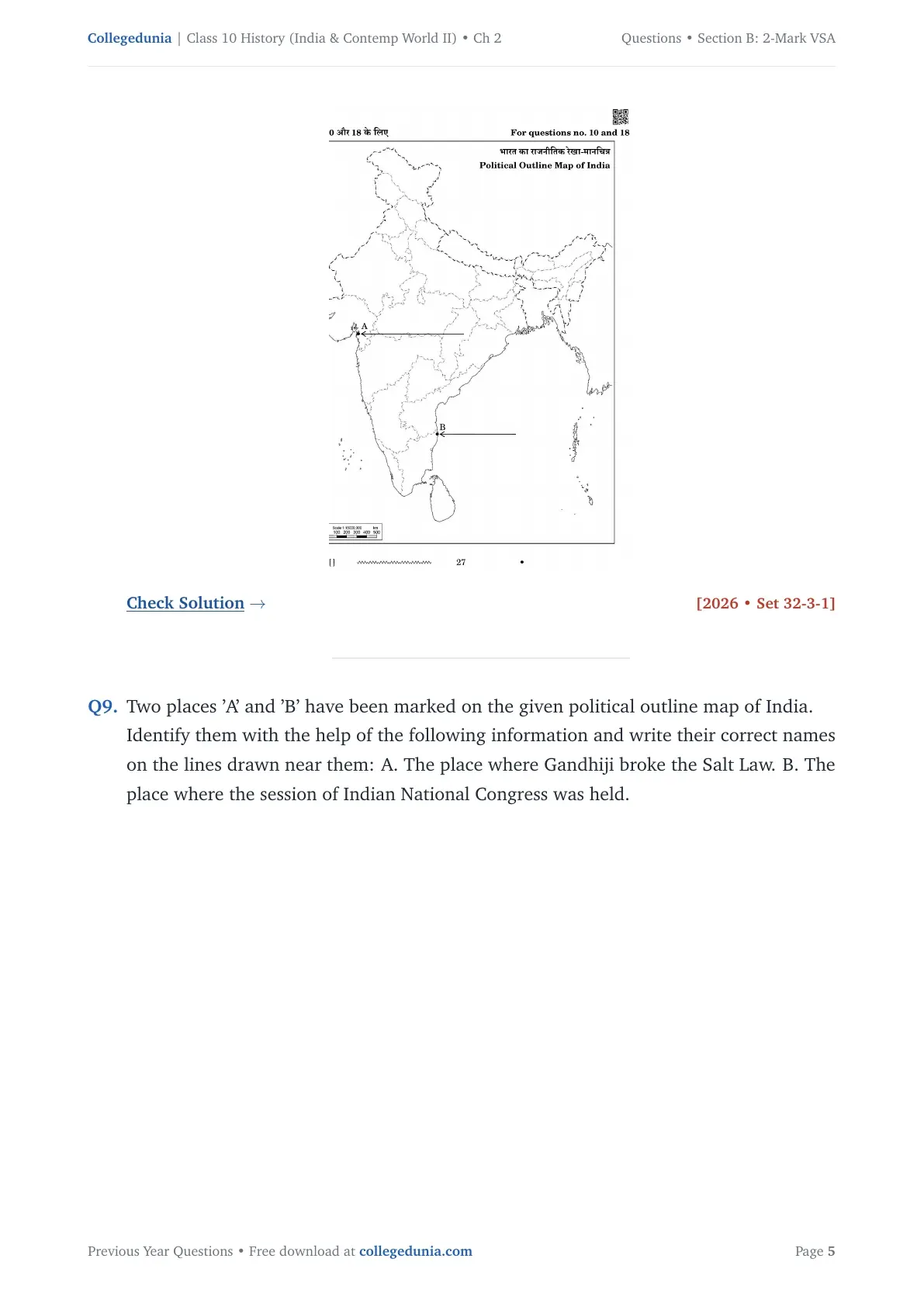
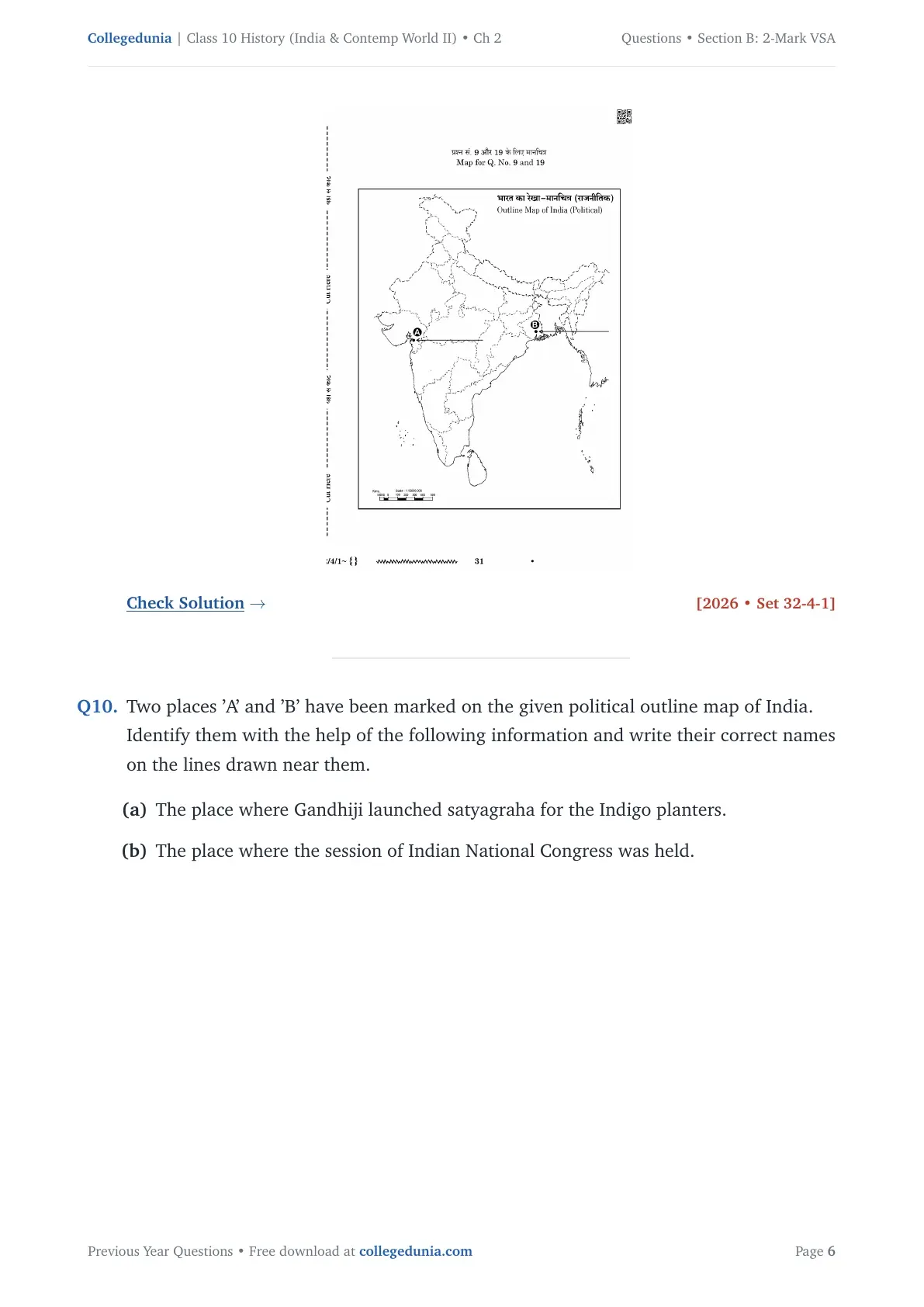
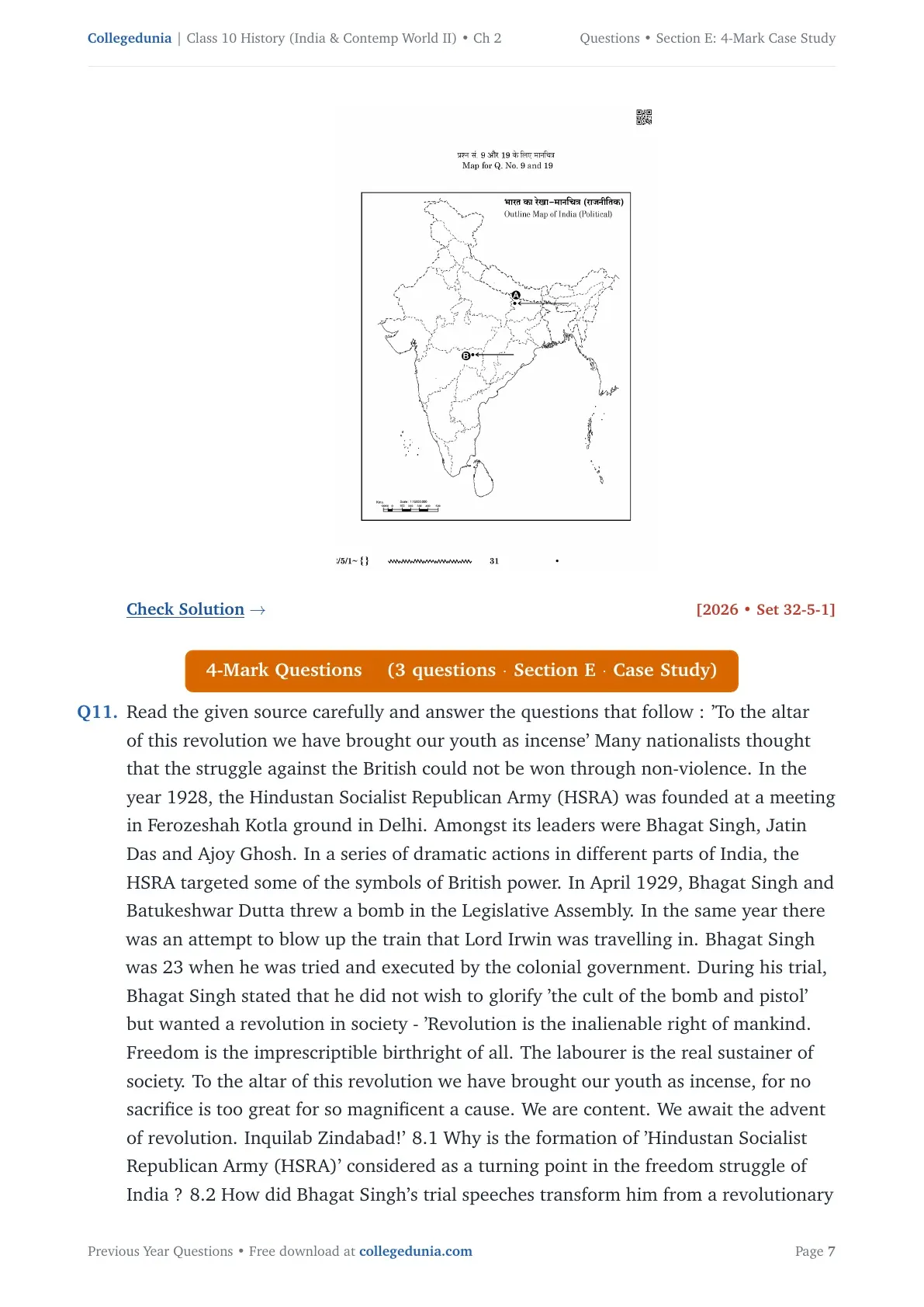
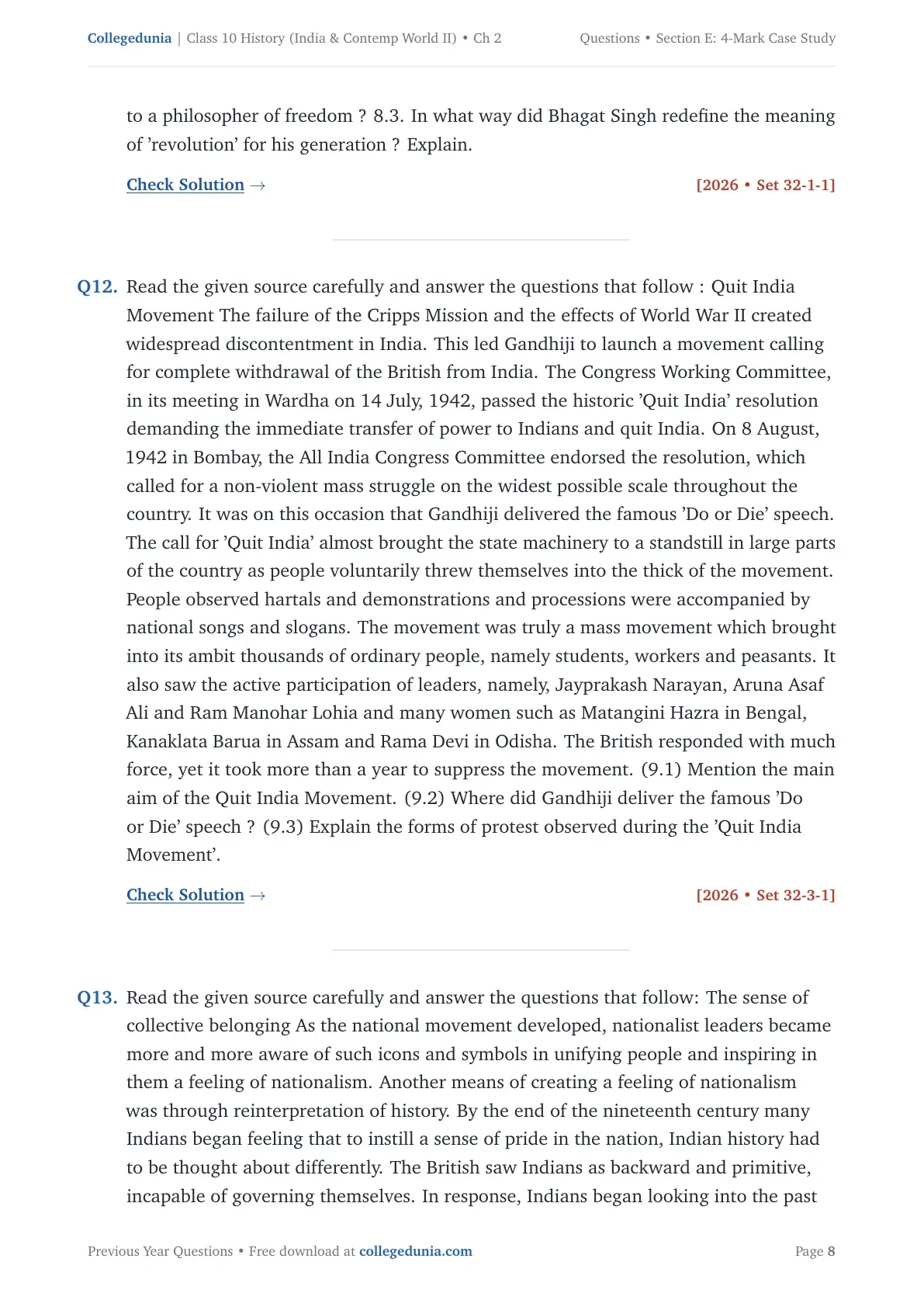
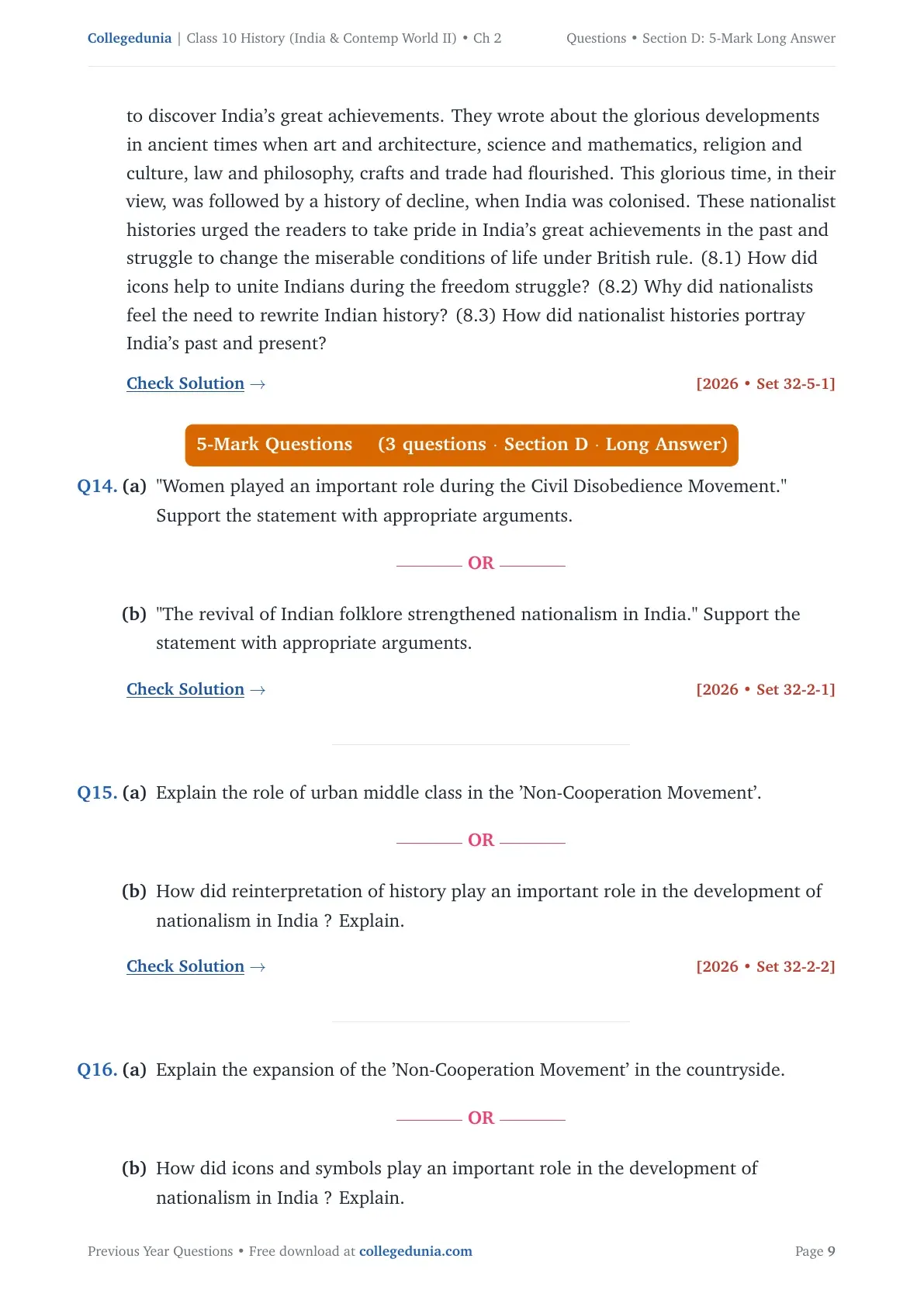
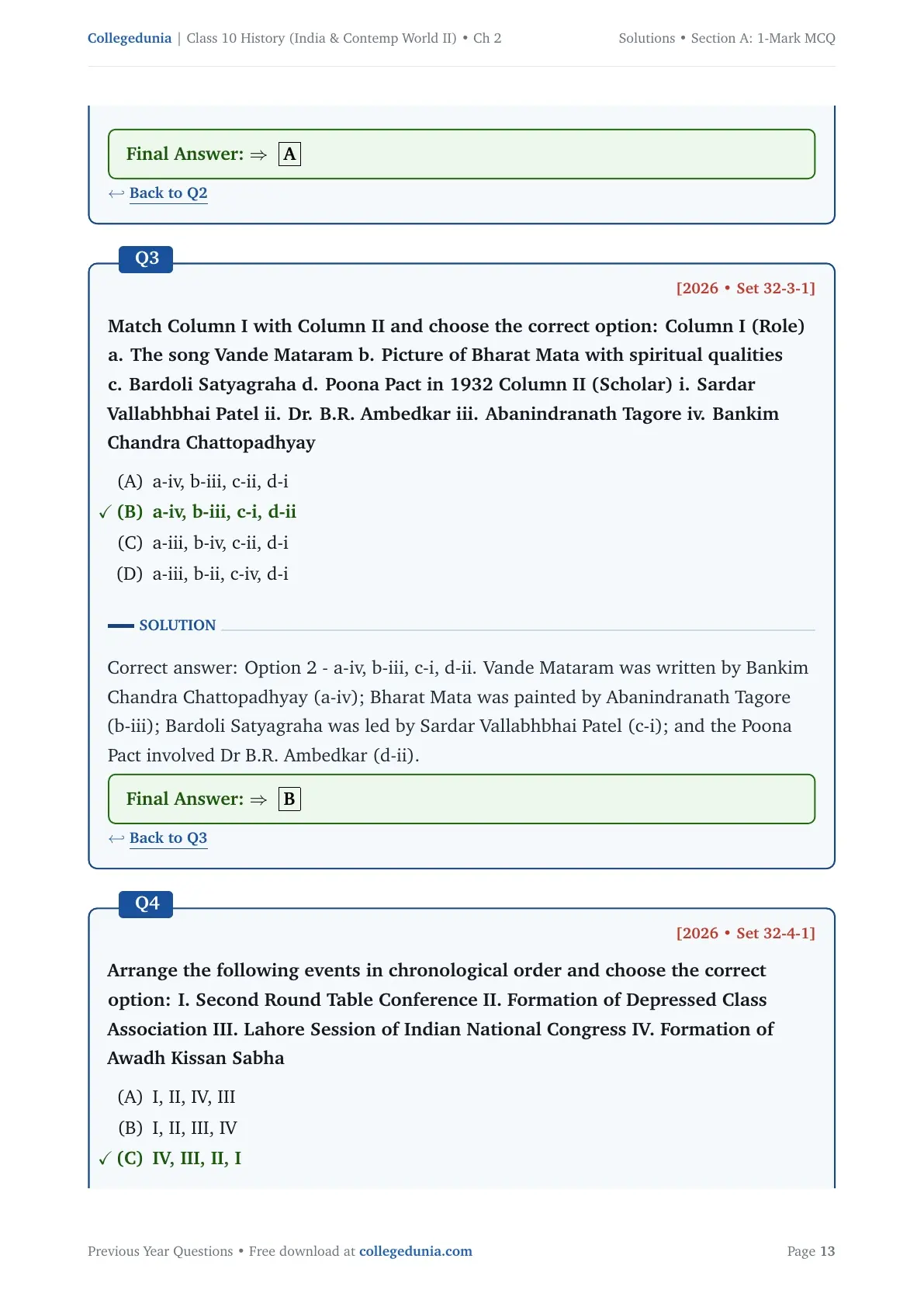
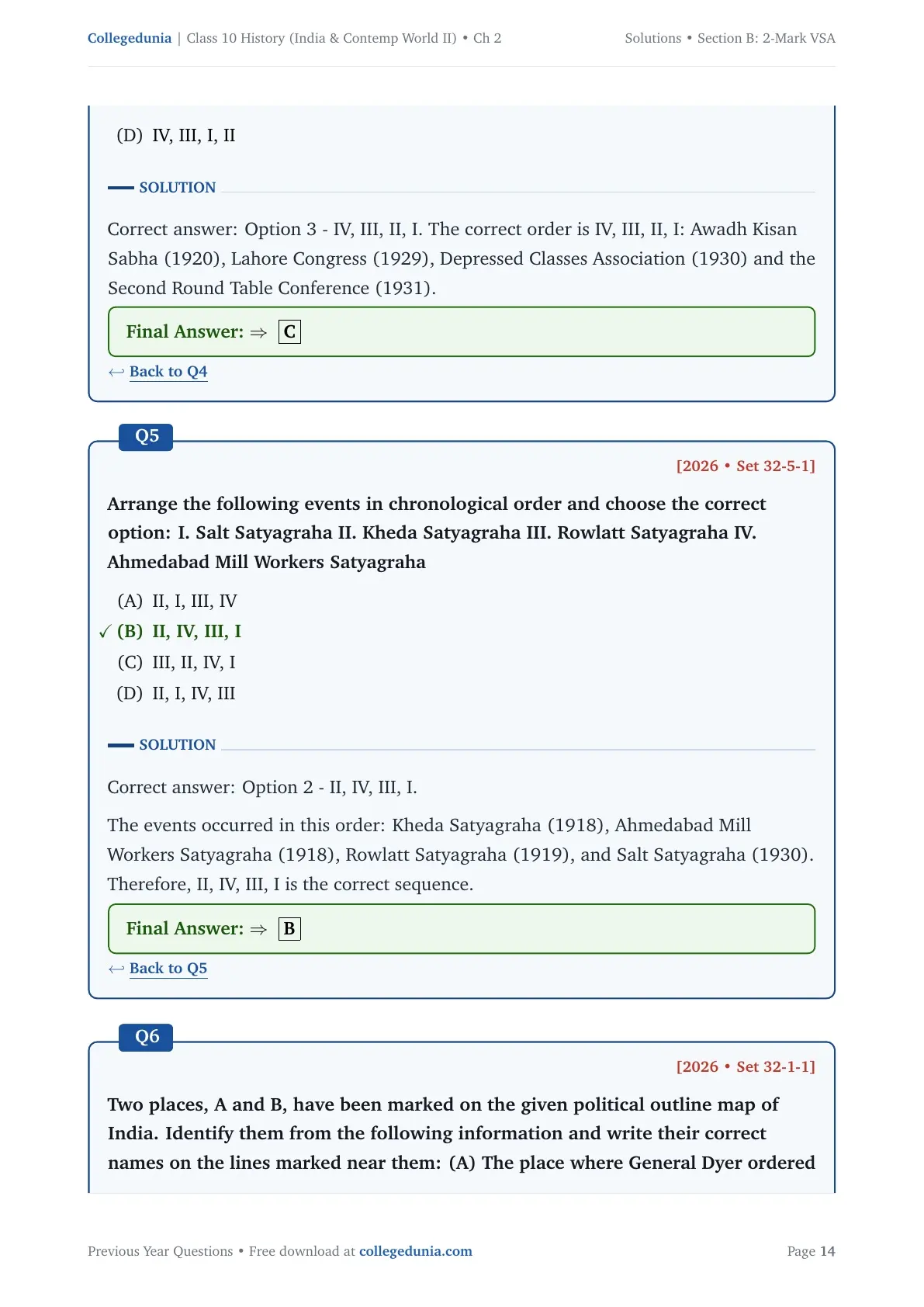
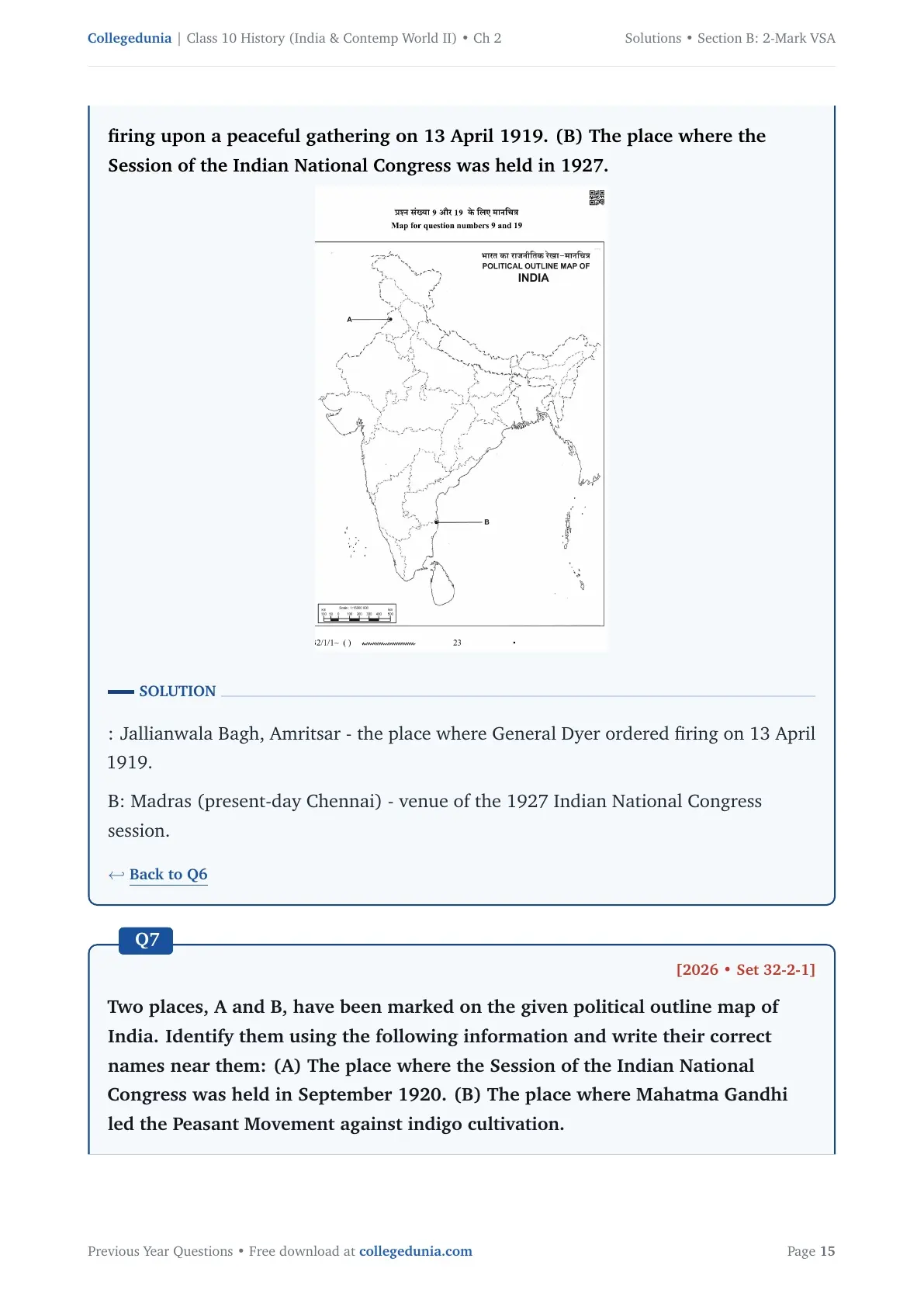
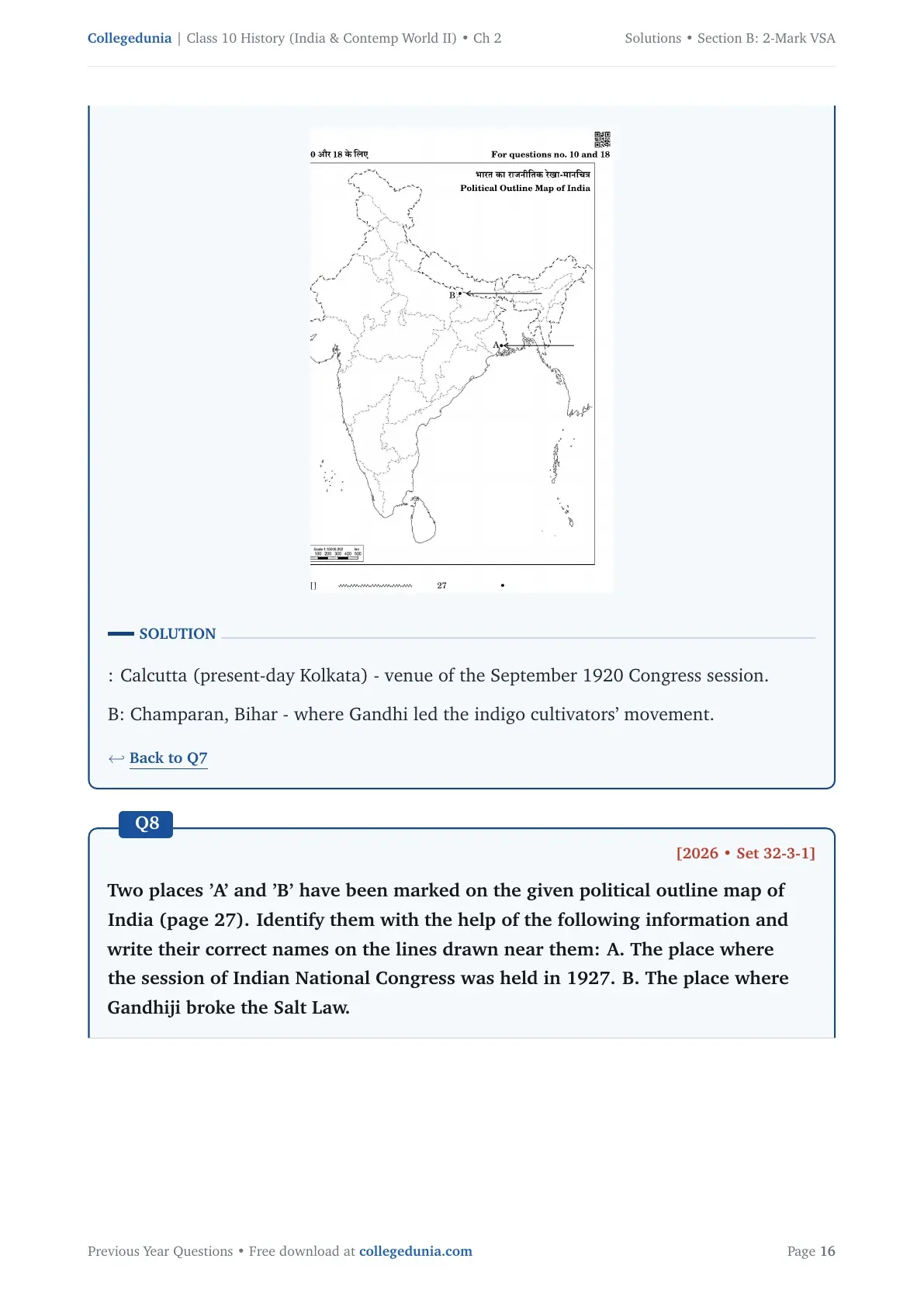
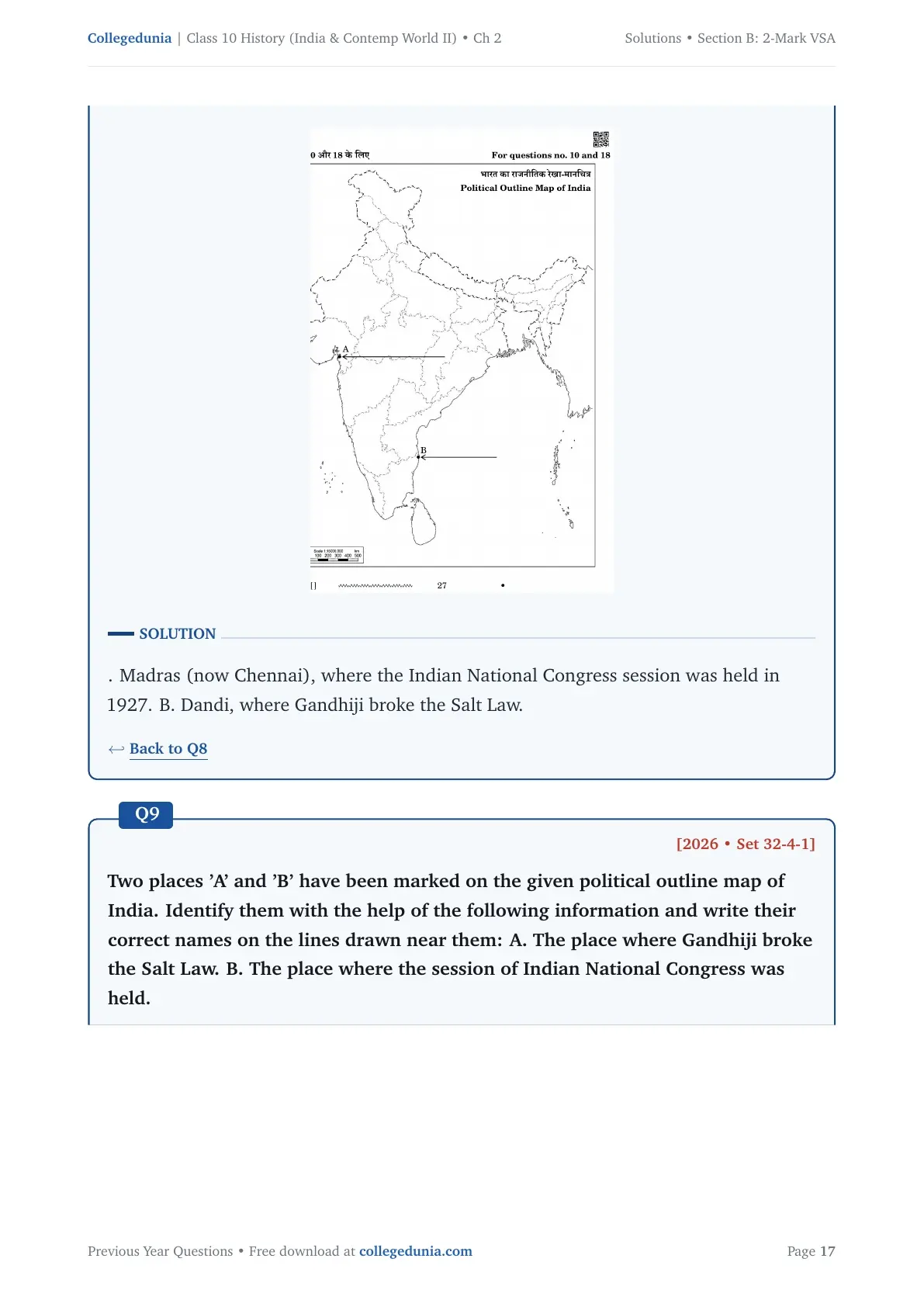
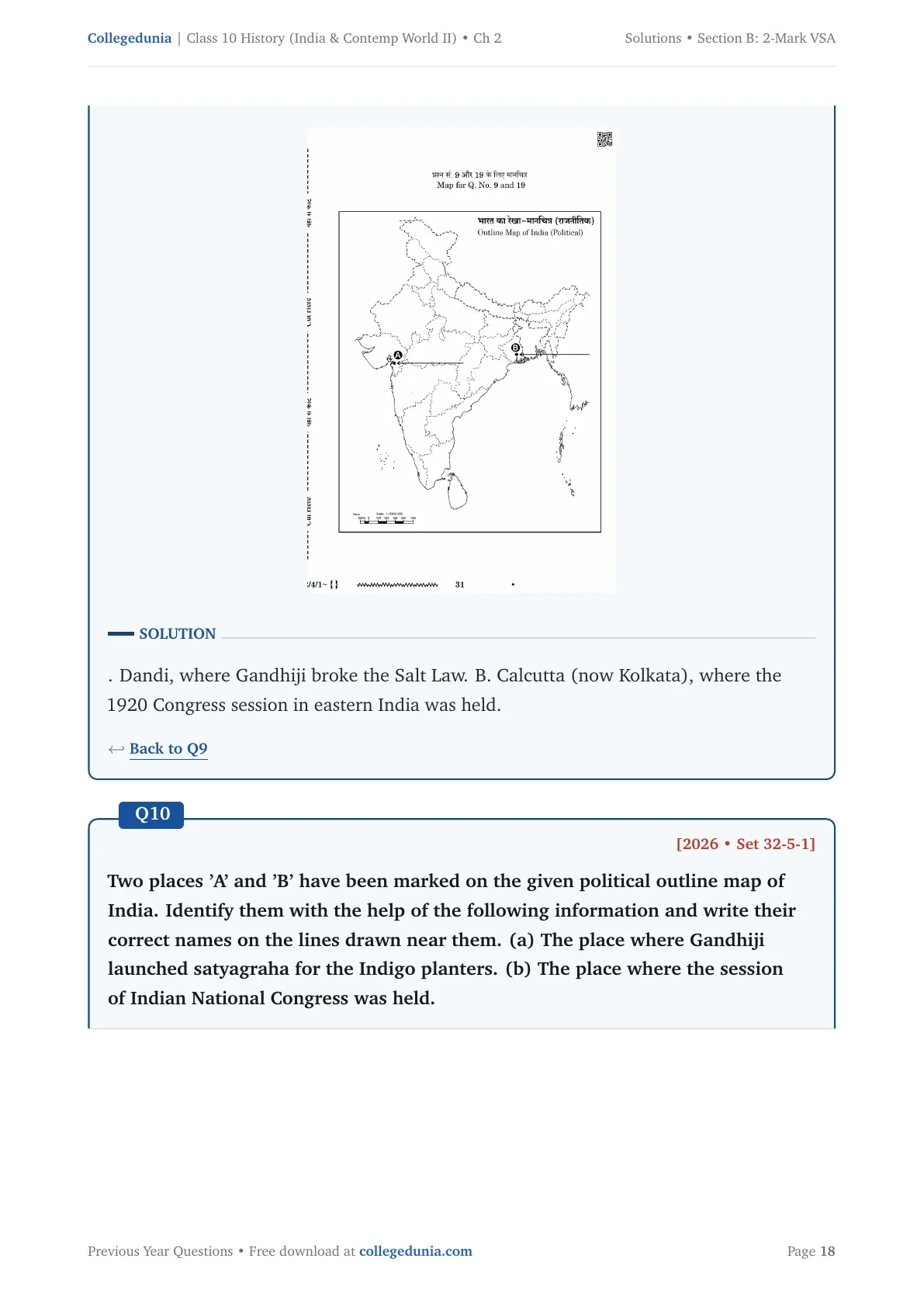
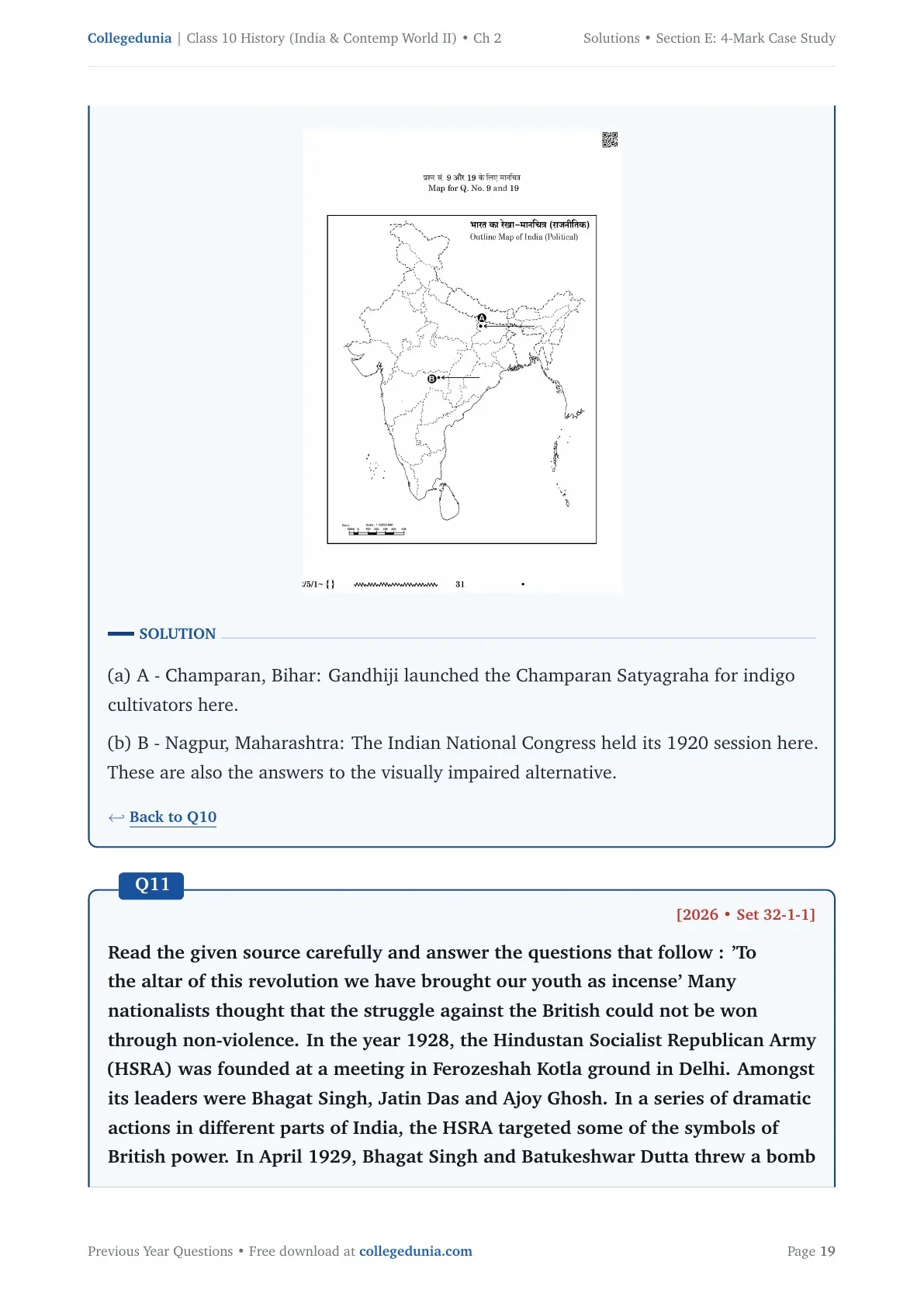
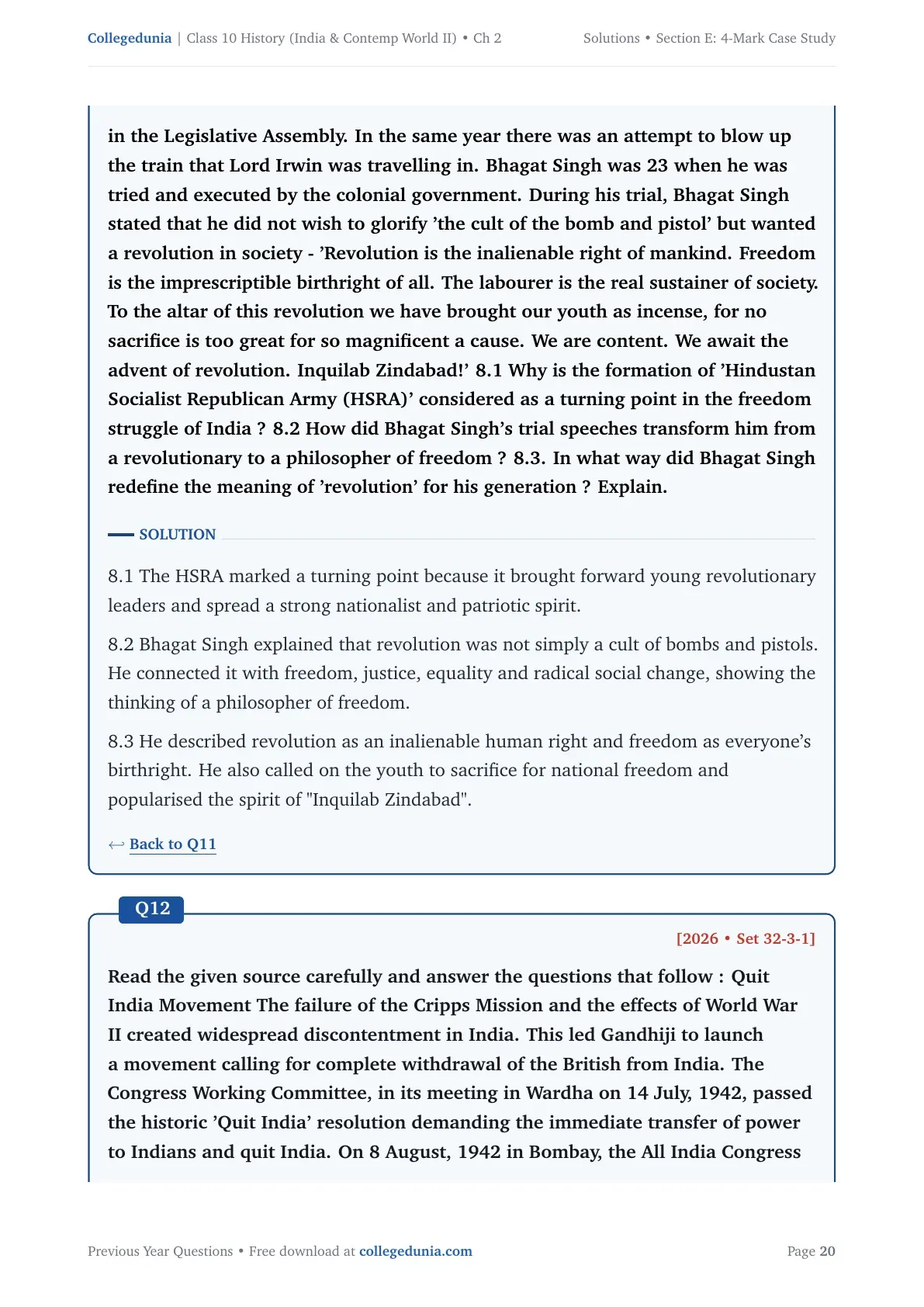
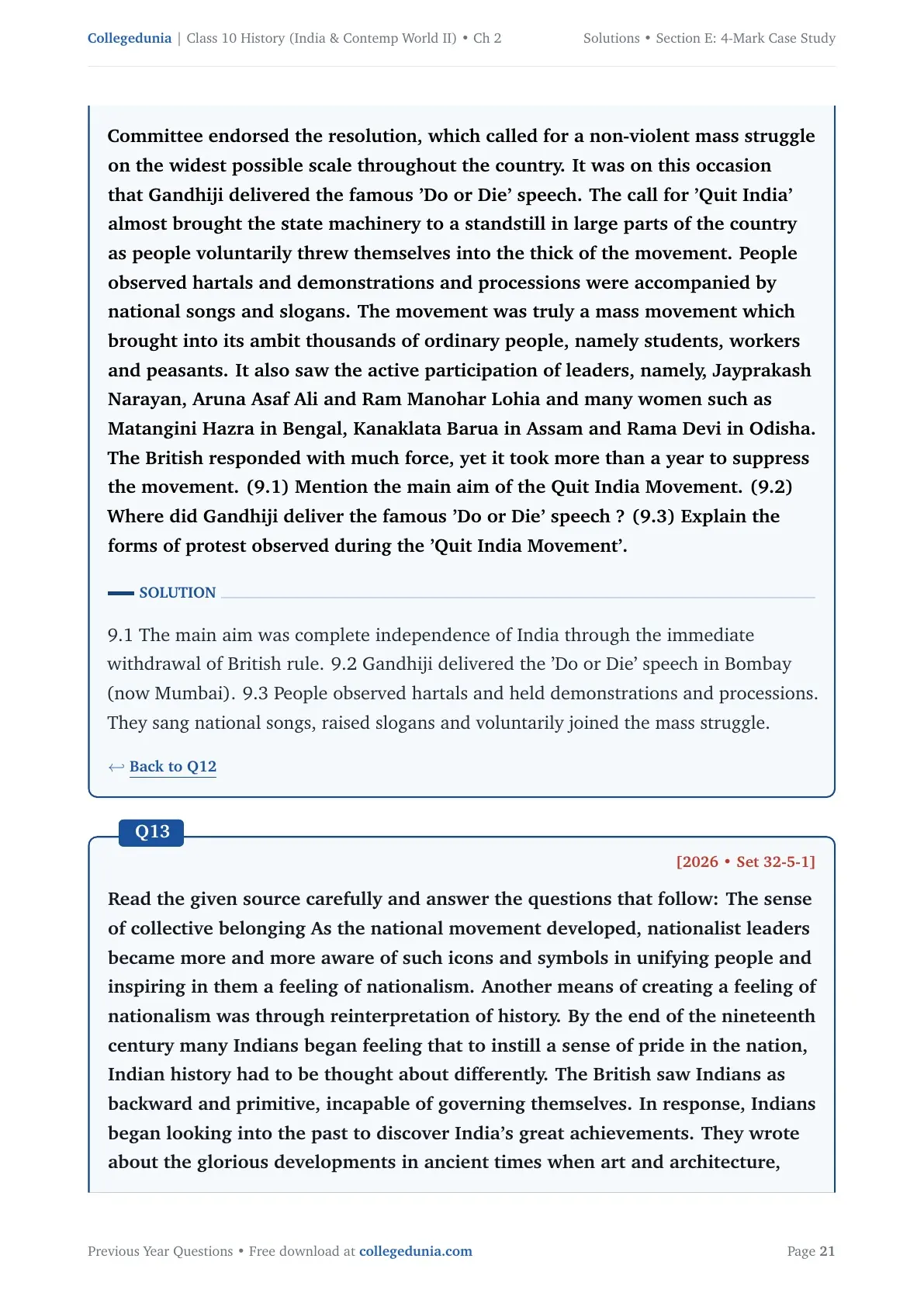
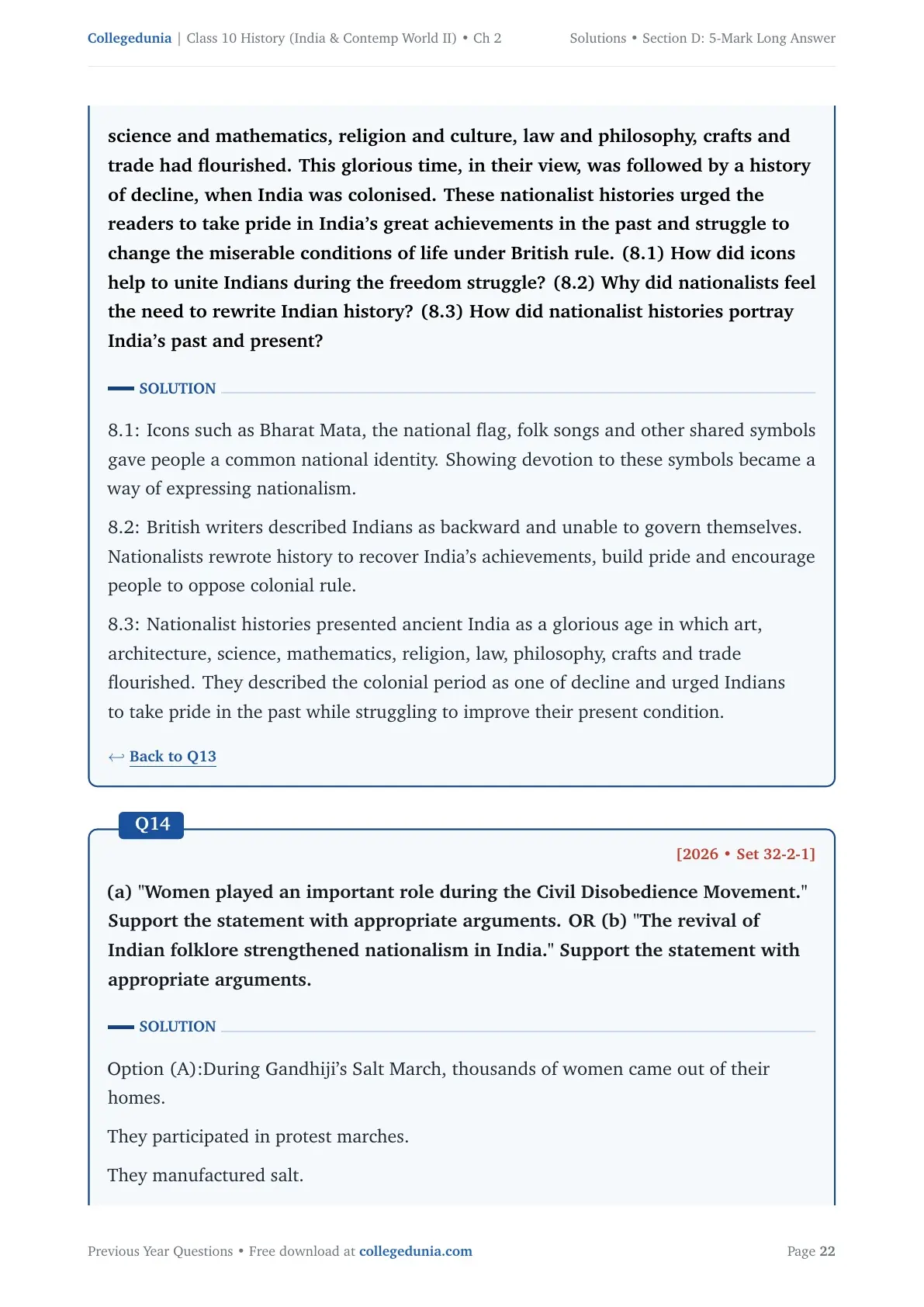
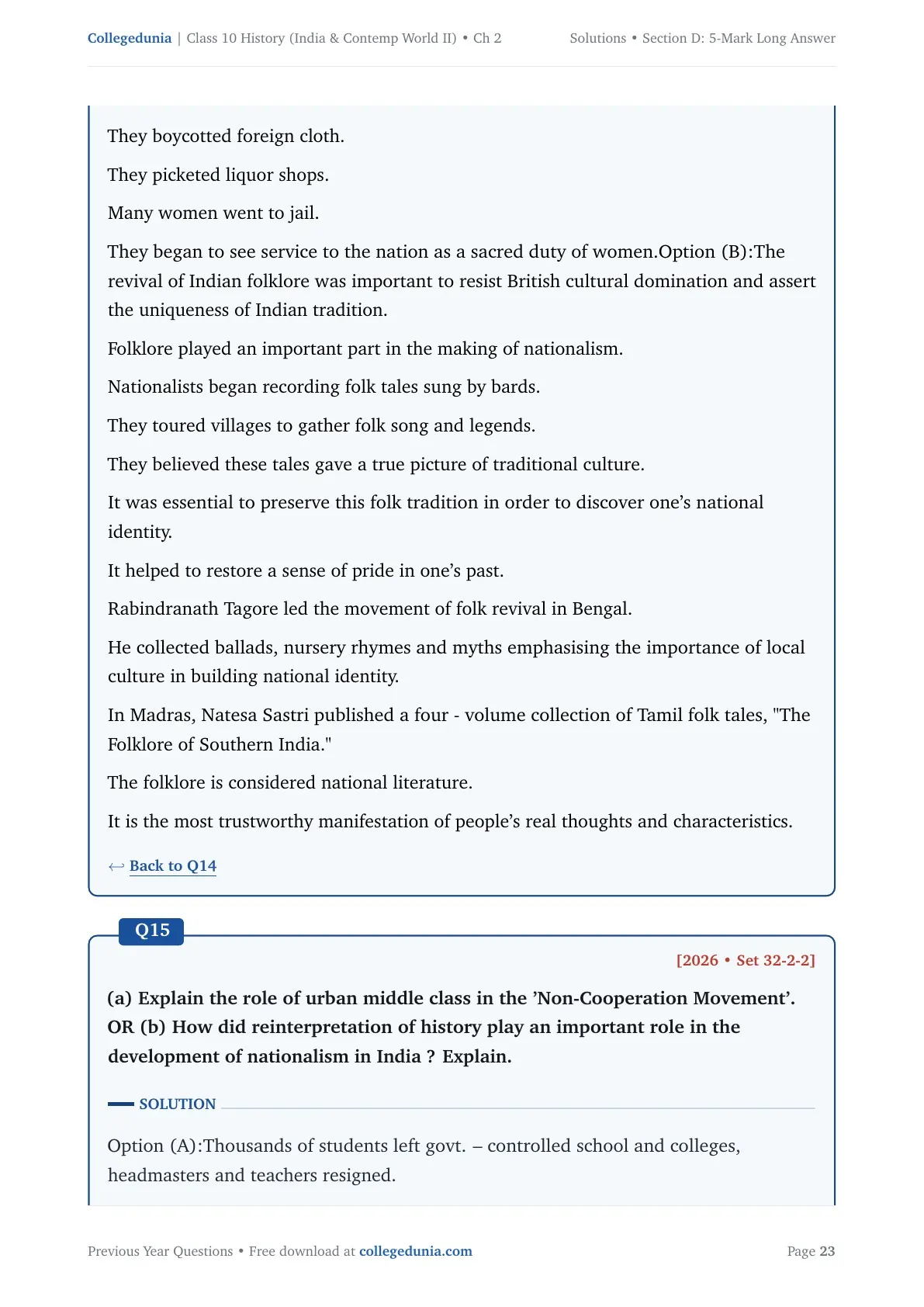
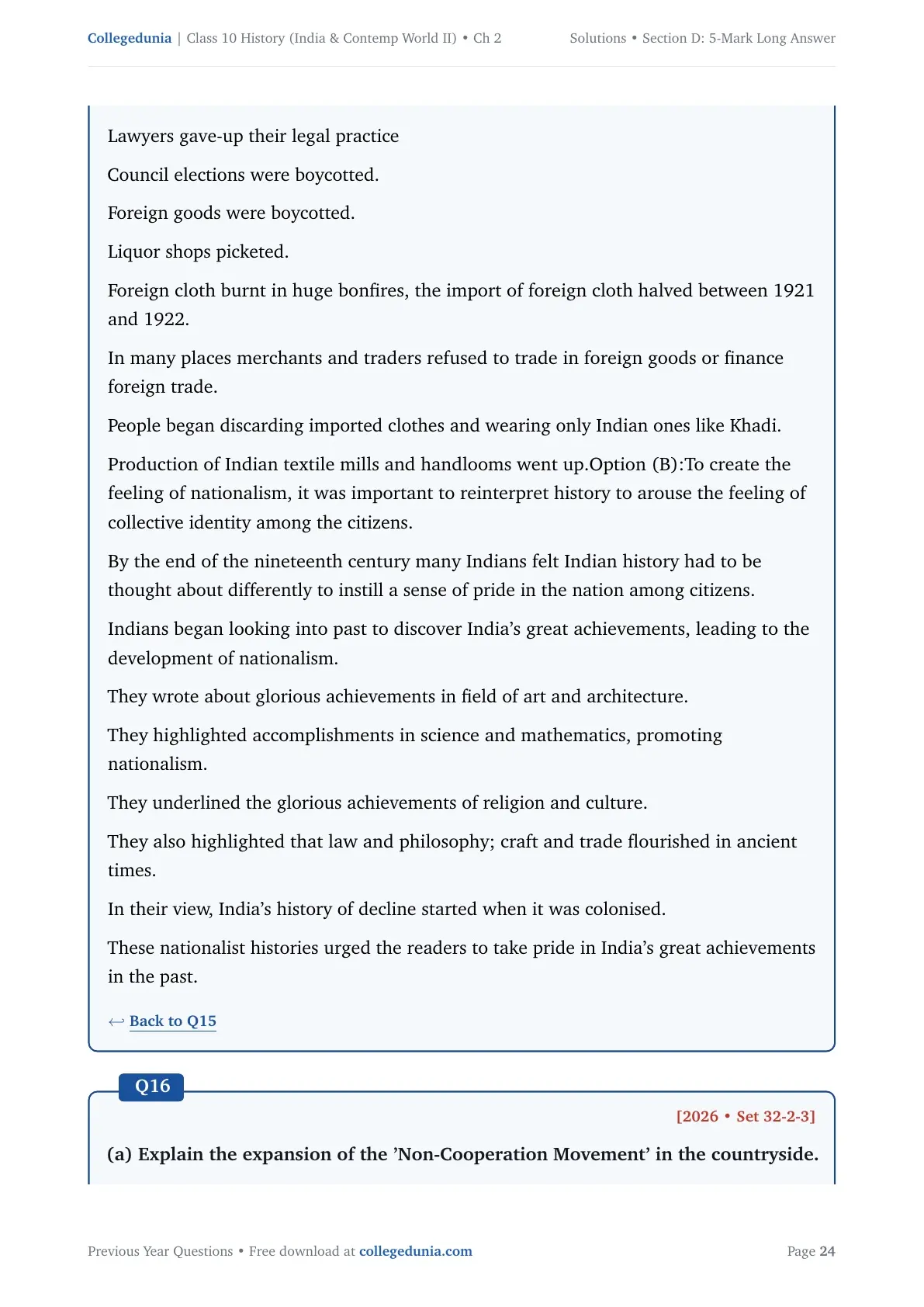
- 16 board questions, 42 marks, drawn from seven CBSE set codes of the 2026 cycle and sorted 1 mark to 5 marks.
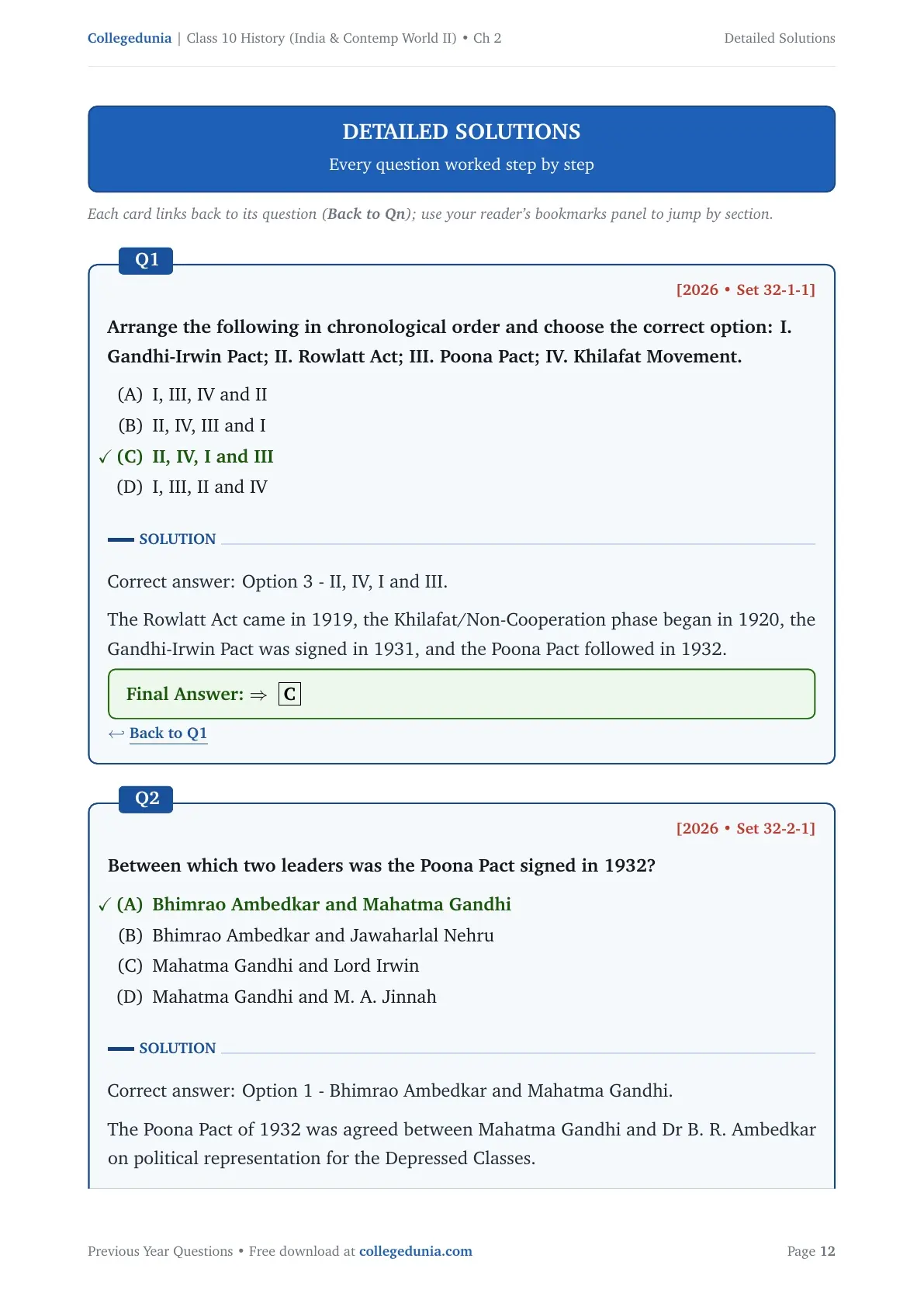
- All 16 questions answered in full. A Detailed Solutions section restates each question above its worked answer and links back to the question it came from.
- Free 26-page PDF, no sign-up, aligned to the 2026-27 CBSE Class 10 Social Science syllabus.
What Is Inside the Nationalism in India PYQ PDF
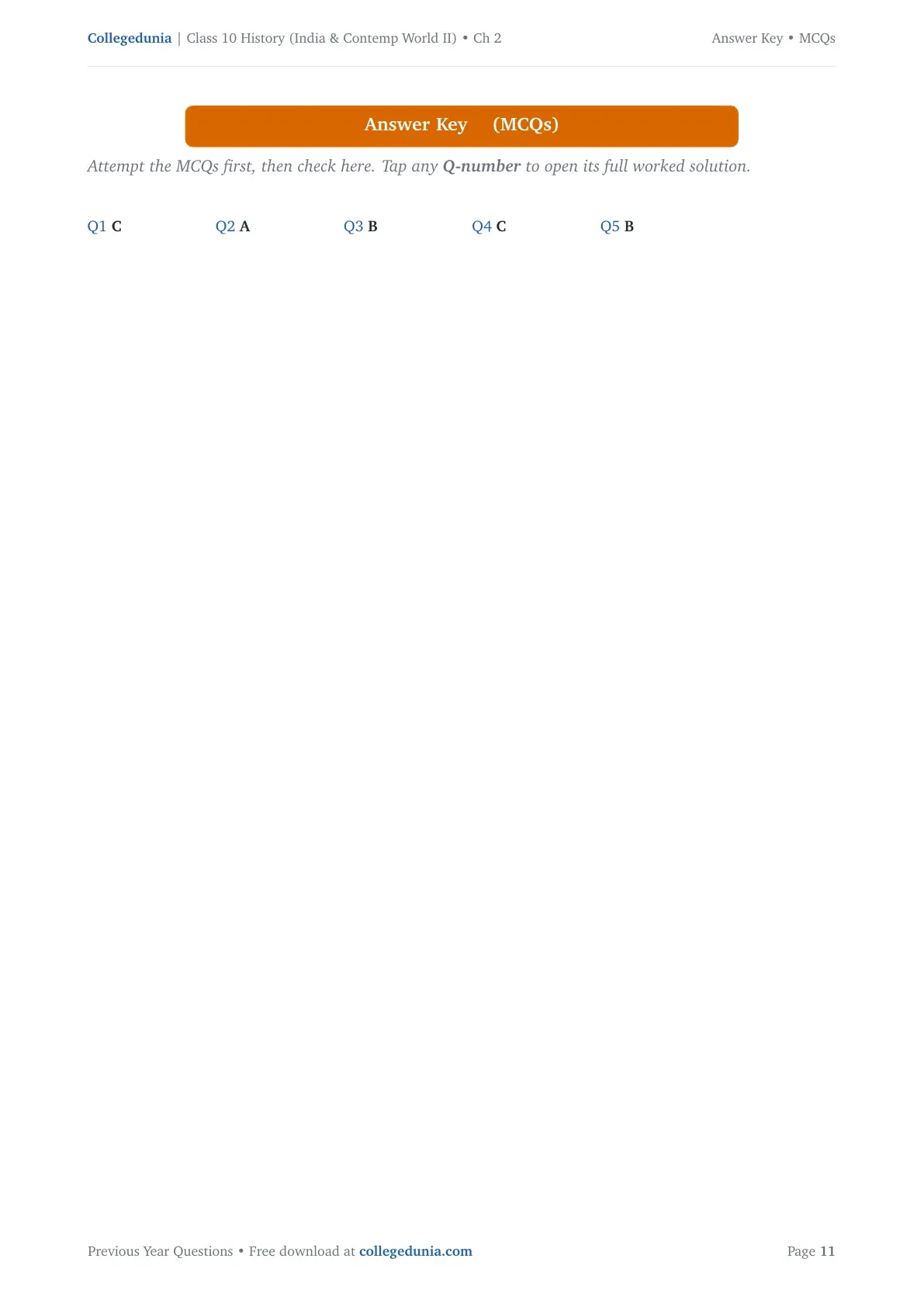
The file has two halves and works either way round. Attempt the raw board questions first and mark yourself against the Detailed Solutions half, or read a question and its solution together when you are revising close to the paper. Each solution card restates the question above the working and carries a link back to it, so you never lose your place, and the objective questions also appear in a short answer key you can scan at a glance.
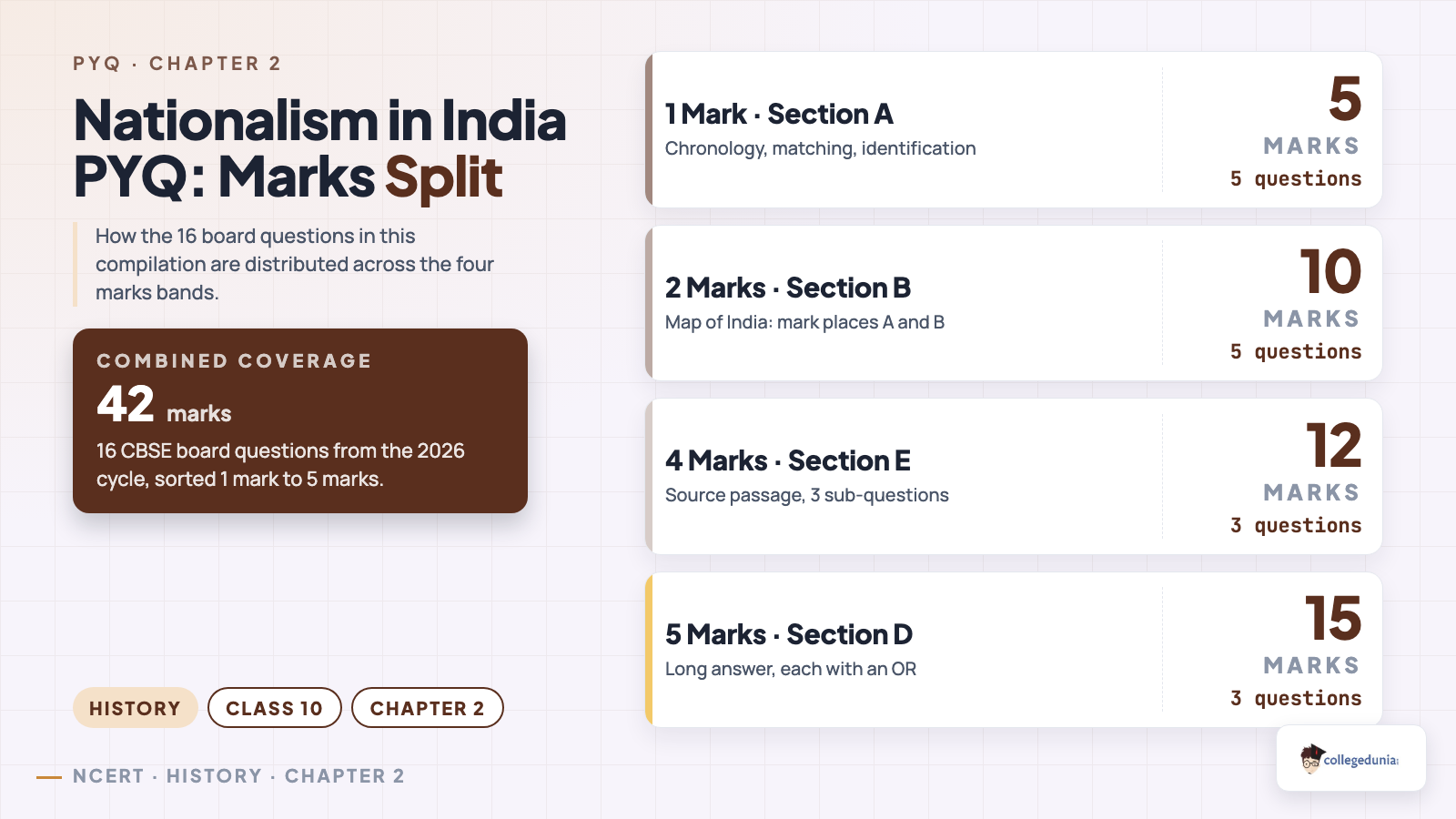
The 16 questions split across four marks bands, and the split is lopsided in a way that is worth knowing before you start.
| Marks | Questions | Total Marks | CBSE Section | Question Type |
|---|---|---|---|---|
| 1 mark | 5 | 5 | Section A | Objective: chronology ordering, matching and one-line identification |
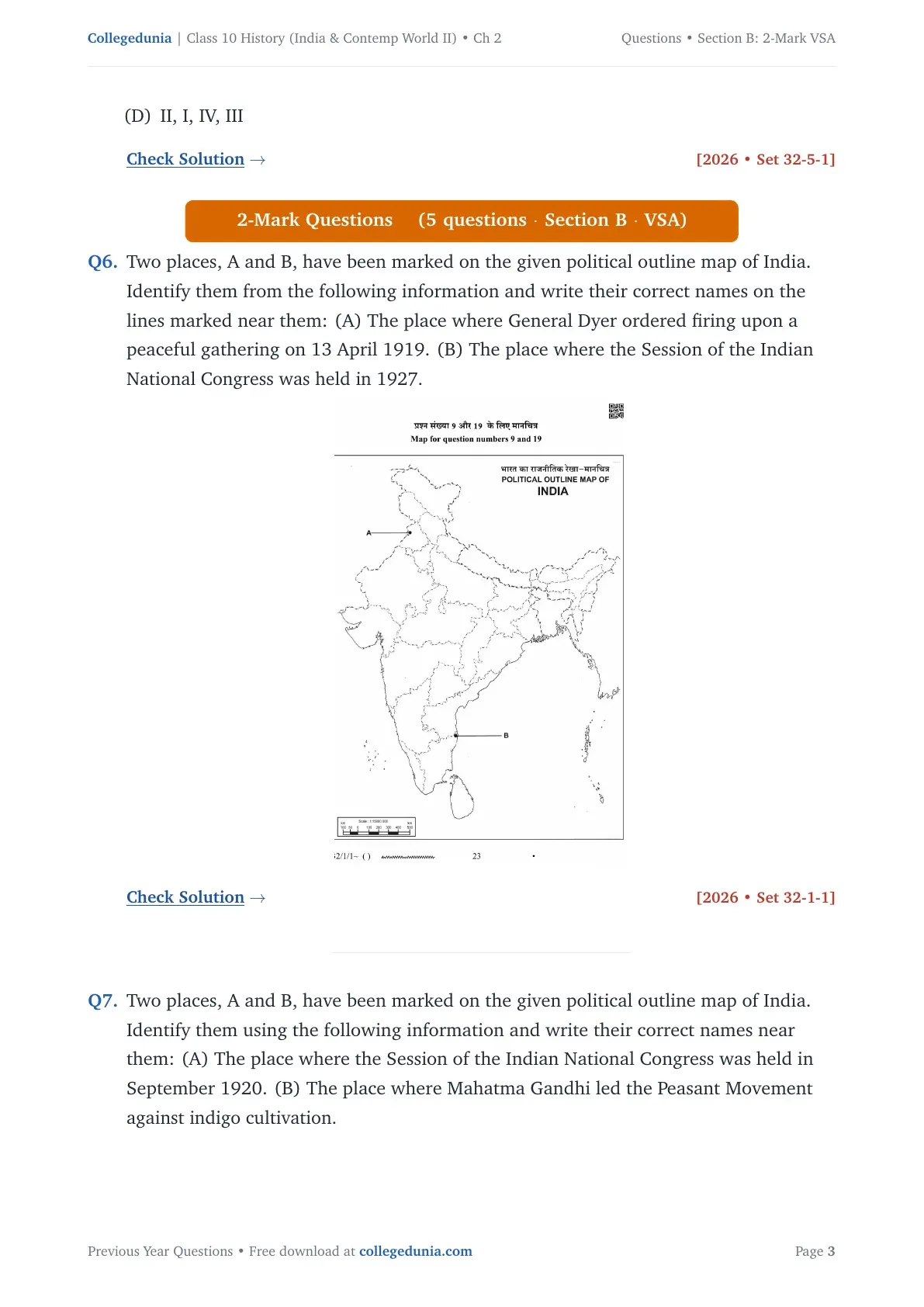
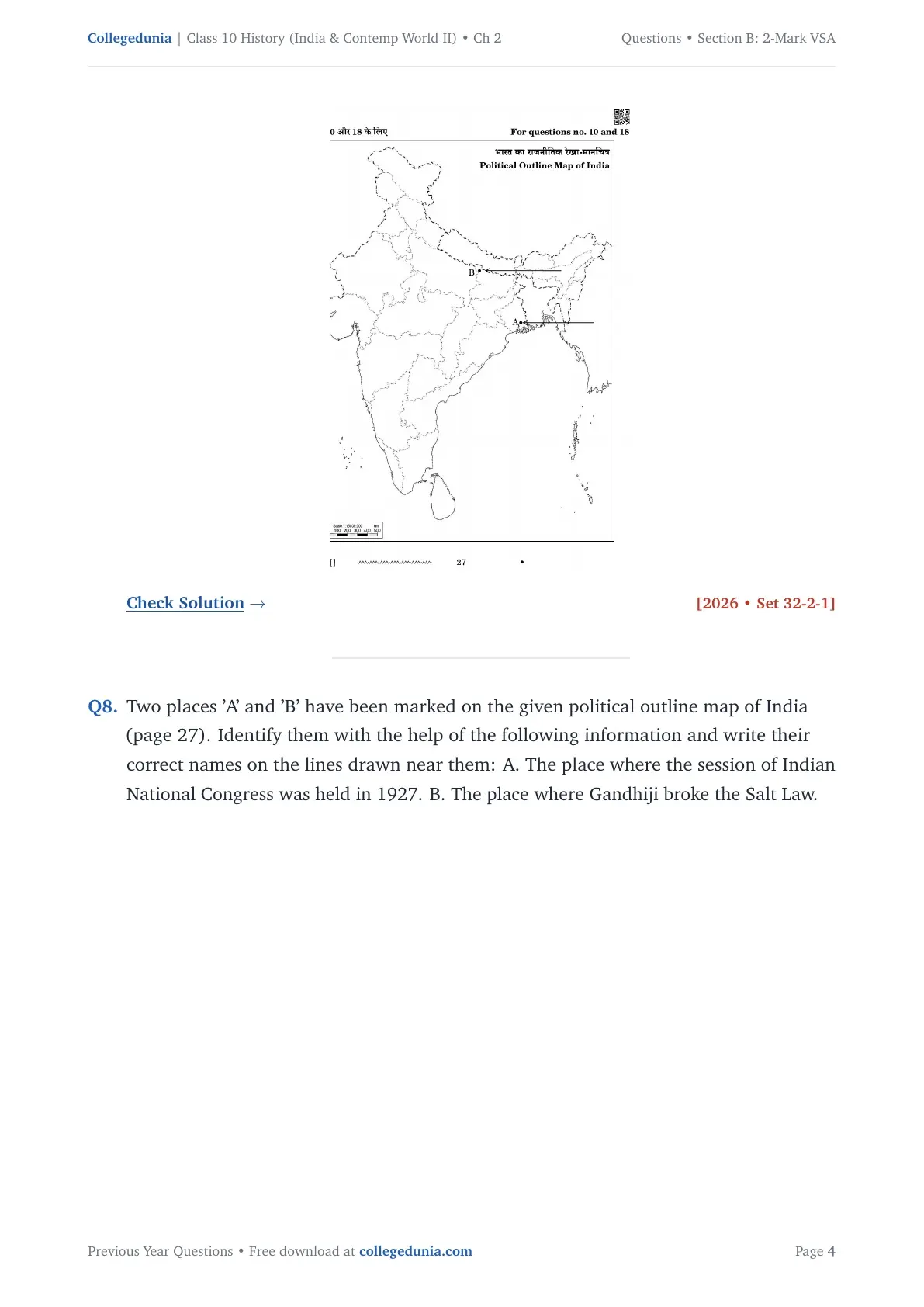
| 2 marks | 5 | 10 | Section B | Map identification on the political outline map of India |
| 4 marks | 3 | 12 | Section E | Source-based case study, three sub-questions under each passage |
| 5 marks | 3 | 15 | Section D | Long answer, each one printed with an OR alternative |
| Total | 16 | 42 | Sections A, B, D and E | Objective, map, source and long answer |
The line to notice is the 2-mark row. All five of the 2-mark questions in this compilation are map questions, and every one of them asks you to identify two places marked A and B on the outline map of India and write their names on the lines drawn near them. If your map work is shaky, this chapter is where it will cost you.
Where the 16 Questions Come From
All 16 questions belong to the 2026 CBSE board cycle. The compilation does not reach further back, so treat it as a compact, recent set rather than a complete archive of everything the board has ever asked on this chapter.
- Seven set codes are represented: 32-1-1, 32-2-1, 32-2-2, 32-2-3, 32-3-1, 32-4-1 and 32-5-1.
- Set 32-2 supplies all three long answers, one each from 32-2-1, 32-2-2 and 32-2-3, which is why the 5-mark band reads like a single paper's Section D.
- Each question carries its own tag printed as the year followed by the set code, so you can rebuild one paper's worth of Chapter 2 questions by filtering on a single code.
Topics the 2026 Papers Actually Tested
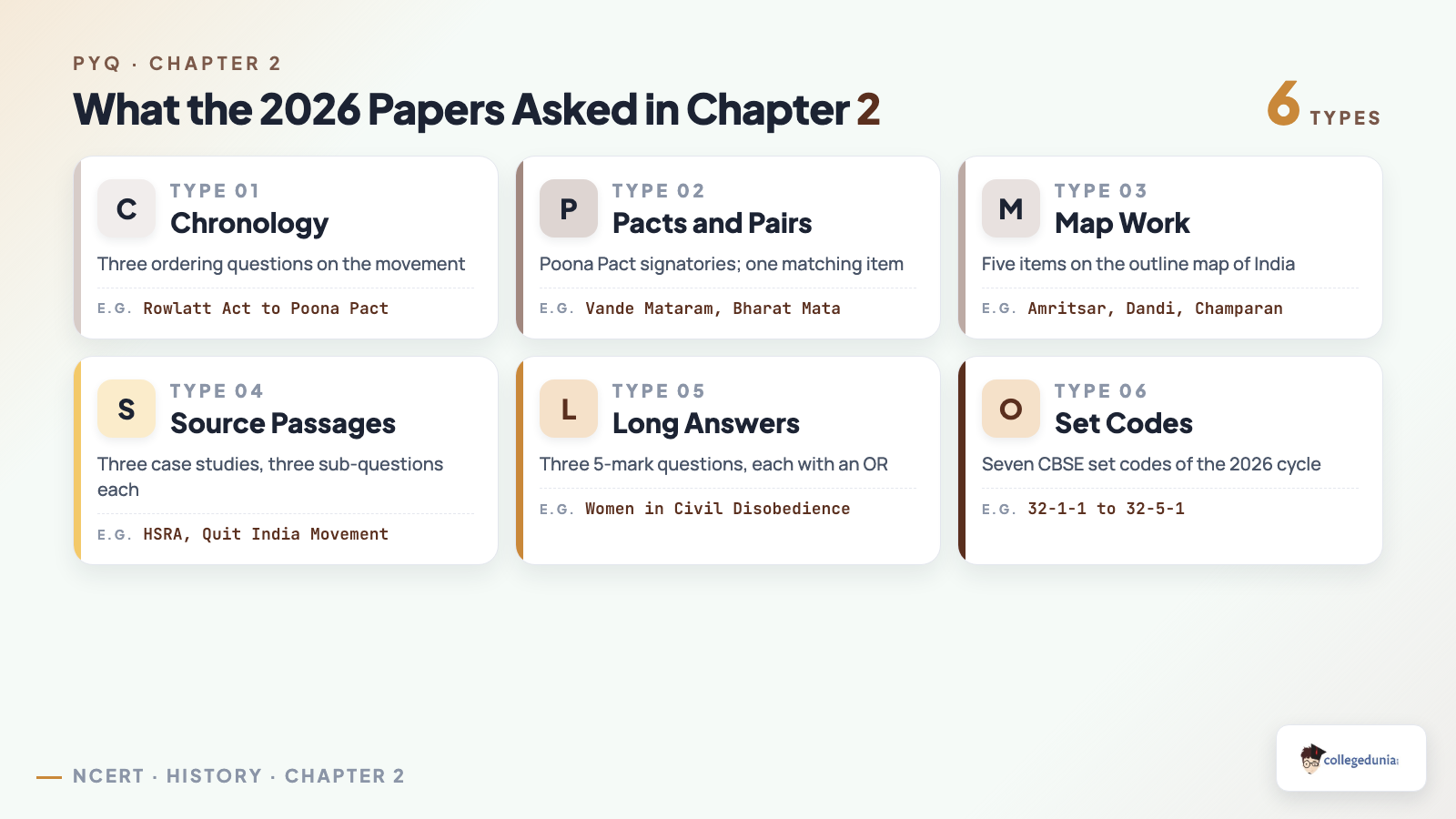
Chapter 2 of India and the Contemporary World II runs from the Rowlatt Act and Jallianwala Bagh through the Non-Cooperation Movement, the Simon Commission, Civil Disobedience and the Salt March, and closes on the sense of collective belonging. The 16 questions in this PDF do not spread evenly across that arc. Here is what the board actually reached for.
- Chronology of the movement. Three of the five objective questions are ordering questions. Between them they involve the Rowlatt Act and the Rowlatt Satyagraha, the Khilafat Movement, the Kheda and Ahmedabad mill workers satyagrahas, the Salt Satyagraha, the formation of the Awadh Kisan Sabha, the Lahore session of the Indian National Congress, the formation of the Depressed Class Association, the Second Round Table Conference, the Gandhi-Irwin Pact and the Poona Pact.
- Named pacts and pairings. One objective question asks which two leaders signed the Poona Pact in 1932. Another is a matching question that pairs the song Vande Mataram, the painting of Bharat Mata, the Bardoli Satyagraha and the Poona Pact with the figures associated with them.
- Map work. The five map questions between them point at the site of the firing on a peaceful gathering on 13 April 1919, the Congress sessions held in September 1920 and in 1927, the place where the salt law was broken, and the places where satyagraha was led for indigo cultivators.
- Source-based passages. The three case studies are built on the founding of the Hindustan Socialist Republican Association and the trial statements of Bhagat Singh, on the Quit India Movement, and on the textbook passage titled the sense of collective belonging.
- Long answers. The three 5-mark questions and their OR branches cover the part women played in the Civil Disobedience Movement, the revival of Indian folklore, the urban middle class in the Non-Cooperation Movement, the reinterpretation of history, the spread of Non-Cooperation in the countryside, and the role of icons and symbols.
How to Practise Each Marks Band
The worked answers sit in the same file, so the practice loop is write first, then turn to the solution and mark yourself against it. Here is a band by band plan that fits the shape of this particular set.
- The five objective questions. Give yourself 45 seconds each. Three of them are chronology, so the fix is not memorising options but fixing a handful of anchor years for the chapter and ordering everything against them. Attempt them cold before you open any notes.
- The five map questions. Each one is printed with the political outline map of India exactly as the board paper carried it, so locate A and B on the page itself before you read the solution. The CBSE map-work list for this chapter is short and fixed, and it is the same list the board draws from every year, so learning it once covers all five questions and the ones that follow in later papers.
- The three case studies. Each passage carries three sub-questions worth roughly one to two marks apiece. Read the passage twice, underline the sentence each sub-question is anchored to, and answer in the words of the passage where the question is a comprehension question rather than a knowledge question.
- The three long answers. Read both branches of the OR before you commit to one. Five points inside about 120 words is the shape the marking scheme rewards, and roughly 10 to 12 minutes is the time budget in the real paper.
Common Mistakes in Chapter 2 Answers
- Treating the ordering questions as guesswork. Every one of the three chronology questions in this set can be settled by fixing the year of each event first and only then reading the four options.
- Writing the map name on the map instead of on the line drawn near it. The instruction printed in all five questions is to write the correct names on the lines marked near the places, and the marking scheme follows the instruction.
- Answering a source-based sub-question with everything you know about the topic. The passage sets the boundary, and marks come from within it.
- Attempting both branches of an OR question. Only one is marked and the second one costs you time in a paper where Section D is already tight.
- Writing the long answers as a story rather than as numbered points. Examiners award per point, so five clearly separated points beat one flowing paragraph of the same length.
Student Feedback
These chapterwise sets are built from the papers students tell us they could not find in one place. If a question in this file is printed unclearly, if a set code looks wrong against the paper you sat, or if there is a Chapter 2 question from a paper you have that is missing here, say so in the comments below. Corrections get folded into the next refresh of the PDF, and requests for particular marks bands help decide which chapter gets extended first.
Other Class 10 History Chapter 2 Resources
The PYQ file already answers every question it asks. These pages cover the rest of the chapter, beyond the questions the 2026 papers happened to set.
| Resource | What It Gives You | Link |
|---|---|---|
| NCERT Solutions | Textbook exercise answers for the chapter | NCERT Solutions |
| Revision Notes | Concept notes to revise before attempting the questions | Revision Notes |
| NCERT Book PDF | The official chapter text the paper is set from | NCERT Book PDF |
| Handwritten Notes | Notebook-style summary for last-week revision | Handwritten Notes |
All Class 10 History Chapterwise PYQ PDFs
India and the Contemporary World II has five chapters. The chapterwise PYQ compilations are built the same way, straight from the official CBSE papers.
| Chapter | Chapter Name | Previous Year Questions |
|---|---|---|
| Chapter 1 | The Rise of Nationalism in Europe | PYQ PDF |
| Chapter 2 | Nationalism in India | You are here |
| Chapter 3 | The Making of a Global World | PYQ PDF (coming soon) |
| Chapter 4 | The Age of Industrialisation | PYQ PDF (coming soon) |
| Chapter 5 | Print Culture and the Modern World | PYQ PDF (coming soon) |
Class 10 History Chapter 2 Nationalism in India PYQ FAQs
What Students Usually Ask About This Question Set
Ques. How many previous year questions are in the Class 10 History Chapter 2 PYQ PDF?
Ans. There are 16 questions worth 42 marks across 26 pages, questions and worked solutions together. They split into 5 one-mark objective questions, 5 two-mark map questions, 3 four-mark case studies and 3 five-mark long answers.
Ques. Does the PDF include answers or a marking scheme?
Ans. Yes. Every one of the 16 questions is followed by a full step-by-step solution in the Detailed Solutions section, and the objective questions are also listed in a short answer key. Each solution restates the question above the working and links back to it, so the file serves as a practice set if you attempt first and check after, and as a revision resource if you read question and answer together.
Ques. Which CBSE papers were used to build this compilation?
Ans. Seven set codes from the 2026 cycle: 32-1-1, 32-2-1, 32-2-2, 32-2-3, 32-3-1, 32-4-1 and 32-5-1. It is a compact recent set, not an exhaustive archive of every question ever asked on the chapter.
Ques. Why are all the 2-mark questions map questions?
Ans. Because that is how the board set them. In the 2026 papers, Chapter 2 supplied the map-work item in Section B, and all five two-mark questions here ask you to identify two places marked A and B on the political outline map of India. The map itself is reproduced with each of the five questions and again with each worked solution.
Ques. What do the source-based case study questions cover?
Ans. Three passages. One is on the founding of the Hindustan Socialist Republican Association and the statements Bhagat Singh made at his trial, one is on the Quit India Movement, and one is the textbook passage on the sense of collective belonging. Each passage is followed by three sub-questions.
Ques. Are these questions valid for the 2026-27 syllabus?
Ans. Yes. Nationalism in India remains the second chapter of the History unit in the 2026-27 CBSE Class 10 Social Science syllabus, and the question shapes used here, objective, map, source-based and long answer, are the shapes the current paper pattern uses.
Ques. How many marks does History carry in the Class 10 board paper?
Ans. India and the Contemporary World II carries 20 marks of the 80-mark Social Science theory paper, shared across its chapters. Chapter 2 is one of the heavier contributors because it supplies both map work and a long answer in most papers.



Comments