




About 15 to 20 marks of the Class 10 Social Science board paper come from History, and Nationalism in India is one of its most asked chapters.
Chapter2NationalisminIndiaSolutions.pdf?page=1&dpi=150)
Chapter2NationalisminIndiaSolutions.pdf?page=2&dpi=150)
Chapter2NationalisminIndiaSolutions.pdf?page=3&dpi=150)
Chapter2NationalisminIndiaSolutions.pdf?page=4&dpi=150)
Chapter2NationalisminIndiaSolutions.pdf?page=5&dpi=150)
Chapter2NationalisminIndiaSolutions.pdf?page=6&dpi=150)
Chapter2NationalisminIndiaSolutions.pdf?page=7&dpi=150)
Chapter2NationalisminIndiaSolutions.pdf?page=8&dpi=150)
Chapter2NationalisminIndiaSolutions.pdf?page=9&dpi=150)
Chapter2NationalisminIndiaSolutions.pdf?page=10&dpi=150)
Chapter2NationalisminIndiaSolutions.pdf?page=11&dpi=150)
Chapter2NationalisminIndiaSolutions.pdf?page=12&dpi=150)
Chapter2NationalisminIndiaSolutions.pdf?page=13&dpi=150)
Chapter2NationalisminIndiaSolutions.pdf?page=14&dpi=150)
Chapter2NationalisminIndiaSolutions.pdf?page=15&dpi=150)
Chapter2NationalisminIndiaSolutions.pdf?page=16&dpi=150)
Chapter2NationalisminIndiaSolutions.pdf?page=17&dpi=150)
Chapter2NationalisminIndiaSolutions.pdf?page=18&dpi=150)
Chapter2NationalisminIndiaSolutions.pdf?page=19&dpi=150)
The NCERT Solutions for Class 10 History Chapter 2 Nationalism in India cover every Write in brief and Discuss question, according to the latest 2026-27 CBSE syllabus. Each answer names the people, dates and events the NCERT text uses, from satyagraha to the Salt March of 1930.
- 8 NCERT questions solved: 4 Write in brief and 4 Discuss answers, each in a step-by-step format.
- This chapter is a regular source of 3 and 5 mark questions in the Class 10 board paper.
- Free PDF download in Normal and HD, plus a Hindi-medium read of every answer.
Every answer here is written by Collegedunia subject experts, checked against the 2026-27 NCERT textbook, and refined using the last five years of CBSE board papers.
What This Class 10 History Chapter Covers for the Boards
This chapter shows how nationalism grew in India under colonial rule, and how Mahatma Gandhi turned scattered grievances into one mass struggle. The story runs from satyagraha to Civil Disobedience, and every answer here keeps the names and years you need.
- The First World War and Khilafat: high taxes, rising prices and forced recruitment fed the national movement.
- Satyagraha and the Rowlatt Act: non-violent struggle and the protest against detention without trial.
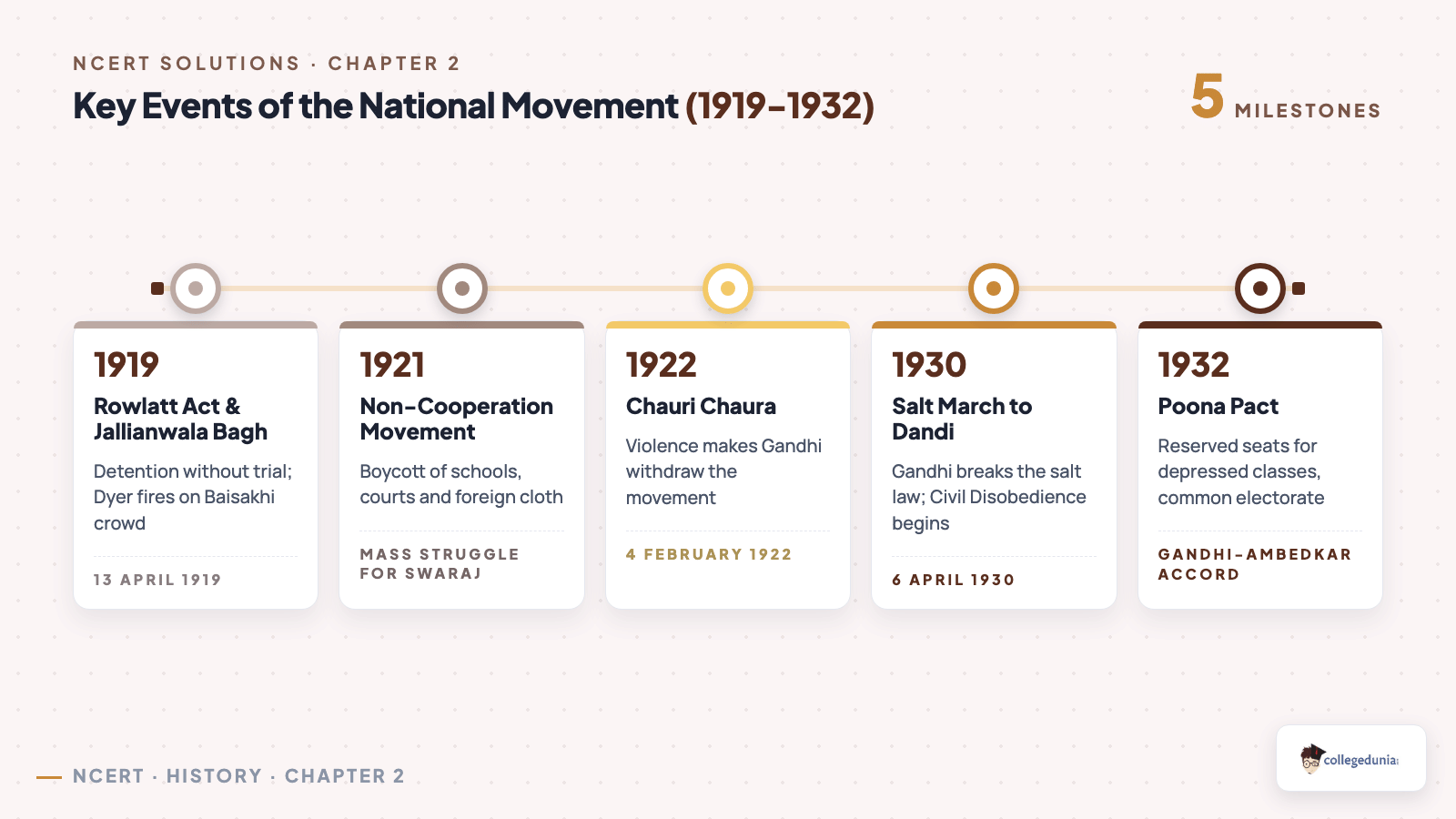
- The Non-Cooperation Movement (1921): who joined, what they hoped for, and why Gandhi withdrew it after Chauri Chaura.
- The Salt March and Civil Disobedience: the march to Dandi in 1930 and the breaking of the salt law.
Nationalism in India One-Shot Revision for Class 10 Boards
Source: Magnet Brains on YouTube
History Class 10 Chapter 2 Question Answer: Write in Brief Section
The Write in brief questions in history class 10 chapter 2 test short, factual recall. The board often picks the four-part explain question and the satyagraha question for 3 and 5 mark slots. Each answer rewards one clean fact-line per part.
| Question | What a full-mark answer must include |
|---|---|
| Explain (a) nationalism and anti-colonialism (b) the First World War (c) the Rowlatt Act (d) the withdrawal of Non-Cooperation | One link per part: a common colonial enemy united Indians; the war raised taxes, doubled prices and forced recruitment; the Rowlatt Act allowed detention without trial; Gandhi withdrew Non-Cooperation after the Chauri Chaura violence of 1922. |
| What is meant by the idea of satyagraha | Satyagraha means holding firmly to truth; a non-violent method that appeals to the conscience of the oppressor; first used by Gandhi at Champaran (1916), Kheda (1917) and Ahmedabad (1918). |
| Write a newspaper report on Jallianwala Bagh and the Simon Commission | Jallianwala Bagh: General Dyer fired on a trapped Baisakhi crowd on 13 April 1919. Simon Commission: an all-British body met with the slogan "Go back Simon" in 1928. |
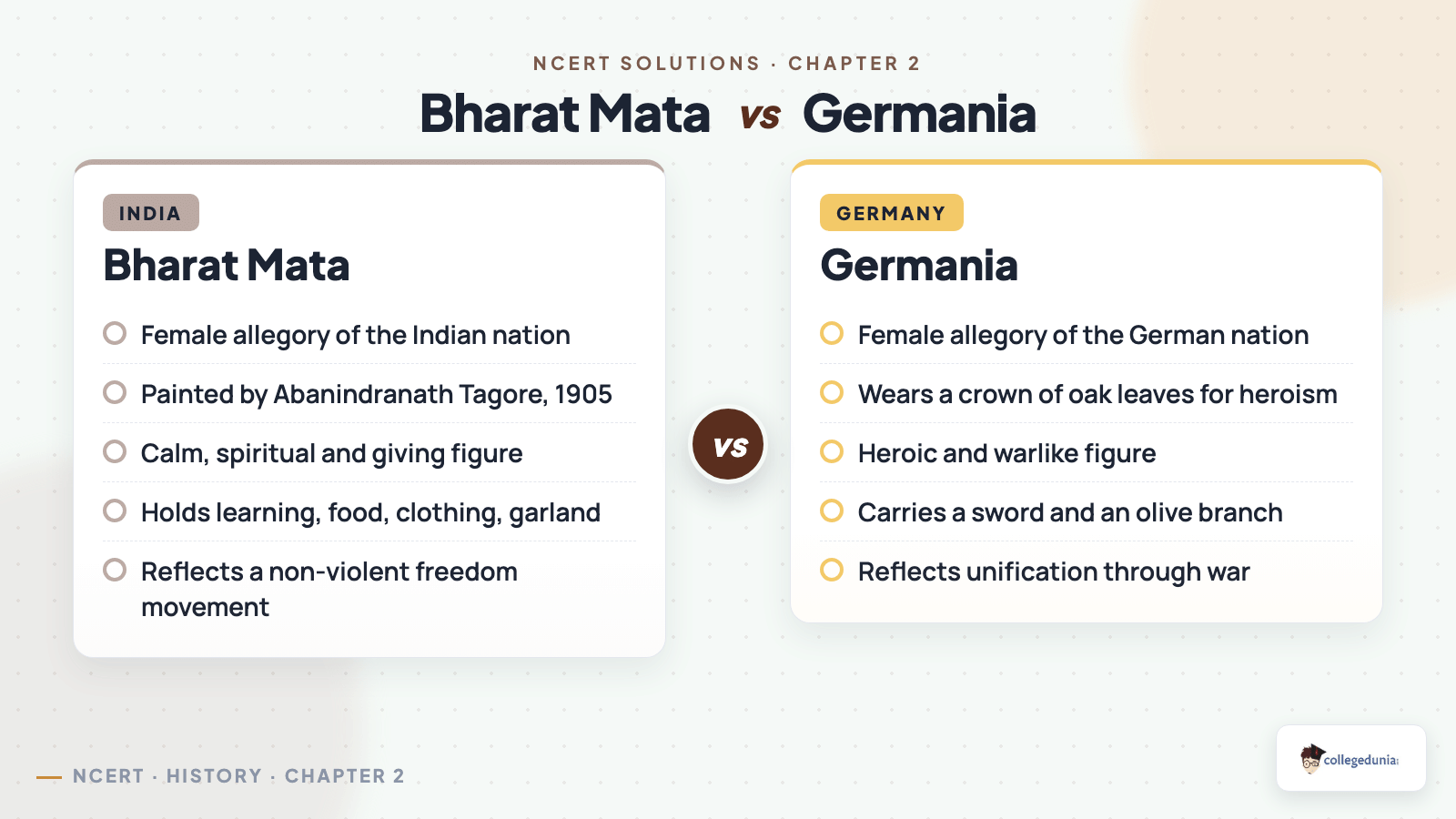
| Compare the images of Bharat Mata and Germania | Both are female allegories of the nation; Bharat Mata is calm and giving (Tagore, 1905), while Germania is heroic and armed (oak crown, sword). |
Tip: learn one date and one outcome per topic. That single line of detail is usually worth one mark in the board scheme.
Nationalism in India Important Question: Discuss Section
The Discuss questions carry the long-answer marks. Each nationalism in india important question asks you to explain a process or take a point of view, so a plain list of facts is not enough. A good answer needs a clear concept line, dated steps, and a one-line conclusion.
- Social groups in the Non-Cooperation Movement (1921): the urban middle class wanted swaraj; Awadh peasants wanted lower rent and an end to begar; Gudem tribals wanted their forest rights back.
- The Salt March of 1930: salt was used by everyone and the tax was unjust, so making salt was a simple act anyone could join.
- Women in Civil Disobedience: women joined marches, picketed shops and went to jail, but the Congress was slow to give them real authority.
- Separate electorates: Ambedkar and the Muslim League wanted them to protect minorities; Gandhi feared they would divide the nation; the Poona Pact (1932) settled it.
Memorise the Dandi march of over 240 miles and the Poona Pact of 1932, since these questions appear most years.
Satyagraha and the Early Movements Explained for Class 10
The idea of satyagraha is one of the most asked topics here. Gandhi made the word from satya (truth) and agraha (holding firmly), so it means holding firmly to truth.
- The core idea: a true cause wins by appealing to the conscience of the oppressor, not by force.
- Champaran, Kheda and Ahmedabad (1916 to 1918): Gandhi's first satyagrahas, for indigo peasants, revenue-hit farmers and mill workers.
The Salt March and How It United the Country
The Salt March turned an everyday thing into a challenge to an empire. The British held a monopoly over salt and taxed it. By marching to Dandi and making salt, Gandhi chose an act everyone could share.
| Stage | What happened |
|---|---|
| The choice of salt | Salt was a basic need, so the tax on it was widely resented. |
| The march, 12 March 1930 | Gandhi set out from Sabarmati with 78 volunteers; thousands joined on the way. |
| Dandi, 6 April 1930 | Gandhi reached the coast and broke the law by making salt from sea water. |
| The result | The march launched the Civil Disobedience Movement and drew worldwide attention. |
A boycott means refusing to buy something as a protest; a picket means blocking a shop entrance. Saying these in your answer is worth a mark.
Student Feedback on this Class 10 History Chapter
What 13,420 students told us about this chapter before the 2026 boards.
- 68% of students rated the four-part explain question as the one they most often answered incompletely.
- 59% of students said the separate-electorates question was the hardest to keep balanced between the dalit and Muslim points of view.
- Most-skipped topic in revision: the social groups in the Non-Cooperation Movement, left for last by about 36% of students.
Source: 2026-27 Class 10 History student poll. Sample of 13,420 students from CBSE schools across 15 states.
Common Mistakes Students Make in this Class 10 History Chapter
A few slips lose easy marks every year.
- Listing only some social groups in the Non-Cooperation question instead of all of them.
- Treating separate electorates as only a Hindu-Muslim issue. The sharpest clash was Gandhi versus Ambedkar over the depressed classes.
- Forgetting the years: Rowlatt Act 1919, Chauri Chaura 1922, Salt March 1930, Poona Pact 1932.
- Writing the newspaper report as an essay instead of using a headline and dateline.
How to Use the NCERT Solutions Class 10 History Chapter 2 Page
Use these solutions in three blocks. First read the chapter, then attempt the questions, then compare and fix the gaps.
- Read and list every name, date and outcome in the NCERT chapter.
- Attempt all 8 questions on your own first.
- Compare with the step-by-step solution and mark the missing fact-lines.
Write the Salt March and separate-electorates answers in full at least once. These ncert solutions class 10 history chapter 2 mirror the board's 5-mark pattern, so each answer doubles as a revision model.
Practice All NCERT Solutions for this Class 10 History Chapter with Step-by-Step Solutions
Open the question bank below to attempt all 8 solved questions with collapsible Solution and Expert Solution tabs. Every answer is mapped to the NCERT text, so each nationalism in india question answer reads the way an examiner expects.
All Solved Questions for this Class 10 History Chapter
Practise every question with step-by-step solutions and an expert version for board marks.
Class 10 History Other Resources for this Chapter
Pair this with the other Class 10 History resources for this chapter, all linked below.
| Resource | Best used for |
|---|---|
| Nationalism in India Class 10 Notes | Quick concept recap before the exam |
| Nationalism in India Class 10 Handwritten Notes | Last-minute scanned revision |
| Nationalism in India Class 10 NCERT Book PDF | Reading the original chapter text |
All Chapters NCERT Solutions for Class 10 History (India and Contemp World II)
Browse the full set of ncert solutions for class 10 history chapter by chapter.
| Chapter | NCERT Solutions |
|---|---|
| Chapter 1 | The Rise of Nationalism in Europe Class 10 NCERT Solutions |
| Chapter 2 | Nationalism in India Class 10 NCERT Solutions |
| Chapter 3 | The Making of a Global World Class 10 NCERT Solutions |
| Chapter 4 | The Age of Industrialisation Class 10 NCERT Solutions |
| Chapter 5 | Print Culture and the Modern World Class 10 NCERT Solutions |
Nationalism in India Class 10 History NCERT Solutions FAQs
Ques. Where can I download the NCERT Solutions Class 10 History Chapter 2 Nationalism in India PDF?
Ans. You can download the nationalism in india class 10 ncert solutions PDF directly from this page. Both the Normal and HD versions are free, and a Hindi-medium read is available too.
Ques. How many questions are solved in class 10 history chapter 2 question answer?
Ans. All 8 NCERT questions are solved: 4 Write in brief questions and 4 Discuss questions, each with a step-by-step solution and an expert version for the long-answer marks.
Ques. Is this NCERT Solutions page aligned with the 2026-27 syllabus?
Ans. Yes. This page reflects the current 2026-27 syllabus for Class 10 History, and every answer is checked against the latest NCERT edition of India and the Contemporary World II.
Ques. Why did Gandhi withdraw the Non-Cooperation Movement?
Ans. Gandhi withdrew the Non-Cooperation Movement in February 1922 after the violence at Chauri Chaura, where a crowd set fire to a police station. He felt people were not yet ready for a non-violent mass struggle.
Ques. What is meant by the idea of satyagraha in class 10 History?
Ans. Satyagraha means holding firmly to truth. It is a non-violent method of mass struggle that wins justice by appealing to the conscience of the oppressor, first used by Gandhi at Champaran, Kheda and Ahmedabad.
Ques. Why was the Salt March an effective symbol of resistance?
Ans. Salt was used by every Indian, and the British tax and monopoly on it were widely resented. Making salt was a simple, non-violent act anyone could join, so the march to Dandi united the country and drew worldwide attention.
Ques. Why did leaders differ over separate electorates in the nationalism in india question answer?
Ans. Ambedkar and the Muslim League wanted separate electorates to protect minorities from majority domination, while Gandhi feared they would divide the nation. The Ambedkar-Gandhi clash was settled by the Poona Pact of 1932.



Comments