




Class 12 Economics Market Equilibrium PYQ, free to download as a 35-page PDF. The chapter comes from the Microeconomics part of the older board pattern, and the set holds 39 solved questions from the 2005 to 2019 papers on how equilibrium price and quantity are fixed, excess demand and excess supply, the chain of effects of a shift in demand or supply, the effect of input prices, technology and income, price ceiling and price floor, support price, and equation-based numericals, and takes roughly three hours to work through, so do the 5 one-mark and 9 three-mark questions in the first sitting, the 9 four-mark questions in the second and the 16 six-mark questions in the third.
Market Equilibrium Weightage in the Class 12 Board Paper
As per Economics Market Equilibrium weightage from past years, this chapter was part of the Microeconomics half of the older Class 12 paper. The theory paper listed for 2026-27 is Macroeconomics (40 marks) plus Indian Economic Development (40 marks), so there is no Microeconomics part now, and we have not found an official chapter-wise mark figure for the old pattern. Treat this set as practice for the concepts and for school tests that still follow the Micro book, not as a forecast of the current board paper.
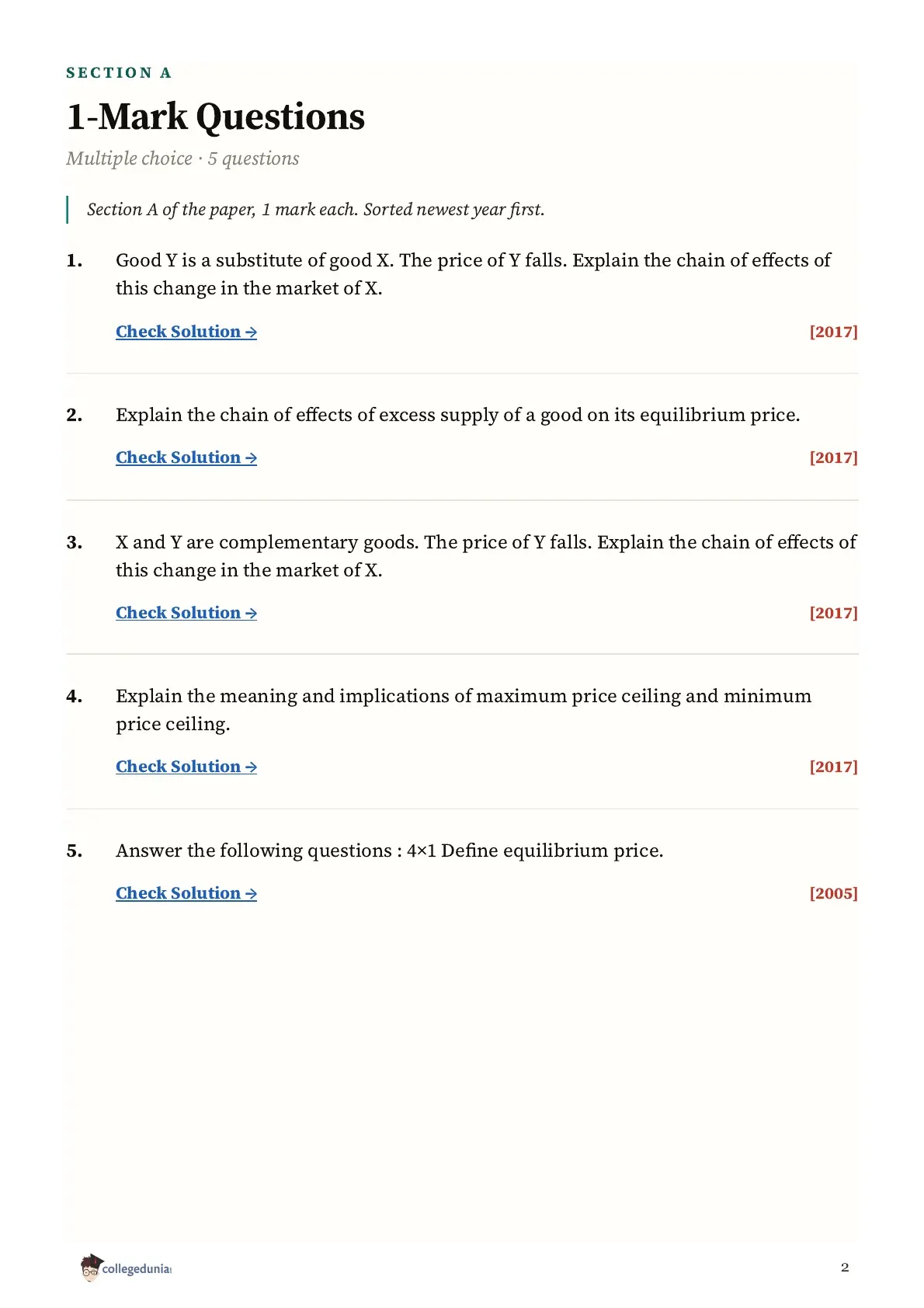
The 39 questions split by marks as shown below. 16 are 6-mark long answers, which makes them the largest group, and 34 of the 39 need a written answer of three marks or more.
| Marks Each | Question Type | Questions in the Set |
|---|---|---|
| 1 mark | Very short answer | 5 |
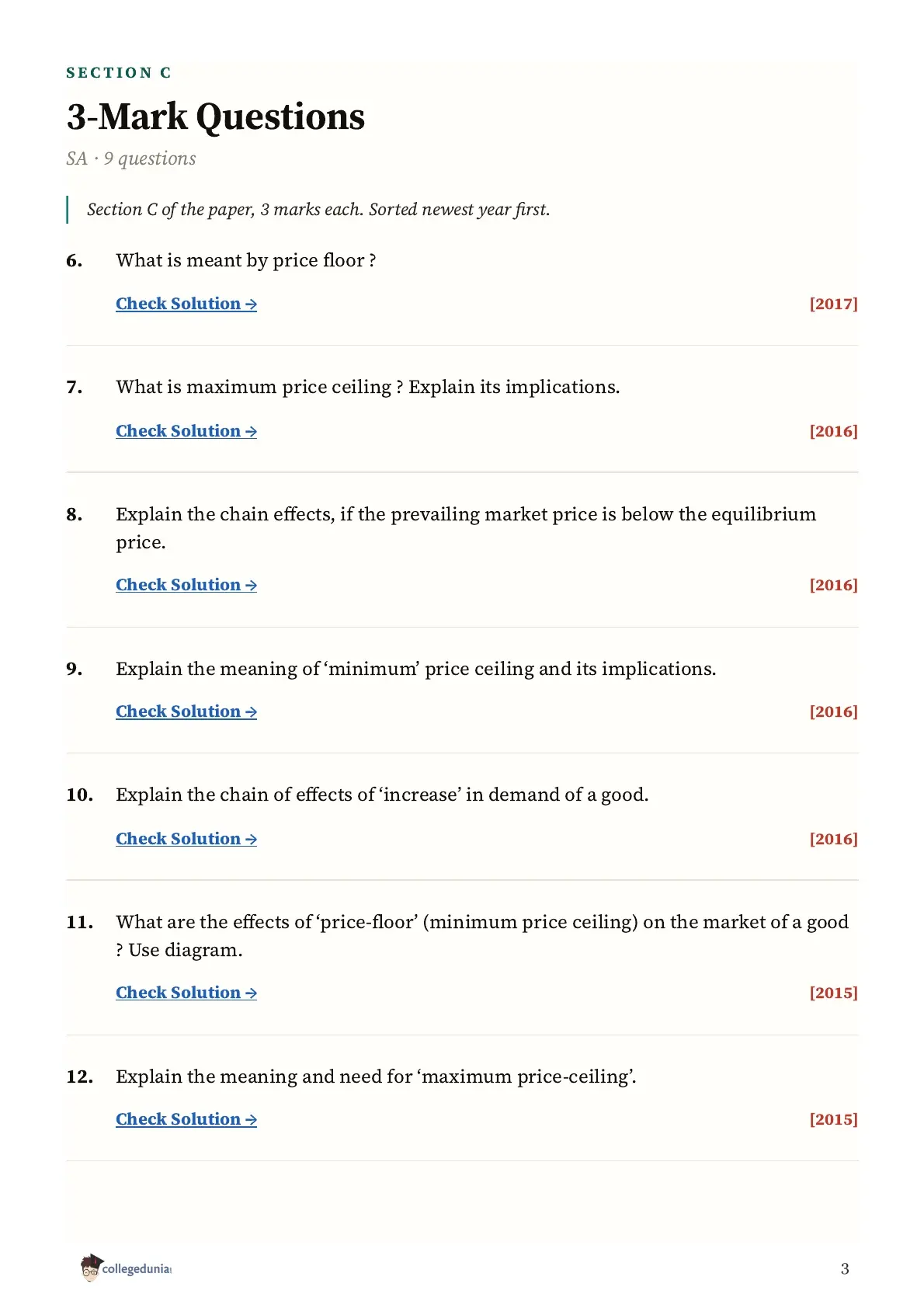
| 3 marks | Short Answer (SA) | 9 |
| 4 marks | Short Answer and Numerical | 9 |
| 6 marks | Long Answer (LA) | 16 |
Market Equilibrium Questions by Topic
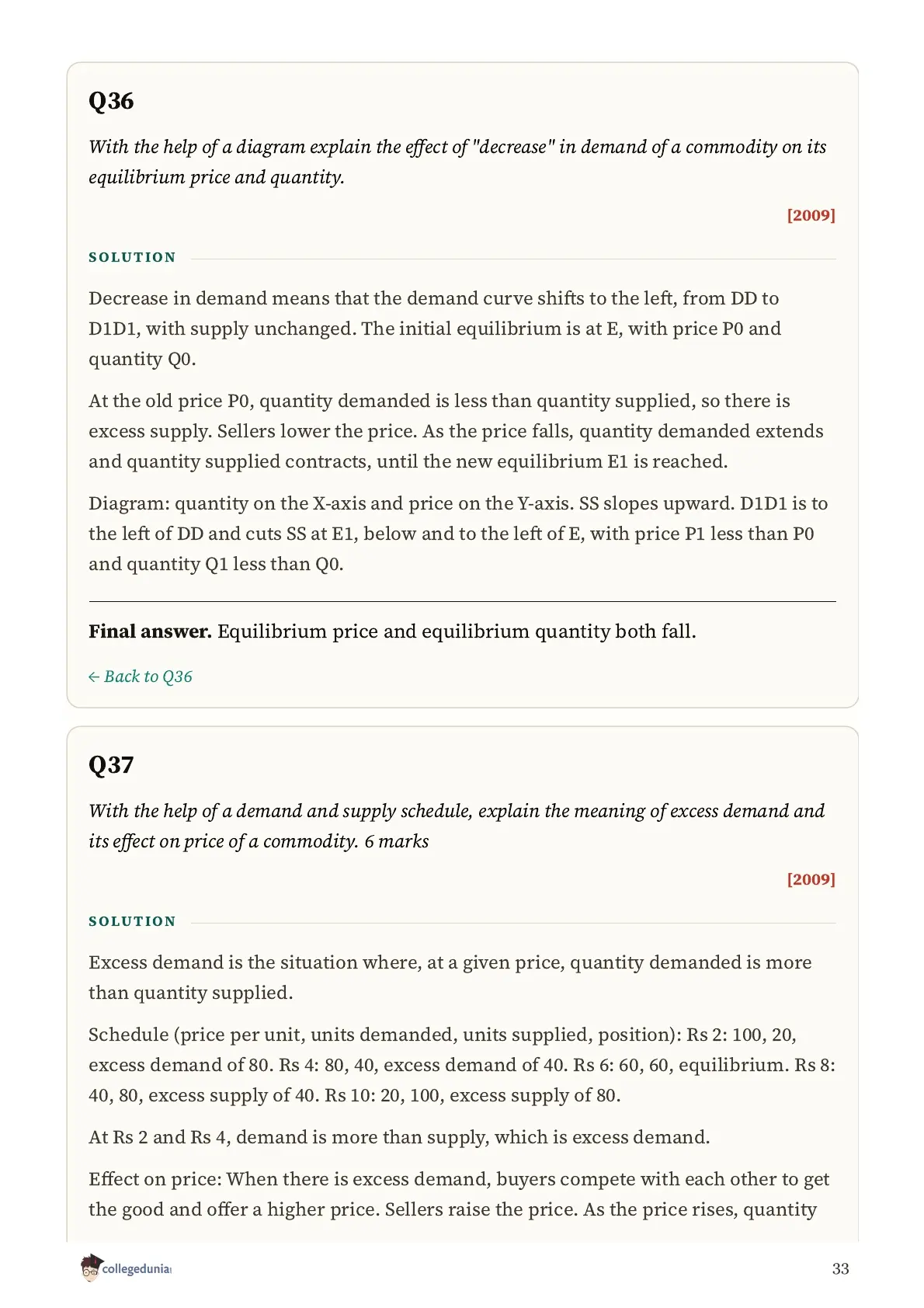
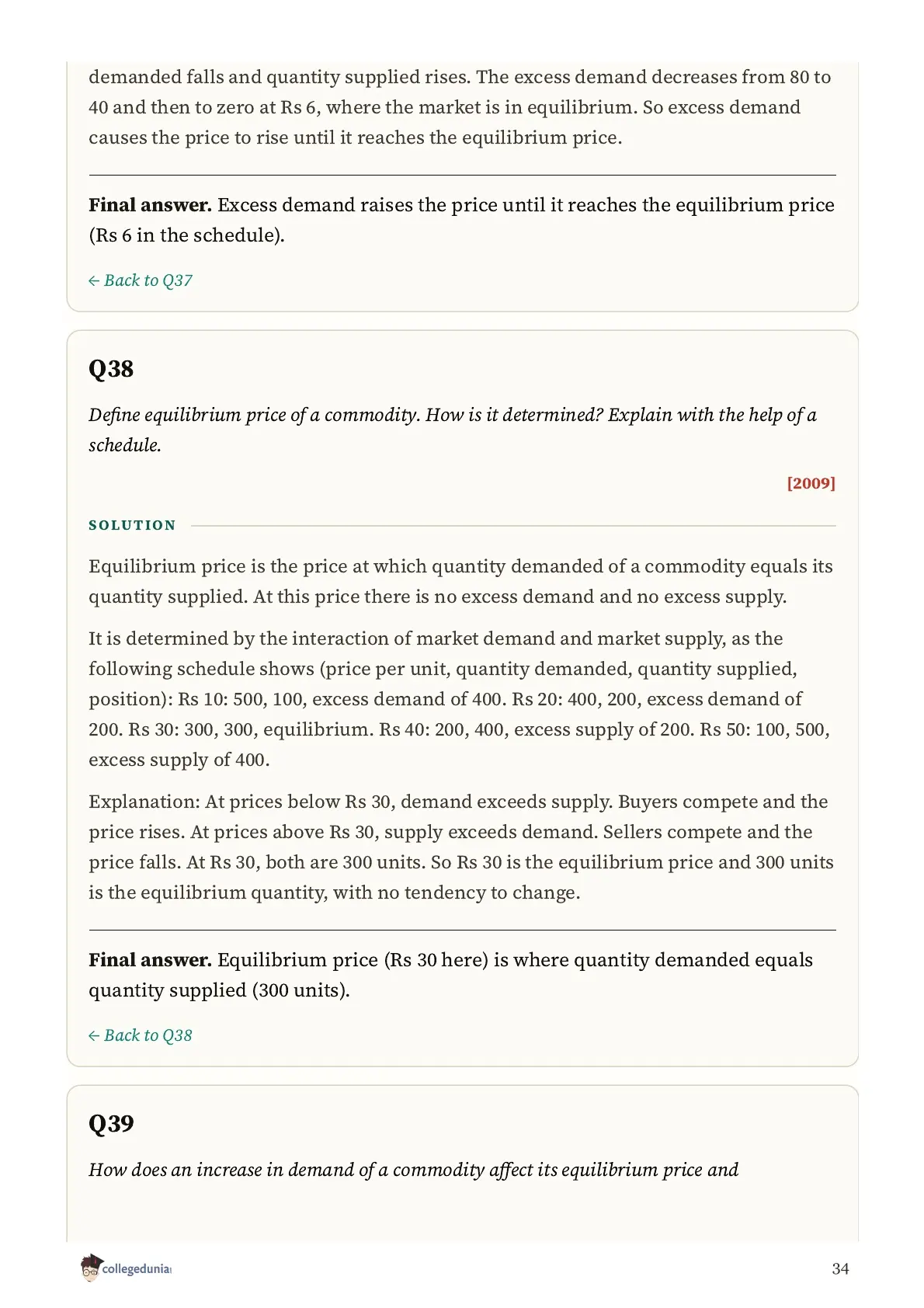
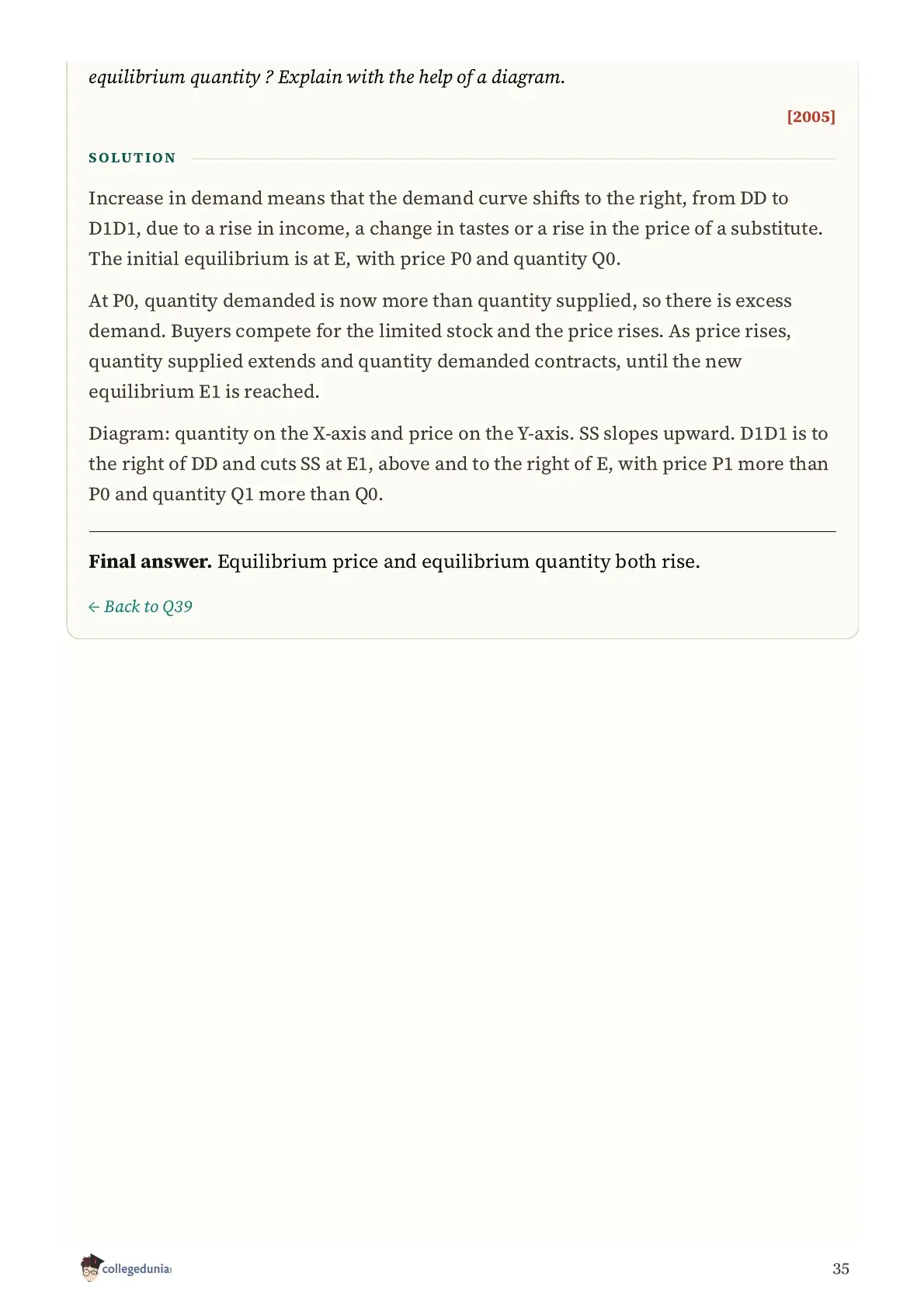
The "chain of effects" wording runs through the set: 14 questions use it, covering a rise or fall in demand, a rise or fall in supply, excess supply, and a market price that sits below equilibrium. 18 questions ask for a diagram, and 16 of those are 4-mark or 6-mark questions. Excess demand is the subject of 6 questions and excess supply of 3, with 3 asking for a schedule.
Shifts of the curves make up a large share. 6 questions are about a change in demand itself, such as a leftward shift in 2007 or an increase in 2005 and 2016. 8 are about supply: 4 on a change in input prices, 2 on better technology, and 2 on a plain increase or decrease in supply. One 2015 question brings in consumer income for a normal good, and two 2017 questions ask what happens in the market of X when the price of a substitute or a complementary good changes. 2 questions ask the student to define equilibrium price or show how it is determined.
On government intervention, 4 questions are about a maximum price ceiling, with its meaning, implications and the goods it is normally imposed on. 6 are about a price floor, including those phrased as a "minimum price ceiling". One 2015 question asks why the government of India fixes a support price for some crops.
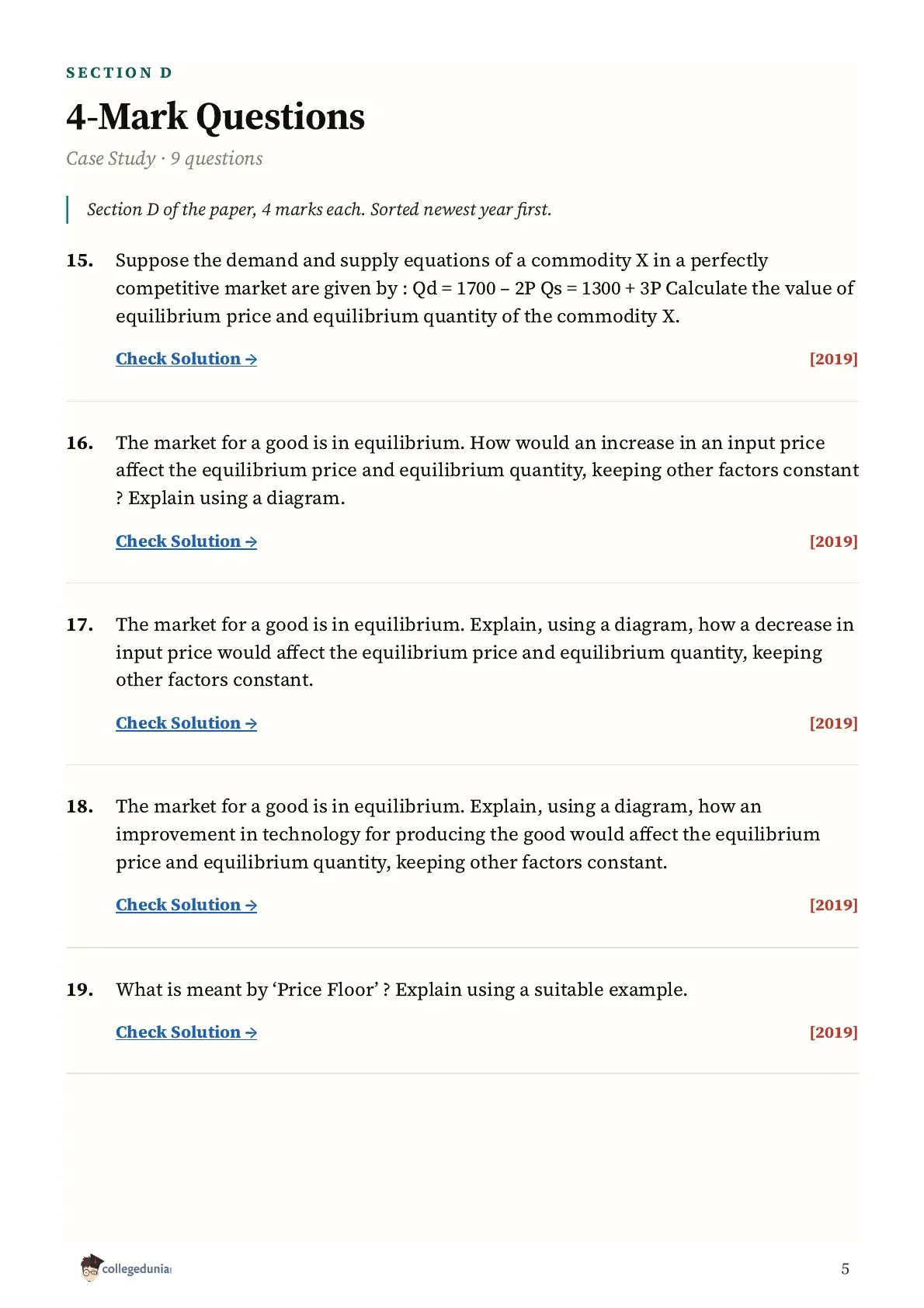
2 questions are equation-based numericals, both from 2019: find equilibrium price and quantity from Qd = 1700 - 2P with Qs = 1300 + 3P, and from Qd = 2200 - 3p with Qs = 1800 + 2p. The counts come from keyword matches, so a question on two topics is counted under both.
Price Determination Video Lesson
Source: Next Toppers - 11th Commerce on YouTube
How to Approach the Market Equilibrium Set
Start with the 5 one-mark and 9 three-mark questions. They are mostly definitions: price ceiling, price floor, support price, equilibrium price. Draw the ceiling and floor diagrams from memory a couple of times, since 2 of the 3-mark questions ask for one.
For the 4-mark group, do the two equation questions first. Set Qd equal to Qs, solve for P, then put P back into either equation for the quantity. Then take the input price and technology questions, where the supply curve shifts and the demand curve stays put. Leave the 16 six-mark questions for the last sitting. Each answer needs a diagram with both curves, the old and new equilibrium marked, and the steps written in order: the shift, the excess demand or excess supply at the old price, the price movement, the new equilibrium.
Common Mistakes in Market Equilibrium Questions
- Shifting the wrong curve. A rise in input prices moves supply, not demand.
- Stopping at the new equilibrium and skipping the chain, when the question asks for the chain of effects.
- Drawing a price floor below the equilibrium price. It binds only when it is set above it, and a maximum price ceiling binds only when set below it.
- Calling a price ceiling and a price floor by one name. The 2015, 2016 and 2017 papers use "minimum price ceiling" for a floor, so read the meaning, not the label.
- Putting P back into only one equation and not checking that Qd and Qs match at the answer.
- Forgetting to label the axes, the curves and both equilibrium points, which costs marks in a 6-mark diagram answer.
Using the Answer Key and Solutions
The PDF is 35 pages and free to download. Questions are grouped by marks, each links to its worked solution and back, and the Answer Key lists the answers at a glance. Attempt a group first, check the key, then read the solution. The solutions are written by Collegedunia's Economics experts and are not official CBSE marking schemes.
Class 12 Economics PYQs by Chapter
| Chapter | PYQ Page |
|---|---|
| Macro Chapter 1 | Macro Chapter 1: Introduction to Macroeconomics Class 12 PYQ |
| Macro Chapter 2 | Macro Chapter 2: National Income Accounting Class 12 PYQ |
| Macro Chapter 3 | Macro Chapter 3: Money and Banking Class 12 PYQ |
| Macro Chapter 4 | Macro Chapter 4: Determination of Income and Employment Class 12 PYQ |
| Macro Chapter 5 | Macro Chapter 5: Government Budget and the Economy Class 12 PYQ |
| Macro Chapter 6 | Macro Chapter 6: Open Economy Macroeconomics Class 12 PYQ |
| Micro Chapter 1 | Micro Chapter 1: Introduction to Microeconomics Class 12 PYQ |
| Micro Chapter 2 | Micro Chapter 2: Theory of Consumer Behaviour Class 12 PYQ |
| Micro Chapter 3 | Micro Chapter 3: Production and Costs Class 12 PYQ |
| Micro Chapter 4 | Micro Chapter 4: The Theory of the Firm under Perfect Competition Class 12 PYQ |
| Micro Chapter 5 | Micro Chapter 5: Market Equilibrium Class 12 PYQ |
Market Equilibrium Class 12 Economics PYQ FAQs
Ques. How many questions are in the Market Equilibrium Class 12 PYQ PDF?
Ans. The PDF has 39 questions from papers between 2005 and 2019: 5 one-mark questions, 9 three-mark questions, 9 four-mark questions and 16 six-mark questions.
Ques. Does this PYQ PDF include solutions, or only the questions?
Ans. Yes. All 39 questions have a worked solution in the PDF, and an Answer Key lists the answers at a glance.
Ques. Are the solutions official?
Ans. No. They are written by Collegedunia's Economics experts and are not an official CBSE marking scheme.
Ques. How many marks did Market Equilibrium carry in the Class 12 board paper?
Ans. It belonged to the Microeconomics part of the older board pattern. The paper listed for 2026-27 has Macroeconomics and Indian Economic Development only, and no official chapter-wise marks figure is available for the old pattern.
Ques. How is equilibrium price determined?
Ans. Equilibrium price is the price at which quantity demanded equals quantity supplied. Above it there is excess supply and the price falls; below it there is excess demand and the price rises. 2 questions in this set ask for the definition or the determination of equilibrium price, one of them with a schedule.
Ques. What is the chain of effects of an increase in demand?
Ans. The demand curve shifts right, so at the old price there is excess demand. Price rises, quantity supplied expands and quantity demanded contracts until the two meet at a higher price and a larger quantity. 14 questions in this set ask for a chain of effects.
Ques. What is the difference between a price ceiling and a price floor?
Ans. A maximum price ceiling is a legal upper limit set below the equilibrium price to protect buyers, and it leads to excess demand. A price floor is a legal lower limit set above the equilibrium price to protect producers, and it leads to excess supply. 4 questions in this set are on the ceiling and 6 on the floor.
Ques. How are equation-based questions on equilibrium solved?
Ans. Put Qd equal to Qs, solve for P, then substitute P into either equation to get the quantity. 2 questions in this set, both from 2019, are of this kind.



Comments