




The Journey Inside the Atom Class 9 Science Handwritten Notes are a topper's own neat revision of Chapter 8 from the new Exploration textbook. Every idea, the electron, proton and neutron, the models of Thomson, Rutherford and Bohr, and the numbers of an atom, is written by hand with the key rule A = Z + N boxed in the margin. You revise the whole 2026-27 chapter in one short sitting, just as you would set it out in the exam.
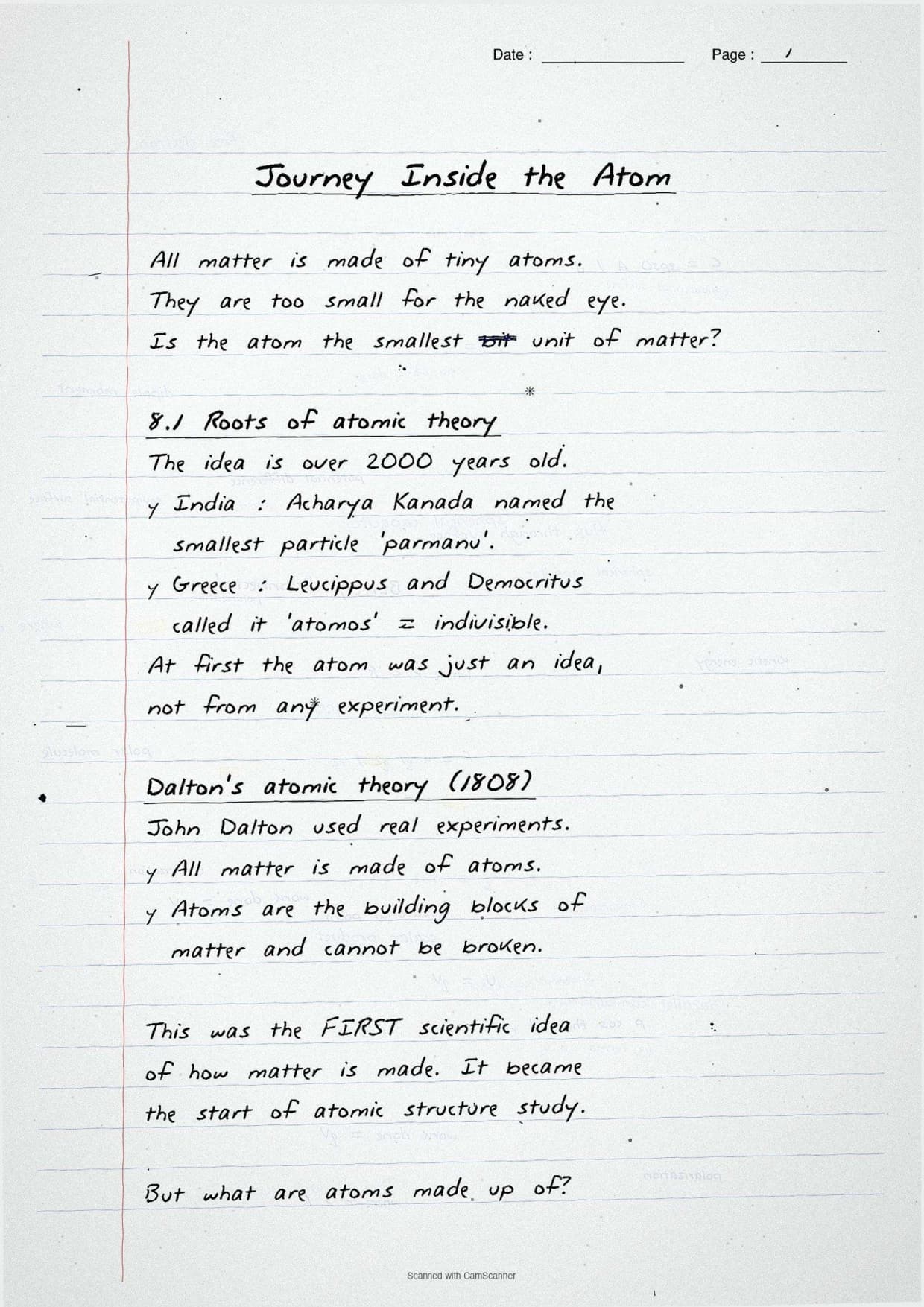
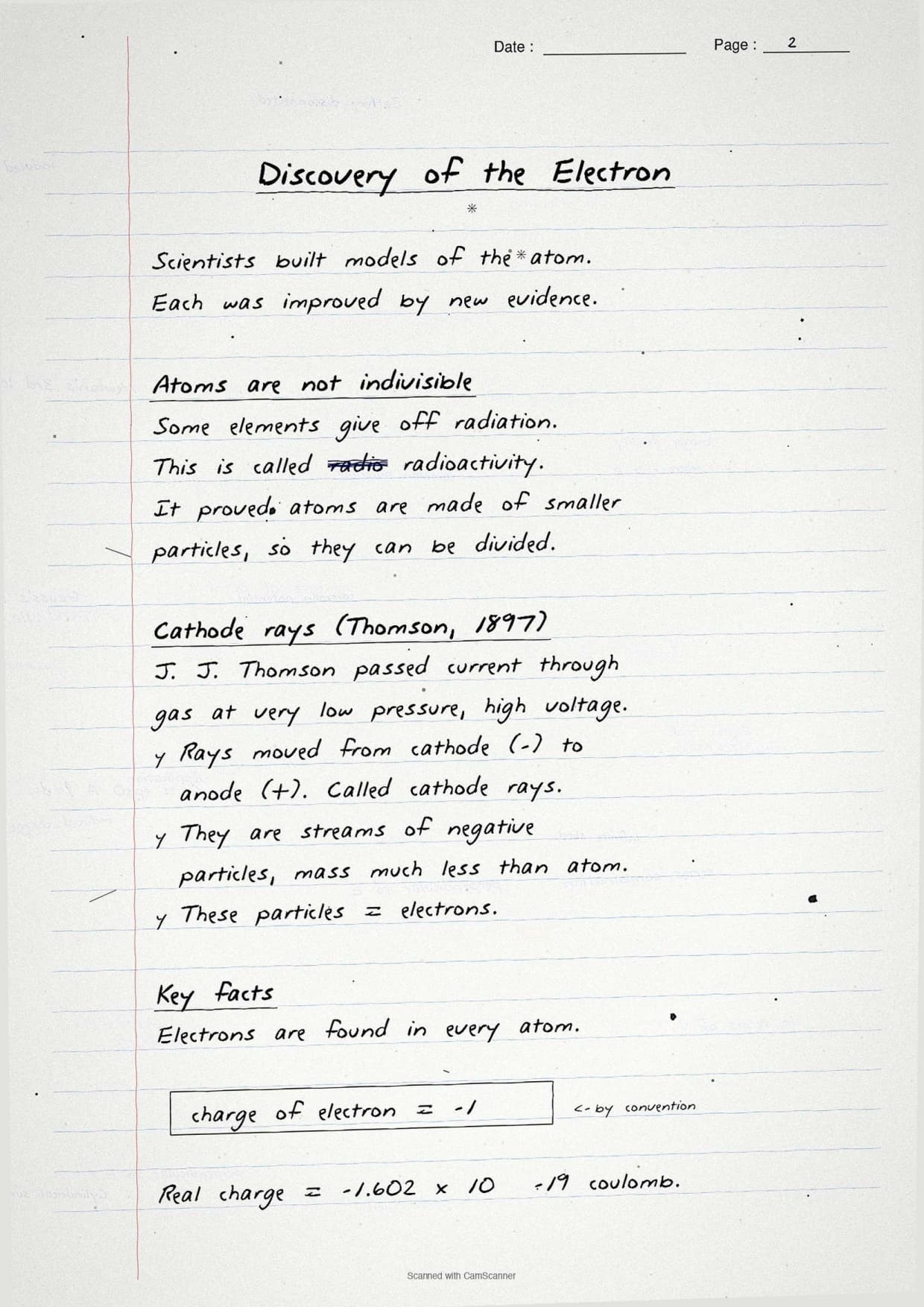
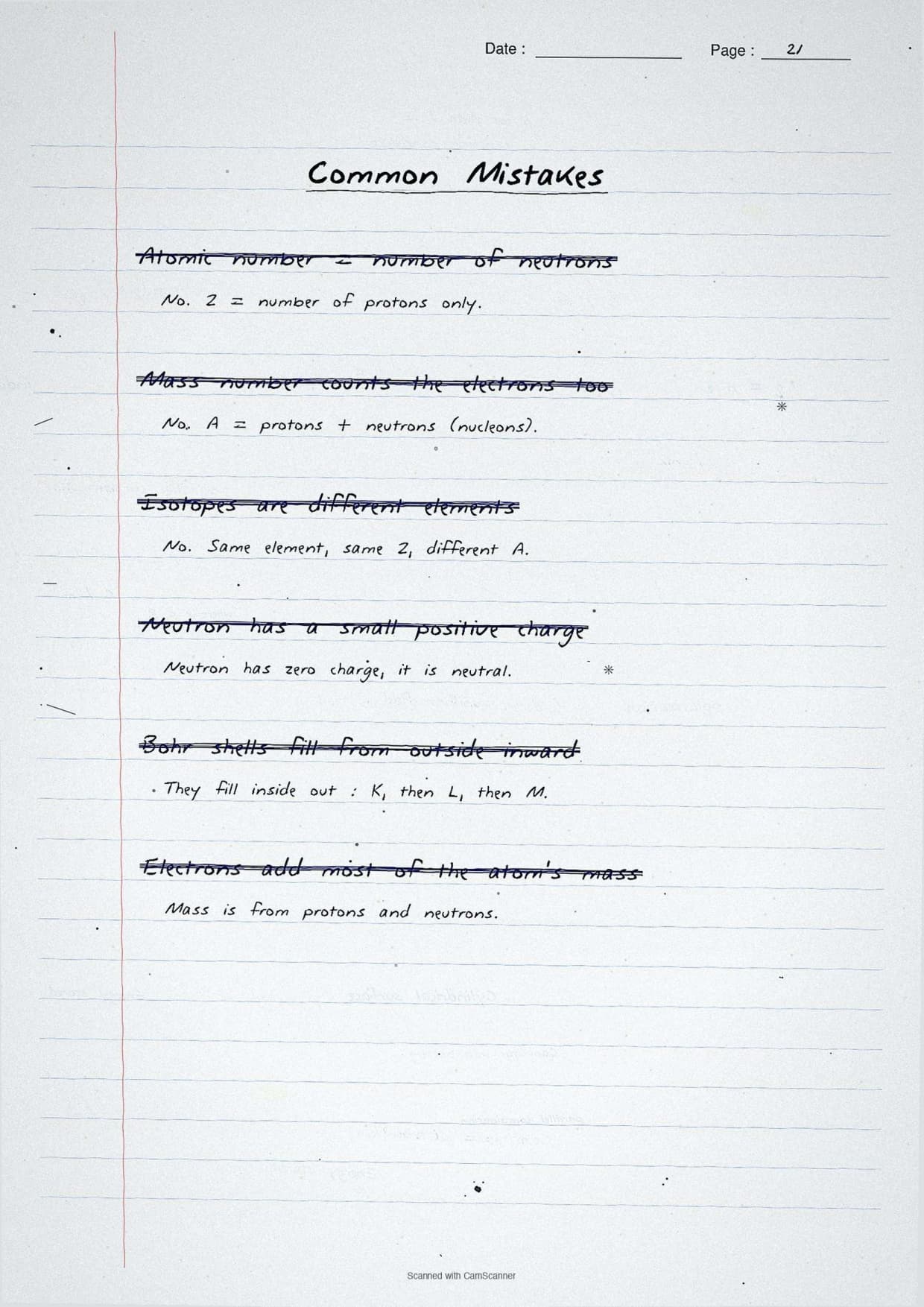
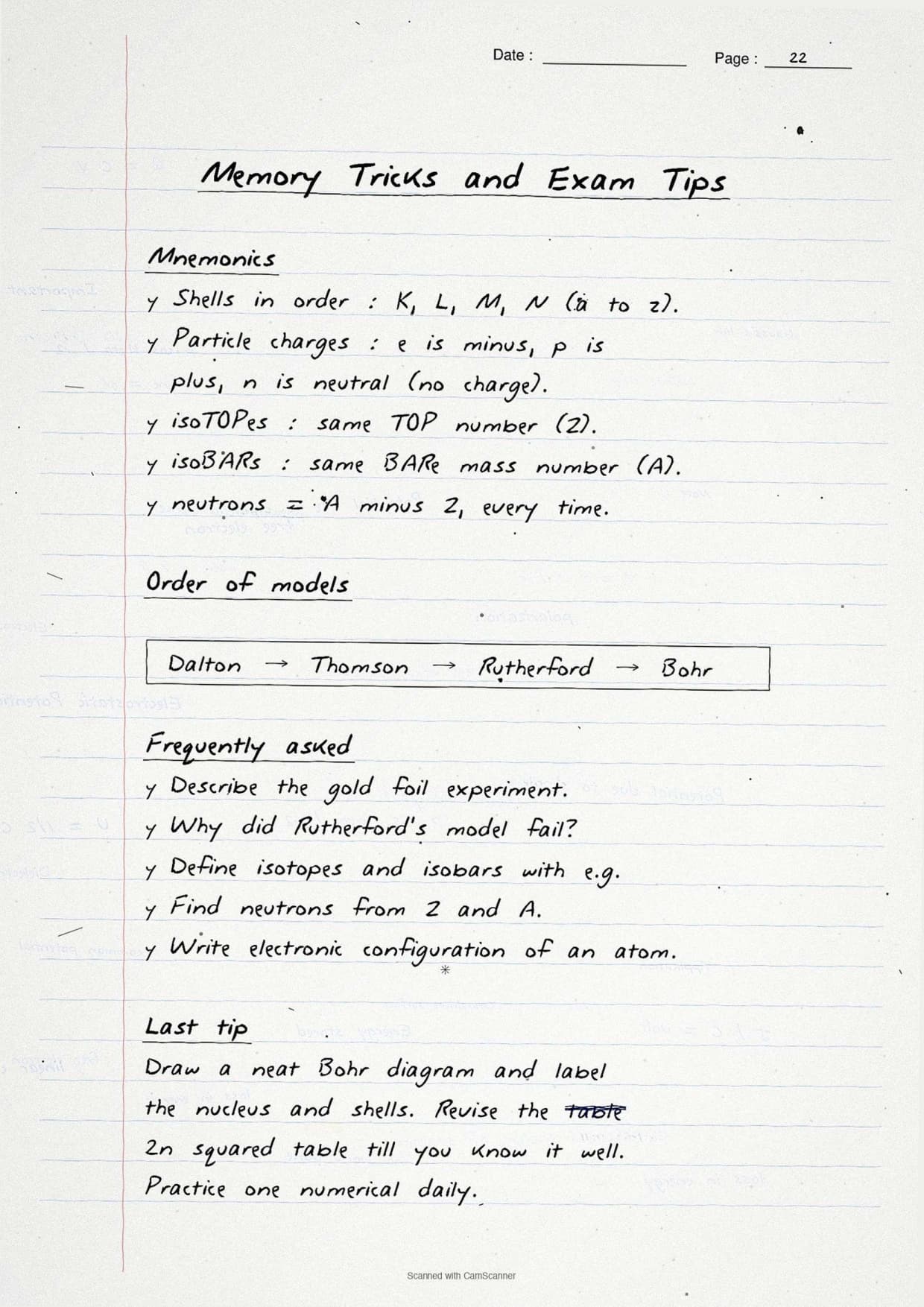
- What you get: the electron, proton and neutron, the atomic models, atomic number, mass number, electronic configuration, valency, isotopes and isobars, all in clear handwriting.
- Colour-coded: new sub-topics in red, each formula in a hand-drawn box, and solved examples in blue.
- Why by hand: writing A = Z + N and each shell diagram by hand helps you recall it fast in the exam.
Student Feedback
In a Collegedunia study of 1,240 Class 9 students, 81% said hand-written pages of the atomic models were easier to recall than typed notes. About 4 out of 5 rated the hand-drawn shell diagrams and the red isotopes-versus-isobars note as the most useful part before a test.
Journey Inside the Atom Class 9 Science Explained in One Shot
Source: Magnet Brains on YouTube
Why Use Handwritten Notes for Class 9 Science Chapter 8 Journey Inside the Atom
Chapter 8 mixes short definitions with a long story of experiments, so a clean, hand-written page saves real time. The Journey Inside the Atom Class 9 Science Handwritten Notes keep one idea per line, with a small atom sketch beside it, so nothing runs together. You revise the full chapter in one sitting without flipping through the Exploration book.
- Each rule, like A = Z + N, sits in its own hand-drawn box.
- A quick shell diagram is drawn next to the atom it explains.
- Red sub-headings split the chapter into short, easy parts.
- The wording is plain, like a senior showing you the method.
What Is Inside the Journey Inside the Atom Handwritten Notes PDF
The PDF runs to 22 pages of neat, hand-written revision. It moves from the first idea of the atom, to the discovery of the electron, proton and neutron, then the models of Thomson, Rutherford and Bohr, and finishes with atomic number, mass number, electronic configuration, valency, isotopes and isobars. A solved example follows each idea. The colour code below tells you what every mark means.
- Red: new sub-topic headings, such as Cathode Rays, Nucleus, or Valency.
- Boxes: each rule, like A = Z + N and the 2n2 rule, drawn by hand.
- Blue: solved examples and the numbers worked out in them.
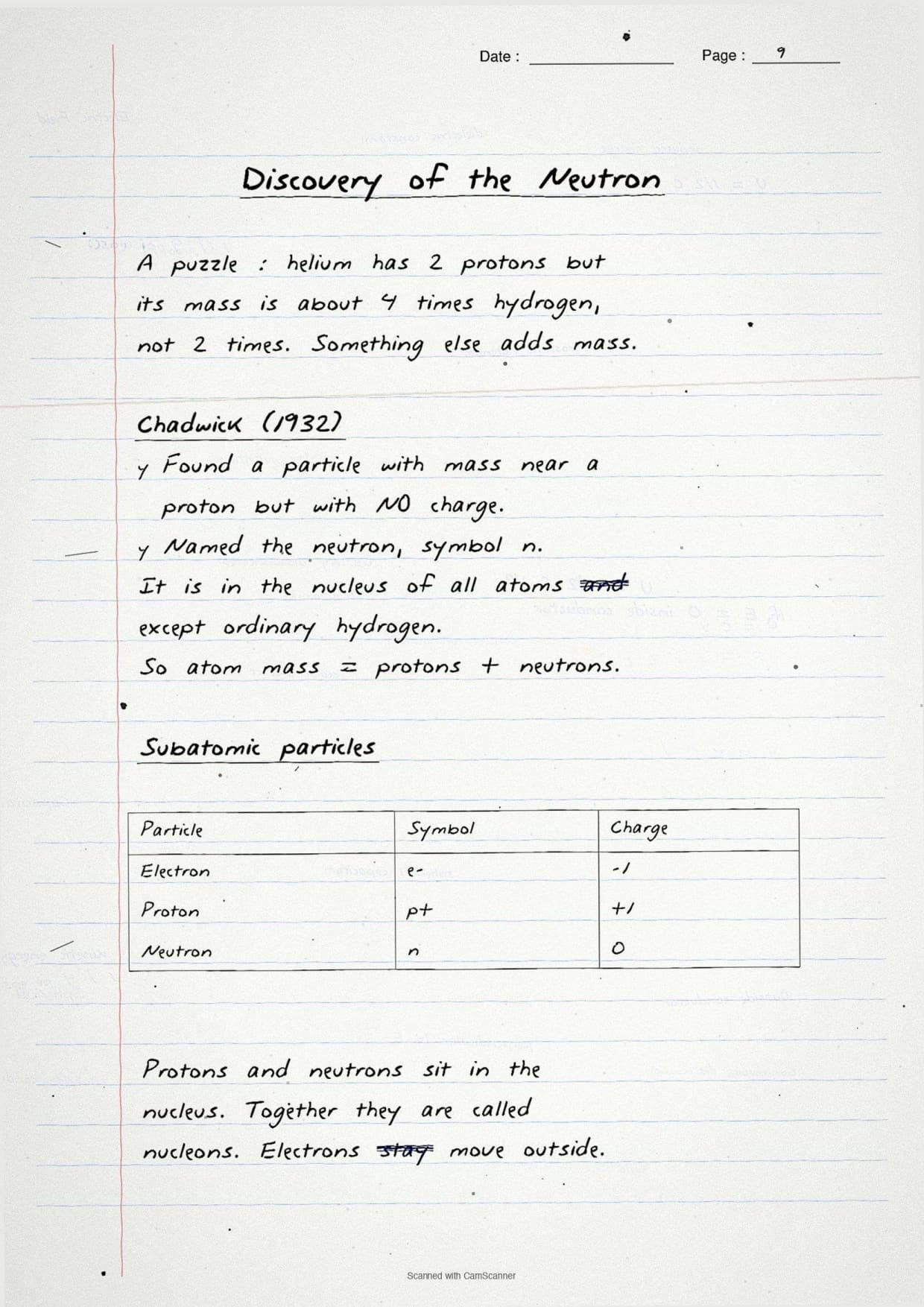
Subatomic Particles: Electron, Proton and Neutron in the Notes
An atom is the smallest particle of an element, but it is not solid inside. The notes open with the three subatomic particles that make up every atom, each with its own mass and charge. Learn this one table and the rest of the chapter falls into place.
| Particle | Symbol | Charge | Where it sits |
|---|---|---|---|
| Electron | e− | −1 | In shells around the nucleus |
| Proton | p+ | +1 | Inside the nucleus |
| Neutron | n0 | 0 | Inside the nucleus |
- Electron: found by J. J. Thomson in 1897 from cathode rays. It is negatively charged and very light. The notes write its charge in short as −1.
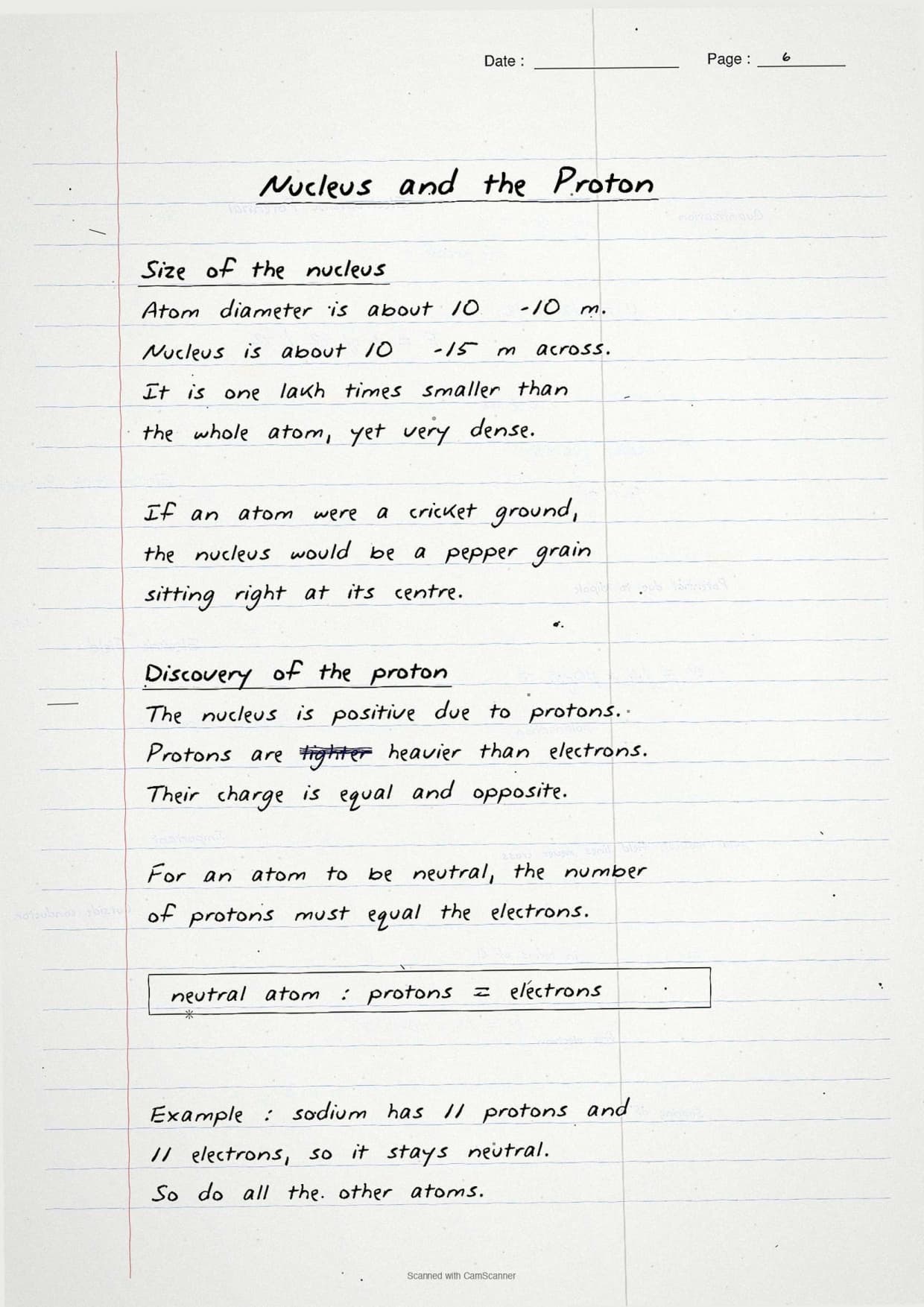
- Proton: a heavy, positively charged particle in the nucleus. In a neutral atom, the number of protons equals the number of electrons.
- Neutron: found by James Chadwick in 1932. It has almost the same mass as a proton but no charge, and it adds mass to the atom.
The notes use one easy line to fix the charges: e minus, p plus, n nought. Only the electron sits outside the nucleus; the proton and neutron stay packed in the centre.

The Journey of Atomic Models: Hand-Drawn Table
The heart of Chapter 8 is a story: each model kept what worked and fixed what did not. The notes give it a clear hand-drawn table so you can see how the picture of the atom grew, step by step.
| Model | Main idea | Why it changed |
|---|---|---|
| Dalton (1808) | Atom is a solid, indivisible particle | Electrons and radioactivity were later found |
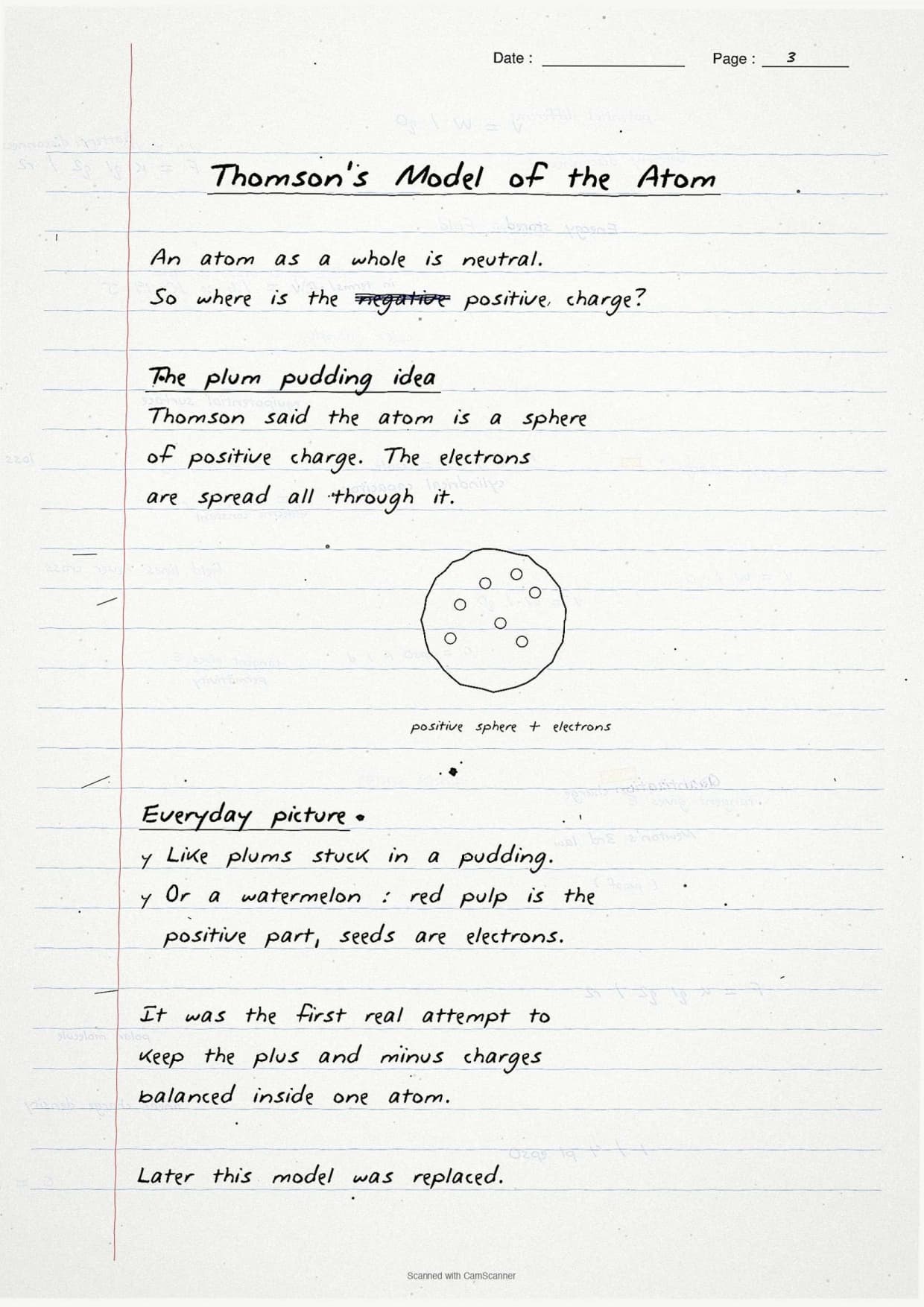
| Thomson (1897) | Electrons stuck in a positive sphere, like seeds in a watermelon | Could not explain the gold foil result |
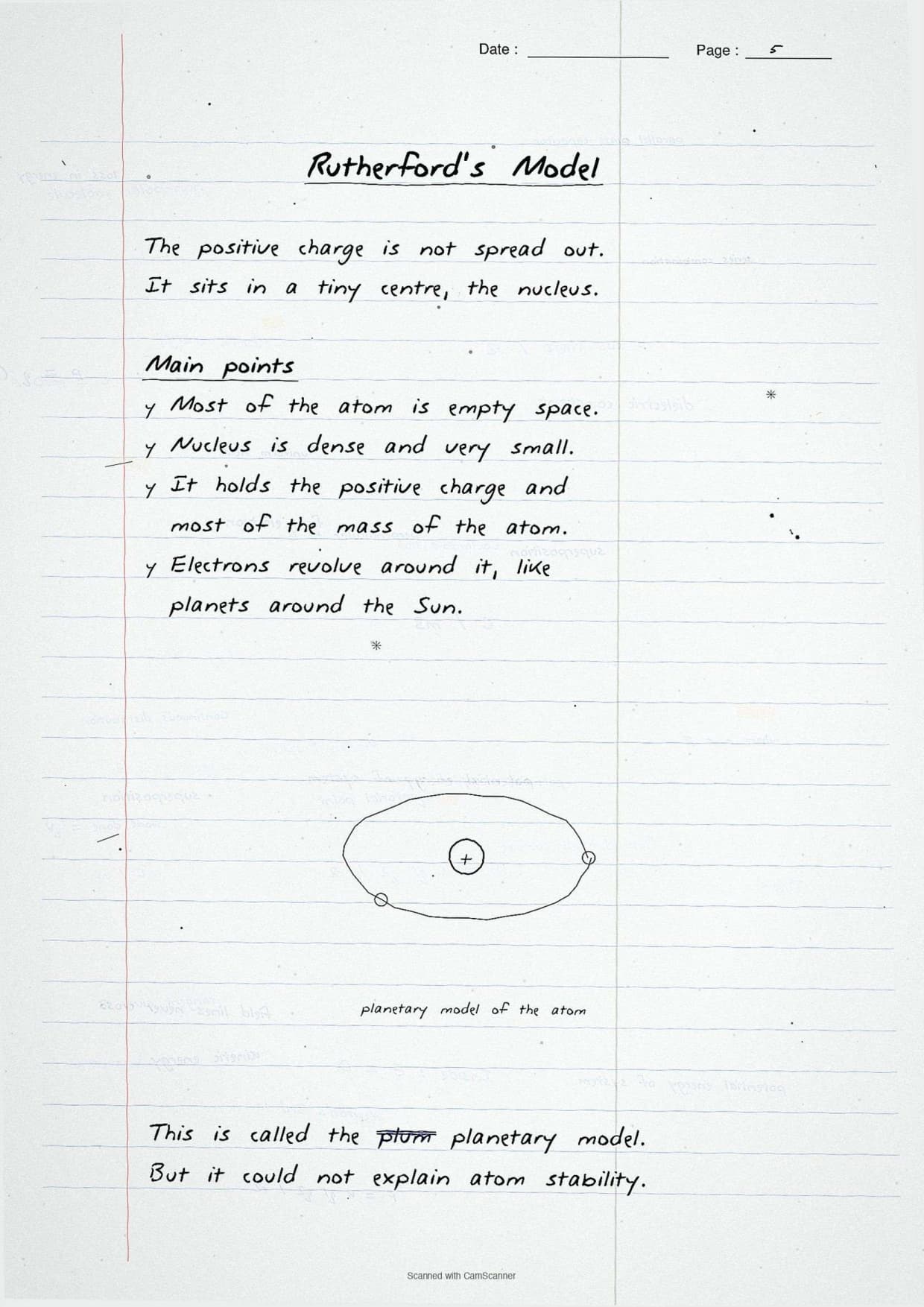
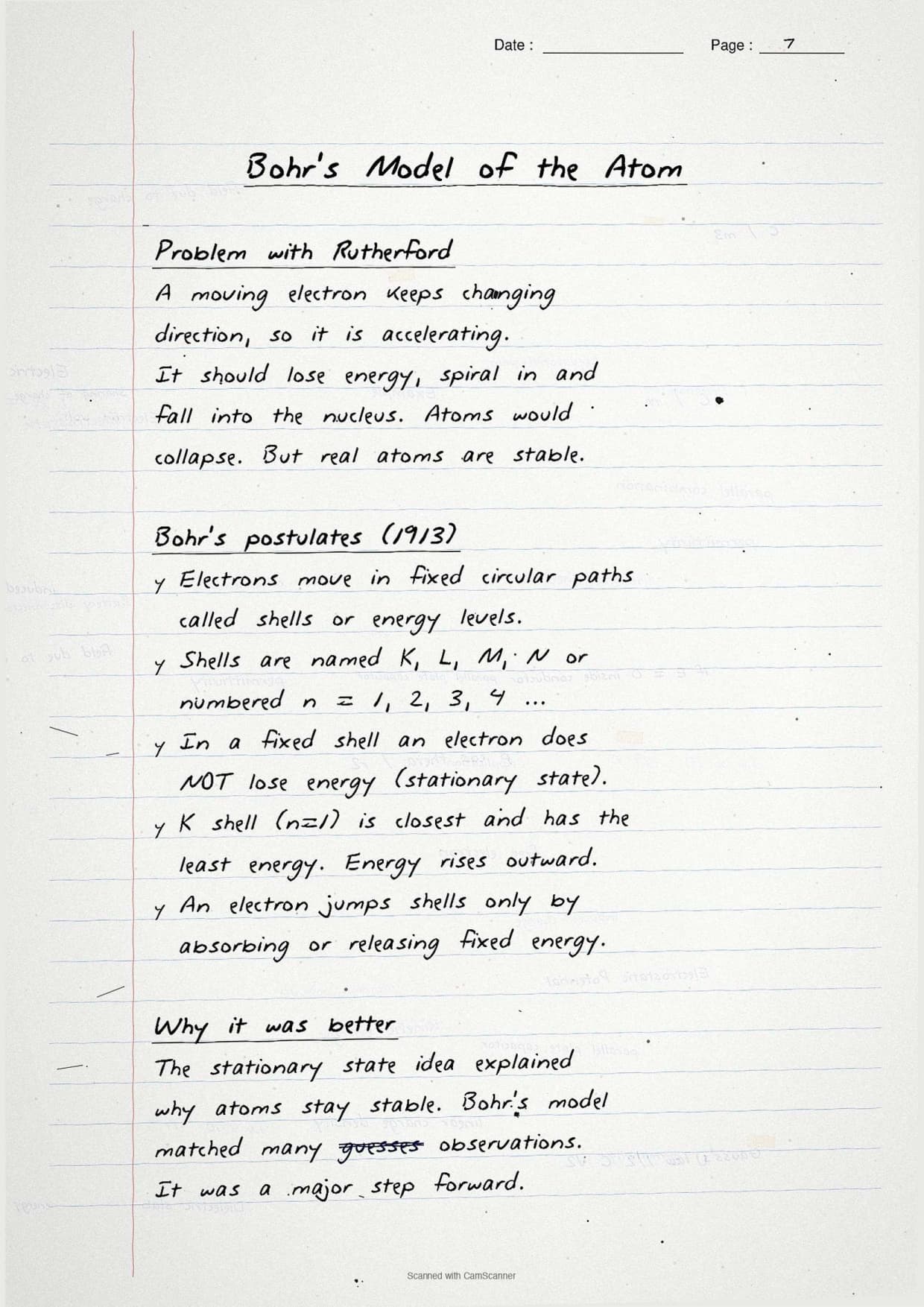
| Rutherford (1911) | A small, dense nucleus with empty space around it | Could not explain why the atom is stable |
| Bohr (1913) | Electrons in fixed energy shells | Refined further by the modern quantum model |
The notes mark one habit in red: learn the models in order. A short mnemonic in the margin, Dalton, Thomson, Run Behind Me, gives you Dalton, Thomson, Rutherford, Bohr, Modern. Thomson's plum pudding atom and Rutherford's planetary atom each get a small hand-drawn sketch beside the table.
Gold Foil Experiment and the Discovery of the Nucleus
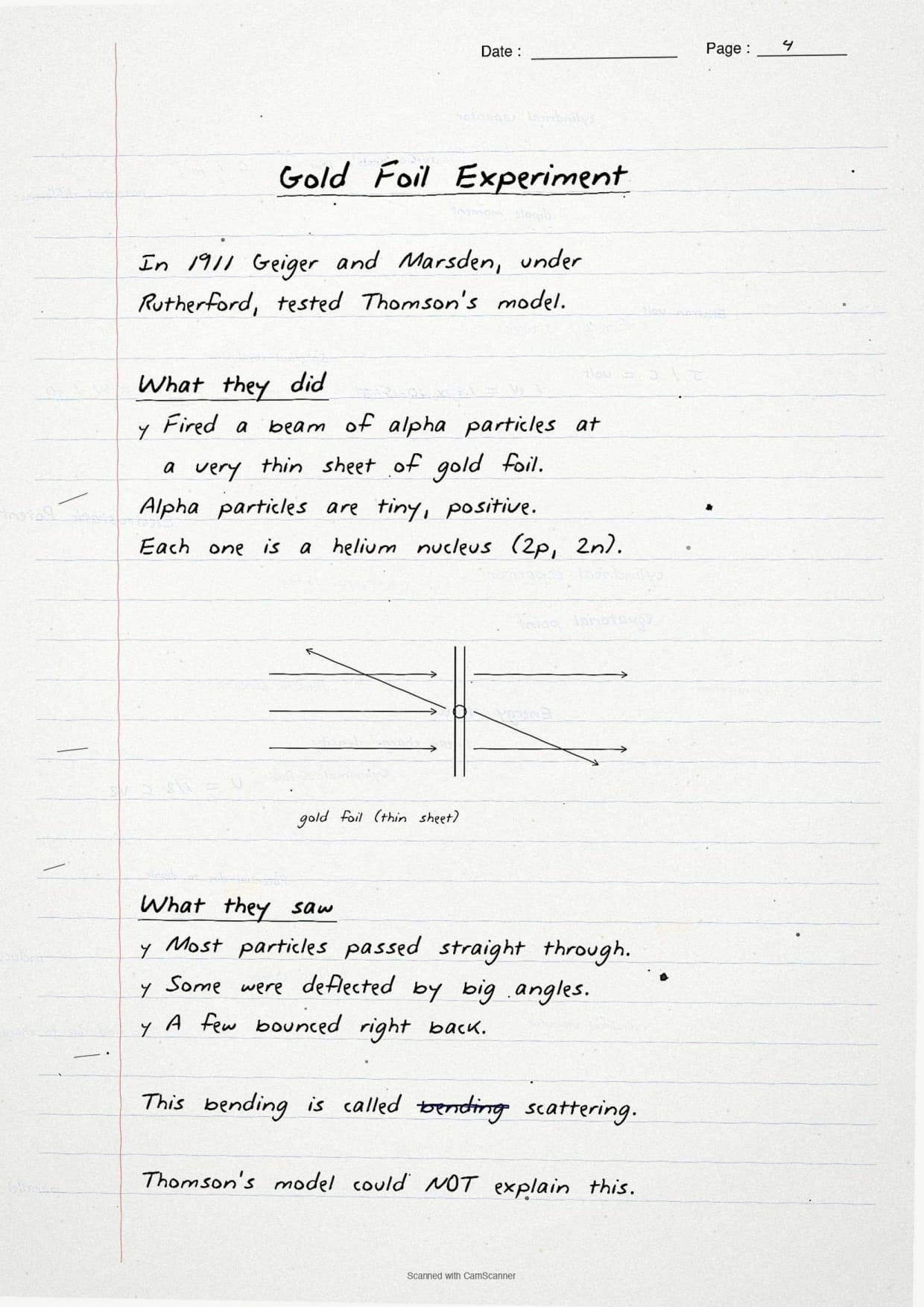
This is the most tested experiment in Chapter 8, so the notes give it a full page. In 1911, Geiger and Marsden, working under Ernest Rutherford, fired a beam of alpha particles at a very thin gold foil. What they saw forced scientists to redraw the atom.
| Observation | What it meant |
|---|---|
| Most alpha particles passed straight through | Most of the atom is empty space |
| Some were deflected through large angles | There is a concentrated positive charge inside |
| A very few bounced straight back | A tiny, dense, heavy centre, the nucleus, exists |
- The bending of the alpha particles is called scattering, so this is also named the alpha-ray scattering experiment.
- Rutherford found the nucleus is about 105 (one lakh) times smaller than the whole atom.
- The atom is about 10−10 m across, while the nucleus is only about 10−15 m across.
The margin note pictures the scale: if an atom were as wide as a cricket ground, the nucleus would be a single grain of pepper at the centre. The notes also flag Rutherford's one gap in red, that a revolving electron should lose energy and spiral in, which Bohr later fixed.
Atomic Number and Mass Number in Your Own Handwriting
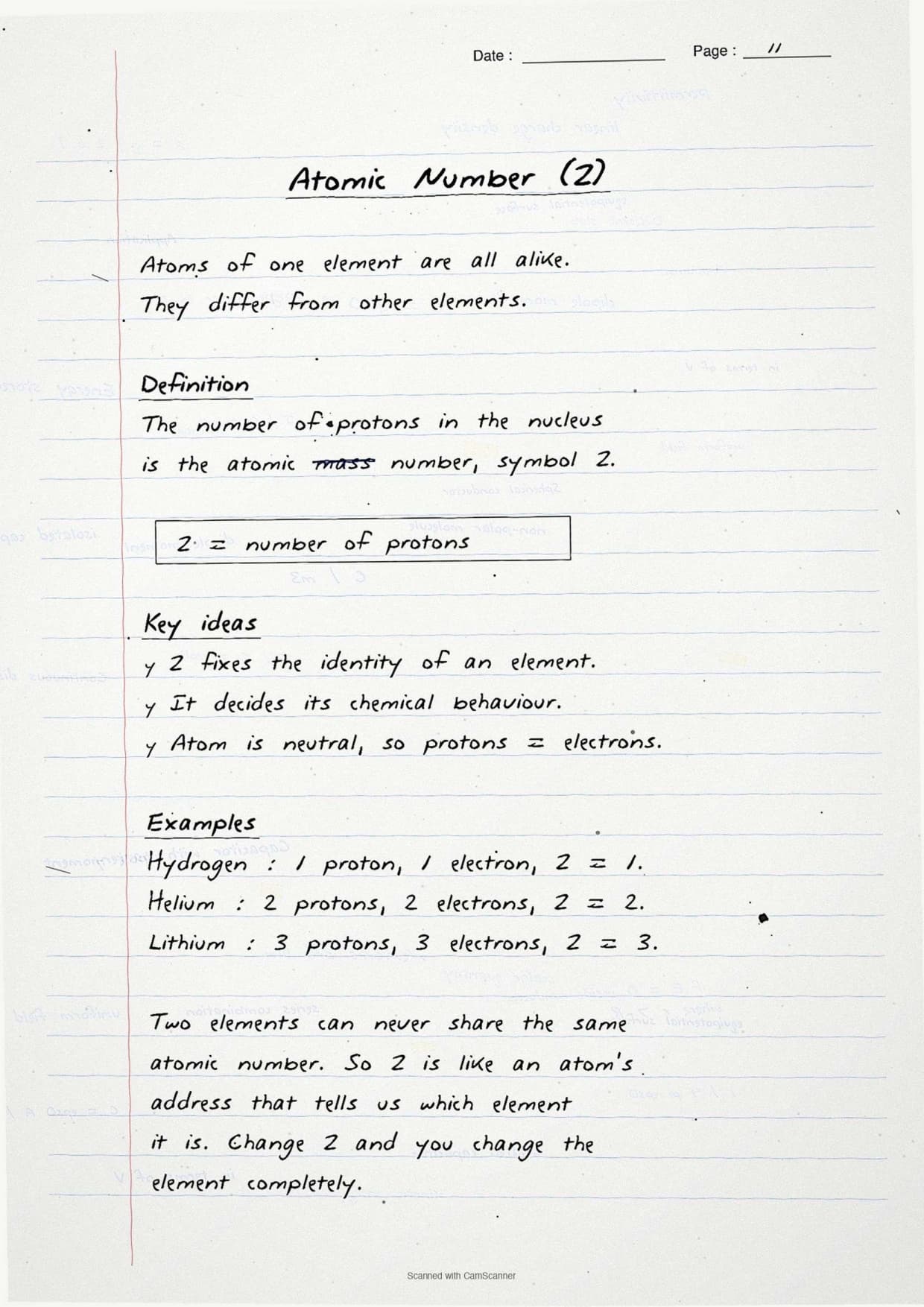
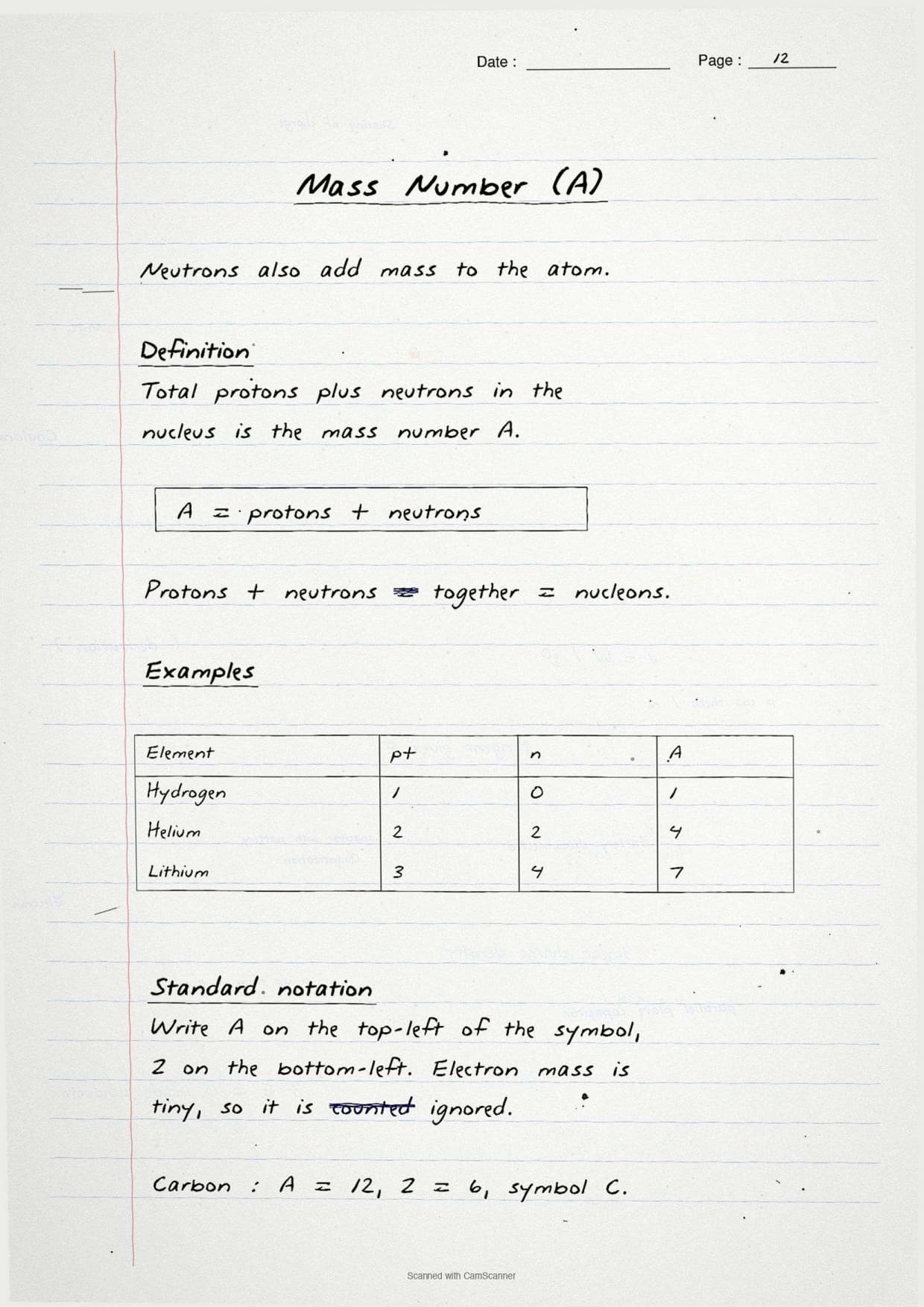
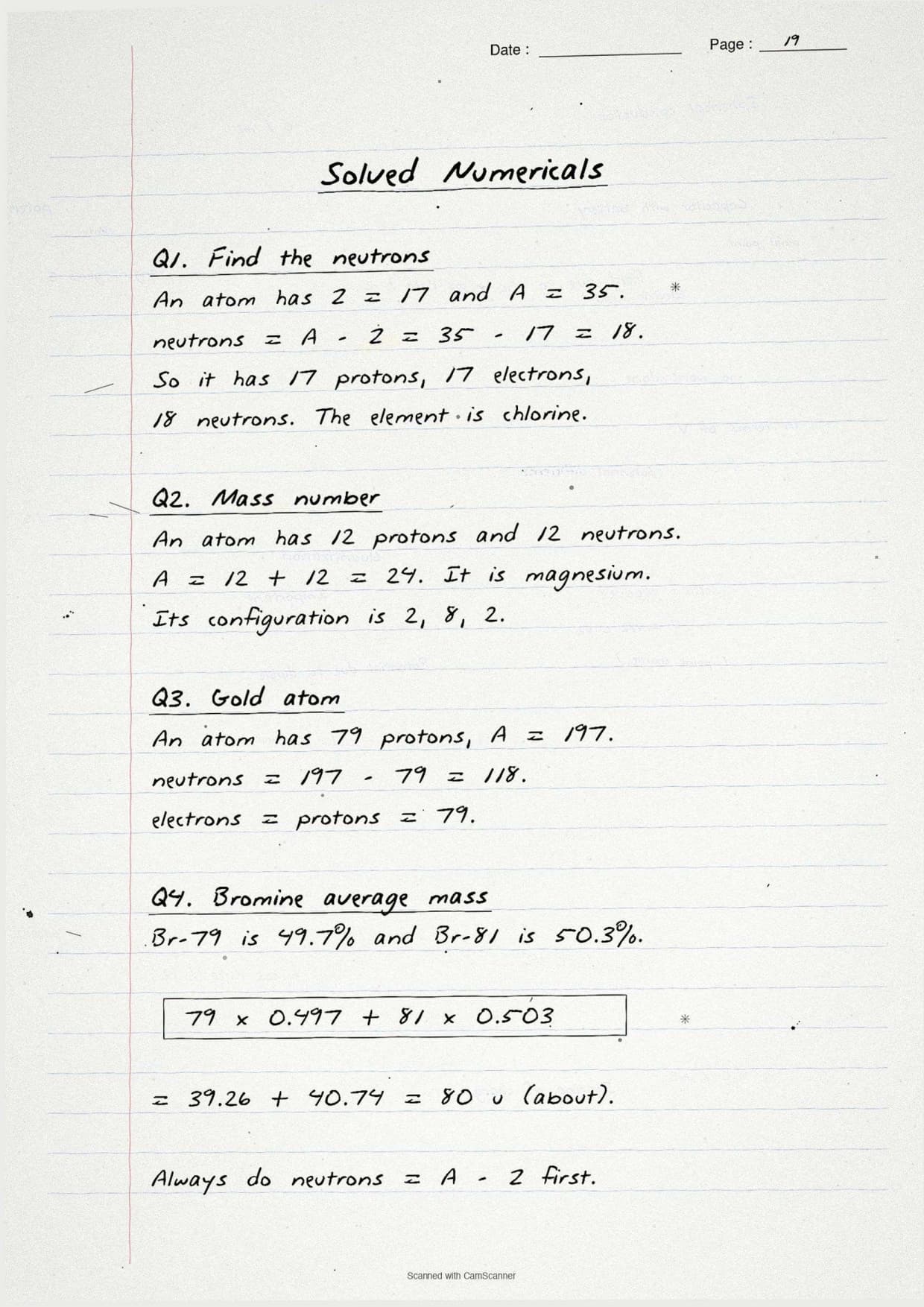
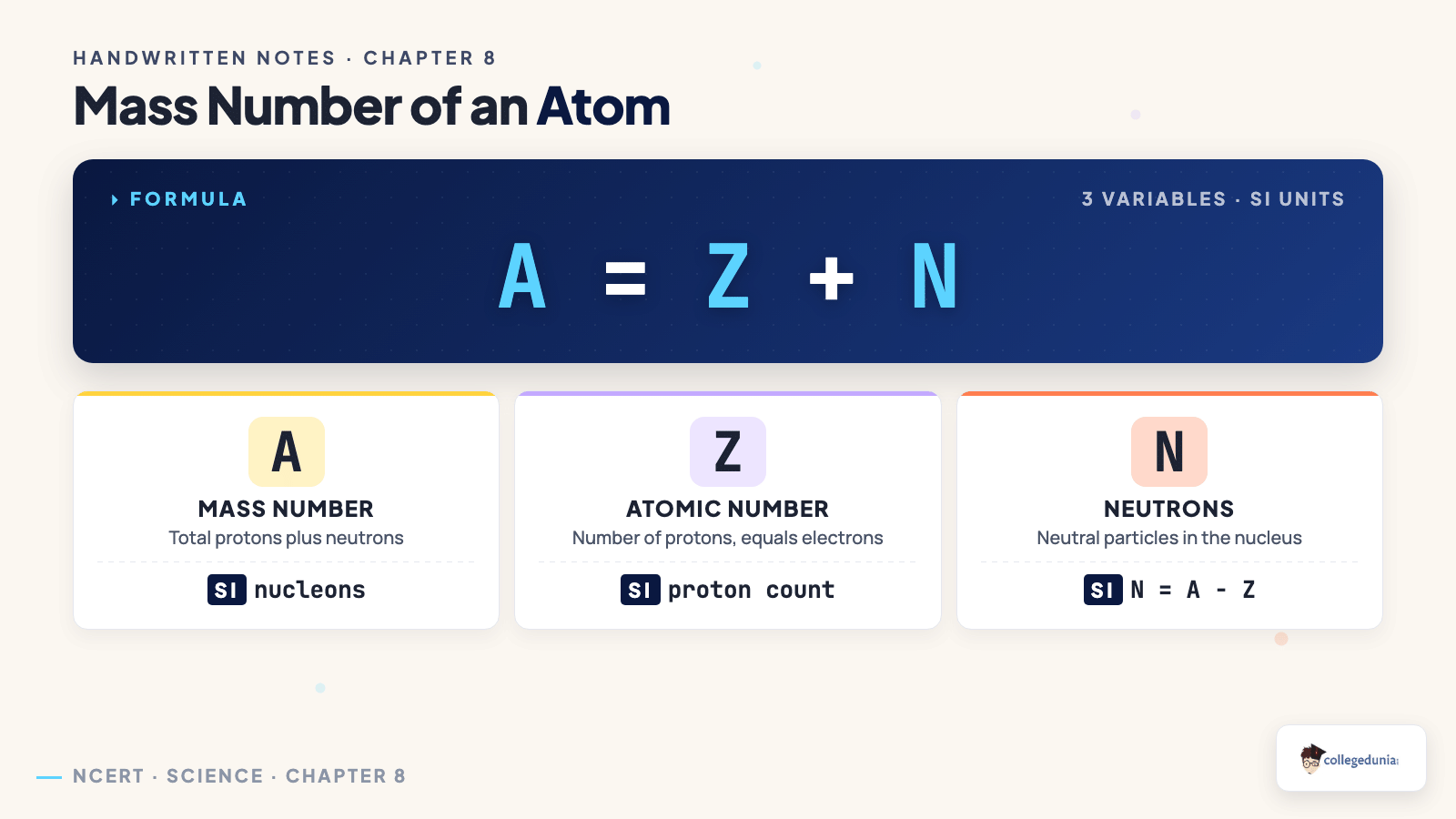
Two simple numbers describe any atom completely, so the notes box both. The atomic number Z is the number of protons, and it decides which element the atom is. The mass number A is the total of protons and neutrons, which together are called nucleons.
| Element | Protons (Z) | Neutrons | Mass number (A) |
|---|---|---|---|
| Hydrogen | 1 | 0 | 1 |
| Helium | 2 | 2 | 4 |
| Lithium | 3 | 4 | 7 |
- Atomic number: Z = protons = electrons in a neutral atom. It is the atom's identity card.
- Mass number: A = Z + N, where N is the number of neutrons.
- Symbol notation: the notes write the atom with mass number on top and atomic number below, on the left of the symbol, so carbon is 126C.
Electronic Configuration and the 2n² Rule Drawn by Hand
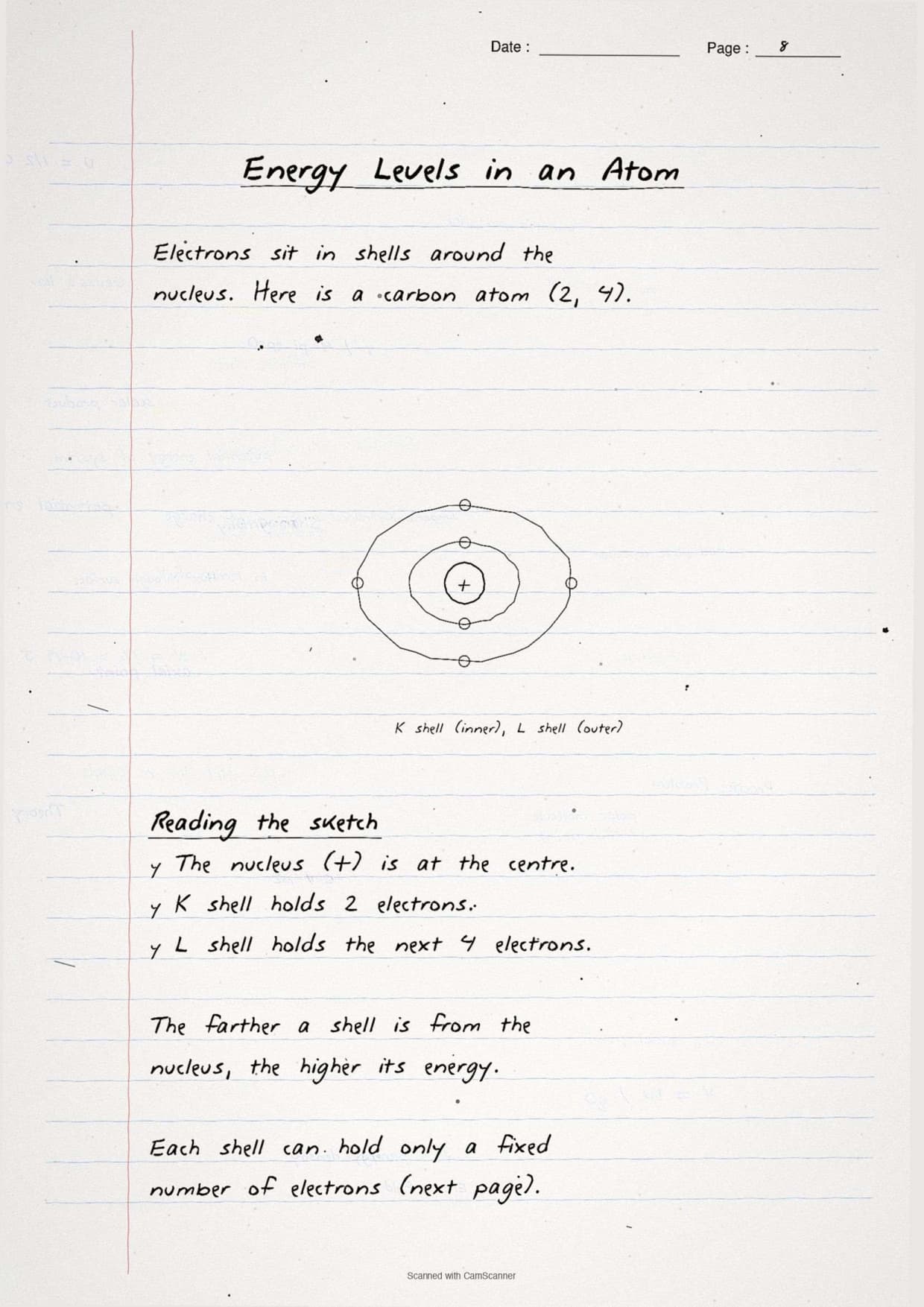
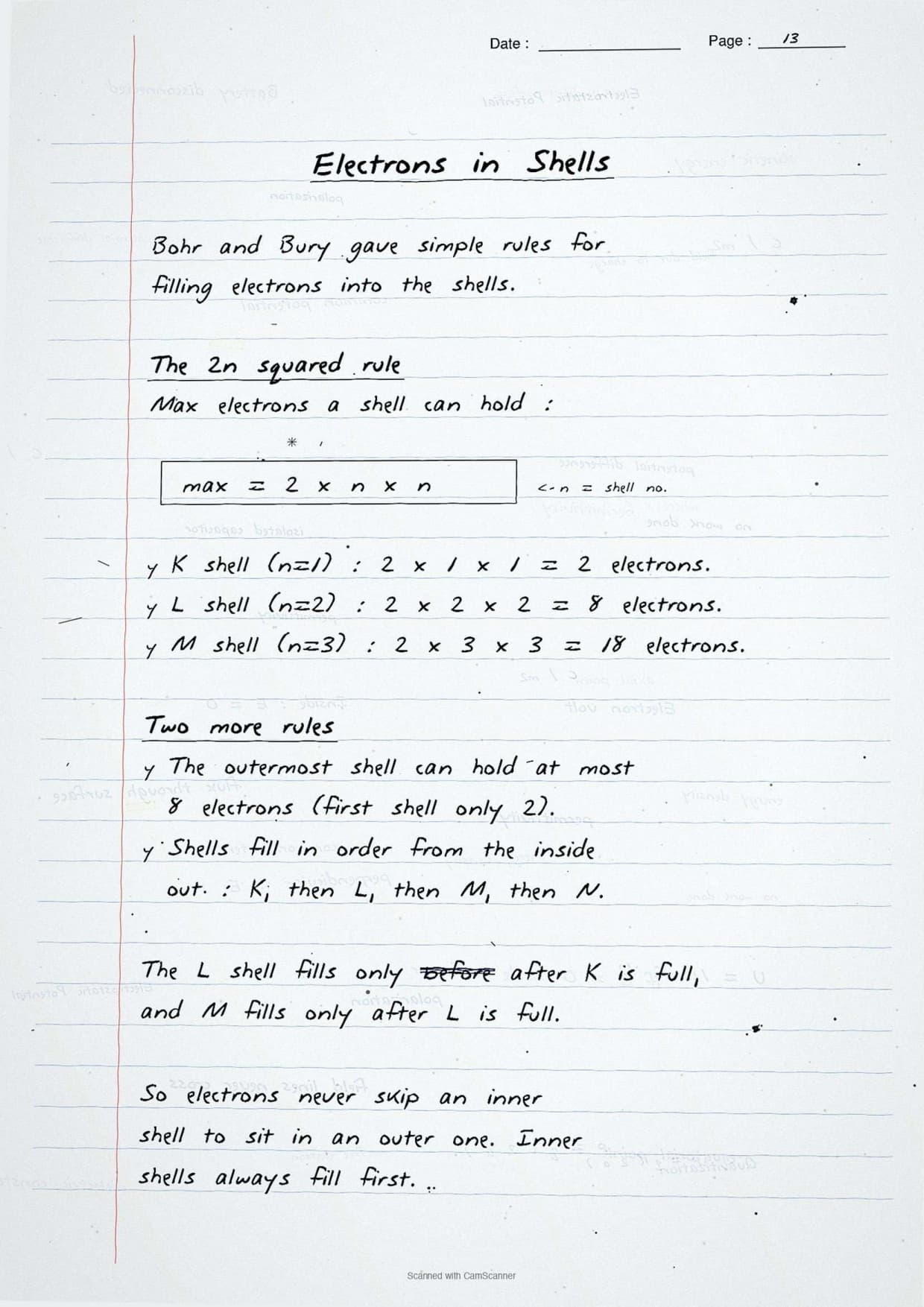
Electrons are not thrown into shells at random. The notes box the Bohr-Bury rules so you can draw any shell diagram from memory. The shells are named K, L, M, N from the nucleus outward, or numbered n = 1, 2, 3, 4.
- Maximum electrons in a shell: 2n2. So K holds 2, L holds 8, and M holds 18.
- Outer-shell limit: the outermost shell can hold at most 8 electrons.
- Filling order: fill from the inside out; a shell fills only after the one before it is complete.
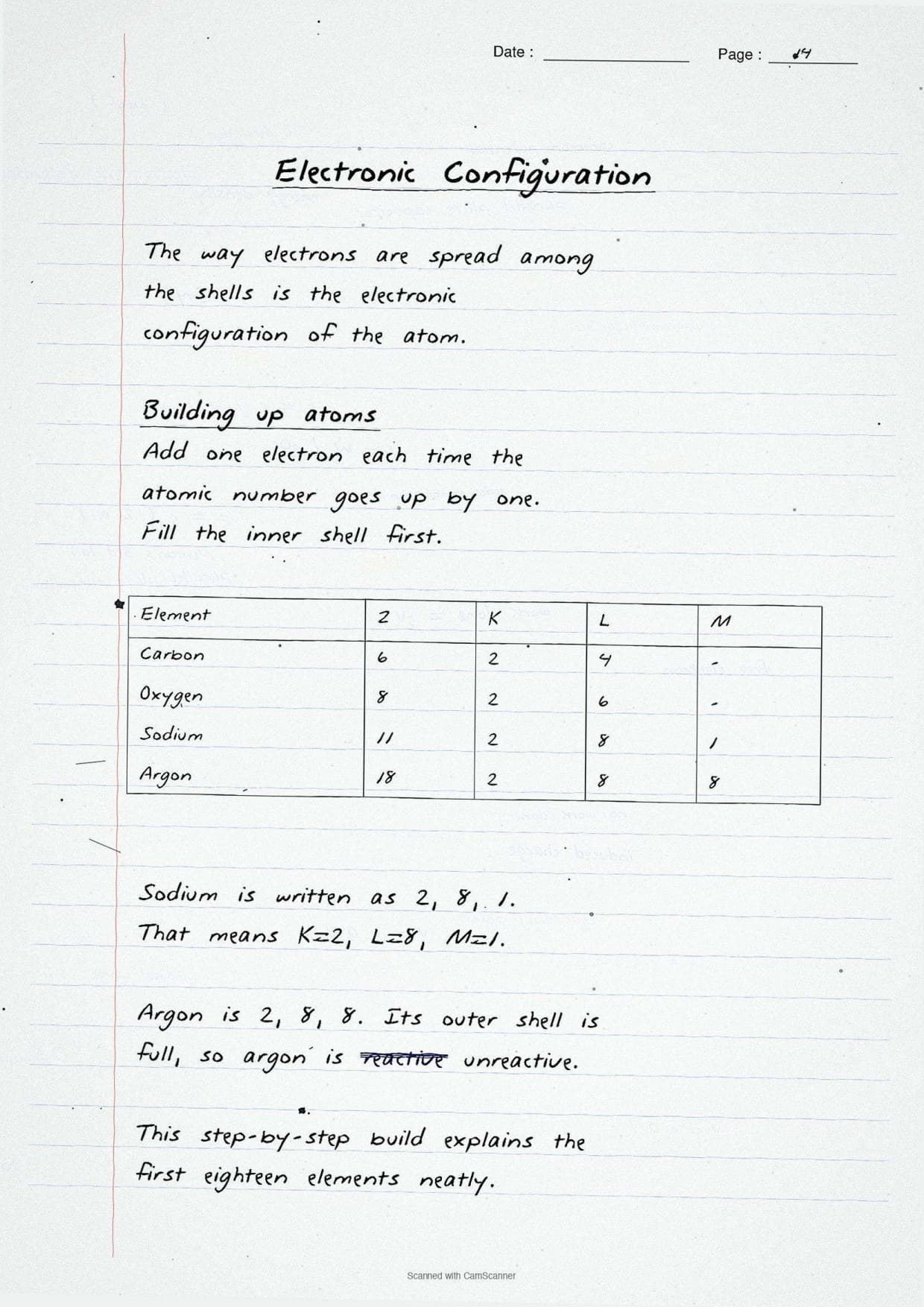
- Electronic configuration: the spread of electrons across shells. Sodium (11 electrons) is 2, 8, 1.
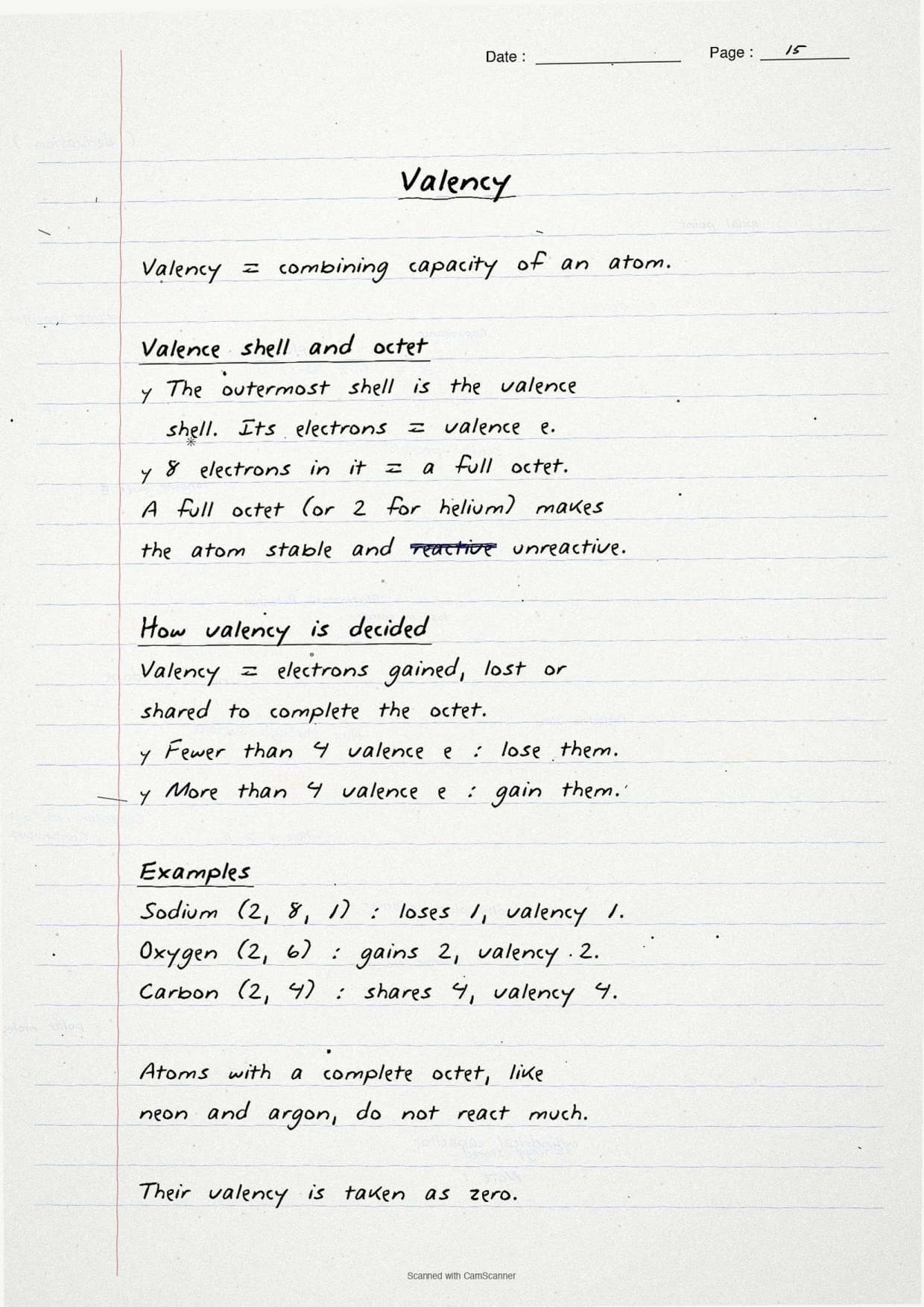
The outermost shell is the valence shell, and the electrons in it are the valence electrons. The number of electrons an atom loses, gains or shares to reach a full outer shell, an octet, is its valency. Sodium (2, 8, 1) loses 1 electron, so its valency is 1; oxygen (2, 6) gains 2, so its valency is 2.
Isotopes and Isobars: Hand-Drawn Comparison
Atoms of the same element are not always identical in mass, so the notes give isotopes and isobars a clear side-by-side box. This pair of terms is asked almost every year, and mixing them up is a common lost mark.
| Feature | Isotopes | Isobars |
|---|---|---|
| Atomic number (Z) | Same | Different |
| Mass number (A) | Different | Same |
| Element | Same element | Different elements |
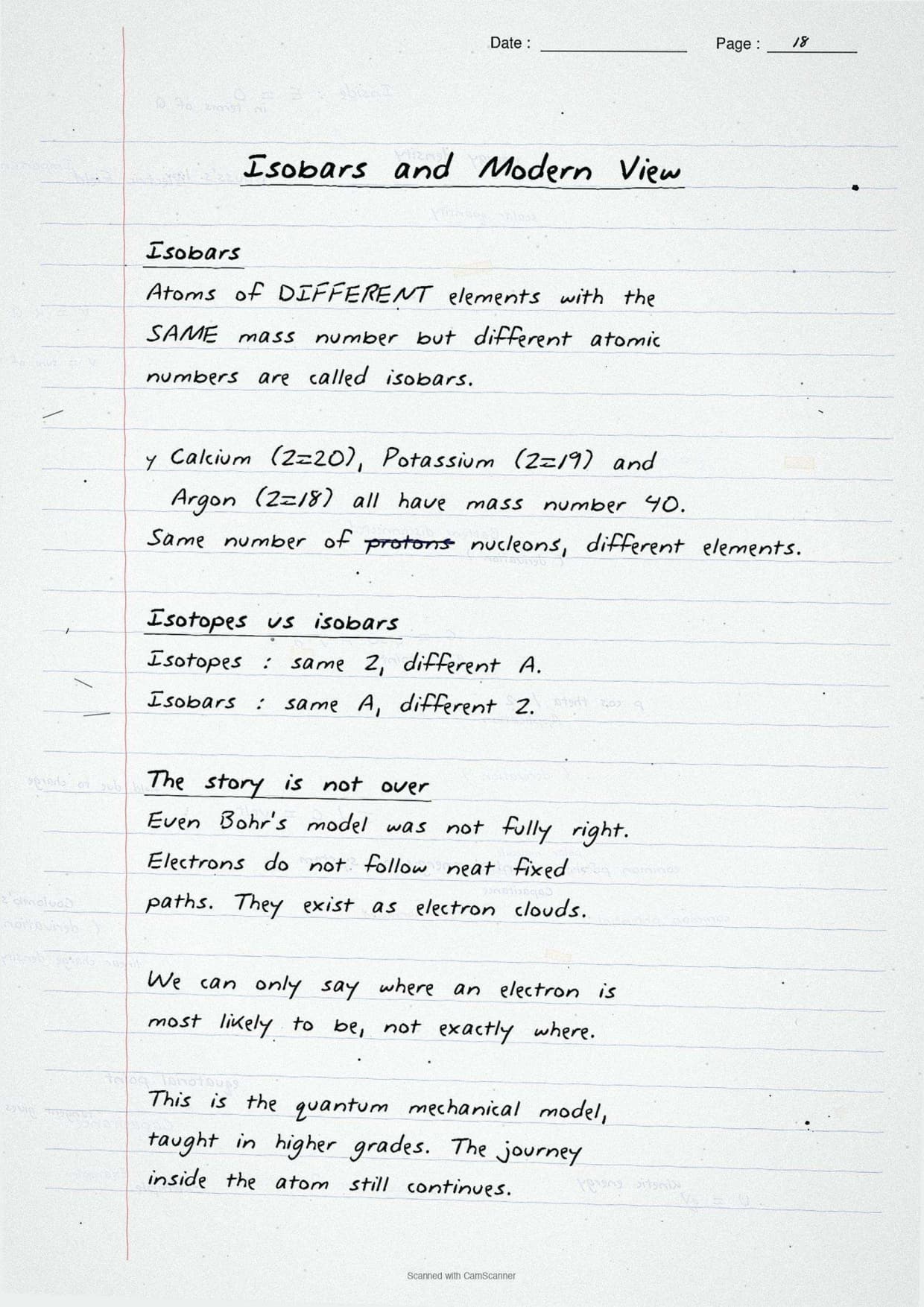
| Example | Protium, Deuterium, Tritium of hydrogen | Argon-40, Potassium-40, Calcium-40 |
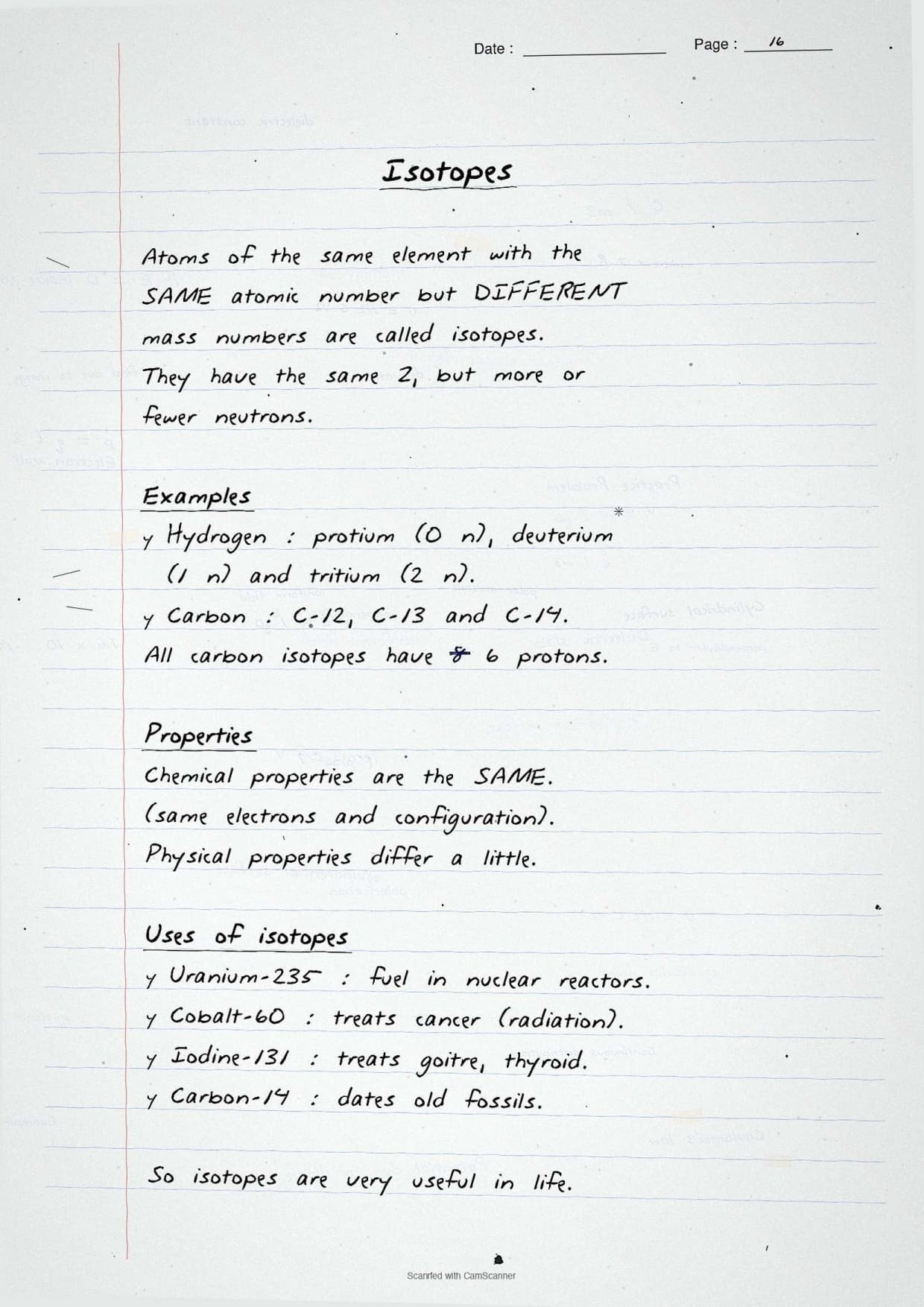
- Isotopes share the atomic number, so they have the same electrons and the same chemical properties. They differ only in physical properties like boiling point.
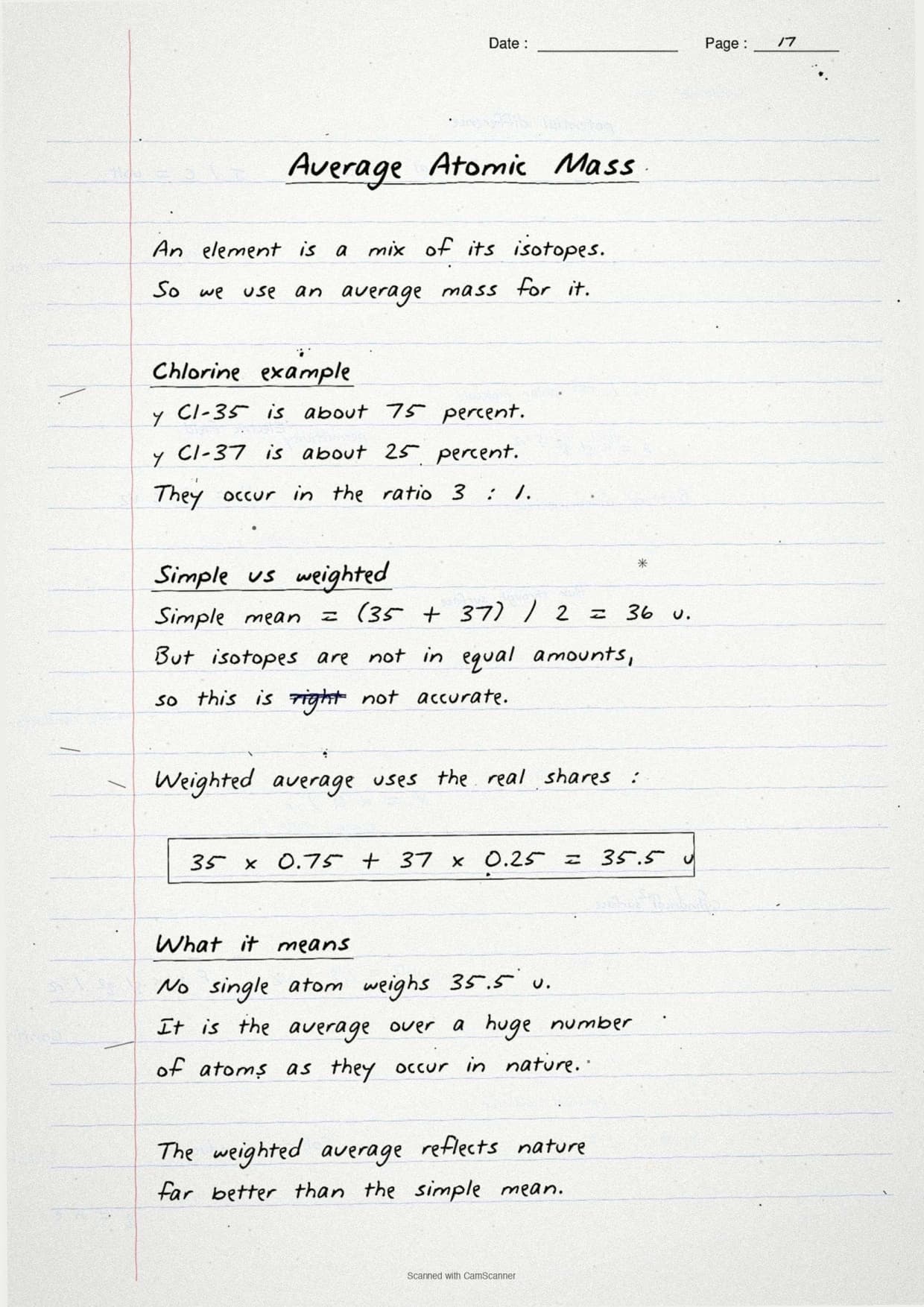
- Average atomic mass: most elements are a mix of isotopes. Chlorine is 35Cl (75%) and 37Cl (25%), so its average is (35 × 0.75) + (37 × 0.25) = 35.5 u.
- Isotopes at work: uranium-235 fuels reactors, cobalt-60 treats cancer, and carbon-14 dates old fossils.
The margin trick pins the pair down: match iso-tope with same pro-tons, and iso-bar with the same mass.
Common Mistakes Flagged in Red
Most lost marks in this chapter come from small slips, not hard ideas. The handwritten notes circle these in red so you fix them while you revise.
- Counting electrons in the mass number. Electrons are almost weightless, so they are left out of A.
- Calling isotopes and isobars the same thing. Isotopes are the same element; isobars are different elements.
- Thinking a chlorine atom weighs 35.5 u. That value is an average; any one atom is 35 u or 37 u.
- Making sodium gain 7 electrons instead of losing 1. Always pick the shorter route to a full octet.
Last-Minute Revision with These Handwritten Notes
The night before your exam, the Journey Inside the Atom Class 9 Science Handwritten Notes work as a quick skim. Every boxed rule and red heading is a checkpoint, so you can cover the whole chapter in well under an hour. They match the new Exploration book and the Revise, Reflect, Refine flow, so nothing extra creeps in.
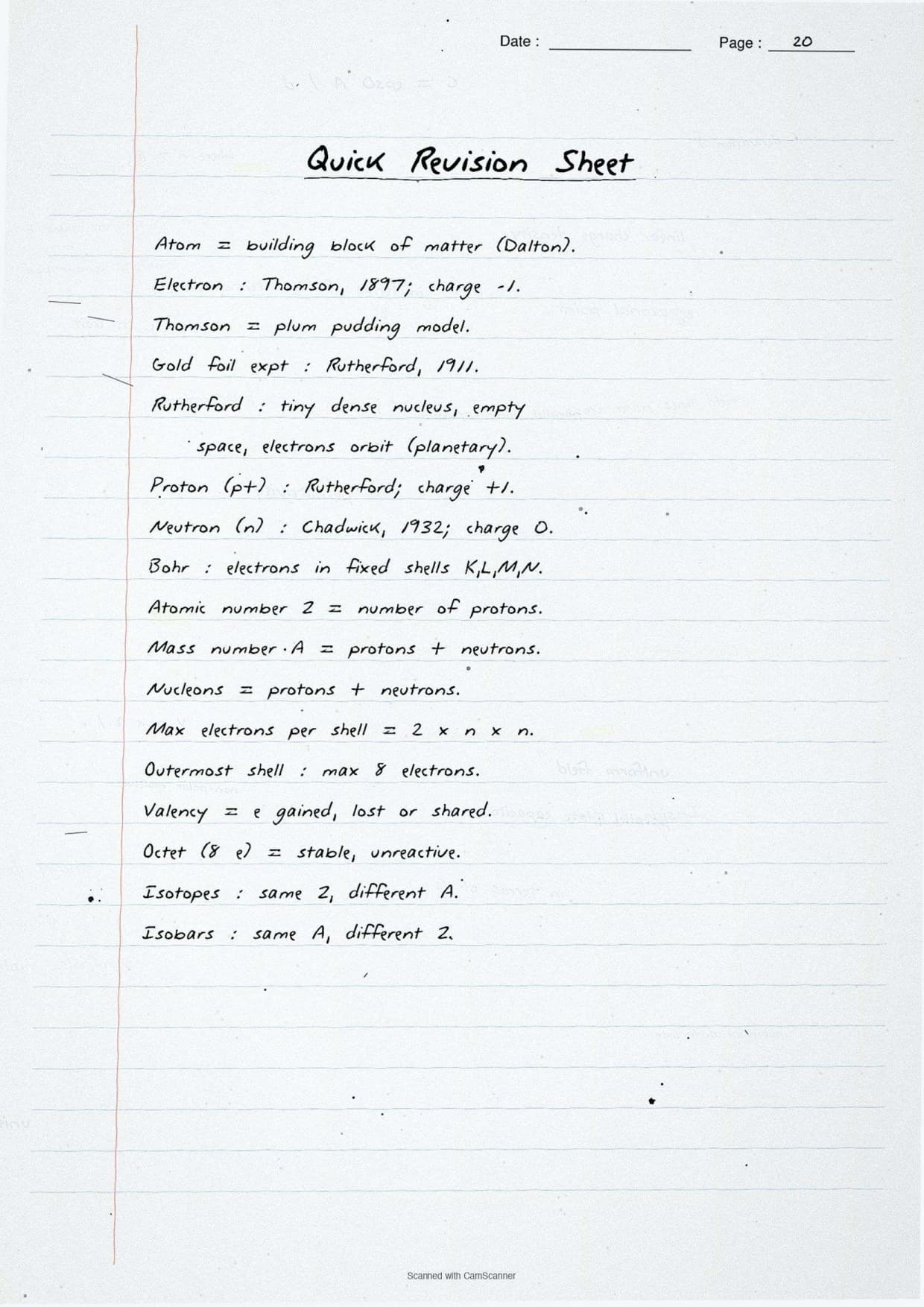
- Name the three subatomic particles with their charge and place.
- Say the atomic models in order and one point about each.
- State the two main observations of the gold foil experiment.
- Write A = Z + N and the 2n2 rule from their boxes.
- Give the isotopes-versus-isobars difference with one example each.
Collegedunia brings you these notes as a free PDF you can open on any phone. It saves you the time of making your own notes, and the boxes and colour cues let you revise fast for the annual exam, and later for the CBSE, JEE and NEET basics of atomic structure.
More Journey Inside the Atom Class 9 Science Resources
Use the table below to open the other resources for this chapter of the new Class 9 Science Exploration book.
| Resource | Open |
|---|---|
| Handwritten Notes | Journey Inside the Atom Class 9 Science Handwritten Notes |
| NCERT Solutions | Journey Inside the Atom Class 9 Science NCERT Solutions |
| Revision Notes | Journey Inside the Atom Class 9 Science Notes |
| Formula Sheet | Journey Inside the Atom Class 9 Science Formula Sheet |
| NCERT Book PDF | Journey Inside the Atom Class 9 Science NCERT Book PDF |
NCERT Handwritten Notes for Class 9 Science: All Chapters
Use the table below to open the handwritten notes for any other chapter of the new Class 9 Science Exploration book.
| Chapter | Handwritten Notes |
|---|---|
| Chapter 2 | Cell The Building Block of Life |
| Chapter 3 | Tissues in Action |
| Chapter 4 | Describing Motion Around Us |
| Chapter 5 | Exploring Mixtures and their Separation |
| Chapter 6 | How Forces Affect Motion |
| Chapter 7 | Work, Energy, and Simple Machines |
| Chapter 8 | Journey Inside the Atom |
| Chapter 9 | Atomic Foundations of Matter |
| Chapter 10 | Sound Waves Characteristics and Applications |
| Chapter 11 | Reproduction How Life Continues |
| Chapter 12 | Patterns in Life Diversity and Classification |
| Chapter 13 | Earth as a System Energy, Matter, and Life |
Journey Inside the Atom Class 9 Science Handwritten Notes FAQs
Ques. How many pages are the Journey Inside the Atom Class 9 Science handwritten notes?
Ans. The handwritten notes run to 22 pages. They cover the full chapter, from the electron, proton and neutron to the atomic models, atomic number, mass number, electronic configuration, valency, isotopes and isobars, with a solved example after each idea.
Ques. Are these real handwritten notes?
Ans. Yes. They are a topper's own clear handwritten revision notes, with each rule boxed, shell diagrams drawn by hand, and sub-headings colour-coded in red.
Ques. What is the main formula in the Chapter 8 notes?
Ans. The key relation is the mass number, A = Z + N, where Z is the atomic number (protons) and N is the number of neutrons. The notes also box the 2n2 rule for the maximum electrons in a shell.
Ques. What is the difference between isotopes and isobars?
Ans. Isotopes have the same atomic number but different mass numbers, so they are the same element, such as protium, deuterium and tritium. Isobars have the same mass number but different atomic numbers, so they are different elements, such as argon-40, potassium-40 and calcium-40.
Ques. Is Journey Inside the Atom part of the new Class 9 Science book?
Ans. Yes. Journey Inside the Atom is Chapter 8 of the new Exploration textbook for the 2026-27 syllabus. It is a core base chapter for later work on atomic structure and chemical bonding.



Comments