




The NCERT notes for Class 9 Science Chapter 8 Journey Inside the Atom pull together every model, particle and number the exam actually tests. Journey Inside the Atom is a core chemistry chapter in the new 2026-27 Exploration book. These notes explain the electron, proton, neutron, the atomic models, electronic configuration, valency, isotopes and isobars in plain English, with tables you can revise in one sitting.
These class 9 science ncert notes chapter 8 Journey Inside the Atom are written by Collegedunia subject experts, checked against the 2026-27 NCERT Exploration textbook, and refined using recent CBSE exam trends.
- Full concept cover: Dalton to Bohr models, the gold foil experiment, atomic and mass number, electronic configuration, valency, isotopes and isobars in one place.
- Journey Inside the Atom is a steady source of 1, 2 and 3 mark questions in the Class 9 Science paper, so it is worth learning well.
- Free PDF download in Normal and HD, with labelled diagrams and quick revision tables.
What Journey Inside the Atom Class 9 Notes Cover
These notes show what an atom is made of and how scientists worked it out. You learn the three subatomic particles, follow the models of Thomson, Rutherford and Bohr, and learn to read any atom from its atomic number and mass number. The journey inside the atom class 9 chapter ends with electronic configuration, valency, isotopes and isobars.
- Subatomic particles: the electron, proton and neutron, with their charge, mass and place in the atom.
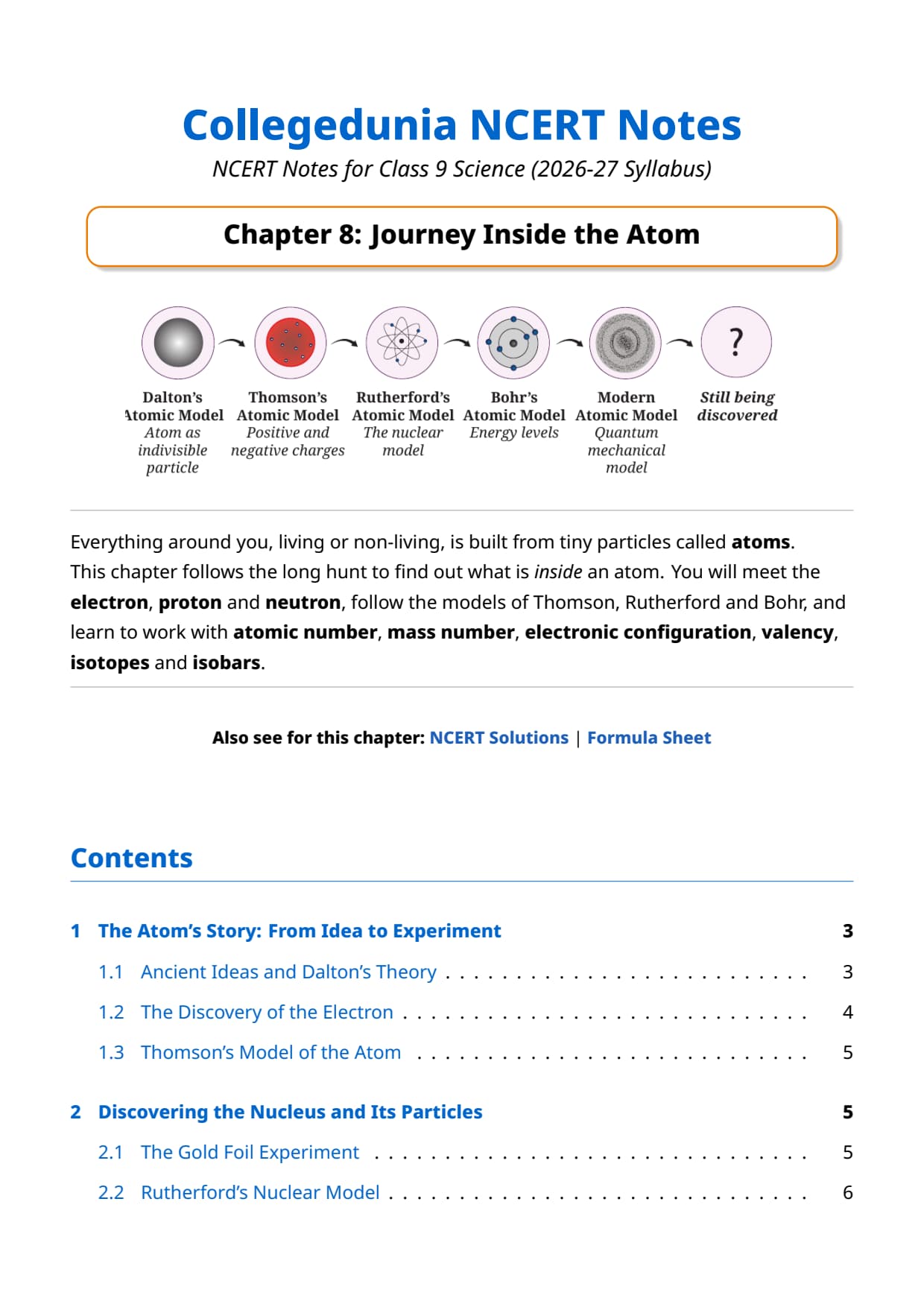
- Atomic models: how the picture of the atom grew from Dalton to Thomson to Rutherford to Bohr.
- Numbers of an atom: atomic number, mass number, nucleons and how to find neutrons.
- Bonding basics: electronic configuration by the 2n² rule, valency, and the isotopes versus isobars comparison.
Journey Inside the Atom Class 9 Full Chapter Explained
Source: Magnet Brains on YouTube
Atomic Models from Dalton to Thomson for Class 9 Science
The word atom is over two thousand years old, but the picture of the atom is much newer. Ancient thinkers only imagined it; real experiments came much later.
- Acharya Kanada in ancient India said the smallest indivisible particle of matter was a parmanu.
- Democritus in ancient Greece called it atomos, which means indivisible.
- John Dalton (1808) gave the first scientific atomic theory: all matter is made of tiny indivisible atoms.
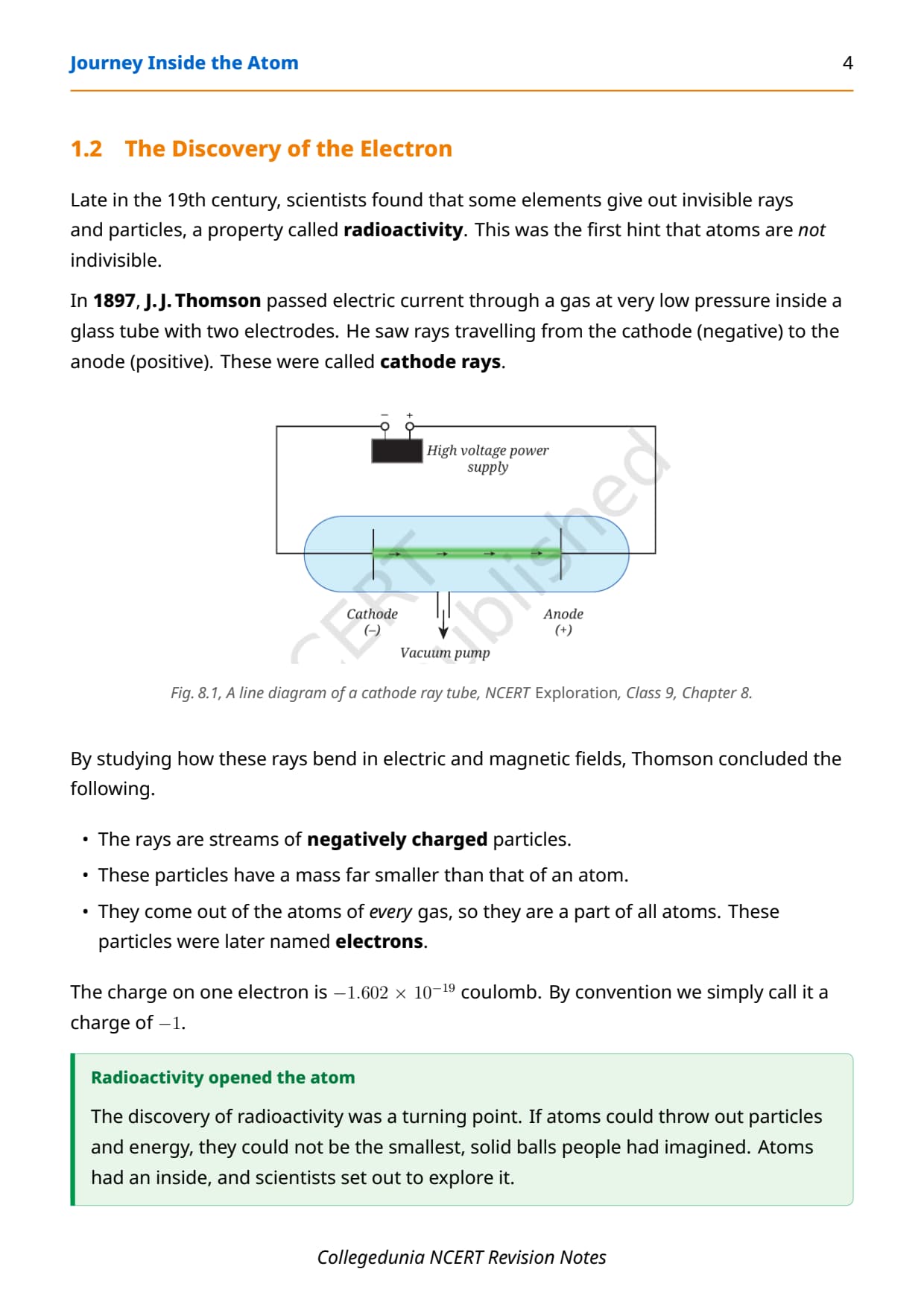
- J. J. Thomson (1897) passed current through a gas at low pressure and found cathode rays, streams of negative particles later named electrons.
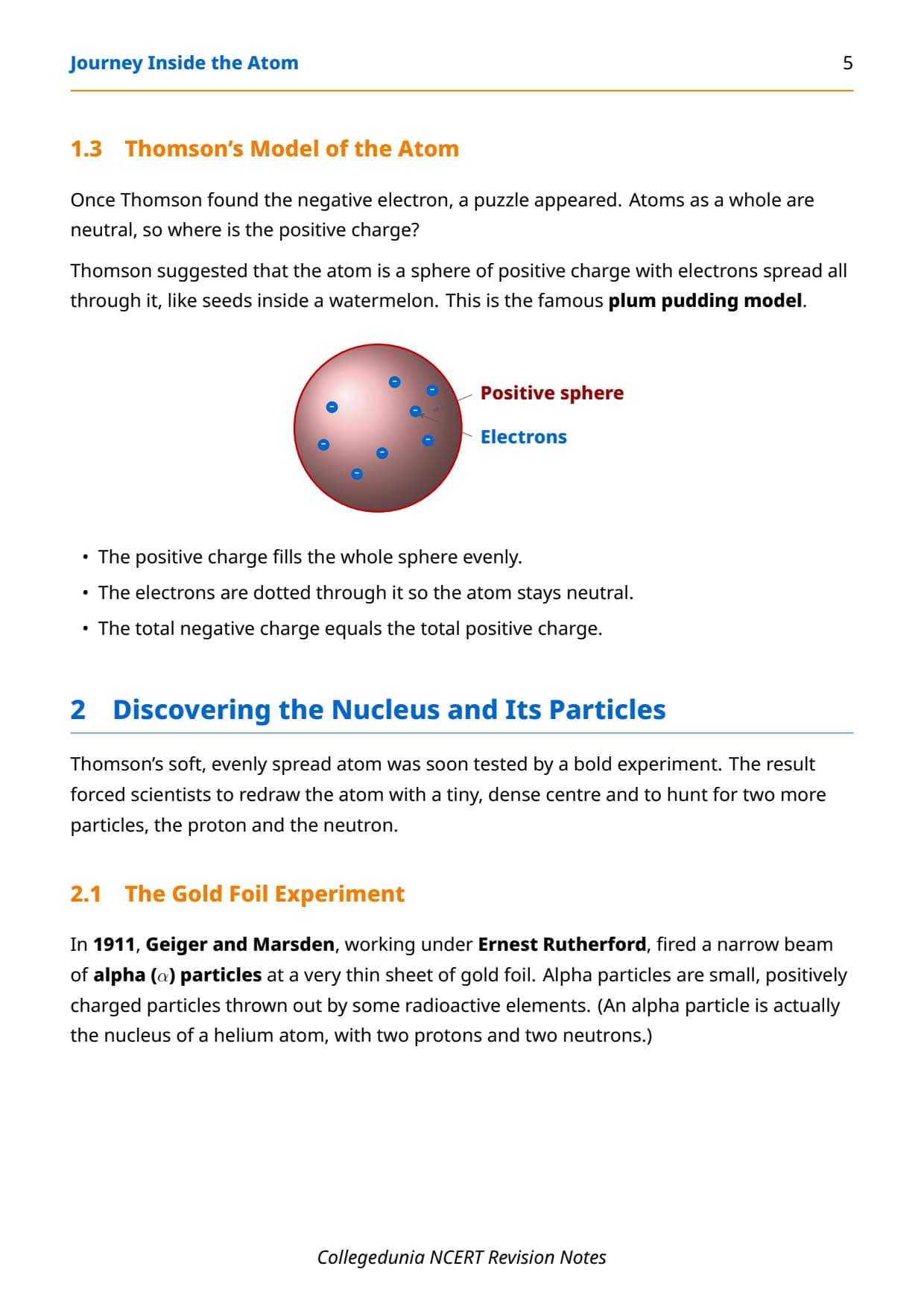
Since atoms are neutral overall, Thomson had to place the positive charge somewhere. He suggested the plum pudding model: a sphere of positive charge with electrons dotted through it, like seeds in a watermelon. The charge on one electron is about −1.6 × 10⁻¹⁹ coulomb, which we simply call a charge of −1.
Tip: radioactivity, discovered late in the 19th century, was the first proof that atoms are not indivisible. Atoms had an inside, and scientists set out to explore it.
Gold Foil Experiment and Rutherford's Nuclear Model in Class 9 Science Chapter 8
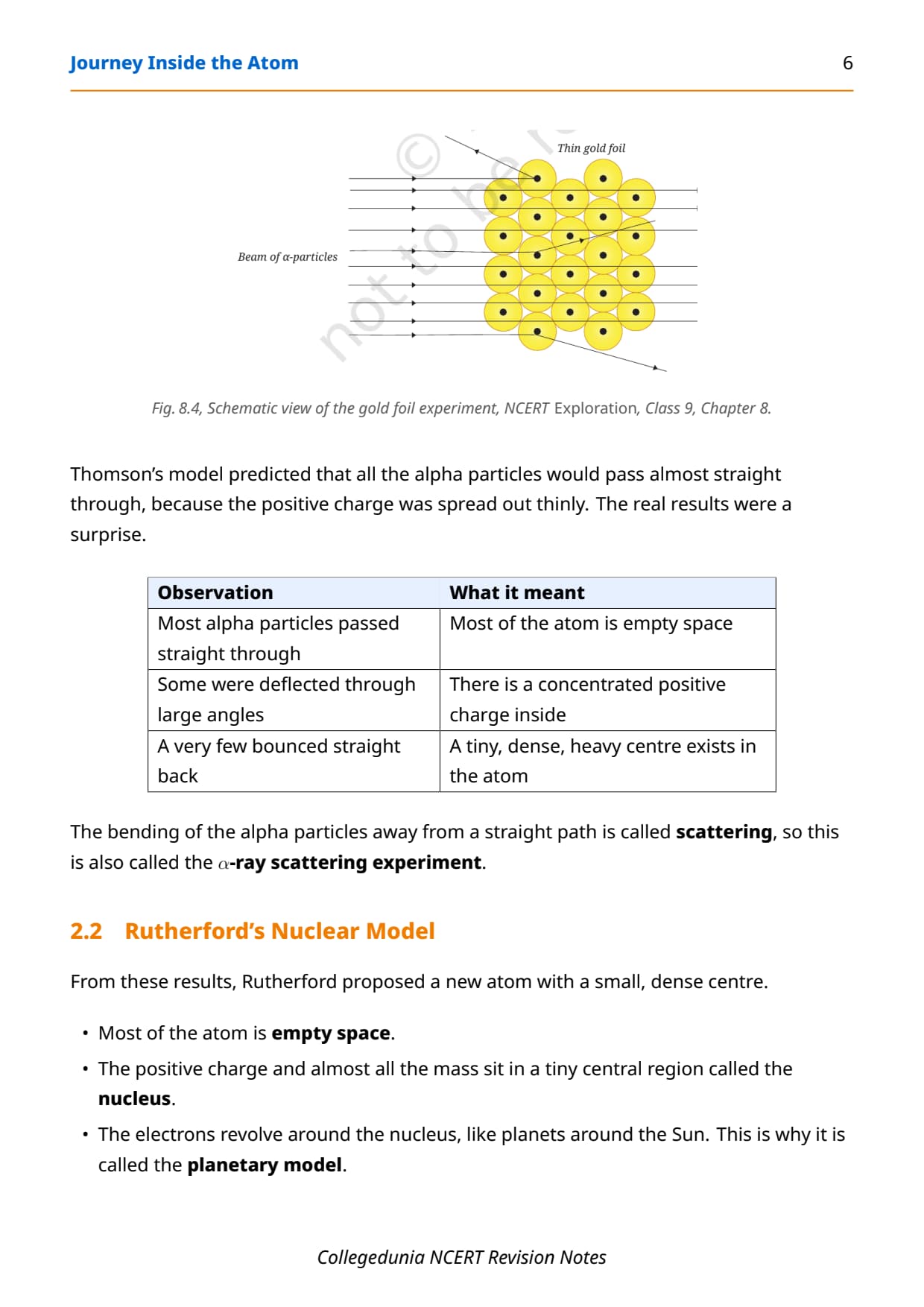
In 1911, Geiger and Marsden, working under Ernest Rutherford, fired a beam of positively charged alpha particles at a very thin gold foil. Thomson's soft atom predicted the particles would pass almost straight through. The real result was a surprise.

| Observation | What it meant |
|---|---|
| Most alpha particles passed straight through | Most of the atom is empty space |
| Some were deflected through large angles | There is a concentrated positive charge inside |
| A very few bounced straight back | A tiny, dense, heavy centre (the nucleus) exists |
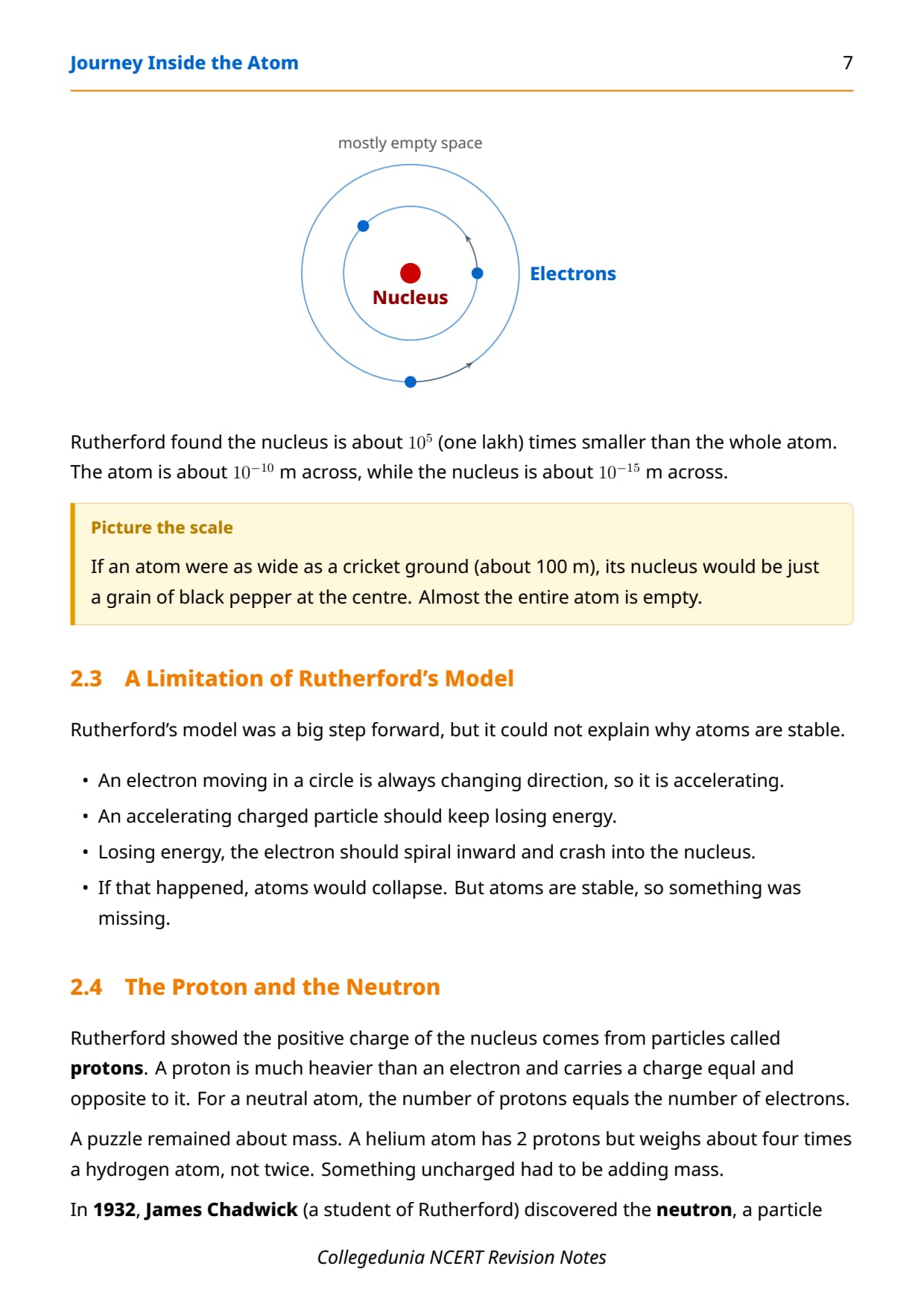
From this, Rutherford proposed the nuclear model: almost all the mass and the positive charge sit in a tiny central nucleus, and electrons revolve around it like planets around the Sun. The nucleus is about one lakh times smaller than the atom.
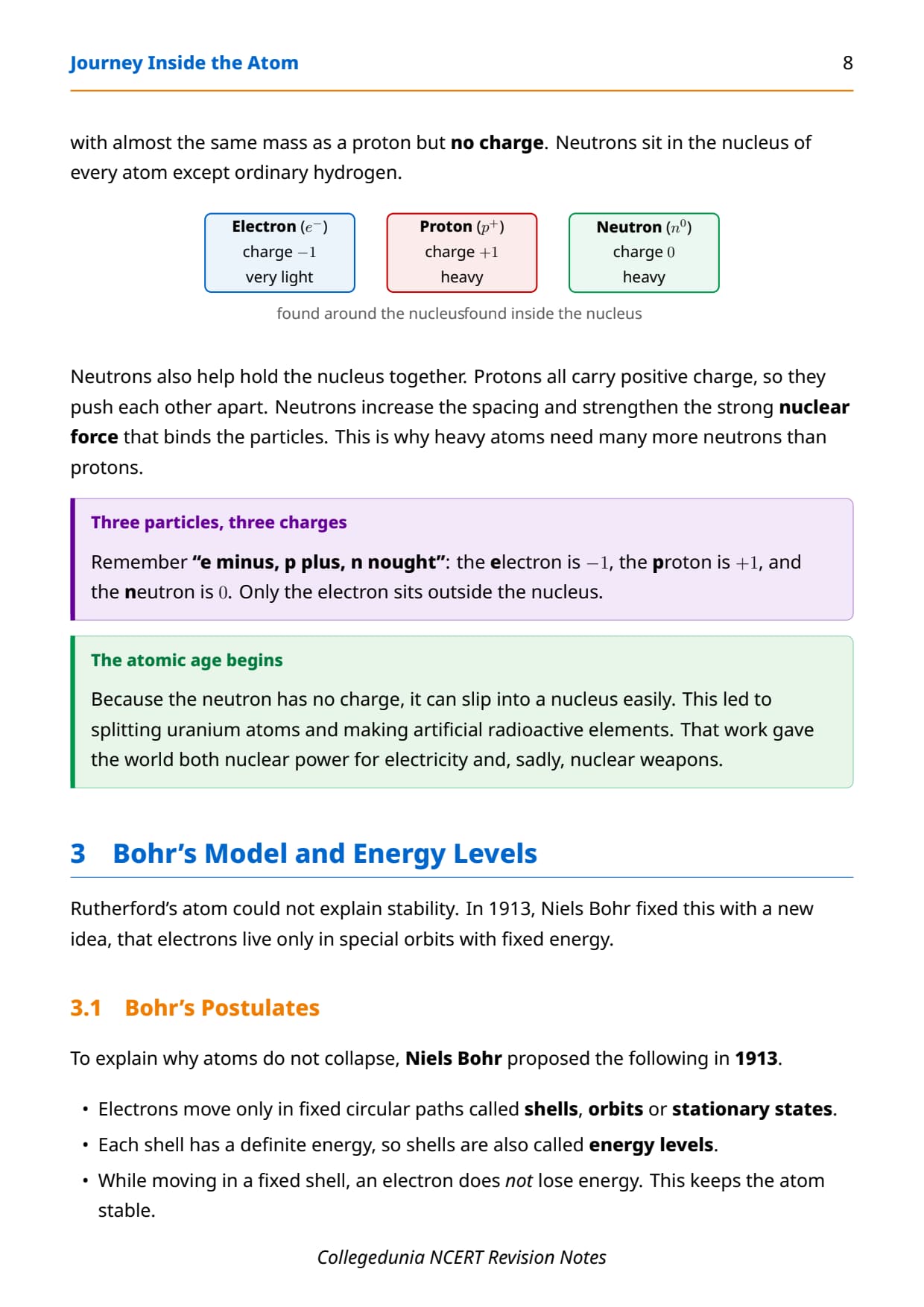
- Proton: Rutherford showed the nucleus holds positive particles called protons, each with charge +1.
- Neutron: in 1932, James Chadwick found the neutron, a particle with no charge and almost the same mass as a proton.
- Limitation: a revolving electron should lose energy and spiral into the nucleus, so Rutherford's atom could not explain why atoms are stable.
Bohr's Model and Energy Levels for Class 9 Science
In 1913, Niels Bohr fixed the stability problem. He said electrons move only in fixed circular paths of definite energy, so they do not lose energy while orbiting.
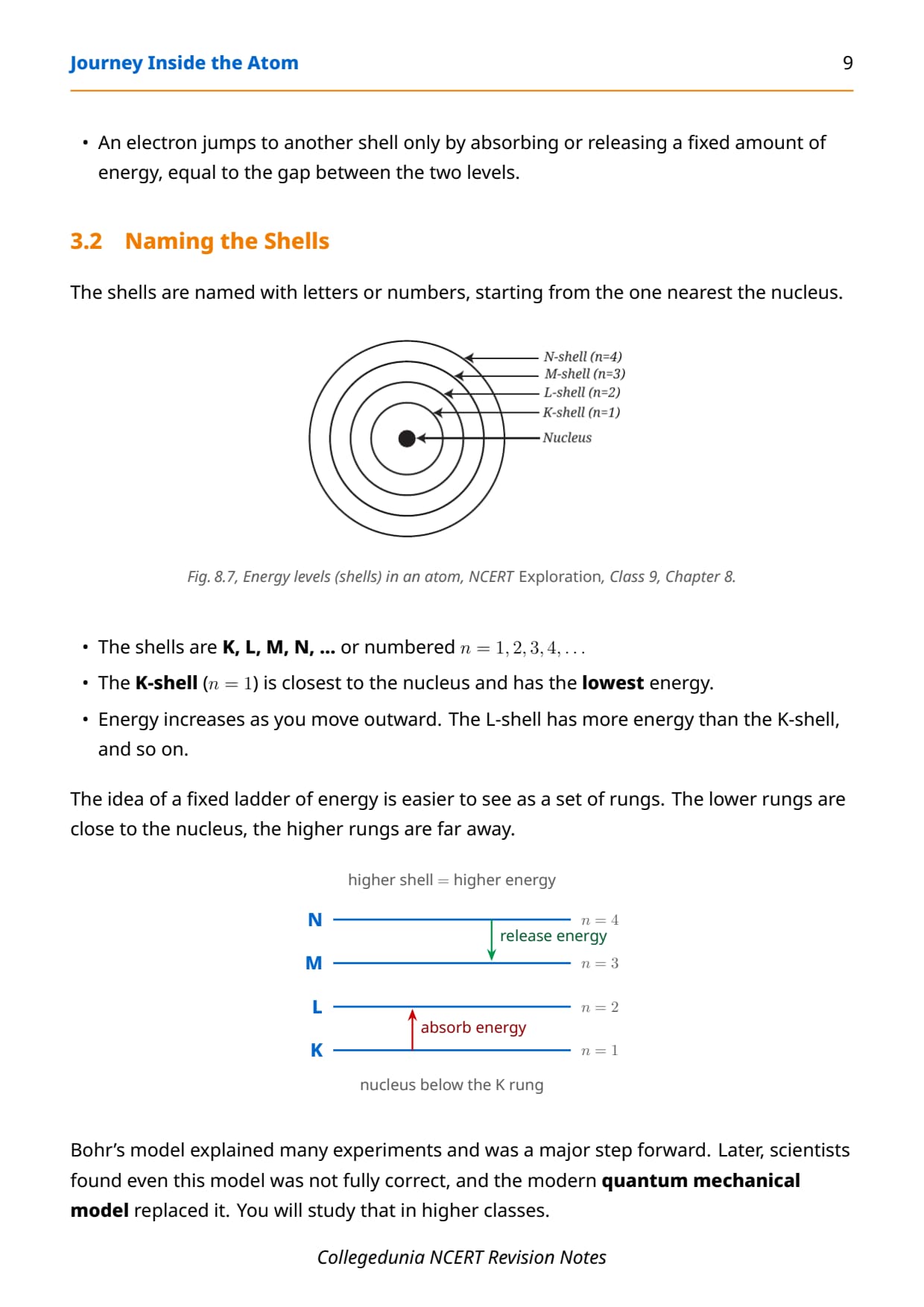
- Electrons move only in fixed paths called shells, orbits or energy levels.
- The shells are named K, L, M, N or numbered n = 1, 2, 3, 4, starting from the one nearest the nucleus.
- The K-shell (n = 1) is closest and has the lowest energy; energy rises as you move outward.
- An electron jumps between shells only by absorbing or releasing a fixed amount of energy equal to the gap between them.
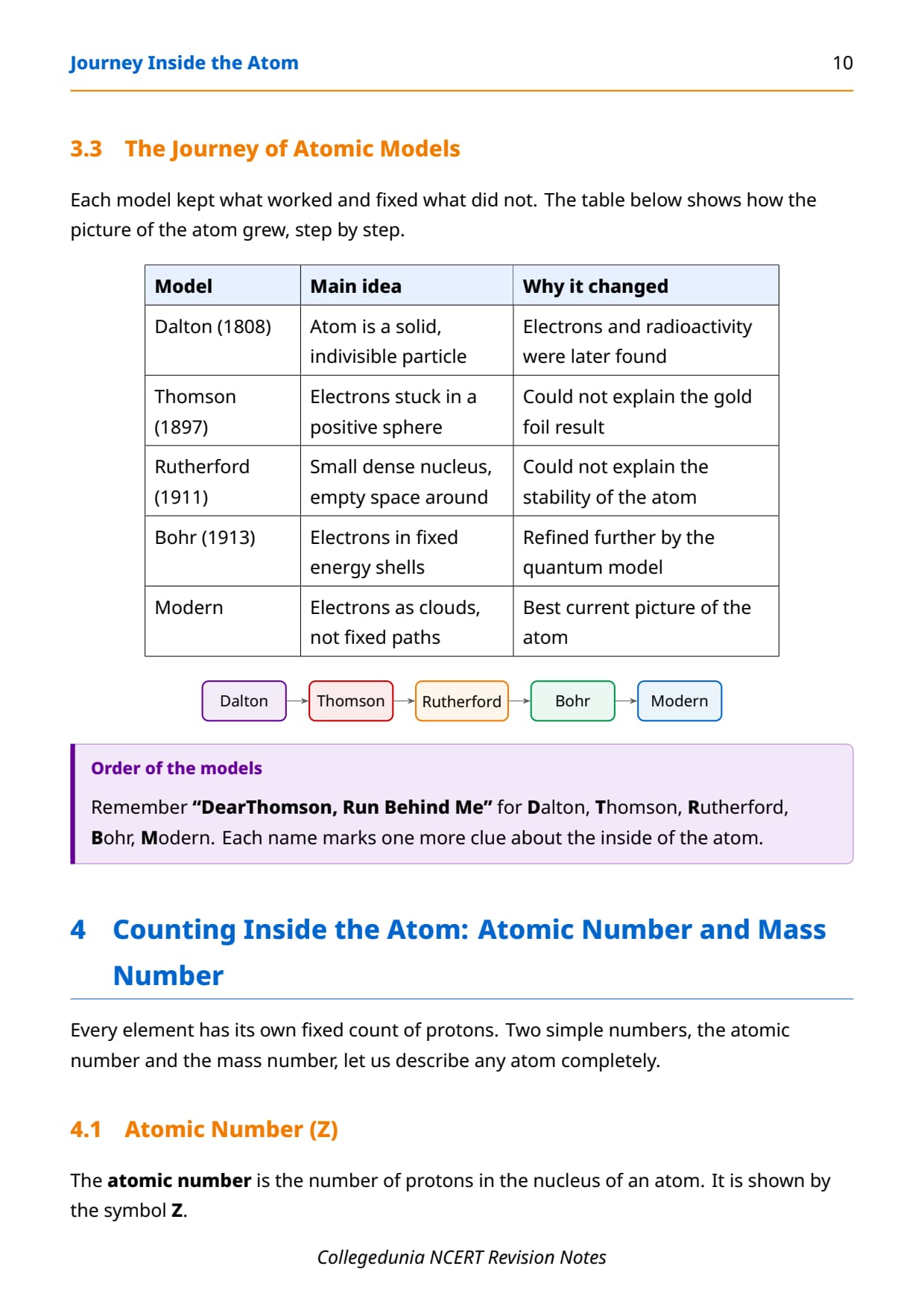
| Model | Main idea | Why it changed |
|---|---|---|
| Dalton (1808) | Atom is a solid, indivisible particle | Electrons and radioactivity were later found |
| Thomson (1897) | Electrons stuck in a positive sphere | Could not explain the gold foil result |
| Rutherford (1911) | Small dense nucleus, empty space around | Could not explain the stability of the atom |
| Bohr (1913) | Electrons in fixed energy shells | Refined further by the modern quantum model |
Tip: recall the order with Dalton, Thomson, Rutherford, Bohr, Modern. Each name marks one more clue about the inside of the atom.
Atomic Number and Mass Number in Journey Inside the Atom Class 9
Two simple numbers describe any atom completely. The atomic number (Z) is the number of protons in the nucleus, and it decides the identity of the element. Since an atom is neutral, protons equal electrons, so Z also equals the number of electrons.
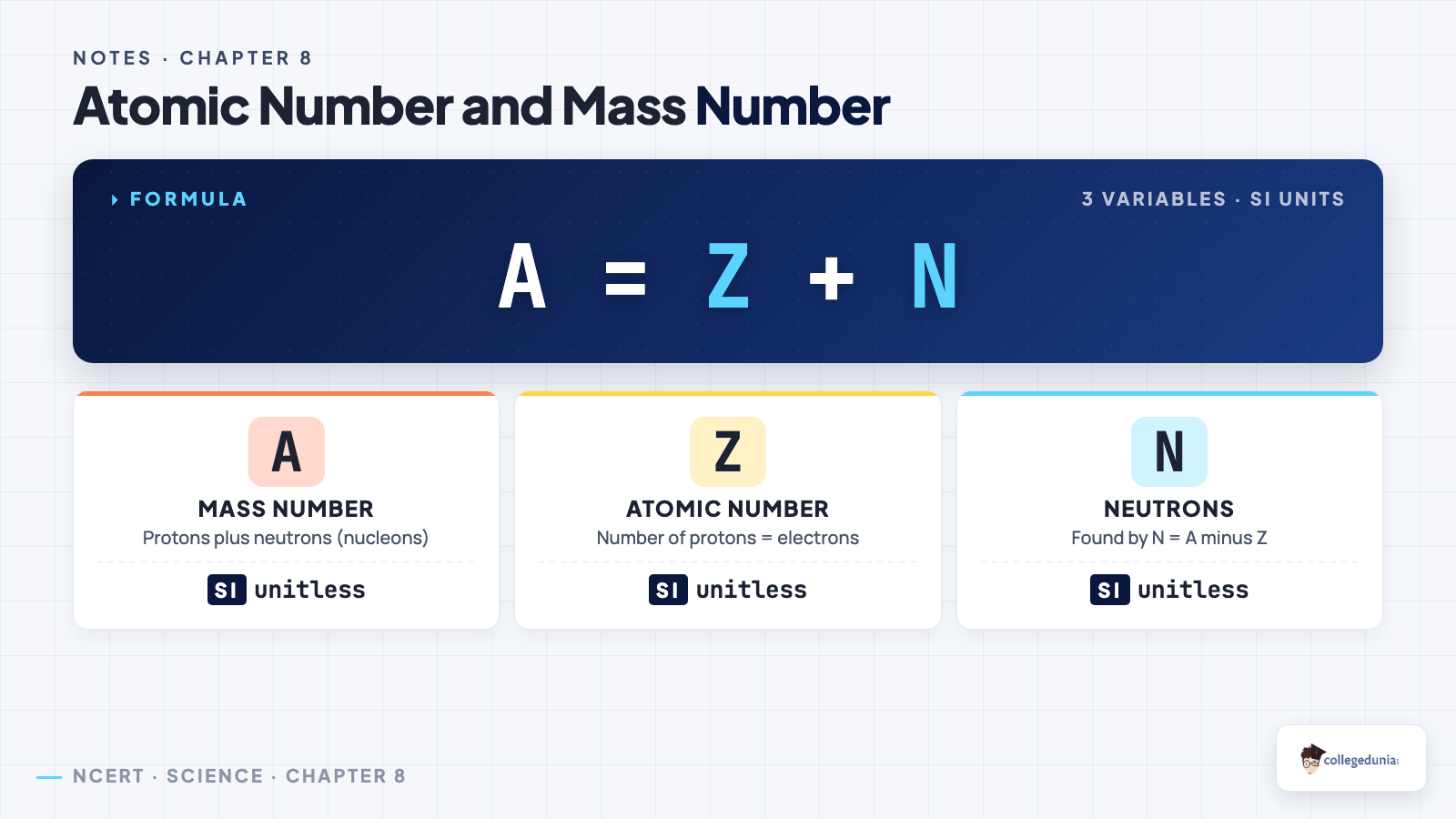
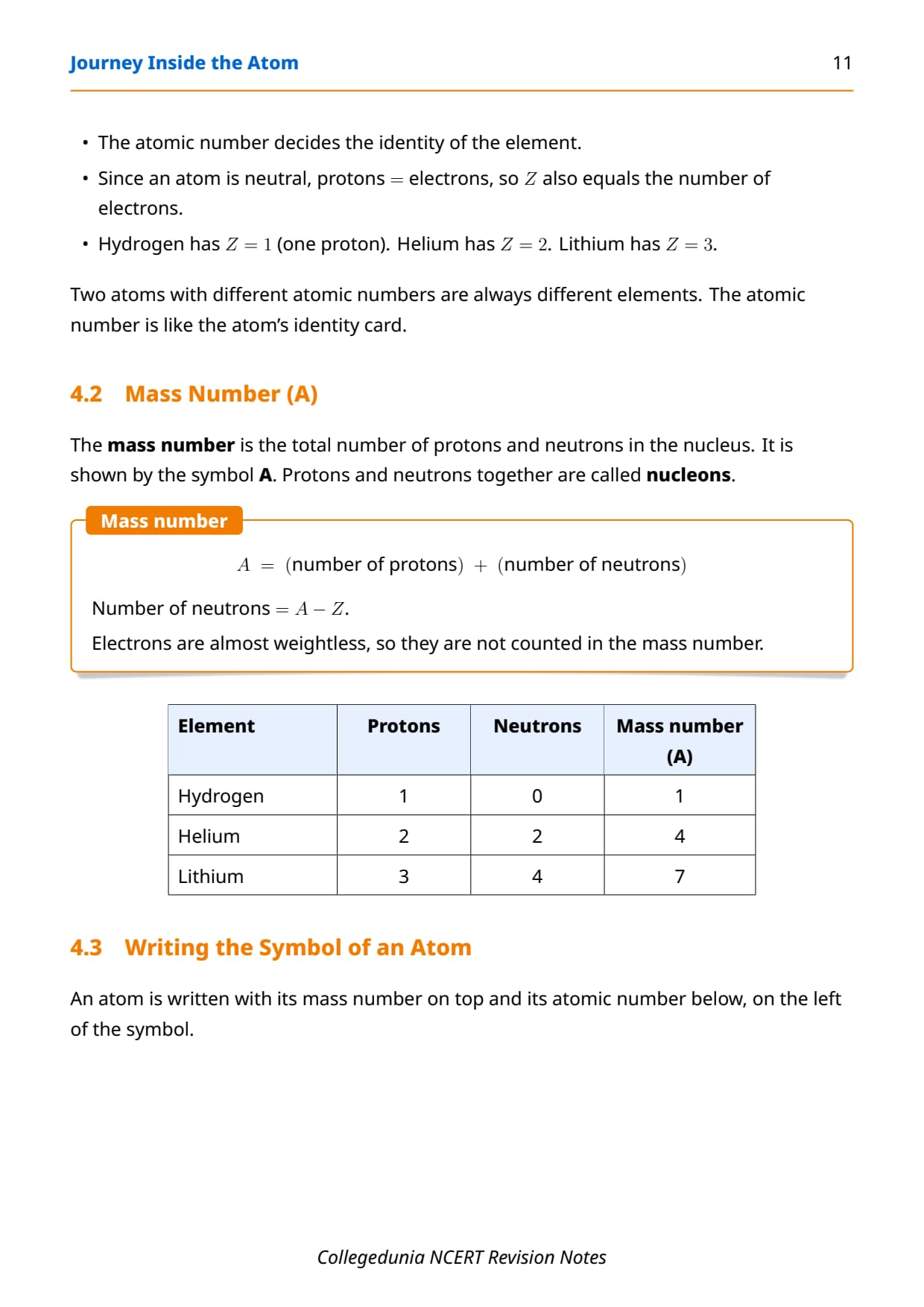
The mass number (A) is the total number of protons and neutrons, which together are called nucleons. Electrons are almost weightless, so they are left out of the mass number.
| Element | Protons | Neutrons | Mass number (A) |
|---|---|---|---|
| Hydrogen | 1 | 0 | 1 |
| Helium | 2 | 2 | 4 |
| Lithium | 3 | 4 | 7 |
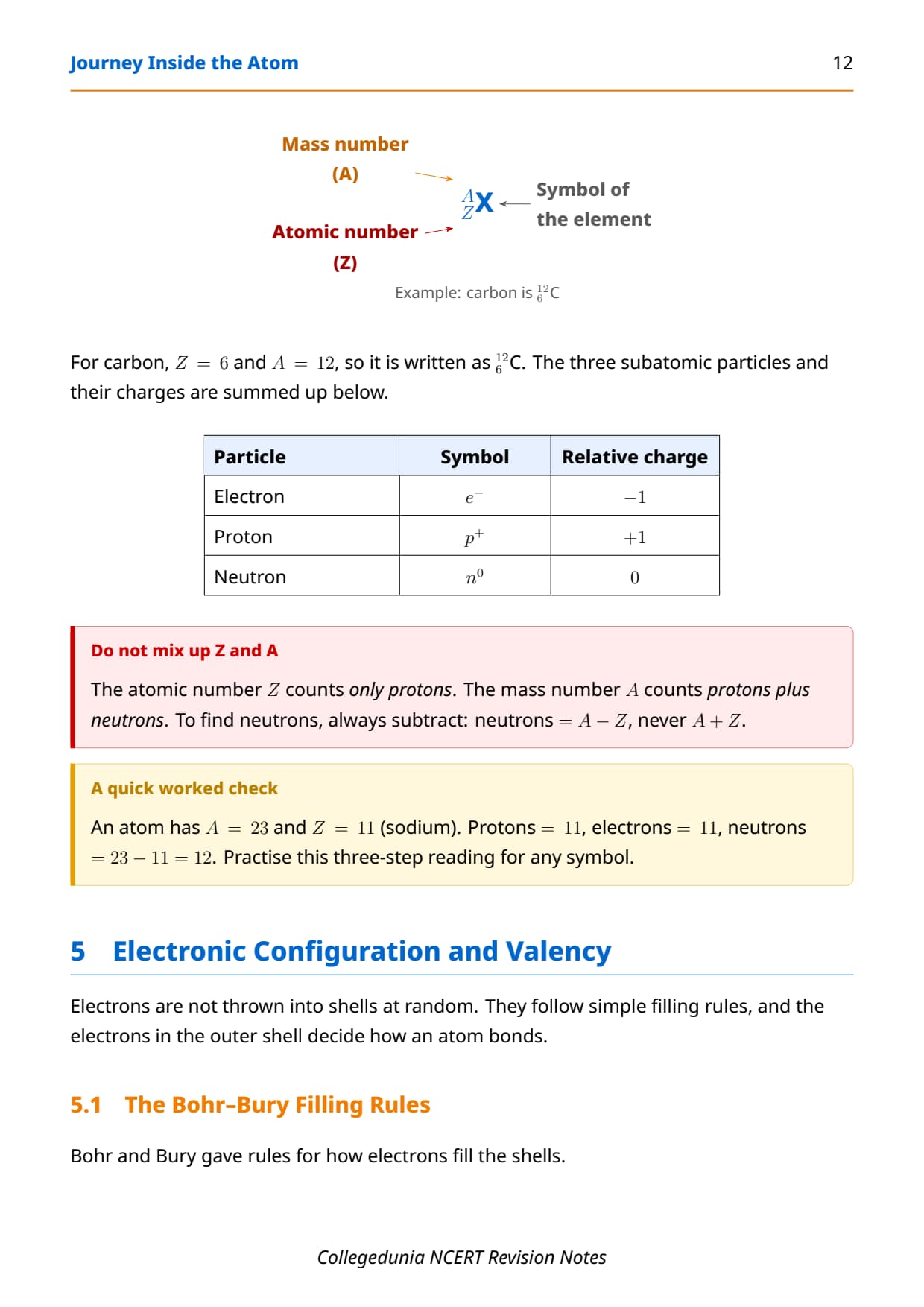
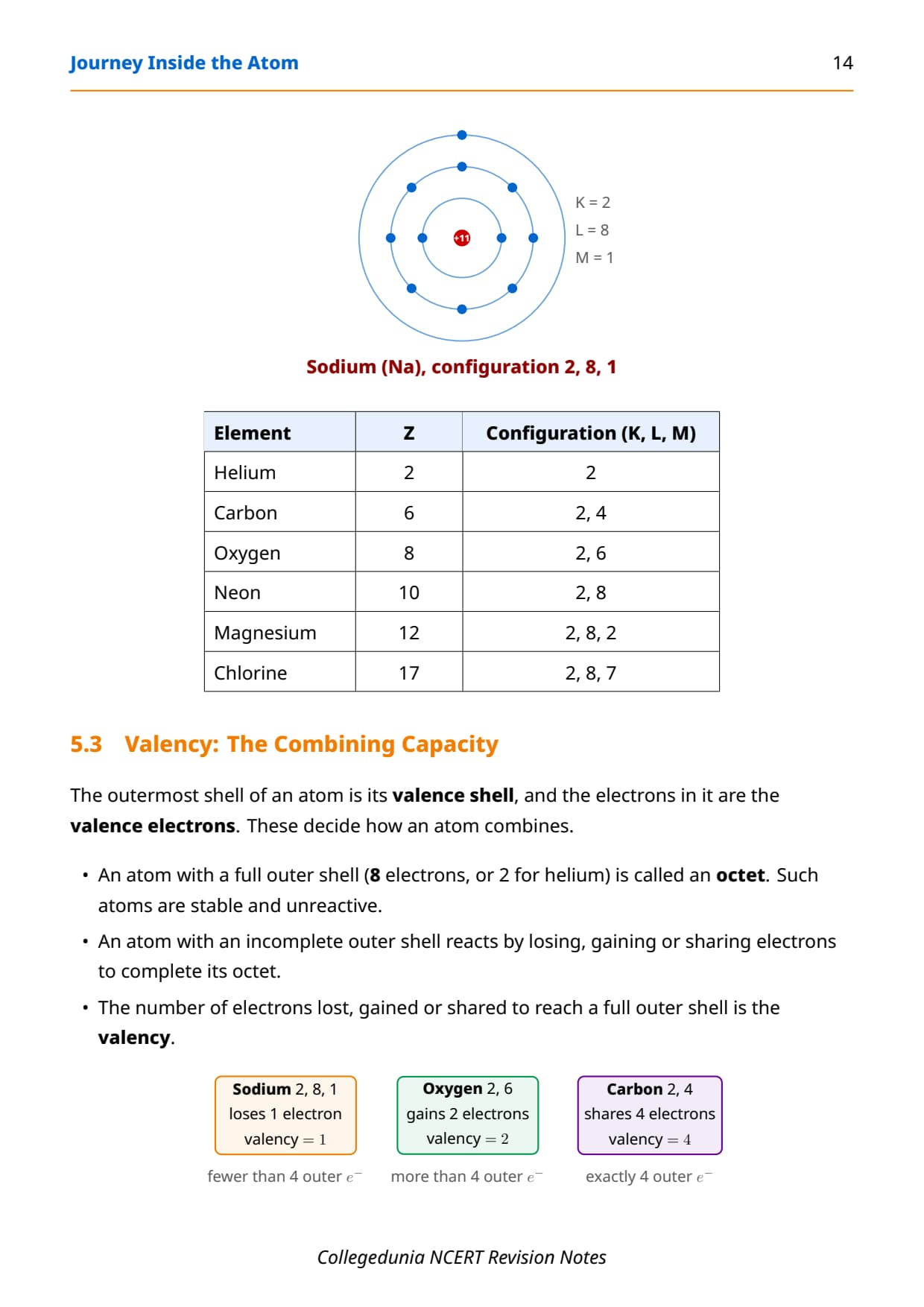
An atom is written with its mass number on top and its atomic number below, to the left of the symbol, so carbon is written as ¹²₆C. To find neutrons, always use neutrons = A − Z. For sodium (A = 23, Z = 11): protons = 11, electrons = 11, neutrons = 23 − 11 = 12.
Electronic Configuration and Valency in Class 9 Science Chapter 8
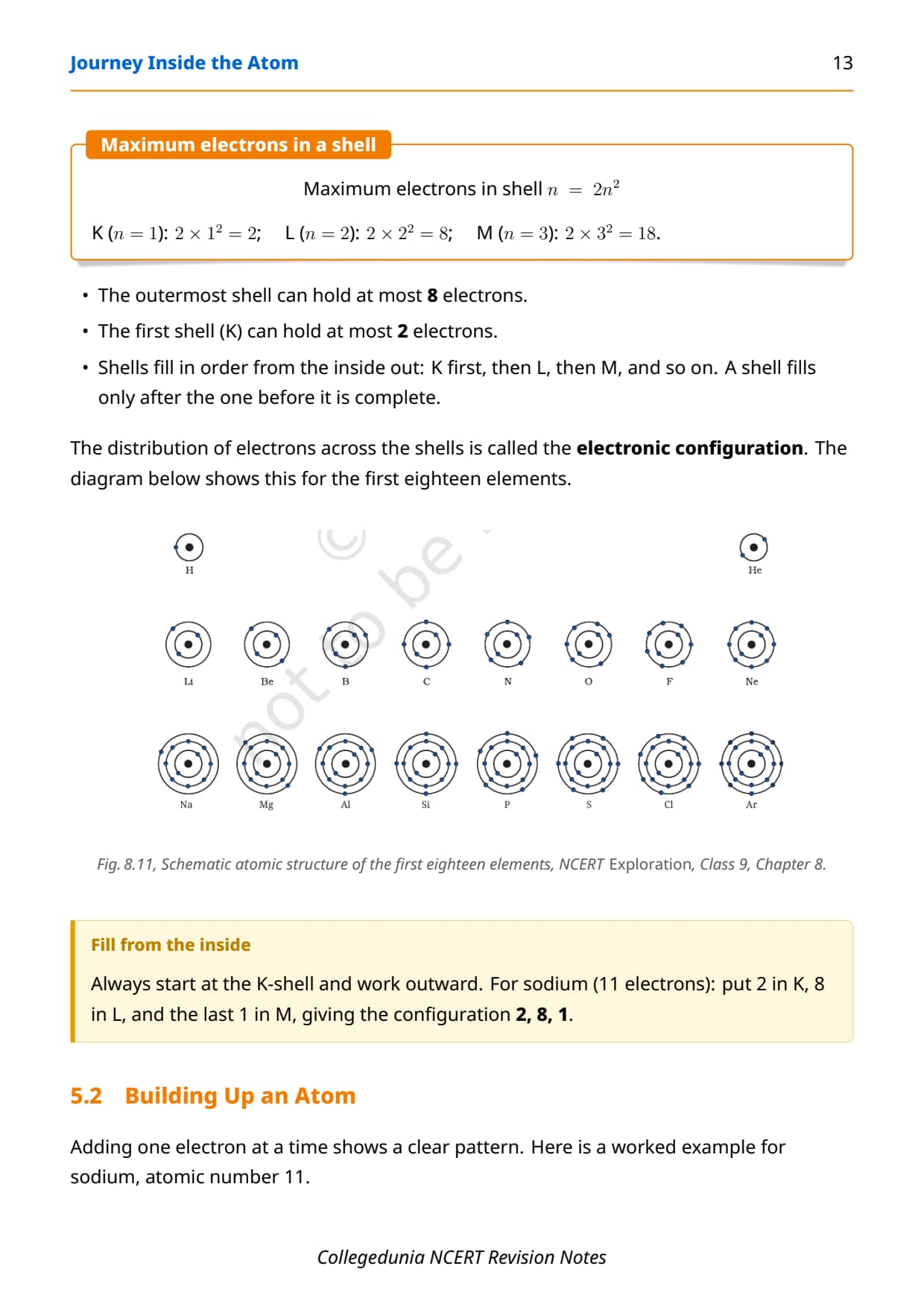
Electrons are not placed at random. They fill shells from the inside out, following the Bohr–Bury rules. The maximum number of electrons a shell can hold is 2n², so K holds 2, L holds 8 and M holds 18. The outermost shell can never hold more than 8.
| Element | Atomic number (Z) | Configuration (K, L, M) |
|---|---|---|
| Carbon | 6 | 2, 4 |
| Oxygen | 8 | 2, 6 |
| Neon | 10 | 2, 8 |
| Sodium | 11 | 2, 8, 1 |
| Chlorine | 17 | 2, 8, 7 |
The electrons in the outermost shell are the valence electrons, and they decide how an atom bonds. The valency is the number of electrons an atom loses, gains or shares to complete its outer shell (an octet of 8, or 2 for helium).
- Fewer than 4 outer electrons: the atom loses them, so valency = number of valence electrons. Sodium (2, 8, 1) loses 1, valency 1.
- More than 4 outer electrons: the atom gains, so valency = 8 − valence electrons. Oxygen (2, 6) gains 2, valency 2.
- Exactly 4 outer electrons: the atom shares. Carbon (2, 4) shares 4, valency 4.
Isotopes, Isobars and Average Atomic Mass for Class 9 Students
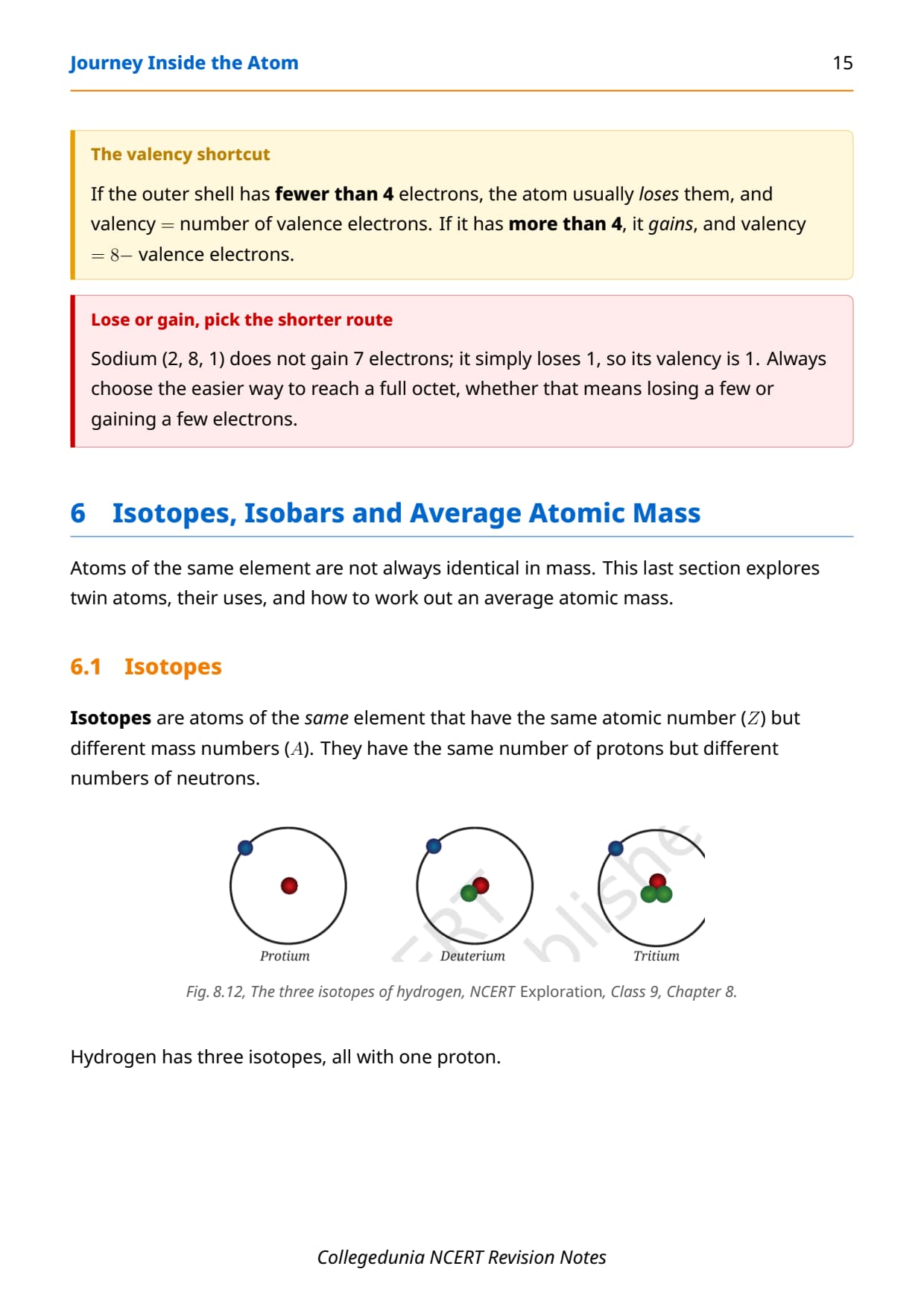
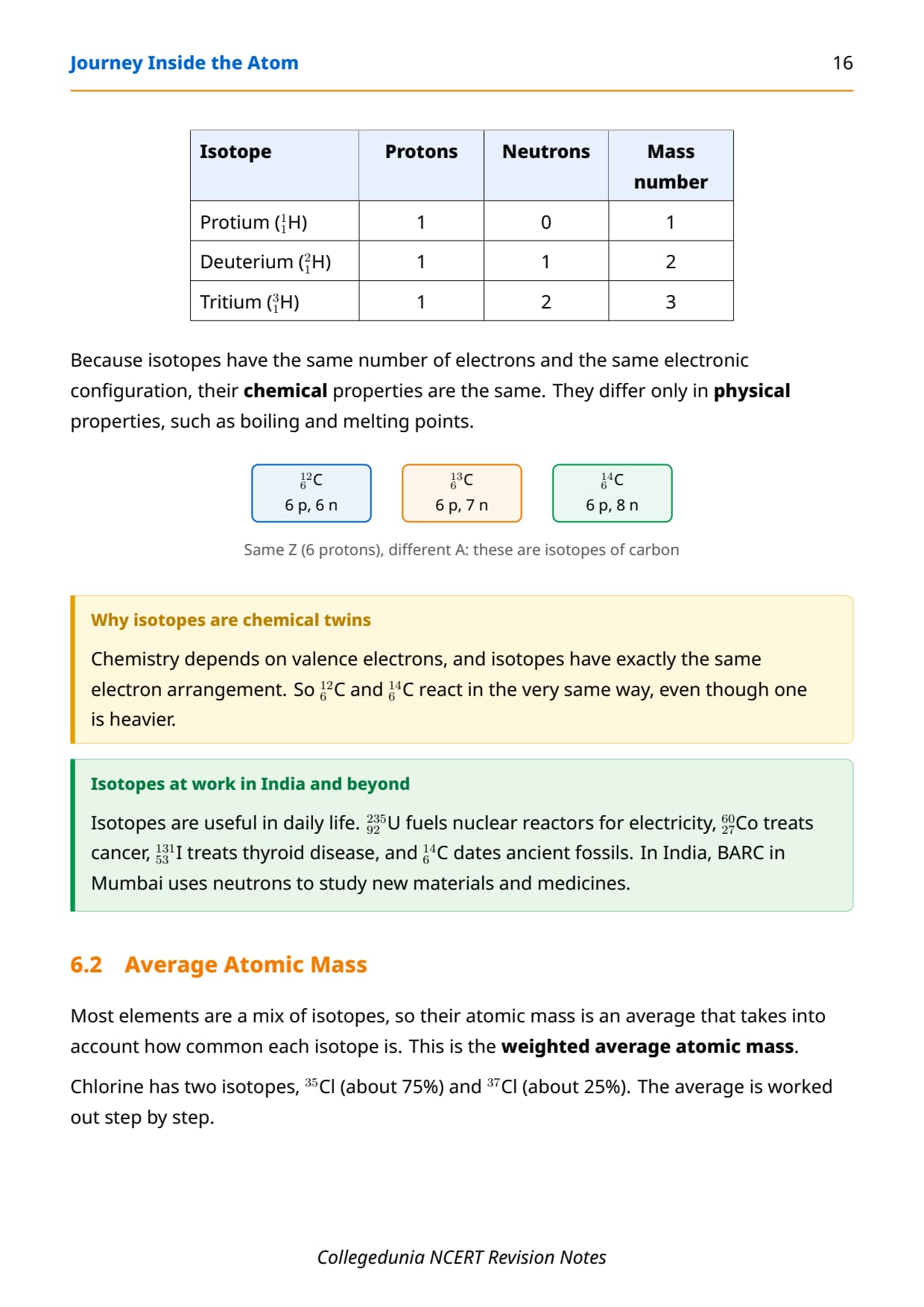
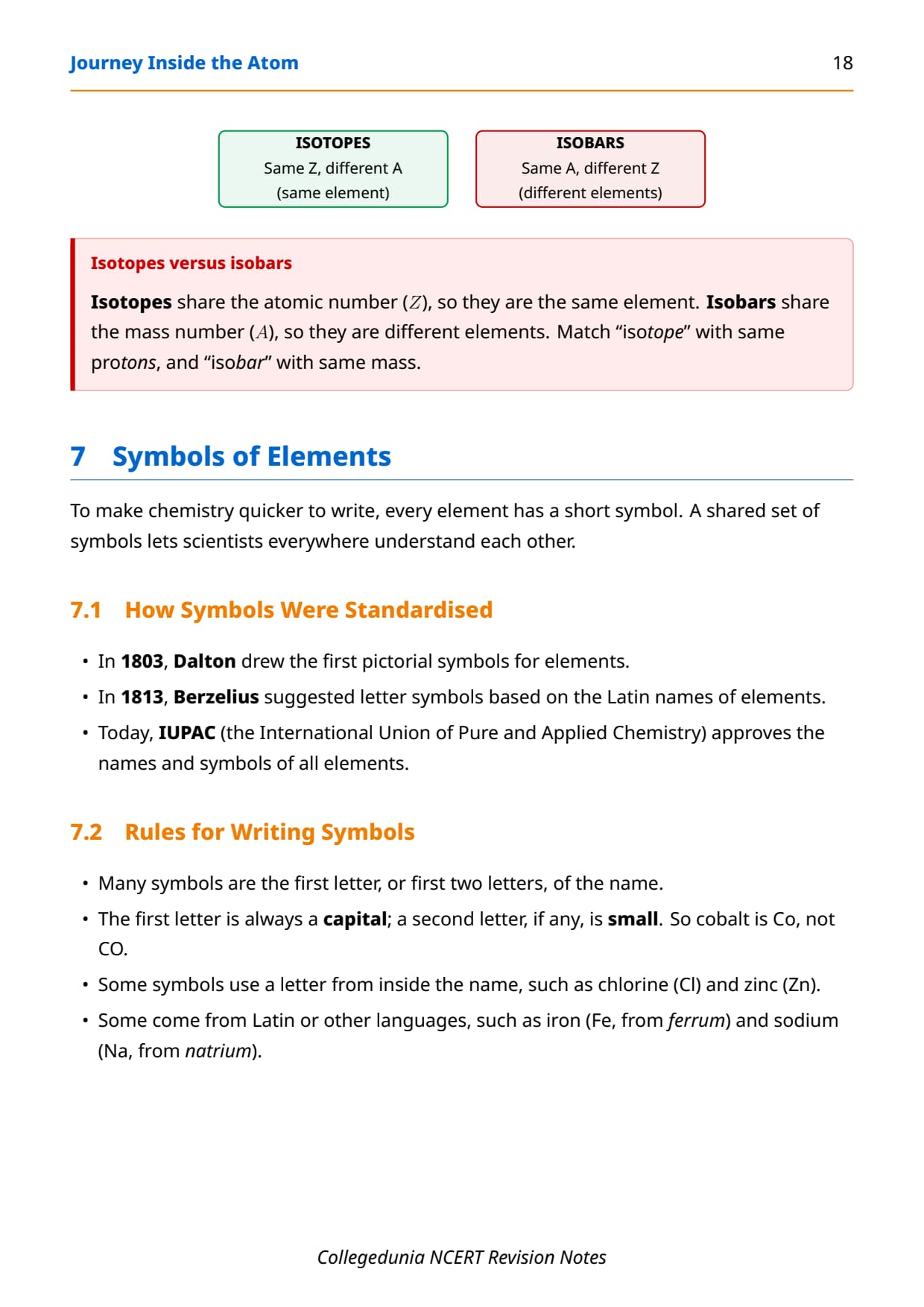
Atoms of the same element are not always identical in mass. Isotopes are atoms of the same element with the same atomic number but different mass numbers, so they have the same protons and different neutrons. Hydrogen has three isotopes: protium, deuterium and tritium, all with one proton.
| Term | What is the same | What differs | Example |
|---|---|---|---|
| Isotopes | Atomic number Z (same element) | Mass number A (neutrons) | ¹²C, ¹³C, ¹⁴C |
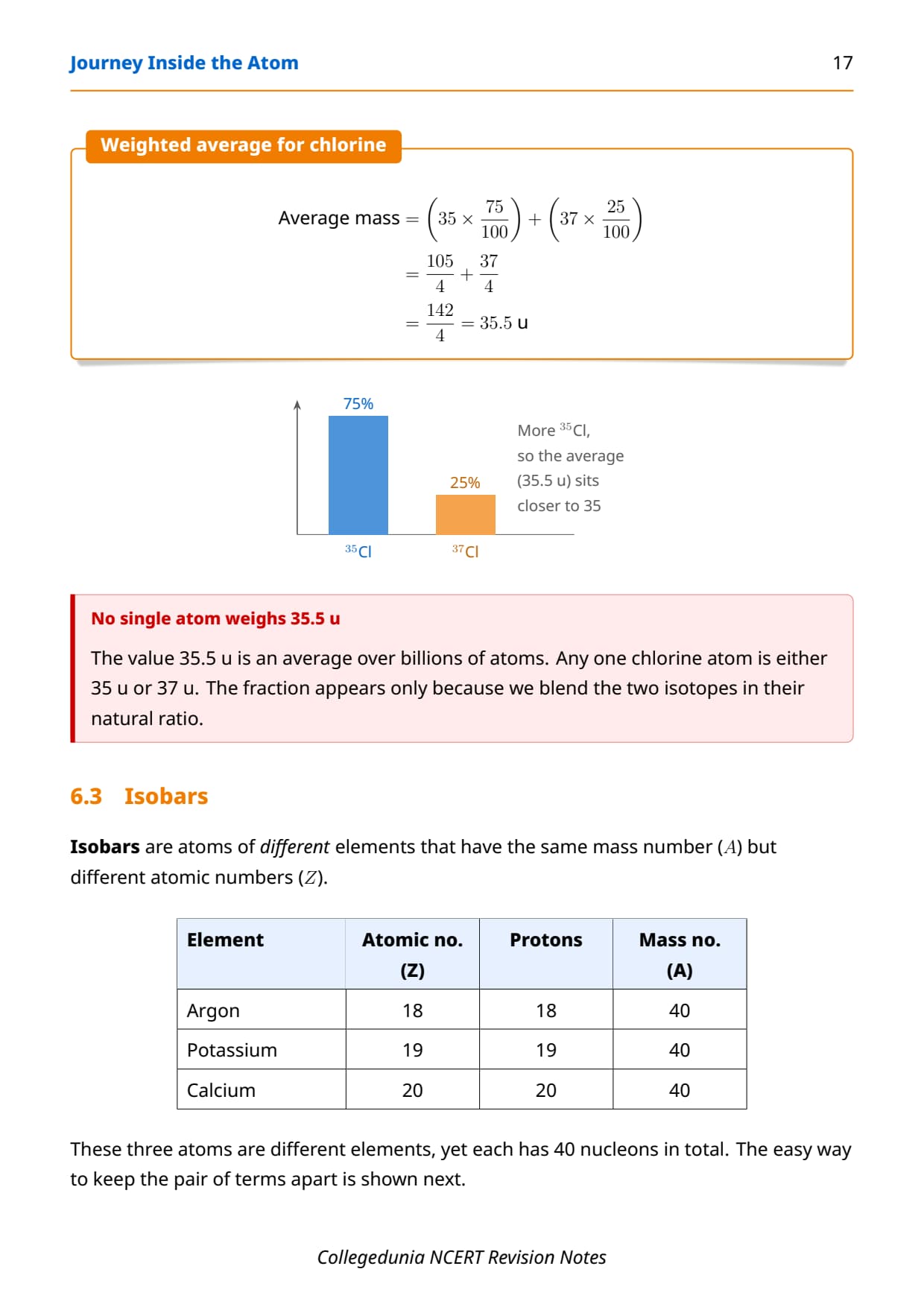
| Isobars | Mass number A | Atomic number Z (different elements) | Argon-40, Potassium-40, Calcium-40 |
Because isotopes have the same electrons, their chemical properties are the same; only physical properties differ. Most elements are a mix of isotopes, so their atomic mass is a weighted average. Chlorine is 75% ¹²C-type ³⁵Cl and 25% ³⁷Cl, giving an average of (35 × 0.75) + (37 × 0.25) = 35.5 u.
Tip: match iso-tope with same pro-tons, and iso-bar with same mass. No single chlorine atom weighs 35.5 u; each is either 35 u or 37 u.
Student Feedback on Journey Inside the Atom Class 9 Notes
What 11,470 students told us about their journey inside the atom revision before the 2026 boards.
- 68% of students said the atomic-models table was the fastest part of the chapter to revise from these notes.
- 59% of students found the isotopes versus isobars difference the easiest to mix up under exam pressure.
- Most-skipped topic in revision: the average atomic mass calculation, left for last by about 37% of students.
Source: 2026-27 Class 9 Science student poll. Sample of 11,470 students from CBSE schools across 13 states.
Common Mistakes Students Make in the Journey Inside the Atom Chapter
A few slips lose easy marks in this chapter every year.
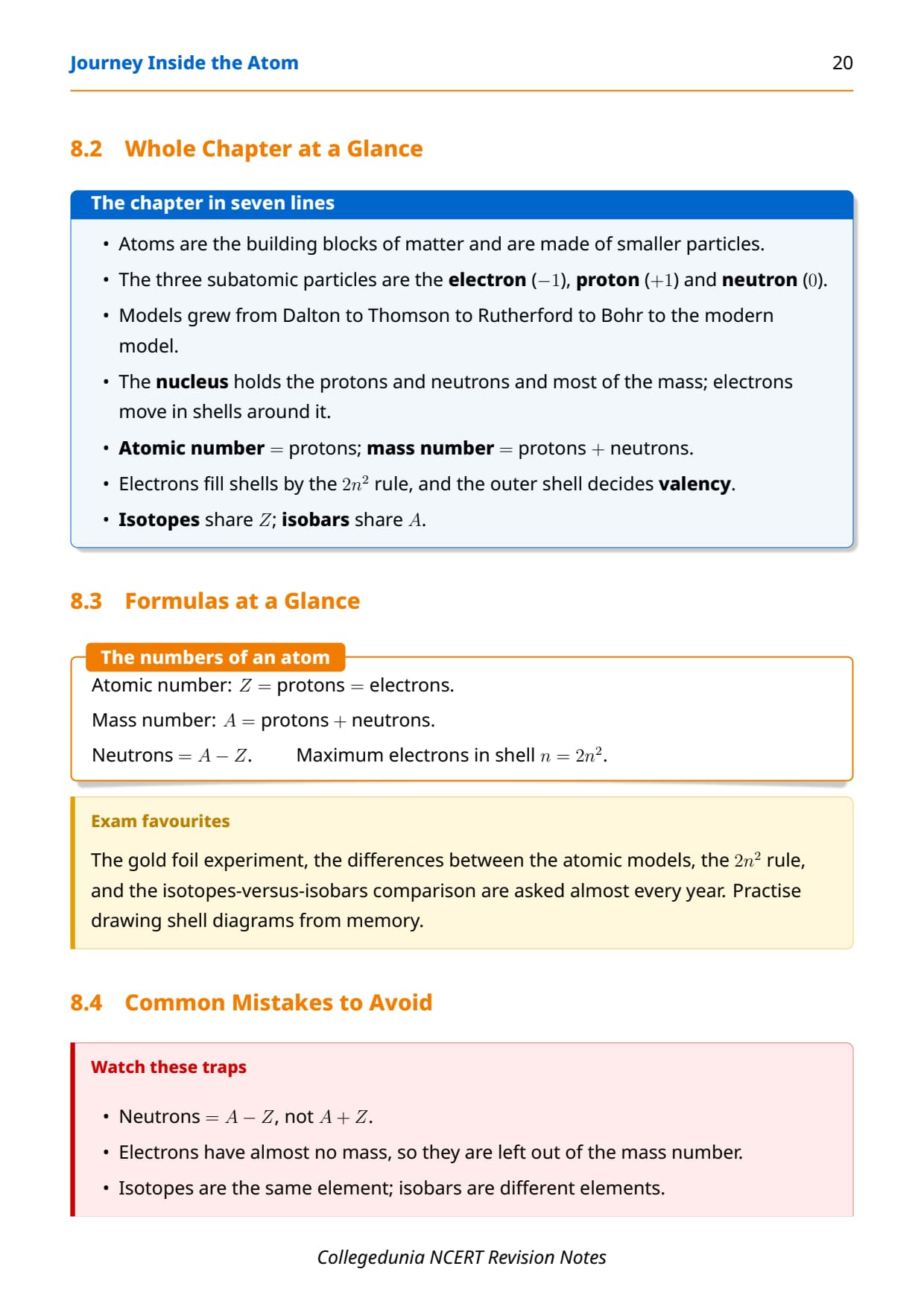
- Writing neutrons = A + Z. The correct rule is neutrons = A − Z.
- Counting electrons in the mass number. Electrons are almost weightless and are left out.
- Swapping isotopes and isobars. Isotopes are the same element; isobars are different elements.
- Calling the bacterial-style free region or the whole atom the nucleus. The nucleus is only the tiny dense centre holding protons and neutrons.
How to Use the Journey Inside the Atom Class 9 Notes
Use these notes in three simple blocks. First read for meaning, then learn the tables, then test yourself with a blank shell diagram.
- Read the chapter once and match each model to the scientist and the year.
- Learn the key tables: the atomic models, the 2n² rule, and the isotopes versus isobars comparison.
- Test yourself by drawing a labelled shell diagram for sodium (2, 8, 1) from memory.
Practise the gold foil observations, the neutrons = A − Z step, and the average atomic mass calculation before the exam. These are asked almost every year in the Class 9 Science paper.
How These Class 9 Science Chapter 8 Notes Pair with the Solutions and Formula Sheet
These notes work best next to the other Class 9 Science resources for this chapter. Read the notes first, then solve, then keep the formula sheet handy for the numbers.
- Use the NCERT Solutions to attempt all the Revise, Reflect, Refine questions after you finish these notes.
- Use the Formula Sheet for the 2n² rule, mass number and average atomic mass in one page.
- Use the Handwritten Notes for a quick one-shot recap on the night before a test.
- Use the NCERT Book PDF to read the full chapter text and study the original diagrams.
Journey Inside the Atom Class 9 Other Resources for this Chapter
Pair these notes with the other Class 9 Science resources for this chapter, all linked below.
| Resource | Best used for |
|---|---|
| Journey Inside the Atom Class 9 NCERT Solutions | Solving all chapter questions step by step |
| Journey Inside the Atom Class 9 Formula Sheet | Quick recall of all key formulas and rules |
| Journey Inside the Atom Class 9 Handwritten Notes | Last-minute one-shot revision |
| Journey Inside the Atom Class 9 NCERT Book PDF | Reading the original chapter text |
All Chapters NCERT Notes for Class 9 Science
Browse the full set of ncert notes for class 9 science chapter by chapter.
| Chapter | NCERT Notes |
|---|---|
| Chapter 2 | Cell the Building Block of Life Class 9 Notes |
| Chapter 3 | Tissues in Action Class 9 Notes |
| Chapter 4 | Describing Motion Around Us Class 9 Notes |
| Chapter 5 | Exploring Mixtures and their Separation Class 9 Notes |
| Chapter 6 | How Forces Affect Motion Class 9 Notes |
| Chapter 7 | Work, Energy, and Simple Machines Class 9 Notes |
| Chapter 8 | Journey Inside the Atom Class 9 Notes |
| Chapter 9 | Atomic Foundations of Matter Class 9 Notes |
| Chapter 10 | Sound Waves Characteristics and Applications Class 9 Notes |
| Chapter 11 | Reproduction How Life Continues Class 9 Notes |
| Chapter 12 | Patterns in Life Diversity and Classification Class 9 Notes |
| Chapter 13 | Earth as a System Energy, Matter, and Life Class 9 Notes |
Journey Inside the Atom Class 9 Notes FAQs
Ques. Where can I download the NCERT Notes Class 9 Science Chapter 8 Journey Inside the Atom PDF?
Ans. You can download the class 9 science chapter 8 notes PDF directly from this page. Both the Normal and HD versions are free, and every topic is written in plain English for the 2026-27 session.
Ques. What topics do the journey inside the atom class 9 notes cover?
Ans. The notes cover the electron, proton and neutron, the atomic models of Dalton, Thomson, Rutherford and Bohr, the gold foil experiment, atomic number and mass number, electronic configuration, valency, and isotopes versus isobars.
Ques. Are these ncert notes for class 9 science chapter 8 aligned with the 2026-27 syllabus?
Ans. Yes. These notes follow the new 2026-27 NCERT book Exploration, where Journey Inside the Atom is Chapter 8. Every table and diagram is checked against that latest edition.
Ques. How do you find the number of neutrons in an atom?
Ans. Use neutrons = mass number − atomic number, that is neutrons = A − Z. For example, sodium has A = 23 and Z = 11, so it has 23 − 11 = 12 neutrons.
Ques. What is the difference between isotopes and isobars in Class 9?
Ans. Isotopes are atoms of the same element with the same atomic number but different mass numbers, such as carbon-12 and carbon-14. Isobars are atoms of different elements with the same mass number but different atomic numbers, such as argon-40 and calcium-40.
Ques. What was the main conclusion of the gold foil experiment?
Ans. The gold foil experiment showed that most of the atom is empty space, with a tiny, dense, positively charged centre called the nucleus. This led Rutherford to propose the nuclear model of the atom.
Ques. What is the maximum number of electrons a shell can hold?
Ans. A shell can hold at most 2n² electrons, where n is the shell number. So K holds 2, L holds 8 and M holds 18, but the outermost shell can never hold more than 8 electrons.



Comments